
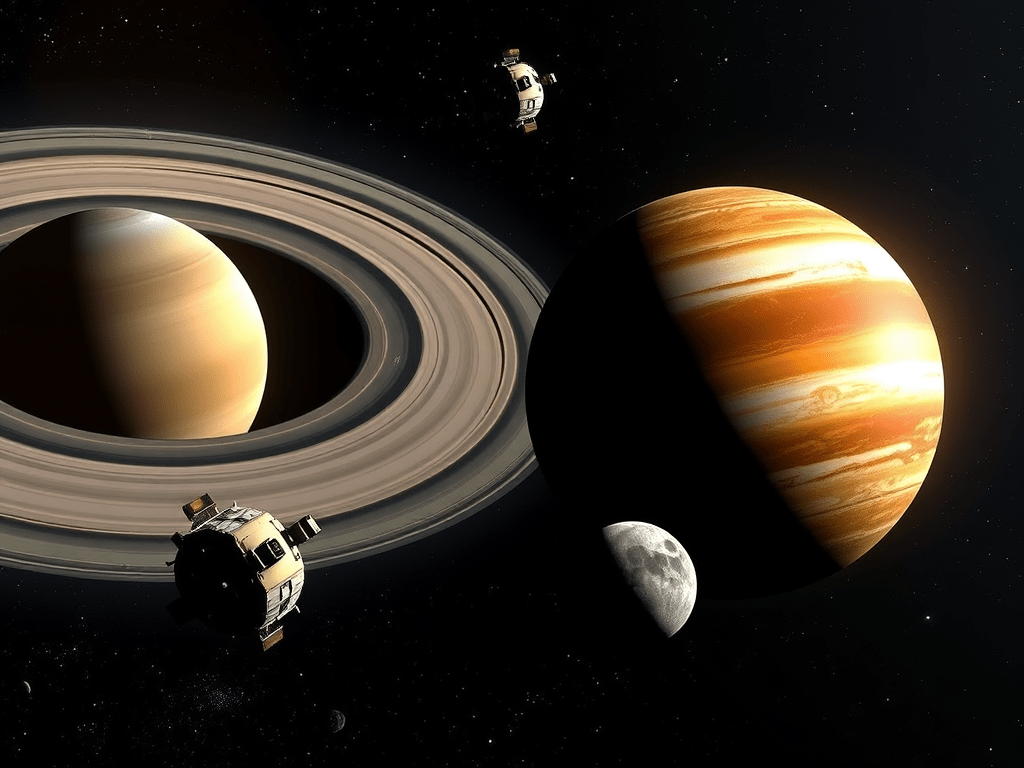
Question: Match List-I (Space Mission) with List-II (Exploration):
List-I (Space Mission):
a. Cassini-Huygens
b. Juno
c. Artemis
d. VERITAS
List-II (Exploration):
- Jupiter
- Saturn and its rings
- Venus
- Human Spaceflight-Moon to Mars
Options:
(A) a-2, b-1, c-4, d-3
(B) a-3, b-1, c-4, d-2
(C) a-2, b-3, c-4, d-1
(D) a-3, b-1, c-2, d-4
Correct Answer: (A) a-2, b-1, c-4, d-3
Question Analysis
- Subject: Science and Technology
- Topic: Space Missions and Exploration
- Difficulty Level: Moderate (requires specific knowledge of space missions and their objectives)
- Context: This question tests candidates’ ability to correctly associate major space missions with their respective exploration targets. It is relevant for the BPSC exam, which often includes questions on recent advancements in science and technology, particularly in space exploration, given its global and national significance.
Key Points of the Question
- Objective of the Question:
- The task is to match each space mission (List-I) with its corresponding exploration target (List-II).
- The missions are well-known NASA (and some collaborative) programs, and the exploration targets include specific celestial bodies or space exploration goals.
- Details of Each Space Mission and Exploration Target:
- Cassini-Huygens (a):
- Exploration: Saturn and its rings (2)
- Details: Cassini-Huygens was a collaborative mission between NASA, ESA (European Space Agency), and the Italian Space Agency, launched in 1997. It orbited Saturn from 2004 to 2017, studying the planet, its rings, and moons (notably Titan). The mission provided detailed insights into Saturn’s ring system and atmospheric composition.
- Key Fact: The Huygens probe landed on Titan, Saturn’s largest moon, in 2005, making it the first landing on a moon other than Earth’s.
- Juno (b):
- Exploration: Jupiter (1)
- Details: Juno is a NASA spacecraft launched in 2011, entering Jupiter’s orbit in 2016. Its mission is to study Jupiter’s atmosphere, magnetic field, and internal structure to understand the planet’s formation and evolution.
- Key Fact: Juno’s polar orbit allows it to observe Jupiter’s poles and collect data on its auroras and gravitational field.
- Artemis (c):
- Exploration: Human Spaceflight-Moon to Mars (4)
- Details: Artemis is NASA’s program to return humans to the Moon and establish a sustainable presence, with plans for lunar landings (e.g., Artemis III, targeted for 2026) as a stepping stone for future Mars missions. It involves international and commercial partnerships.
- Key Fact: Artemis aims to land the first woman and first person of color on the Moon, emphasizing inclusivity and long-term exploration goals.
- VERITAS (d):
- Exploration: Venus (3)
- Details: VERITAS (Venus Emissivity, Radio Science, InSAR, Topography, and Spectroscopy) is a NASA mission planned for launch in the late 2020s. It aims to map Venus’s surface, study its geology, and investigate its interior to understand why Venus and Earth evolved differently.
- Key Fact: VERITAS will use advanced radar and spectroscopy to create high-resolution maps of Venus’s surface.
- Cassini-Huygens (a):
- Matching Analysis:
- a. Cassini-Huygens → 2. Saturn and its rings: Cassini’s primary mission was to study Saturn, its rings, and moons, making this a direct match.
- b. Juno → 1. Jupiter: Juno is specifically designed to explore Jupiter, confirming this pairing.
- c. Artemis → 4. Human Spaceflight-Moon to Mars: Artemis focuses on human lunar exploration with a long-term goal of Mars missions, aligning with this target.
- d. VERITAS → 3. Venus: VERITAS is a Venus-specific mission, completing the correct matches.
- Evaluation of Options:
- Option (A): a-2, b-1, c-4, d-3
- Cassini-Huygens (Saturn and its rings), Juno (Jupiter), Artemis (Human Spaceflight-Moon to Mars), VERITAS (Venus). Correct.
- Option (B): a-3, b-1, c-4, d-2
- Incorrect because Cassini-Huygens (a) is matched with Venus (3), and VERITAS (d) with Saturn and its rings (2), which are mismatched.
- Option (C): a-2, b-3, c-4, d-1
- Incorrect because Juno (b) is matched with Venus (3), and VERITAS (d) with Jupiter (1), which are incorrect pairings.
- Option (D): a-3, b-1, c-2, d-4
- Incorrect because Cassini-Huygens (a) is matched with Venus (3), Artemis (c) with Saturn and its rings (2), and VERITAS (d) with Human Spaceflight-Moon to Mars (4), all of which are incorrect.
- Option (A): a-2, b-1, c-4, d-3
- Common Misconceptions:
- Candidates might confuse Cassini-Huygens with other planetary missions due to its long duration and multiple objectives (e.g., Titan exploration).
- Artemis’s focus on both the Moon and Mars might lead some to incorrectly associate it with a single celestial body rather than a broader human spaceflight program.
- VERITAS, being a lesser-known mission (not yet launched as of 2025), might be unfamiliar, leading candidates to guess incorrectly.
- The question requires precise knowledge of each mission’s primary objective, which tests both factual recall and the ability to avoid confusion between missions.
Answer Explanation
- Correct Answer: (A) a-2, b-1, c-4, d-3
- Reason: The correct matches are:
- a. Cassini-Huygens → 2. Saturn and its rings
- b. Juno → 1. Jupiter
- c. Artemis → 4. Human Spaceflight-Moon to Mars
- d. VERITAS → 3. Venus
- Each mission aligns with its designated exploration target based on its objectives and design, as outlined above. This question emphasizes the importance of staying updated on space exploration, a key area in the BPSC Science and Technology syllabus.
Most Probable 5 Similar Questions (Moderate to Hard Level)
- Question: Match the following space missions with their primary objectives:
List-I (Space Mission): a. Voyager 2, b. Parker Solar Probe, c. DAVINCI, d. Gateway
List-II (Objective): 1. Study the Sun’s corona, 2. Deep atmosphere study of Venus, 3. Outer planets exploration, 4. Lunar orbital space station
Answer: a-3, b-1, c-2, d-4
Difficulty: Hard
Explanation: Voyager 2 explored outer planets (Jupiter, Saturn, Uranus, Neptune); Parker Solar Probe studies the Sun; DAVINCI (Deep Atmosphere Venus Investigation) targets Venus’s atmosphere; Gateway is a lunar orbital station for Artemis. This question tests knowledge of diverse mission objectives. - Question: Which of the following missions is specifically designed to study the moons of Jupiter?
- A) Europa Clipper
- B) Cassini-Huygens
- C) MAVEN
- D) InSight
Answer: A) Europa Clipper
Difficulty: Moderate
Explanation: Europa Clipper (NASA, planned for 2024 launch, arrival 2030) targets Jupiter’s moon Europa to study its icy surface and subsurface ocean. Cassini-Huygens studied Saturn, MAVEN studies Mars’s atmosphere, and InSight studied Mars’s interior, making them incorrect.
- Question: Which space mission is associated with the first human landing on the Moon since the Apollo program?
- A) Chandrayaan-3
- B) Artemis III
- C) Luna 25
- D) Orion
Answer: B) Artemis III
Difficulty: Moderate
Explanation: Artemis III (planned for 2026) aims to land humans on the Moon, the first since Apollo 17 (1972). Chandrayaan-3 and Luna 25 are uncrewed lunar missions, and Orion is the spacecraft used in Artemis, not a mission itself.
- Question: Match the following space agencies with their Venus exploration missions:
List-I (Agency): a. NASA, b. ESA, c. ISRO, d. Roscosmos
List-II (Mission): 1. Shukrayaan-1, 2. Venera-D, 3. EnVision, 4. VERITAS
Answer: a-4, b-3, c-1, d-2
Difficulty: Hard
Explanation: NASA’s VERITAS and ESA’s EnVision are Venus missions, ISRO’s Shukrayaan-1 is India’s planned Venus orbiter, and Roscosmos’s Venera-D is a proposed Venus mission. This tests knowledge of international space programs. - Question: Which of the following is a key objective of the Artemis program?
- A) Study Saturn’s rings
- B) Establish a sustainable human presence on the Moon
- C) Map Venus’s surface
- D) Explore Jupiter’s magnetic field
Answer: B) Establish a sustainable human presence on the Moon
Difficulty: Moderate
Explanation: Artemis aims to return humans to the Moon and establish a sustainable presence for future Mars missions. Other options relate to Cassini (Saturn), VERITAS (Venus), and Juno (Jupiter), making them incorrect.
Importance of Following BPSC Section on Crack Target
Following the BPSC section on platforms like Crack Target (or similar educational resources) is crucial for aspirants preparing for the Bihar Public Service Commission (BPSC) exams, particularly for questions like the one on space missions, for the following reasons:
- Coverage of Science and Technology Syllabus:
- The BPSC syllabus emphasizes recent advancements in science and technology, including space exploration. Crack Target provides detailed notes on missions like Juno, Cassini, Artemis, and VERITAS, ensuring candidates are well-prepared for matching-type questions like this one.
- Updated Information on Space Missions:
- Space exploration is a dynamic field with frequent updates (e.g., Artemis’s progress, VERITAS’s planned launch). Crack Target offers current affairs updates and mission-specific details, helping candidates stay informed about global and Indian space programs.
- Practice with Matching and Objective Questions:
- The 69th BPSC Prelims included matching-type questions, as seen here, which require precise knowledge and quick recall. Crack Target’s mock tests and practice sets include similar questions, helping candidates master this format and avoid errors due to negative marking (1/3rd marks deducted per wrong answer).
- Bihar-Specific and National Relevance:
- While this question focuses on NASA missions, BPSC exams often integrate questions on India’s space achievements (e.g., ISRO’s Chandrayaan, Mangalyaan). Crack Target provides a balanced approach, covering both international and Indian space programs, which are crucial for comprehensive preparation.
- Time Management and Exam Strategy:
- The Prelims’ 150 questions in 2 hours demand efficient time management. Crack Target’s timed quizzes and strategic tips help candidates quickly solve matching questions by recognizing key mission-target associations, as required in this question.
- Mains Preparation Support:
- For BPSC Mains, where descriptive answers are needed, Crack Target offers model answers and key points (e.g., objectives of Artemis or Cassini’s findings), enabling candidates to write detailed responses on space exploration topics.
- Doubt Resolution and Expert Guidance:
- Platforms like Crack Target provide forums or expert sessions to clarify doubts about complex topics like space missions, ensuring candidates understand nuances (e.g., distinguishing VERITAS from other Venus missions).
- Holistic Preparation:
- By offering resources on science, technology, and current affairs, Crack Target ensures candidates are equipped to handle interdisciplinary questions that combine factual knowledge with contemporary developments, as seen in this space mission question.
By consistently using resources like Crack Target, candidates can build a strong foundation in science and technology, practice exam-relevant questions, and develop the confidence to tackle moderate-to-hard questions like this one, improving their overall performance in the BPSC exam.
Visit Dedicated BPSC Section for more

Leave a comment