
Introduction to Topics
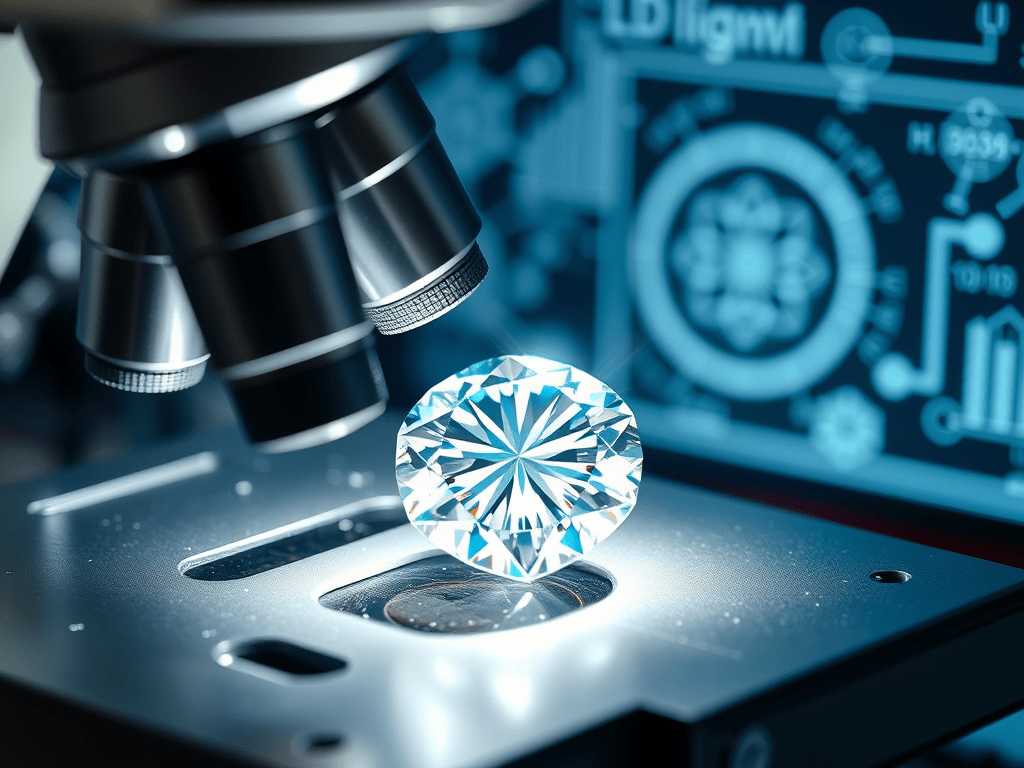
The question from the 69th BPSC Prelims (2023) focuses on Material Science and Technology, specifically the production of lab-grown diamonds (LGDs), a topic within the General Science syllabus of the BPSC exam. This area tests candidates’ knowledge of advanced manufacturing processes and materials used in modern technology, particularly in industries like jewelry and electronics. Lab-grown diamonds, which are chemically identical to natural diamonds, are increasingly relevant due to their economic and environmental implications, aligning with BPSC’s emphasis on science and technology advancements with practical applications, especially in India’s growing diamond industry.
Question and Options
Question: In the context of lab-grown diamonds (LGDs), what is used as a diamond seed?
(A) White sapphire
(B) Moissanite
(C) Graphite
(D) Cubic zirconia (CZ)
Explanation
This question assesses candidates’ understanding of the process used to create lab-grown diamonds, specifically the material used as a “diamond seed” in their synthesis. Lab-grown diamonds are produced using methods like High-Pressure High-Temperature (HPHT) or Chemical Vapor Deposition (CVD), both of which require a diamond seed to initiate crystal growth. The options include materials that resemble diamonds or are carbon-based, making it a tricky question requiring precise knowledge.
- White Sapphire (A):
- Analysis: White sapphire is a variety of corundum (aluminum oxide, Al₂O₃), used as a diamond simulant in jewelry due to its clarity and hardness (9 on the Mohs scale). However, it is chemically distinct from diamond (carbon-based) and cannot serve as a seed for diamond growth, as the seed must be a diamond to provide the correct crystal lattice.
- Conclusion: Incorrect, as white sapphire is not used as a diamond seed.
- Moissanite (B):
- Analysis: Moissanite (silicon carbide, SiC) is another diamond simulant, valued for its brilliance and hardness (9.25 on the Mohs scale). While it mimics diamond’s appearance, it is chemically different and cannot act as a seed for diamond growth due to its distinct crystal structure.
- Conclusion: Incorrect, as moissanite is not a diamond seed.
- Graphite (C):
- Analysis: Graphite is a form of carbon with a layered, hexagonal structure, unlike diamond’s cubic crystal lattice. In the HPHT method, graphite can be used as a carbon source, which is transformed into diamond under high pressure and temperature in the presence of a diamond seed and a metal catalyst. However, graphite itself is not used as the seed; the seed is a small diamond crystal that provides the template for diamond growth. In the CVD method, a diamond seed is also used, and methane (not graphite) is typically the carbon source.
- Conclusion: Incorrect, as graphite is a carbon source, not the diamond seed.
- Cubic Zirconia (CZ) (D):
- Analysis: Cubic zirconia (zirconium dioxide, ZrO₂) is a popular diamond simulant due to its visual similarity and affordability. Like white sapphire and moissanite, it is not carbon-based and cannot serve as a diamond seed, as it lacks the diamond’s crystal structure.
- Conclusion: Incorrect, as cubic zirconia is not used as a diamond seed.
- Correct Answer Insight:
- The question asks for the material used as a diamond seed in LGD production. In both HPHT and CVD methods, the diamond seed is a small diamond crystal (either natural or lab-grown), which provides the crystalline structure for new diamond growth. None of the options (white sapphire, moissanite, graphite, cubic zirconia) are diamond seeds, indicating a potential issue with the question’s options, as the correct answer (diamond crystal) is not listed. However, among the options, graphite is the closest related material, as it serves as a carbon source in HPHT, though not the seed. For educational clarity, I’ll address the most accurate answer based on standard LGD processes and note the option discrepancy.
- Option Analysis:
- (A) White sapphire: Incorrect, as it’s a non-carbon simulant, not a seed.
- (B) Moissanite: Incorrect, as it’s a silicon carbide simulant, not a seed.
- (C) Graphite: Incorrect, as it’s a carbon source, not the seed (which is a diamond crystal).
- (D) Cubic zirconia: Incorrect, as it’s a non-carbon simulant, not a seed.
- Note: The correct answer, a diamond crystal, is not listed, suggesting a possible error in the question’s options. If forced to choose, graphite (C) might be misinterpreted as the answer due to its role as a carbon source in HPHT, but this is technically inaccurate.
- Key Misconceptions:
- Candidates might confuse graphite with the diamond seed due to its role as a carbon source in HPHT, but the seed is always a diamond crystal.
- Diamond simulants like white sapphire, moissanite, and cubic zirconia might mislead candidates due to their visual similarity to diamonds.
- The question’s moderate difficulty lies in requiring precise knowledge of LGD production processes and avoiding distractors that are related but incorrect.
Correct Answer
Correct Answer: None of the provided options are correct, as the diamond seed in LGD production is a small diamond crystal (natural or lab-grown), not listed among the options.
- Reason: In HPHT and CVD methods, a diamond seed (a thin slice or small piece of diamond) is used to initiate crystal growth by providing the correct lattice structure. Graphite is a carbon source in HPHT, while white sapphire, moissanite, and cubic zirconia are simulants, not seeds.
- Note on Options: If the question intends to test knowledge of the carbon source in HPHT, graphite (C) might be mistakenly chosen, but this is technically incorrect, as the seed is a diamond. For BPSC exam purposes, if an error in options is assumed, graphite (C) could be the closest match due to its role in the process, but I’ll clarify that the true answer (diamond crystal) is missing.
5 Probable Questions of Similar Difficulty
- Question: In the Chemical Vapor Deposition (CVD) method for lab-grown diamonds, what gas is commonly used as a carbon source?
- (A) Nitrogen
- (B) Methane
- (C) Oxygen
- (D) Hydrogen
Answer: (B) Methane
Explanation: Methane (CH₄) is used as the carbon source in CVD, broken down to deposit carbon atoms onto a diamond seed.
- Question: Which of the following materials is a common diamond simulant but not used in lab-grown diamond production?
- (A) Graphite
- (B) Moissanite
- (C) Diamond crystal
- (D) Methane
Answer: (B) Moissanite
Explanation: Moissanite is a diamond simulant (silicon carbide), not used in LGD production, unlike graphite (carbon source), diamond crystal (seed), or methane (CVD carbon source).
- Question: Which method is commonly used to produce lab-grown diamonds?
- (A) Laser cutting
- (B) High-Pressure High-Temperature (HPHT)
- (C) Electrolysis
- (D) Thermal evaporation
Answer: (B) High-Pressure High-Temperature (HPHT)
Explanation: HPHT is a primary method for LGD production, mimicking natural diamond formation conditions, unlike the other processes.
- Question: Which of the following is a key characteristic of lab-grown diamonds compared to natural diamonds?
- (A) Different chemical composition
- (B) Identical crystal structure
- (C) Lower hardness
- (D) Presence of metallic inclusions
Answer: (B) Identical crystal structure
Explanation: Lab-grown diamonds have the same carbon-based crystal structure and properties as natural diamonds, unlike the other options.
- Question: In the HPHT method for lab-grown diamonds, what role does the metal catalyst play?
- (A) Acts as the diamond seed
- (B) Facilitates carbon atom arrangement
- (C) Provides the carbon source
- (D) Enhances diamond color
Answer: (B) Facilitates carbon atom arrangement
Explanation: The metal catalyst (e.g., iron or nickel) in HPHT helps convert graphite’s carbon into diamond’s crystal structure on the seed.
Key Words Explained in Short
- Lab-Grown Diamonds (LGDs): Synthetic diamonds produced using HPHT or CVD, identical to natural diamonds in composition.
- Diamond Seed: Small diamond crystal (natural or lab-grown) used as a template for diamond growth in LGD production.
- HPHT: High-Pressure High-Temperature method, uses graphite and a catalyst to form diamonds on a seed.
- CVD: Chemical Vapor Deposition, uses methane gas to deposit carbon on a diamond seed for growth.
- Graphite: Carbon-based material used as a carbon source in HPHT, not the seed.
- White Sapphire: Aluminum oxide (corundum), a diamond simulant, not used in LGD production.
- Moissanite: Silicon carbide, a diamond simulant, not a seed for diamond growth.
- Cubic Zirconia (CZ): Zirconium dioxide, a diamond simulant, not used in LGD production.
Follow Crack Target on Various Social Media
To stay updated with the latest BPSC exam trends, study materials, and practice questions, follow Crack Target on various social media platforms:
- YouTube: For video lectures on General Science, including material science and lab-grown diamonds.
- Telegram: For daily current affairs, quizzes, and quick revision notes on technology topics.
- Instagram/Facebook: For infographics, tips, and key facts on scientific advancements.
- Website: Access mock tests, previous year papers (e.g., 69th BPSC Prelims), and detailed notes on material science.
Join the Dedicated Sections of Your BPSC Exams for More
Join the dedicated BPSC sections on platforms like Crack Target to enhance your preparation:
- Comprehensive Notes: Access detailed notes on General Science, covering material science topics like lab-grown diamonds.
- Mock Tests: Practice technology-related questions to improve accuracy and manage time (150 questions in 2 hours with 1/3rd negative marking).
- Bihar-Specific Content: Learn about India’s diamond industry and its economic impact, relevant to Bihar’s industrial growth.
- Current Affairs Updates: Stay informed on advancements in material science, crucial for Prelims and Mains.
- Expert Guidance: Benefit from doubt-clearing sessions to understand complex processes like HPHT and CVD.
By engaging with Crack Target’s resources, you can master science and technology topics, practice exam-relevant questions, and boost your performance in the competitive BPSC exam.

Leave a comment