

As candidates prepare for the 71st BPSC Prelims, mastering Physics within the General Science syllabus is critical, as evidenced by this question from the 69th BPSC Prelims (2023) on concave mirror image formation. This topic tests fundamental concepts in optics, specifically the properties of mirrors, which are foundational for understanding light and its applications in technology and daily life. Such questions are relevant to Bihar’s educational focus on science and align with BPSC’s emphasis on conceptual clarity in objective formats, making it essential to grasp the relationship between object position and image characteristics.
Question and Options
Question: The image formed by a concave mirror is real, inverted, and of the same size as that of the object. The position of the object should be:
(A) At the focus
(B) At the centre of curvature
(C) Between the focus and centre of curvature
(D) Beyond the centre of curvature
Explanation
This question evaluates candidates’ understanding of concave mirror optics, focusing on how the position of an object affects the nature, orientation, and size of the image formed. A concave mirror, which curves inward, can produce real or virtual images depending on the object’s position relative to key points like the focus (F) and centre of curvature (C). Let’s analyze the problem systematically.
Key Concepts:
- Concave Mirror: A mirror with a reflecting surface that curves inward, capable of forming real or virtual images.
- Focus (F): The point where parallel rays converge after reflection, located at a distance equal to the focal length (f).
- Centre of Curvature (C): The center of the sphere from which the mirror is derived, located at a distance of twice the focal length (C = 2f).
- Real Image: Formed where rays actually converge, can be projected on a screen, and is typically inverted.
- Virtual Image: Formed where rays appear to diverge, cannot be projected, and is typically upright.
The question specifies that the image is real, inverted, and of the same size as the object. Let’s examine each option based on the rules of image formation for concave mirrors:
- At the focus (A):
When the object is placed at the focus (F, at distance f), rays from the object become parallel after reflection, forming an image at infinity. This image is real, inverted, and highly magnified (much larger than the object), not the same size.
Assessment: Incorrect, as the image at the focus is magnified, not same-sized. - At the centre of curvature (B):
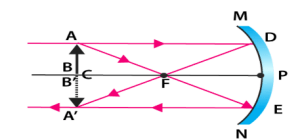
When the object is placed at the centre of curvature (C, at distance 2f), the reflected rays converge back at C. The image formed is real, inverted, and of the same size as the object, located at C itself. This matches the question’s criteria perfectly.
Ray Diagram Insight: For an object at C, rays from the object’s top (e.g., parallel to the principal axis) reflect through F, and rays through C reflect back along the same path, intersecting at C to form an image of equal size and inverted orientation.
Mirror Formula Confirmation: Using the mirror formula,\frac{1}{u} + \frac{1}{v} = \frac{1}{f}, where ( u ) is object distance, ( v ) is image distance, and ( f ) is focal length:- Object at C:
u = 2f. \frac{1}{2f} + \frac{1}{v} = \frac{1}{f}.\frac{1}{v} = \frac{1}{f} - \frac{1}{2f} = \frac{2 - 1}{2f} = \frac{1}{2f}.v = 2f, so the image is at C.- Magnification,
m = -\frac{v}{u} = -\frac{2f}{2f} = -1, indicating same size (magnitude 1) and inverted (negative sign).
Assessment: Correct, as the image is real, inverted, and same-sized when the object is at C.
- Object at C:
- Between the focus and centre of curvature (C):
When the object is between F (f) and C (2f), the image is formed beyond C, is real, inverted, and larger than the object. The magnification is greater than 1, as the image distance exceeds the object distance.
Assessment: Incorrect, as the image is magnified, not same-sized. - Beyond the centre of curvature (D):
When the object is beyond C (distance > 2f), the image is formed between F and C, is real, inverted, and smaller than the object. The magnification is less than 1, as the image distance is less than the object distance.
Assessment: Incorrect, as the image is diminished, not same-sized.
Key Takeaways:
- The condition for a real, inverted, same-sized image uniquely occurs when the object is at the centre of curvature (C), where
u = v = 2f, and magnification is -1. - Distractors test understanding of other object positions, which produce different image characteristics (e.g., magnified at F, smaller beyond C).
- The question’s moderate difficulty lies in requiring precise recall of concave mirror rules and applying them to specific image properties.
Correct Answer
Correct Answer: (B) At the centre of curvature
Reason: For a concave mirror, when the object is placed at the centre of curvature (C, at 2f), the image is real, inverted, and of the same size as the object, formed at C itself. Options A, C, and D produce images that are either magnified, diminished, or at infinity, not matching the criteria.
Five Probable Questions of Similar Difficulty
To enhance preparation for the 71st BPSC Prelims, here are five optics-related questions of comparable difficulty, with brief explanations:
- Question: Where should an object be placed in front of a concave mirror to produce a real, inverted, and magnified image?
- (A) At the focus
- (B) Between focus and centre of curvature
- (C) At the centre of curvature
- (D) Beyond the centre of curvature
Answer: (B) Between focus and centre of curvature
Explanation: An object between F and C produces a real, inverted, and larger image beyond C, unlike other positions.
- Question: What type of image is formed by a concave mirror when the object is placed between the pole and focus?
- (A) Real, inverted, magnified
- (B) Virtual, upright, magnified
- (C) Real, inverted, diminished
- (D) Virtual, upright, diminished
Answer: (B) Virtual, upright, magnified
Explanation: An object between the pole and F forms a virtual, upright, and enlarged image behind the mirror.
- Question: For a concave mirror, what is the focal length if the centre of curvature is 20 cm from the mirror?
- (A) 5 cm
- (B) 10 cm
- (C) 20 cm
- (D) 40 cm
Answer: (B) 10 cm
Explanation: The centre of curvature is at 2f, so if C = 20 cm, then f = 20/2 = 10 cm.
- Question: A concave mirror forms a real image at 30 cm when the object is placed at 45 cm. What is the focal length?
- (A) 18 cm
- (B) 20 cm
- (C) 15 cm
- (D) 25 cm
Answer: (A) 18 cm
Explanation: Using the mirror formula,u = 45cm,v = 30cm;\frac{1}{f} = \frac{1}{45} + \frac{1}{30} = \frac{1 + 1.5}{45} = \frac{2.5}{45};f = \frac{45}{2.5} = 18cm.
- Question: Which mirror always produces a virtual, upright, and diminished image regardless of object position?
- (A) Concave mirror
- (B) Convex mirror
- (C) Plane mirror
- (D) Cylindrical mirror
Answer: (B) Convex mirror
Explanation: A convex mirror always forms a virtual, upright, and smaller image, unlike concave or plane mirrors.
Key Terms Explained
- Concave Mirror: Inward-curving mirror that can form real or virtual images based on object position.
- Centre of Curvature (C): Center of the mirror’s spherical surface, at twice the focal length (2f).
- Focus (F): Point where parallel rays converge, at the focal length (f).
- Real Image: Formed by converging rays, projectable, typically inverted.
- Inverted Image: Image oriented upside-down relative to the object.
- Magnification: Ratio of image size to object size, equal to 1 when image and object are same-sized.
- Mirror Formula:
\frac{1}{u} + \frac{1}{v} = \frac{1}{f}, relating object distance (u), image distance (v), and focal length (f). - Ray Diagram: Graphical method to trace light rays and determine image properties.
Preparation Strategies for 71st BPSC Prelims
To excel in optics and physics questions for the 71st BPSC Prelims, adopt these strategies:
- Master Core Concepts: Study mirror properties, image formation rules, and formulas (e.g., mirror formula, magnification).
- Use Visual Aids: Practice ray diagrams to visualize image formation for different object positions.
- Solve Numerical Problems: Apply the mirror formula to calculate focal length, image distance, or magnification in mock tests.
- Differentiate Mirror Types: Understand differences between concave, convex, and plane mirrors to avoid confusion.
- Link to Applications: Relate optics to real-world uses (e.g., telescopes, microscopes) for broader context, relevant to Bihar’s science education.
Follow Crack Target for 71st BPSC Success
To optimize your 71st BPSC Prelims preparation, engage with Crack Target across platforms:
- YouTube: Access video tutorials on General Science, including optics and physics concepts like mirror image formation.
- Telegram: Receive daily science quizzes, current affairs, and concise revision notes.
- Instagram/Facebook: Explore infographics and quick tips on physics fundamentals.
- Website: Download mock tests, previous year papers (e.g., 69th BPSC Prelims), and structured study materials.
Join Crack Target’s Dedicated BPSC Resources
Enhance your preparation with Crack Target’s tailored offerings:
- Comprehensive Notes: Study detailed materials on General Science, covering optics, mechanics, and more.
- Mock Tests: Practice physics questions to build speed and accuracy, accounting for negative marking (1/3rd per wrong answer).
- Bihar-Specific Focus: Understand science’s role in Bihar’s educational initiatives, enhancing regional relevance.
- Current Affairs Integration: Stay updated on scientific advancements, critical for Prelims and Mains.
- Expert Support: Attend doubt-clearing sessions to resolve complex physics concepts like concave mirror optics.
By leveraging Crack Target’s resources, aspirants can confidently tackle physics-related questions, securing a competitive edge in the 71st BPSC Prelims. For additional 69th BPSC questions or specific topics, please share, and I’ll provide a professional response with a distinct style, as requested.

Leave a comment