
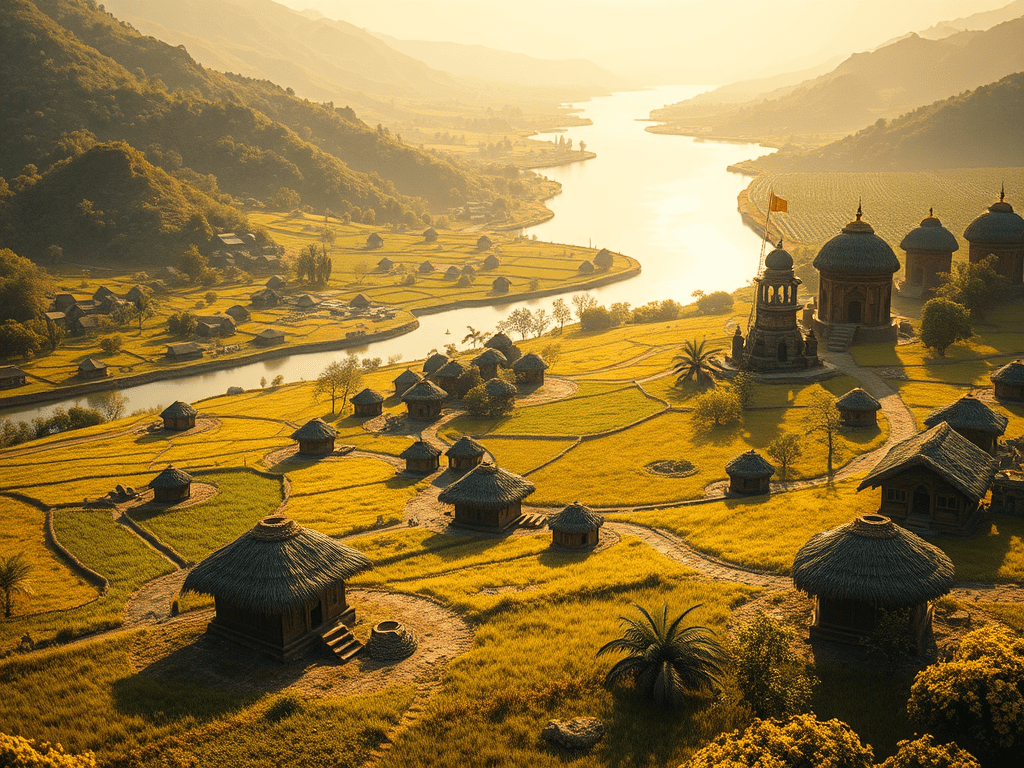
Panchala was a significant kingdom in ancient India, evolving from a Vedic tribal confederacy into one of the sixteen Mahajanapadas during the Iron Age (c. 6th century BCE). Located in the fertile Ganges-Yamuna Doab region, primarily in modern-day western Uttar Pradesh, Panchala was a key center of Vedic culture, intellectual development, and political activity. Renowned for its contributions to Vedic literature, philosophy, and the standardization of rituals, Panchala played a crucial role alongside the neighboring Kuru kingdom. This study material explores Panchala’s historical context, political and social structure, cultural significance, and legacy, with a focus on its role in the Vedic and Mahajanapada periods.
1. Historical and Geographical Context
Panchala emerged during the Later Vedic period (c. 1000–500 BCE) as an Indo-Aryan tribal group that transitioned from a pastoral to an agrarian society. Its prominence continued into the Mahajanapada era, reflecting the broader Second Urbanization in northern India.
Key Features:
- Geography: Centered in the Ganges-Yamuna Doab, covering modern Bareilly, Budaun, Farrukhabad, and parts of Rohilkhand in Uttar Pradesh. The region was fertile, supporting agriculture and trade.
- Capitals:
- Ahichhatra (northern Panchala, near Bareilly): A major urban center.
- Kampilya (southern Panchala, near Farrukhabad): Associated with Vedic rituals and the Mahabharata.
- Timeline: Prominent from the Later Vedic period (c. 1100 BCE) through the Mahajanapada era (c. 6th century BCE), declining with the rise of Magadha (c. 4th century BCE).
- Significance: A hub of Vedic scholarship, ritual standardization, and early philosophical thought, closely allied with Kuru.
2. Panchala in the Vedic Period
a) Early Vedic References
- The Rigveda (c. 1500–1000 BCE) indirectly mentions Panchala through its precursor tribes, such as the Bharatas and Purus, who later merged into the Kuru-Panchala confederacy.
- The name “Panchala” (meaning “five clans” or “five regions”) may refer to a confederation of tribes, though the exact clans are debated.
b) Later Vedic Period (c. 1000–500 BCE)
- Panchala is prominently featured in Brahmanas (e.g., Shatapatha Brahmana, Aitareya Brahmana) and early Upanishads (e.g., Brihadaranyaka, Chhandogya).
- The Kuru-Panchala region became the heartland of Vedic culture, known as Brahmavarta (land of the Vedas), where priests and scholars standardized rituals and composed texts.
- Panchala was a center for intellectual debates, with sages like Yajnavalkya and kings like Janaka (of nearby Videha) engaging in philosophical discussions.
c) Political Structure
- Monarchy: Ruled by a rajan (king), whose authority was legitimized through Vedic rituals like the Rajasuya (royal consecration).
- Assemblies: The sabha (elite council) and samiti (popular assembly) advised the king, though their role diminished as monarchy strengthened.
- Dynasty: Legendary kings like Drupada (Mahabharata) and historical figures in Vedic texts are associated with Panchala.
3. Panchala as a Mahajanapada (c. 6th Century BCE)
By the 6th century BCE, Panchala was listed among the sixteen Mahajanapadas in Buddhist texts like the Anguttara Nikaya. It was a prosperous but less militaristic state compared to Magadha.
a) Key Features
- Capitals: Divided into:
- Northern Panchala (Ahichhatra): A fortified urban center with archaeological remains of Painted Grey Ware (PGW) and Northern Black Polished Ware (NBPW).
- Southern Panchala (Kampilya): A ritual and cultural hub.
- Geography: Its fertile plains and proximity to the Ganges supported agriculture and trade.
- Governance: A hereditary monarchy, with kings supported by Brahmin priests and a Kshatriya elite. Some texts suggest periods of oligarchic rule.
- Economy:
- Agriculture: Iron tools and irrigation enabled surplus production of rice, wheat, and barley.
- Trade: Connected to the Uttarapatha trade route, exchanging textiles, pottery, and grains with Gandhara, Kuru, and eastern states.
- Craftsmanship: Known for pottery (PGW, NBPW) and metalwork, as seen in Ahichhatra excavations.
- Military: Maintained chariots and infantry but was less aggressive than Magadha or Kosala.
b) Political Dynamics
- Alliance with Kuru: The Kuru-Panchala axis was a cultural and political powerhouse, fostering Vedic scholarship and ritual standardization.
- Rivalries: Competed with Kosala and Magadha, eventually losing prominence to the latter.
- Decline: Absorbed into the Nanda Empire (c. 4th century BCE) and later the Mauryan Empire after Magadha’s rise.
4. Social Structure
Panchala’s social organization mirrored Vedic norms, with increasing stratification during the Mahajanapada period.
a) Varna System
- The fourfold varna system (Brahmins, Kshatriyas, Vaishyas, Shudras) was rigid, as seen in Vedic texts composed in Panchala.
- Brahmins: Dominated religious and intellectual life, compiling Brahmanas and Upanishads.
- Kshatriyas: Ruled as kings and warriors, with figures like Drupada exemplifying their role.
- Vaishyas: Engaged in agriculture, trade, and cattle rearing, forming the economic base.
- Shudras: Performed manual labor, with limited social mobility.
- Early jati (caste) groups emerged, tied to occupations like pottery and weaving.
b) Family and Gender
- Patriarchal joint families were led by the grihapati (householder), who managed land and rituals.
- Gotra rules regulated marriage, ensuring exogamy for political alliances.
- Women’s status:
- In the Early Vedic period, women like Gargi Vachaknavi (from the Kuru-Panchala region) participated in philosophical debates.
- By the Mahajanapada period, women’s roles became more domestic, with practices like dowry and restricted remarriage emerging.
c) Labor and Slavery
- Dasas and dasis (slaves), often war captives or debtors, supported agriculture and households.
- Shudras were increasingly relegated to servile roles, reflecting growing inequality.
5. Economic Life
a) Agriculture
- The fertile Doab supported intensive farming, with iron ploughs and canals boosting yields of rice, wheat, and millets.
- The grihapati became a prosperous landowner, managing surplus production.
b) Trade and Craftsmanship
- Panchala’s location on the Uttarapatha facilitated trade with Kuru, Gandhara, and eastern Mahajanapadas.
- Goods included textiles, pottery, and agricultural products.
- Ahichhatra’s archaeological remains reveal advanced pottery (PGW, NBPW) and metalwork.
c) Urbanization
- Ahichhatra was a fortified city with ramparts, houses, and public structures, indicating urban growth.
- Kampilya, though smaller, was a ritual center, hosting Vedic sacrifices.
6. Cultural and Religious Significance
Panchala was a cornerstone of Vedic culture, rivaling Kuru in intellectual and religious contributions.
a) Vedic Religion
- Panchala was a hub for Vedic rituals, with Brahmins standardizing sacrifices like the Soma yajna and Agnihotra.
- Texts like the Shatapatha Brahmana and Gopatha Brahmana were likely composed or compiled here.
- The region’s sanctity is evident in its association with Brahmavarta and Madhyadesha (central land).
b) Philosophical Developments
- The Upanishads, composed in the Kuru-Panchala region, introduced metaphysical concepts like Brahman (universal soul) and Atman (individual soul).
- Sages like Yajnavalkya (Brihadaranyaka Upanishad) and women scholars like Gargi were active in Panchala, reflecting its intellectual vibrancy.
- These ideas influenced later Indian philosophy and heterodox movements like Buddhism and Jainism.
c) Epic Tradition
- Panchala features prominently in the Mahabharata:
- King Drupada of Panchala was an ally of the Pandavas, and his daughter Draupadi (Panchali) was the wife of the five Pandava brothers.
- Kampilya is traditionally the site of Draupadi’s swayamvara (marriage ceremony).
- The epic reflects Panchala’s political alliances and cultural prominence, though mythologized.
d) Education
- Panchala hosted gurukuls where students studied Vedic texts, rituals, and philosophy.
- Its proximity to Kuru made it part of a broader intellectual network, attracting scholars from across northern India.
7. Panchala in the Mahabharata
The Mahabharata provides a semi-historical view of Panchala:
- Political Role: Panchala’s alliance with the Pandavas against the Kauravas (Kuru) highlights its strategic importance.
- Social Norms: The epic depicts varna duties, patriarchal families, and the grihapati’s role, consistent with Vedic society.
- Cultural Values: Draupadi’s story emphasizes honor, alliance-building, and the centrality of dharma.
8. Decline and Legacy
a) Decline
- Panchala’s influence declined by the 5th century BCE due to:
- Competition from eastern Mahajanapadas like Magadha and Kosala.
- Annexation by the Nanda Empire (c. 4th century BCE) and later integration into the Mauryan Empire.
- Archaeological evidence suggests Ahichhatra remained inhabited but lost political prominence.
b) Legacy
- Cultural Foundation: Panchala’s contributions to Vedic literature and philosophy shaped Hinduism and Indian thought.
- Epic Influence: The Mahabharata’s portrayal of Panchala ensures its enduring cultural significance.
- Archaeological Heritage: Sites like Ahichhatra and Kampilya preserve Panchala’s material culture, with findings of PGW and NBPW.
- Intellectual Legacy: The Kuru-Panchala region’s Upanishadic ideas influenced global philosophy through Buddhism and Jainism.
9. Challenges in Studying Panchala
- Textual Bias: Vedic and epic sources focus on elites, with limited insights into lower varnas or non-Aryans.
- Archaeological Gaps: Ahichhatra yields evidence of urban life, but Kampilya’s remains are less explored, limiting historical reconstruction.
- Myth vs. History: The Mahabharata blends fact and legend, complicating historical analysis.
10. Suggested Further Reading
- Primary Sources:
- Shatapatha Brahmana, Brihadaranyaka Upanishad (trans. Ralph T.H. Griffith).
- Mahabharata (trans. Kisari Mohan Ganguli or Bibek Debroy).
- Secondary Sources:
- A History of Ancient and Early Medieval India by Upinder Singh.
- The Vedic People by Rajesh Kochhar.
- Ancient Indian Social History by Romila Thapar.
- Online Resources:
- Sacred-texts.com for Vedic and epic texts.
- Archaeological Survey of India (ASI) reports on Ahichhatra.
11. Conclusion
Panchala was a vital kingdom in ancient India, thriving as a Vedic confederacy and Mahajanapada. Its role in standardizing Vedic rituals, fostering philosophical inquiry, and shaping the Mahabharata narrative underscores its cultural and intellectual significance. Closely allied with Kuru, Panchala was a heartland of Vedic civilization, contributing to India’s religious and philosophical heritage. Though its political power waned with Magadha’s rise, Panchala’s legacy endures in Vedic texts, epic traditions, and archaeological sites, offering a window into ancient India’s complex past.

Leave a comment