
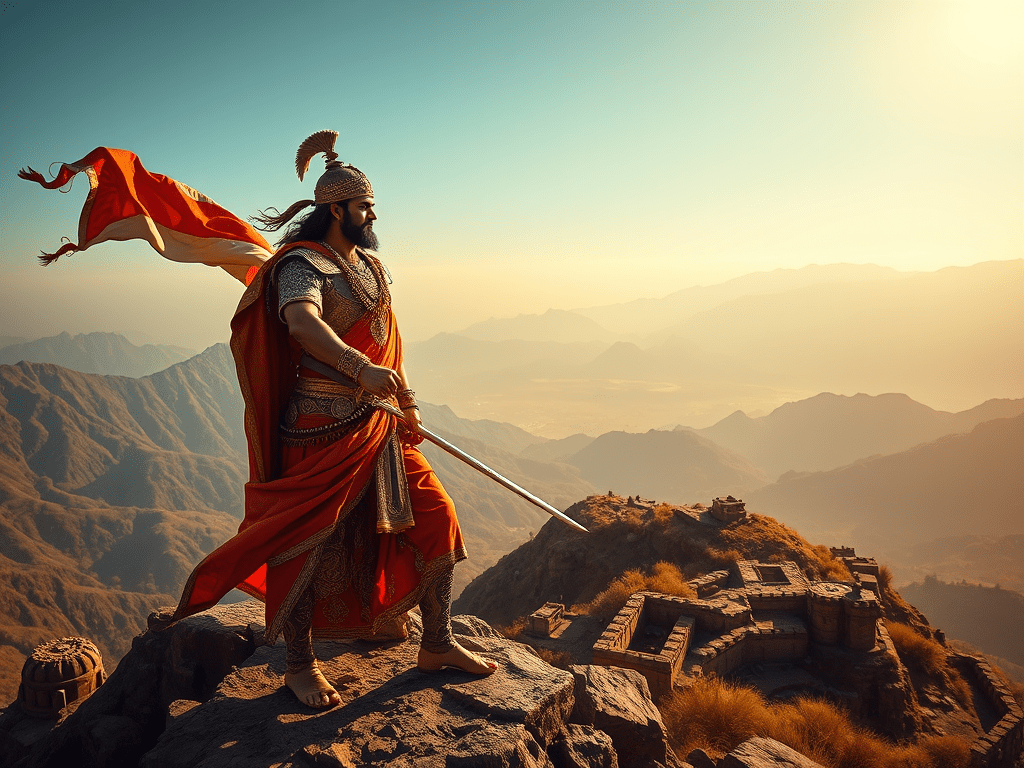
1. Introduction to Shivaji and the Maratha Empire
Shivaji Bhonsle (1630–1680 CE), also known as Chhatrapati Shivaji Maharaj, was the founder of the Maratha Empire, a significant power in 17th-century India that challenged Mughal dominance. Born in the hill-fort of Shivneri, Shivaji established a formidable state in the Deccan, leveraging guerrilla warfare, strategic alliances, and administrative innovations. His reign (1645–1680 CE) laid the foundation for Maratha supremacy, which peaked in the 18th century. Shivaji is celebrated for his military genius, promotion of swaraj (self-rule), and inclusive governance, earning him a lasting legacy as a symbol of resistance against Mughal hegemony.
The provided text emphasizes the importance of corroborating literary and archaeological sources for historical reconstruction, noting their strengths and limitations. For Shivaji’s period, literary sources like Bakhar chronicles and European accounts provide detailed narratives, while archaeological evidence, including forts, inscriptions, and artifacts, offers insights into material culture. Integrating both is crucial, as literary sources may reflect regional biases, and archaeological evidence focuses on cultural processes rather than specific events.
2. Chronology and Key Events
Shivaji’s career is divided into three phases: early conquests, consolidation of power, and expansion against the Mughals.
- Early Conquests (1645–1659 CE):
- Began capturing Bijapur forts (e.g., Torna, 1645) in his teens, establishing a base in the Western Ghats.
- Battle of Purandar (1648): Captured Purandar Fort, marking early defiance of Bijapur.
- Killing of Afzal Khan (1659): Defeated the Bijapur general at Pratapgad through strategic planning, consolidating Maratha control over Jawali.
- Consolidation and Mughal Conflicts (1660–1667 CE):
- Sack of Surat (1664): Raided the Mughal port, showcasing Maratha naval and economic disruption capabilities.
- Battle of Sinhagad (1670): General Tanaji Malusare recaptured the fort, a significant victory symbolizing Maratha resilience.
- Treaty of Purandar (1665): Forced to sign with Mughal general Jai Singh I, ceding 23 forts and acknowledging Mughal suzerainty temporarily.
- Expansion and Coronation (1667–1680 CE):
- Coronation as Chhatrapati (1674): Declared himself king at Raigad, formalizing swaraj and asserting independence.
- Expanded into southern India, capturing parts of Karnataka and Tamil Nadu from Bijapur and Golconda.
- Died in 1680, leaving a robust Maratha state to his son Sambhaji.
The text highlights that literary sources provide event-based history, while archaeology reveals cultural processes. Maratha Bakhars and European accounts detail Shivaji’s campaigns, while forts and inscriptions corroborate his territorial and administrative achievements.
3. Archaeological Sources for Shivaji’s Reign
Archaeological evidence, including forts, inscriptions, and artifacts, provides insights into Shivaji’s military, administrative, and cultural contributions. The text classifies these as structures, inscriptions, and artifacts, emphasizing their role in understanding socio-cultural contexts.
Key Archaeological Findings:
- Structures:
- Forts: Shivaji controlled over 300 forts, including Raigad (capital), Pratapgad, Sinhagad, and Purandar. These hill-forts, strategically located in the Western Ghats, reflect military ingenuity.
- Naval Bases: Forts like Sindhudurg and Vijaydurg highlight Shivaji’s naval capabilities, protecting the Konkan coast.
- The text notes that monuments provide reliable socio-cultural information, evident in the forts’ defensive architecture and strategic planning.
- Artifacts:
- Weapons: Excavations at forts reveal swords, daggers, and early firearms, reflecting guerrilla warfare tactics (ganimi kava).
- Coins: Shivaji minted gold hons and copper shivarais, inscribed with his titles, indicating economic autonomy. The text classifies coins as durable economic indicators.
- Seals and Copper Plates: Administrative seals and grants document land revenue and governance systems.
- Inscriptions:
- Inscriptions at Raigad and other forts proclaim Shivaji’s titles (Chhatrapati, Haindava Dharmoddharak) and victories, aligning with the text’s classification of inscriptions as socio-cultural sources.
- Revenue grants on copper plates detail administrative assignments to local officials.
- Significance of Archaeological Sources:
- The text emphasizes archaeology’s role in reconstructing man-land relationships. Shivaji’s forts reflect strategic use of terrain for defense and governance.
- Scientific techniques like GIS mapping (noted in the text) help trace fort networks, confirming their role in Maratha military strategy. Recent ASI surveys (2024) at Raigad Fort uncovered administrative structures, supporting literary accounts.
4. Literary Sources and Their Limitations
Shivaji’s reign is documented through Maratha chronicles, European accounts, and Mughal records. The text divides literary sources into religious and secular, cautioning against biases due to regional loyalties or oral transmission.
Key Literary Sources:
- Maratha Chronicles (Bakhars):
- Texts like Sabhasad Bakhar (by Krishnaji Anant Sabhasad) and Shedgaonkar Bakhar detail Shivaji’s life, campaigns, and administration.
- The text praises regional chronicles for event-based history but notes their bias. Bakhars glorify Shivaji, often exaggerating his victories.
- European Accounts:
- Portuguese, Dutch, and English records (e.g., East India Company letters) describe Shivaji’s raids on Surat and naval activities, offering external perspectives.
- The text cautions that foreign accounts may misinterpret Indian contexts due to cultural differences.
- Mughal Chronicles:
- Maasir-i-Alamgiri and Akbarnama (for context) portray Shivaji as a rebel, reflecting Mughal bias.
- Letters between Aurangzeb and his generals (e.g., Jai Singh I) detail campaigns against Shivaji.
- Religious Texts:
- Texts like Shivapurana (hagiographic accounts) emphasize Shivaji’s role as a protector of Hinduism, aligning with his title Haindava Dharmoddharak.
- The text notes religious texts as ideological but less historical, requiring corroboration.
Limitations:
- Bias in Bakhars: The text warns that regional chronicles idealize rulers. Bakhars portray Shivaji as a near-mythical hero, downplaying setbacks like the Treaty of Purandar.
- Oral Transmission: Early Bakhars were orally transmitted, risking distortion, as noted in the text’s caution about Shruti traditions.
- Foreign Bias: European accounts may exaggerate Shivaji’s piracy or misunderstand his swaraj ideology.
- Mughal Bias: Mughal chronicles depict Shivaji negatively, necessitating cross-verification with archaeology.
5. Socio-Economic and Cultural Features
Shivaji’s reign is characterized by military innovation, administrative reforms, and cultural revival, as reconstructed from archaeological and literary sources. The text emphasizes archaeology’s role in revealing lifestyles and literary sources’ contribution to event-based history.
Social Organization:
- Stratification: Shivaji’s administration integrated local elites (deshmukhs, patils) into a merit-based system, reducing dependence on hereditary nobility.
- Inclusive Governance: He appointed officials from diverse communities (e.g., Brahmins, Marathas), fostering unity.
- The text notes that archaeology reveals social life, evident in fort-based communities and diverse burial practices.
Economy:
- Agriculture: Shivaji’s revenue system (malguzari) taxed farmers lightly to ensure loyalty, with rates often lower than Mughal or Bijapur systems. Bakhars describe his emphasis on peasant welfare.
- Trade: Control over Konkan ports (e.g., Vijaydurg) facilitated trade with Arabs and Europeans. Coins and seals indicate economic autonomy.
- Raids: Plundering Mughal territories (e.g., Surat) supplemented revenue, as noted in European accounts.
- The text highlights commercial inscriptions (e.g., on coins) as economic indicators, relevant to Shivaji’s fiscal policies.
Religion and Culture:
- Religious Policy: Shivaji promoted Haindava Dharma (Hinduism) as a unifying ideology against Mughal orthodoxy, protecting temples and granting land to Brahmins.
- Cultural Revival: Patronized Marathi language and festivals, fostering regional identity. His coronation (1674) used Vedic rituals, emphasizing Hindu kingship.
- The text classifies religious artifacts (e.g., temple grants) as didactic, evident in Shivaji’s support for Hindu institutions.
Technology:
- Military Technology: Shivaji’s guerrilla warfare (ganimi kava) leveraged light cavalry and forts. Archaeological finds of weapons and fort designs confirm this.
- Naval Innovation: Built a navy with ships like gurabs, evidenced by Sindhudurg’s dockyard remains.
- The text highlights archaeology’s role in understanding technology, evident in fort architecture and naval bases.
6. Decline and Legacy of Shivaji’s Reign
Shivaji died in 1680 CE, leaving a robust but nascent empire to his son Sambhaji. The text notes that archaeology informs about cultural shifts, while literary sources detail events.
Factors of Transition:
- Succession Challenges: Sambhaji faced Mughal pressure and internal dissent, as noted in Bakhars.
- Mughal Pressure: Aurangzeb’s Deccan campaigns intensified post-1680, targeting Maratha territories.
- Archaeological Evidence: Forts like Raigad show signs of continued use but also Mughal sieges post-Shivaji.
Legacy:
- Foundation of Maratha Empire: Shivaji’s swaraj vision and fort network laid the groundwork for 18th-century Maratha expansion under the Peshwas.
- Military Innovation: His guerrilla tactics and navy influenced Indian warfare.
- Cultural Revival: His promotion of Marathi and Hindu identity inspired regional pride.
7. Integration of Literary and Archaeological Sources
The text stresses corroborating literary and archaeological evidence for a holistic historical reconstruction. For Shivaji:
- Literary Dominance: Bakhars and European accounts provide detailed event-based history, covering campaigns and governance.
- Archaeological Support: Forts, coins, and inscriptions corroborate literary descriptions of Shivaji’s military and administrative achievements.
- Challenges: The text notes the difficulty of integrating biased literary sources with anonymous archaeological data. Bakhars’ glorification requires validation from fort remains and inscriptions.
- Complementary Insights: Literary sources detail events (e.g., battles, coronation), while archaeology reveals cultural processes (e.g., fort architecture, trade).
8. Relevance for Competitive Exams
Shivaji’s reign is a high-weightage topic in UPSC, BPSC, and other competitive exams, appearing in Prelims (factual recall) and Mains (analytical depth). Focus areas include:
- Battles: Purandar (1648), Pratapgad (1659), Surat (1664), Sinhagad (1670).
- Administration: Swaraj, ashtapradhan (council of eight ministers), revenue system.
- Military Innovations: Guerrilla warfare (ganimi kava), navy, fort strategy.
- Literary Sources: Sabhasad Bakhar, European accounts, Mughal chronicles.
- Archaeological Evidence: Raigad, Pratapgad, Sindhudurg, coins.
- Legacy: Foundation of Maratha Empire, cultural revival.
The text’s emphasis on critical source analysis aligns with Mains’ requirements for evaluating historical evidence. For Prelims, memorize key events, forts, and policies.
9. Recent Developments (as of June 7, 2025)
- Raigad Fort Conservation: ASI restoration (2024) uncovered administrative structures, supporting Bakhar accounts of Shivaji’s capital.
- Sindhudurg Excavations: Recent surveys (2023–24) revealed naval dock remains, confirming Shivaji’s maritime focus.
- Digital Archiving: Digitized Bakhars and Portuguese records enhance research access, aligning with the text’s emphasis on scientific techniques.
10. Conclusion
Shivaji’s reign (1645–1680 CE) established the Maratha Empire as a formidable power, challenging Mughal dominance through military innovation, swaraj, and cultural revival. Literary sources like Bakhars and European accounts provide detailed event-based history, while archaeological evidence (forts, coins, inscriptions) reveals military and administrative contexts. The text’s advocacy for corroborating both sources is critical, given the biases in Bakhars and the anonymous nature of archaeology. For competitive exams, mastering Shivaji’s campaigns, governance, and recent findings is essential for factual recall and analytical depth.
Key Points for Quick Revision
- Reign: 1645–1680 CE; founder of Maratha Empire.
- Key Battles: Purandar (1648), Pratapgad (1659), Surat (1664), Sinhagad (1670).
- Policies: Swaraj, ashtapradhan, light taxation (malguzari).
- Literary Sources: Sabhasad Bakhar, European accounts, Mughal chronicles.
- Archaeological Evidence: Raigad, Pratapgad, Sindhudurg, coins.
- Innovations: Guerrilla warfare, navy, fort network.
- Legacy: Maratha expansion, Hindu revival, swaraj ideology.
- Exam Tips: Focus on battles, governance, sources, and recent findings.

Leave a comment