
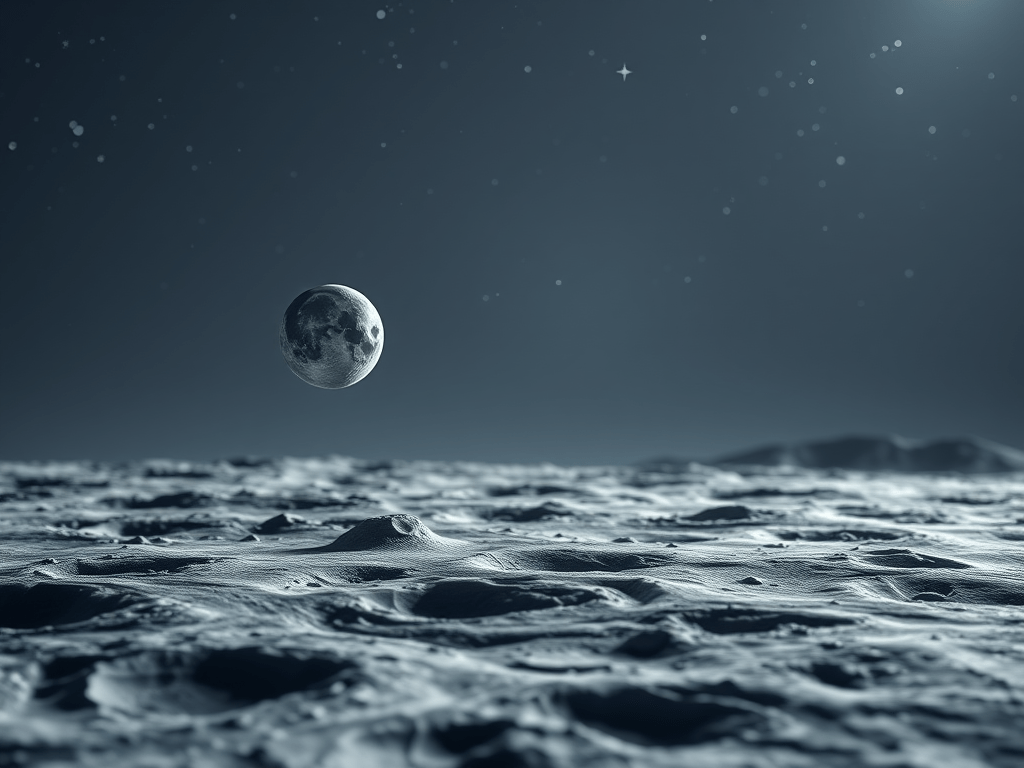
Question No. 21: Two objects of different masses falling freely near the surface of the Moon would
(A) have different accelerations
(B) undergo a change in their inertia
(C) have same velocity at any instant
(D) experience forces of same magnitude Correct Answer: (C) have same velocity at any instant Explanation in Simple Sentences:
- Option (A): Acceleration is the rate of change in velocity. On the Moon, gravity is the same for all objects (1.62 m/s²), so both objects accelerate equally. No air resistance exists on the Moon. This is incorrect.
- Option (B): Inertia is an object’s resistance to motion change, based on its mass. Mass doesn’t change during free fall, so inertia stays constant. This is incorrect.
- Option (C): Velocity is speed with direction. Objects dropped together on the Moon fall at the same rate due to equal gravitational acceleration. Their velocities are the same at any moment. This is correct.
- Option (D): Gravitational force depends on mass (Force = mass × gravity). Different masses mean different forces. This is incorrect.
Reason: On the Moon, all objects fall with the same acceleration (1.62 m/s²) regardless of mass. If dropped at the same time from the same height, they have the same velocity at any instant, making (C) correct.
Key Terms Explained:
- Mass: Amount of matter in an object (kg). It stays constant everywhere. Example: A 1 kg rock is 1 kg on Earth or Moon.
- Gravitation: Force pulling objects toward the Moon’s surface. Moon’s gravity is 1/6th of Earth’s (1.62 m/s²).
- Acceleration: Rate of velocity change (m/s²). On the Moon, all objects in free fall accelerate at 1.62 m/s².
- Inertia: Resistance to motion change, depends on mass. Unchanged during free fall.
- Velocity: Speed with direction (m/s). In free fall on the Moon, objects dropped together have equal velocities at all times.
- Magnitude: Size of a force. Gravitational force varies with mass, so heavier objects experience greater force.
- Weight: Force from gravity (Weight = mass × gravity). On the Moon, weight is less than on Earth due to weaker gravity.
Five Probable Questions of Similar Difficulty
- Question: What causes objects to fall at the same rate on the Moon?
(A) Air resistance
(B) Equal gravitational acceleration
(C) Same mass
(D) Equal weight
Answer: (B) Equal gravitational acceleration
Explanation: Moon’s gravity (1.62 m/s²) accelerates all objects equally, with no air resistance. - Question: How does the Moon’s gravity compare to Earth’s?
(A) Stronger
(B) About 1/6th as strong
(C) Equal
(D) Zero
Answer: (B) About 1/6th as strong
Explanation: Moon’s gravity is 1.62 m/s², roughly 1/6th of Earth’s 9.8 m/s². - Question: Two objects dropped on the Moon from the same height will:
(A) Hit the ground at different times
(B) Have different velocities
(C) Hit the ground together
(D) Have different weights
Answer: (C) Hit the ground together
Explanation: Equal acceleration means objects dropped together reach the ground simultaneously. - Question: What is an object’s weight on the Moon compared to Earth?
(A) Same
(B) Greater
(C) Less
(D) Zero
Answer: (C) Less
Explanation: Moon’s weaker gravity reduces weight (Weight = mass × gravity). - Question: Which does NOT affect free fall on the Moon?
(A) Mass
(B) Gravity
(C) Height
(D) No atmosphere
Answer: (A) Mass
Explanation: Mass doesn’t change free fall rate; gravity and no atmosphere ensure equal acceleration.
Preparation Strategies for 71st BPSC Prelims
- Study gravity and free fall on the Moon vs. Earth.
- Understand terms like mass, weight, and acceleration.
- Solve problems on free fall and gravity calculations.
- Review experiments like Apollo 15’s feather-hammer drop.
- Avoid confusing mass with weight or thinking mass affects fall rate on the Moon.

Leave a comment