

Characteristics and Functions of Vata, Pitta, Kapha; Five Subtypes; Signs of Increase (Vridhi) and Decrease (Kshaya)
Introduction to Doshas in Ayurveda
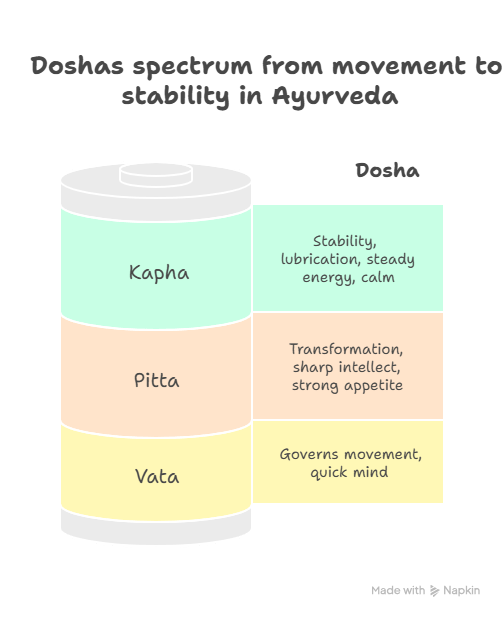
In Ayurveda, the ancient Indian system of medicine, the concept of Doshas forms the foundational framework for understanding human physiology, psychology, and pathology. The three primary Doshas—Vata, Pitta, and Kapha—are bio-energies derived from the five great elements (Panchamahabhutas): ether (akasha), air (vayu), fire (agni), water (jala), and earth (prithvi). These Doshas govern all biological, psychological, and physiopathological functions in the body and mind. When in balance (samya), they promote health; when imbalanced, they lead to disease.
Guna refers to the inherent qualities or attributes of each Dosha, which define its nature and influence on the body. Karma denotes the functions or actions performed by the Dosha, encompassing physiological roles like movement, transformation, and stability. Each Dosha has distinct characteristics that manifest physically, mentally, and emotionally. Furthermore, every Dosha is subdivided into five subtypes based on their specific locations and functions in the body.
Imbalances in Doshas are categorized as Vridhi (increase or aggravation), leading to hyperfunction and related disorders, and Kshaya (decrease or depletion), resulting in hypofunction and deficiency symptoms. Vridhi often causes diseases, while Kshaya manifests as weakness without necessarily leading to pathology. Diagnosis involves observing signs through self-assessment or clinical evaluation, and management focuses on restoring balance via diet, lifestyle, herbs, and therapies.
These notes draw from classical Ayurvedic texts like Charaka Samhita and Sushruta Samhita, as well as modern interpretations, to provide a comprehensive overview.
Vata Dosha
Characteristics and Guna (Qualities)
Vata Dosha, composed primarily of air (vayu) and ether (akasha) elements, embodies movement, subtlety, and change. 8 Its key characteristics include being light, dry, cold, rough, mobile, subtle, and clear. These qualities make Vata responsible for all forms of motion in the body, from cellular to systemic levels. Physically, Vata types tend to be slender, with irregular appetites, dry skin, and a propensity for variability in energy and mood. Mentally, they are creative, quick-thinking, but prone to anxiety and restlessness when imbalanced. Vata’s dry and rough nature can lead to issues like constipation or joint problems if aggravated, while its mobility supports agility and adaptability in balance.
In terms of psychological correlates, Vata is linked to Rajas (activity and passion), fostering enthusiasm and initiative but also instability. 10 Its sensory associations include sound (shabda) and touch (sparsha), making it crucial for perception and communication.
Karma (Functions)
Vata’s primary function is to govern movement and communication throughout the body. 4 This includes the flow of breath (prana), pulsation of the heart, muscle contractions, nerve impulses, and cellular mobility. It facilitates the transportation of nutrients, oxygen, and wastes, ensuring proper circulation and elimination. In digestion, Vata initiates peristalsis and absorption. Psychologically, it supports mental agility, creativity, and sensory processing. When balanced, Vata promotes vitality, enthusiasm, and proper nervous system function; imbalanced, it disrupts these, leading to disorders like neurological issues or digestive irregularities.
Five Subtypes
Vata is divided into five subtypes based on location and specific roles:
| Subtype | Location | Functions |
|---|---|---|
| Prana Vata | Brain, head, throat, heart, respiratory organs | Governs inhalation, sensory perception, mind, swallowing, and life force. |
| Udana Vata | Navel, lungs, throat | Controls speech, self-expression, effort, enthusiasm, strength, and vitality. |
| Samana Vata | Stomach, small intestines | Regulates digestive peristalsis, assimilation, and balance of other Vatas. |
| Vyana Vata | Heart, whole body | Manages circulation, heart rhythm, locomotion, and nutrient distribution. |
| Apana Vata | Navel to anus | Oversees downward impulses like elimination, urination, menstruation, and childbirth. |
These subtypes ensure coordinated movement; imbalance in one can affect others, e.g., Apana Vata issues may cause constipation.
Signs of Vridhi (Increase)
Vata Vridhi manifests as excessive movement, dryness, and coldness, often leading to degenerative conditions. 3 Common signs include emaciation, weight loss, black discoloration, desire for hot things, tremors, bloating, constipation, weakness, insomnia, sensory loss, irrelevant speech, delusion, dizziness, ptosis, prominent veins, cutting pain, numbness, contraction, rigidity, lameness, and various pains (e.g., body ache, joint crippling). Specific symptoms encompass cracking nails/feet, foot drop, sciatica, paraplegia, kyphosis, dwarfism, chest pain, hoarseness, tinnitus, headache, facial paralysis, convulsions, fainting, yawning, hiccups, depression, delirium, dryness, hardness, and unstable mind. From Charaka, additional signs are lack of strength, complexion loss, discomfort, anxiety, fetal abnormalities, and breathing difficulties. Sushruta notes hoarseness, leanness, rough skin, and desire for heat. Overall, Vridhi causes disorders like gulma (tumors), kampa (tremors), and anaha (flatulence), with pain as a hallmark.
Signs of Kshaya (Decrease)
Vata Kshaya, though less common and not disease-causing, presents as deficiency symptoms due to reduced movement and dryness, often with increased Kapha or Pitta. 3 Key signs include sluggish metabolism (agni sadana), indigestion, increased unctuousness (leading to heaviness), body ache, desire for sour/hot/pungent tastes, and lethargy. There may be weakness, dullness, and reduced vitality, with symptoms like loss of enthusiasm, slow movements, and Kapha-like heaviness. Classical texts describe it as causing mild Vata functions, such as poor circulation or weak nerve signals, without severe pathology.
Pitta Dosha
Characteristics and Guna (Qualities)
Pitta Dosha, derived from fire (agni) and water (jala) elements, represents transformation and metabolism. 8 Its qualities include heat, sharpness, lightness, liquidity, oiliness, spreading, and sourness. Pitta individuals are typically medium-built, with strong digestion, warm skin, sharp intellect, and a driven personality. They exhibit ambition and leadership but can become irritable or critical when imbalanced. Psychologically, Pitta correlates with Sattva (purity and harmony), promoting intelligence and understanding. 10 It governs vision (related to sight perception) and embodies heat, making it central to digestion and body temperature regulation.
Karma (Functions)
Pitta oversees digestion, metabolism, and transformation at all levels. 4 It directs bile for food breakdown, maintains body heat, supports vision, hunger, thirst, and intelligence. In the mind, it processes thoughts, emotions, and experiences, fostering comprehension and decision-making. Balanced Pitta ensures radiant skin, sharp memory, and efficient nutrient absorption; excess leads to inflammation, while deficiency causes dullness.
Five Subtypes
Pitta’s subtypes focus on metabolic and perceptual functions:
| Subtype | Location | Functions |
|---|---|---|
| Pachaka Pitta | Lower stomach, small intestine | Digests food, separates nutrients from waste. |
| Ranjaka Pitta | Liver, gallbladder, spleen | Forms red blood cells, colors blood and stools. |
| Sadhaka Pitta | Heart | Governs emotions, memory, intelligence, and mental digestion. |
| Alochaka Pitta | Eyes | Controls visual perception and eye health. |
| Bhrajaka Pitta | Skin | Regulates complexion, temperature, pigmentation, and luster. |
Imbalances here can cause specific issues, like Pachaka Pitta excess leading to hyperacidity.
Signs of Vridhi (Increase)
Pitta Vridhi is characterized by excess heat, sharpness, and acidity, often resulting in inflammatory diseases. 31 Signs include yellow discoloration of feces, urine, eyes, and skin; excess hunger/thirst; burning sensation; reduced sleep; reddish inflammation; pus formation; foul sweat; dizziness; sour taste; preference for cold; early graying; heat intolerance; acidic belching; heartburn; and fever. Charaka lists burning (daaha), heat (ushna), suppuration (paaka), perspiration (sveda), sloughing (kleda), putrefaction (kotha), itching (kandu), discharge (srava), and redness (raaga). Emotional signs: anger, jealousy, criticism. Physical: jaundice-like yellowness, ulcers, blood toxicity, and infections.
Signs of Kshaya (Decrease)
Pitta Kshaya involves reduced heat and metabolism, leading to coldness and dullness. 30 Symptoms include weak digestion (manda agni), indigestion, hypothermia (manda ushmata), excessive coldness (sheeta), and lack of luster (nishprabhata or prabha hani). There may be dull intelligence, poor appetite, and pale complexion, with no major diseases but overall weakness.
Kapha Dosha
Characteristics and Guna (Qualities)
Kapha Dosha, formed from water (jala) and earth (prithvi), provides structure, lubrication, and stability. 8 Qualities: heavy, slow, cool, oily, smooth, dense, soft, stable, gross, and sticky. Kapha types are sturdy, with steady energy, calm demeanor, and strong immunity, but prone to lethargy and attachment. It correlates with Tamas (inertia), promoting endurance but risking stagnation. 10 Kapha nourishes tissues, lubricates joints, and supports taste perception.
Karma (Functions)
Kapha provides cohesiveness, hydration, and protection. 4 It lubricates joints, moisturizes skin, maintains immunity, and hydrates cells. Emotionally, it embodies love, compassion, and stability. Balanced Kapha ensures strong tissues and calm mind; excess causes congestion, deficiency leads to dryness.
Five Subtypes
Kapha subtypes emphasize lubrication and nourishment:
| Subtype | Location | Functions |
|---|---|---|
| Kledaka Kapha | Upper stomach | Moistens and liquefies food for digestion. |
| Avalambaka Kapha | Chest, heart, lungs | Lubricates heart/lungs, supports back/chest strength. |
| Tarpaka Kapha | Head, sinuses, cerebrospinal fluid | Nourishes senses, promotes calmness and stability. |
| Bodhaka Kapha | Tongue, mouth, throat | Perceives taste, moistens food. |
| Shleshaka Kapha | Joints | Lubricates joints for smooth movement. |
Disruptions can lead to sinus issues (Tarpaka) or arthritis (Shleshaka).
Signs of Vridhi (Increase)
Kapha Vridhi features excess heaviness, coldness, and oiliness, causing accumulative disorders. 21 Signs: weak digestion, excess salivation, laziness, heaviness, white discoloration, coldness, dyspnea, cough, excess sleep, oiliness, itching, channel obstruction, swelling, sweet/salty taste, indigestion, coated tongue, depression, greed, weight gain, mucus congestion, diabetes, nausea, pale clammy skin, edema, high cholesterol, aching joints, anorexia, drowsiness, timidity, mucus expectoration, goiter, urticaria, numbness, moistness, and lethargy. Charaka adds whiteness, coolness, steadiness, unctuousness, binding, sweetness, and slowness.
Signs of Kshaya (Decrease)
Kapha Kshaya results in dryness and instability, often with Vata increase. 20 Symptoms: dryness (rukshata), internal burning (antardaha), emptiness in Kapha seats (e.g., head heaviness), joint looseness (sandhi shaithilya), thirst (trishna), debility (daurbalyam), insomnia (prajaagaranam), and giddiness (bhrama). It leads to fragility without direct disease.

Leave a comment