
Detailed Study Material for UPSC EPFO and UPSC ALC Exams
Introduction to Dispute Resolution Mechanisms
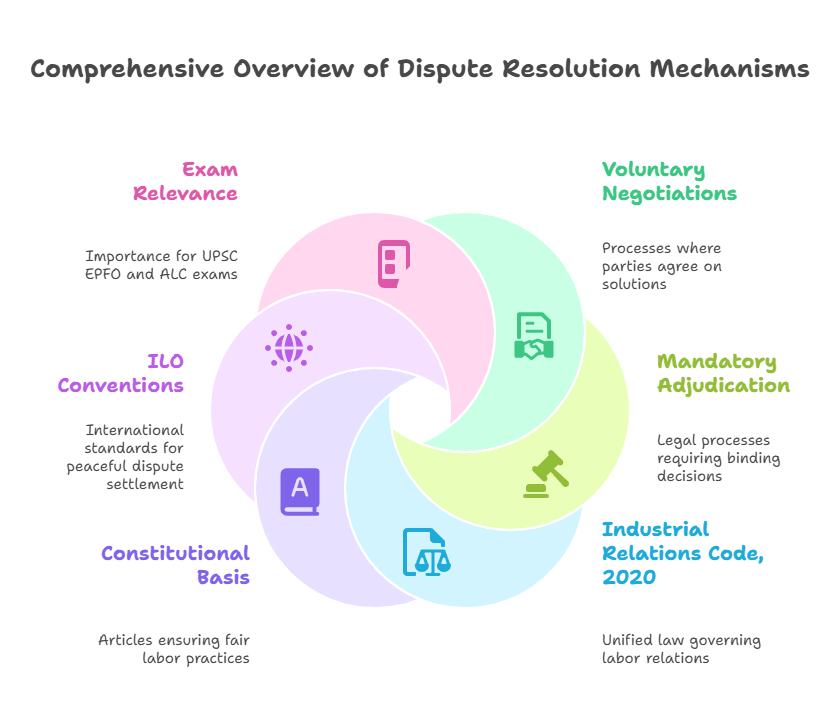
Key Concepts in Dispute Resolution Mechanisms
Definition and Types of Disputes
Industrial disputes are conflicts between employers and employees (or unions) over employment matters, classified as individual (e.g., wrongful termination) or collective (e.g., wage demands affecting groups). Types include interest disputes (new terms) and rights disputes (existing agreement violations). Resolution mechanisms aim at amicable settlements, reducing economic losses from disruptions.
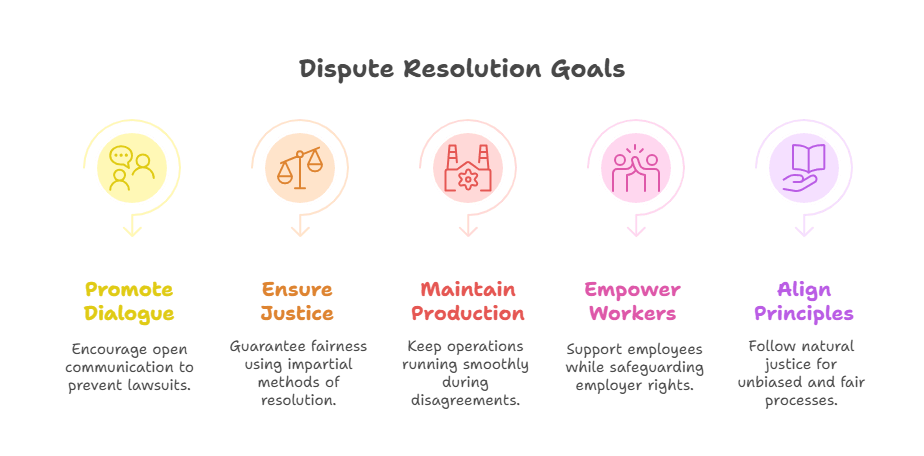
Objectives
Classification of Mechanisms
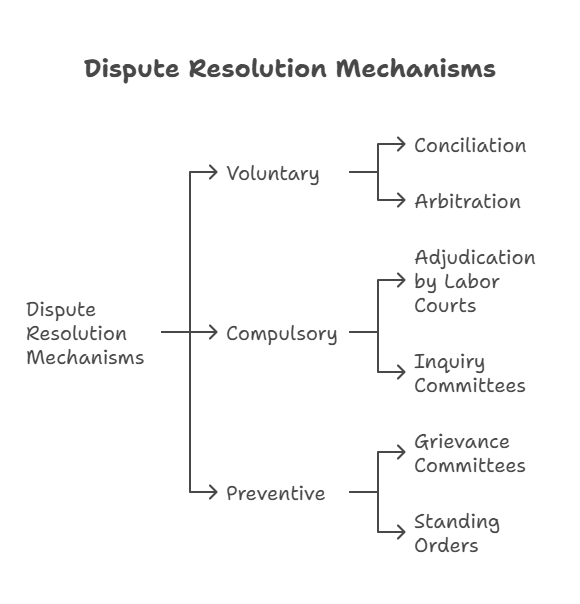
- Voluntary: Conciliation, arbitration (mutual agreement).
- Compulsory: Adjudication by labor courts/tribunals, inquiry committees.
- Preventive: Grievance committees, standing orders to avert disputes.
Legal Framework
The Industrial Relations Code, 2020, provides the primary framework, effective from 2025 in phases, replacing fragmented laws. Key provisions:
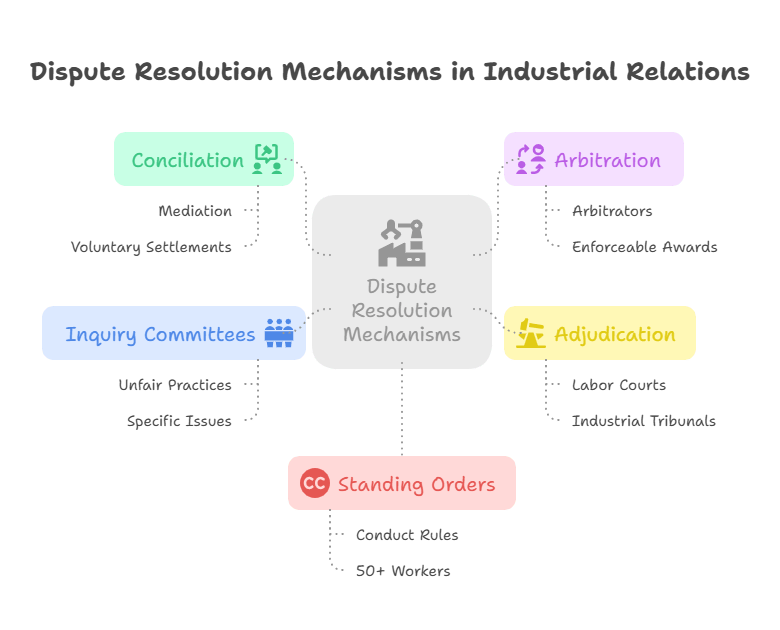
- Conciliation: Officers mediate voluntary settlements (binding if signed).
- Arbitration: Voluntary referral to arbitrators; award enforceable as decree.
- Adjudication: Labor Courts for individual disputes, Industrial Tribunals for collective (wages, hours, retrenchment).
- Inquiry Committees: For specific issues like unfair practices.
- Standing Orders: Certified rules on conduct, preventing disputes (mandatory for 50+ workers).
Other laws: Code on Wages, 2019 (wage claims), Social Security Code, 2020 (benefit disputes), OSH Code, 2020 (safety-related conflicts). ILO Convention 144 on tripartite consultations influences tripartite bodies like Indian Labour Conference.
| Mechanism | Governing Provision | Key Features | Applicability |
|---|---|---|---|
| Conciliation | Section 12, IR Code | Voluntary mediation; binding settlement | All disputes; first step |
| Arbitration | Section 22, IR Code | Mutual arbitrator; award final | Voluntary; faster than courts |
| Adjudication | Sections 9-10, IR Code | Labor Court/Tribunal; compulsory referral | Individual/collective; government reference |
| Grievance Committee | Section 4, IR Code | Bipartite committee (20+ workers) | Preventive; internal resolution |
Process of Dispute Resolution
The resolution process under IR Code, 2020, is stepwise:
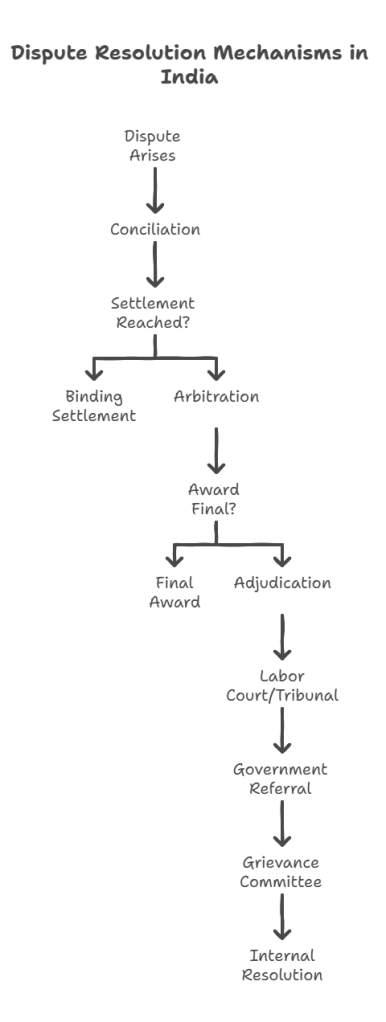
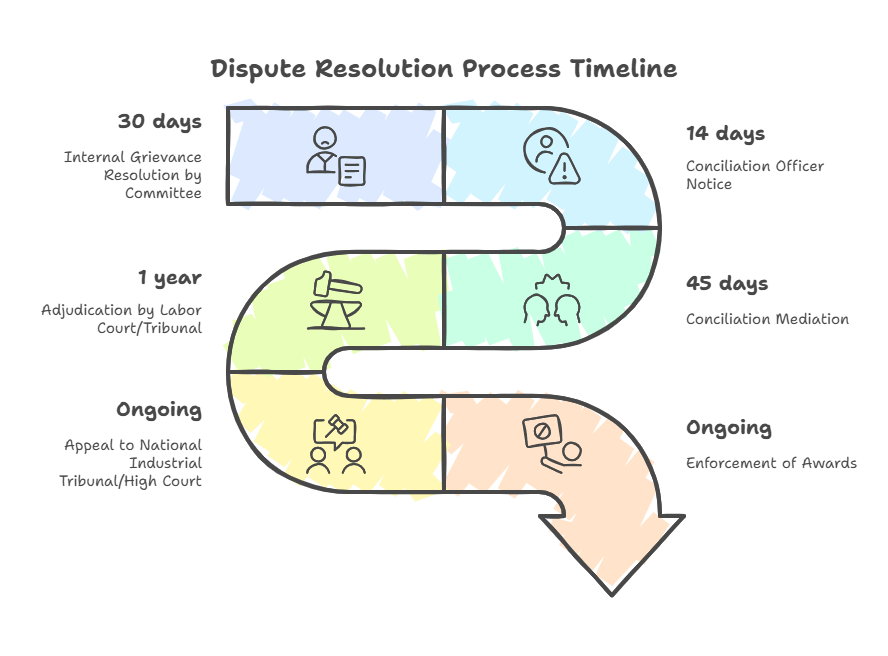
- Internal Grievance: Employee submits to Grievance Redressal Committee (equal representation); resolution within 30 days.
- Conciliation: If unresolved, referred to Conciliation Officer (notice within 14 days); mediation for settlement (45-day limit, extendable).
- Arbitration: Parties agree on arbitrator; award within specified time, appealable only on limited grounds.
- Adjudication: Government refers to Labor Court (individual disputes) or Tribunal (collective); inquiry, evidence, award within 1 year.
- Appeal: To National Industrial Tribunal or High Court on substantial legal questions.
- Enforcement: Awards enforced as civil decrees; non-compliance penalties (fines up to Rs. 50,000, imprisonment up to 3 months).
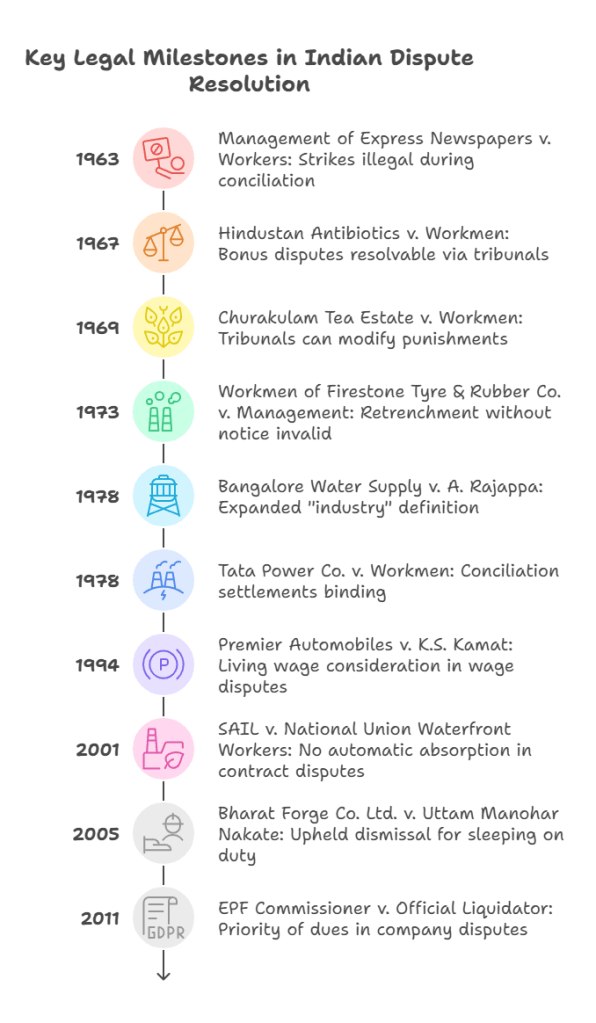
For strikes/lockouts: 60-day notice, prohibited during conciliation/adjudication. Case example: Process failure leads to references, as in Workmen v. Firestone Tyre (1973).
Historical Evolution in India
Dispute resolution evolved through phases:
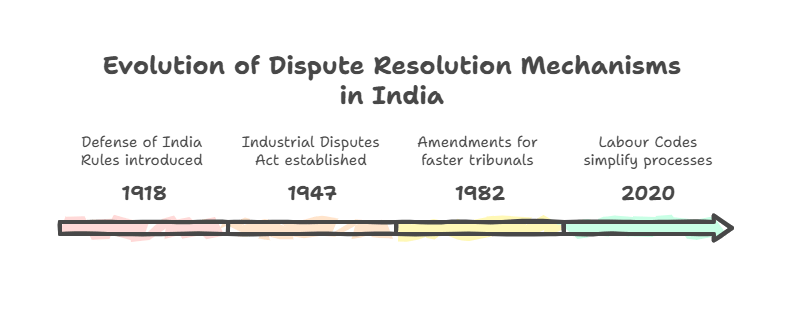
- Pre-Independence (1918-1947): Ad hoc mechanisms; Defense of India Rules (1918) for war-time disputes; Industrial Disputes Act, 1947, introduced formal processes.
- Post-Independence (1947-1991): ID Act emphasized conciliation/tribunals; tripartite forums like Indian Labour Conference (1942) for consultations.
- Liberalization Era (1991-2019): Rise in individual disputes due to privatization; amendments for faster tribunals (1982).
- Labour Codes Era (2020-2025): IR Code simplifies with time-bound processes, single tribunals; states like Rajasthan pioneered reforms.
Key Milestone: ID Act, 1947, post-World War II labor unrest. Evolution reflects shift from state intervention to voluntary settlements.
Key Features of Dispute Resolution under IR Code, 2020
| Feature | Description | Implications |
|---|---|---|
| Grievance Committee | Equal representation, women included | Preventive, internal; reduces escalation |
| Conciliation Timeline | 45 days, extendable | Speedy; binding if agreed |
| Tribunal Structure | Single bench for faster decisions | Efficiency; covers multiple laws |
| Strike Notice | 60 days, ballot for unions | Balances rights; prevents sudden stoppages |
| Appeal Limits | Only on legal questions | Reduces delays; finality emphasized |
Challenges in Dispute Resolution
Major Case Laws on Dispute Resolution
Relevance to UPSC EPFO and ALC Exams
UPSC EPFO (EO/AO/APFC)
- Syllabus Link: Industrial Relations (dispute mechanisms, IR Code), Labour Laws (resolution impact on welfare).
- Weightage: 15-20%; 8-12 MCQs on processes, cases.
- Focus Areas:
- Link to social security (disputes affecting PF/ESI claims).
- Preventive mechanisms like grievances.
- Case laws on adjudication.
- Question Types: MCQs on timelines, features; short notes on types.
UPSC ALC
- Syllabus Link: Industrial Relations (ID Act/IR Code, tribunals), Labour Welfare (fair resolution), HR Development (conflict management).
- Weightage: 30-40%; 15-20 MCQs, 3-5 descriptives.
- Focus Areas:
- Detailed processes, tribunal powers.
- Challenges in unorganized sectors.
- Case laws on fairness, strikes.
- Integration with new codes.
| Exam | Syllabus Focus | Weightage | Key Topics | Preparation Strategy |
|---|---|---|---|---|
| EPFO | Industrial Relations, Labour Laws | 15-20% | Mechanisms, preventive, social security link | MCQs on IR Code, cases; PYQs analysis |
| ALC | Industrial Relations, Welfare, HR | 30-40% | Processes, challenges, adjudication | Descriptives on evolution, reforms; case ratios |

Leave a comment