
For UPSC EPFO and UPSC ALC Exams
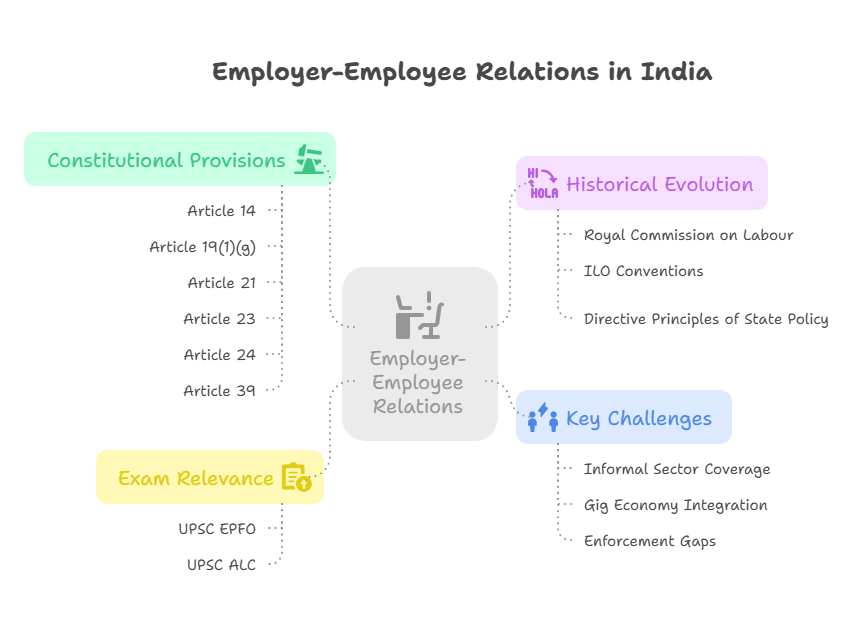
Employer-employee relations, also known as industrial relations, refer to the dynamic interactions between employers (management), employees (workers), and their representatives (trade unions) in the workplace. This field encompasses the regulation of work conditions, dispute resolution, collective bargaining, and social security measures to ensure harmonious and productive labor environments. In the Indian context, it is rooted in constitutional provisions like Articles 14 (equality), 19(1)(g) (freedom to practice occupation), 21 (right to life and dignity), 23 (prohibition of forced labor), 24 (prohibition of child labor), and 39 (directive principles for just work conditions and living wages).
The evolution of these relations in India traces back to colonial-era laws influenced by the Royal Commission on Labour (1931) and ILO conventions, transitioning post-independence to a welfare-oriented framework under the Directive Principles of State Policy.
For UPSC EPFO (Enforcement Officer/Accounts Officer) and APFC (Assistant Provident Fund Commissioner) exams,
this topic falls under “Industrial Relations & Labour Laws,” emphasizing labor codes, social security, and dispute mechanisms. In UPSC ALC (Assistant Labour Commissioner) exams, it is a core component covering labour welfare, industrial relations, human resource development, trade unions, and new labour codes. The subject is interdisciplinary, linking polity, economy, and social issues, with a focus on recent reforms like the four Labour Codes of 2019-2020 (implemented in stages from 2025). Key challenges include informal sector coverage, gig economy integration, and enforcement gaps, making it a high-weightage area in both exams (20-30% of paper).
Key Concepts in Employer-Employee Relations
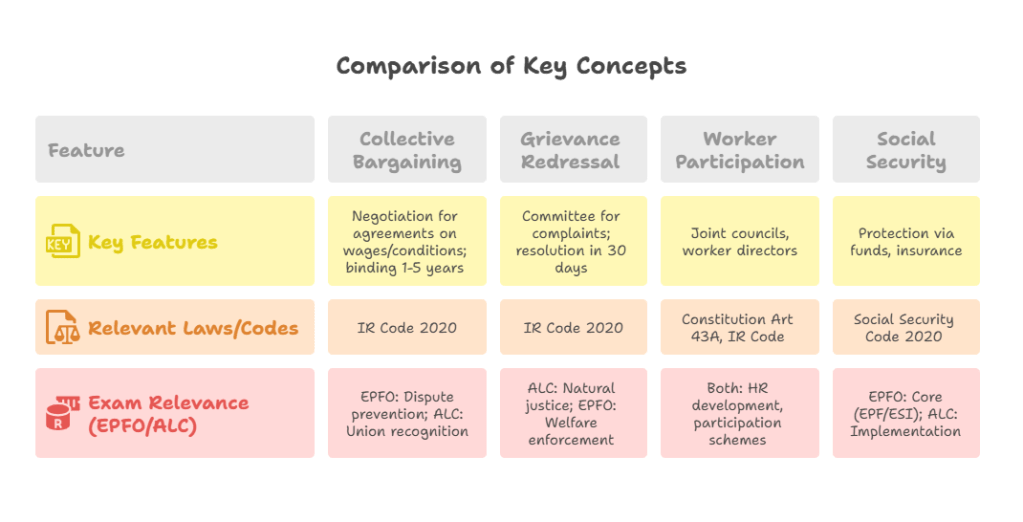
Employer-employee relations involve several core concepts that form the backbone of industrial harmony. These are frequently tested in UPSC exams for their theoretical and practical implications.
1. Collective Bargaining
Collective bargaining is the process where employers and employee representatives (trade unions) negotiate terms of employment, such as wages, working conditions, and benefits, leading to a collective agreement. In India, it is governed by the Industrial Relations Code, 2020 (replacing the Trade Unions Act, 1926, and Industrial Disputes Act, 1947), promoting bipartite settlements without third-party intervention. The process includes recognition of negotiating unions (with 51% membership threshold under the new code), good-faith bargaining, and enforceability of agreements for 1-5 years. Importance: Reduces disputes, empowers workers; challenges include weak unions in unorganized sectors. For exams, focus on levels (plant, industry, national) and ILO Convention 98 ratification.
2. Grievance Redressal Mechanism
Grievance redressal involves systematic procedures to address employee complaints on wages, conditions, or unfair treatment, preventing escalation to disputes. Under the Industrial Relations Code, 2020, establishments with 20+ workers must form Grievance Redressal Committees (equal employer-employee representation, including women). Steps: Informal resolution, committee hearing (within 30 days), appeal to conciliation officer. Significance: Enhances morale, reduces absenteeism; for ALC exams, link to natural justice principles (audi alteram partem). Models: Open-door policy, step-ladder process.
3. Worker Participation in Management
Worker participation involves employees in decision-making through committees or boards, fostering cooperation. In India, mandated by Article 43A (Directive Principle) and schemes like Works Committees (Industrial Disputes Act, 1947, now in IR Code). Forms: Joint Management Councils, Shop Councils (1975 Scheme), equity participation. Benefits: Improves productivity, reduces conflicts; challenges: Tokenism in practice. For EPFO, link to social security committees.
4. Social Security in India
Social security provides protection against risks like old age, disability, and unemployment through contributory schemes. Key laws: Code on Social Security, 2020 (consolidating EPF Act 1952, ESI Act 1948, Maternity Benefit Act 1961, etc.), covering provident fund, pension, insurance, gratuity. Coverage: Organized sector (10+ employees); unorganized via gig platforms from 2025. EPFO role: Administers EPF, EPS, EDLI; ALC enforces compliance. Issues: Low coverage (10% workforce), gig worker inclusion.
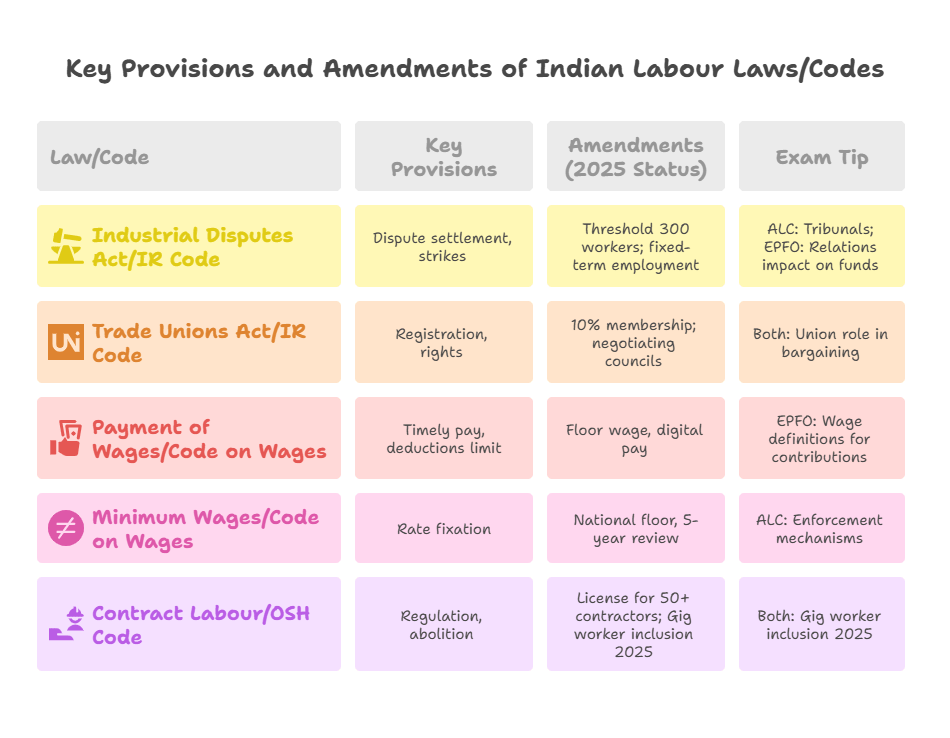
Important Labour Laws in India for Employer-Employee Relations
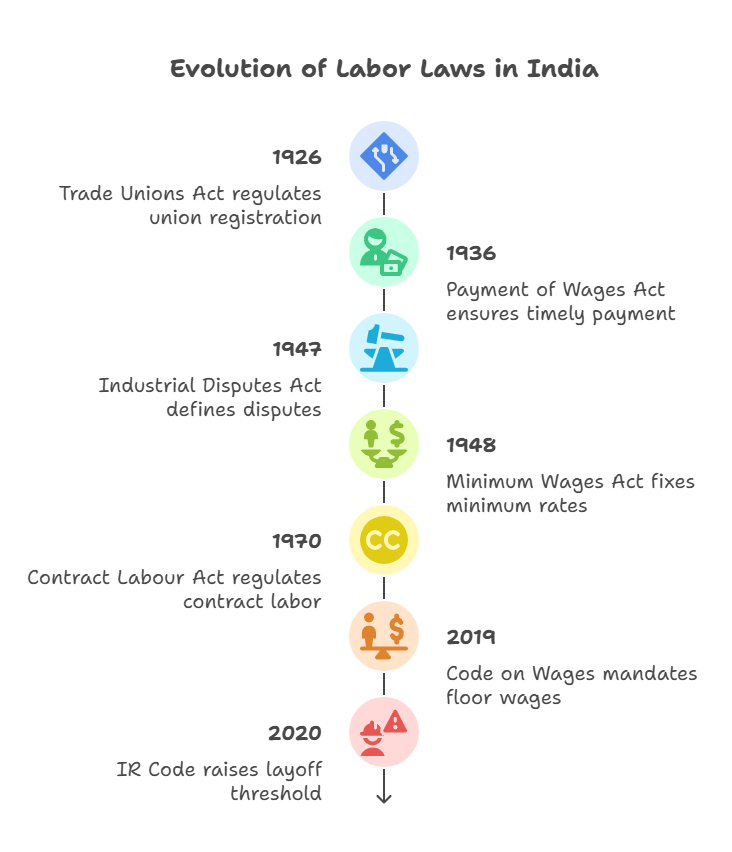
India’s labor framework is consolidated into four Codes (2019-2020), effective in phases from 2025, replacing 29 old laws. Focus on key acts relevant for exams.
Other laws: ESI Act 1948,
EPF Act 1952 (Social Security Code),
Maternity Benefit Act 1961.
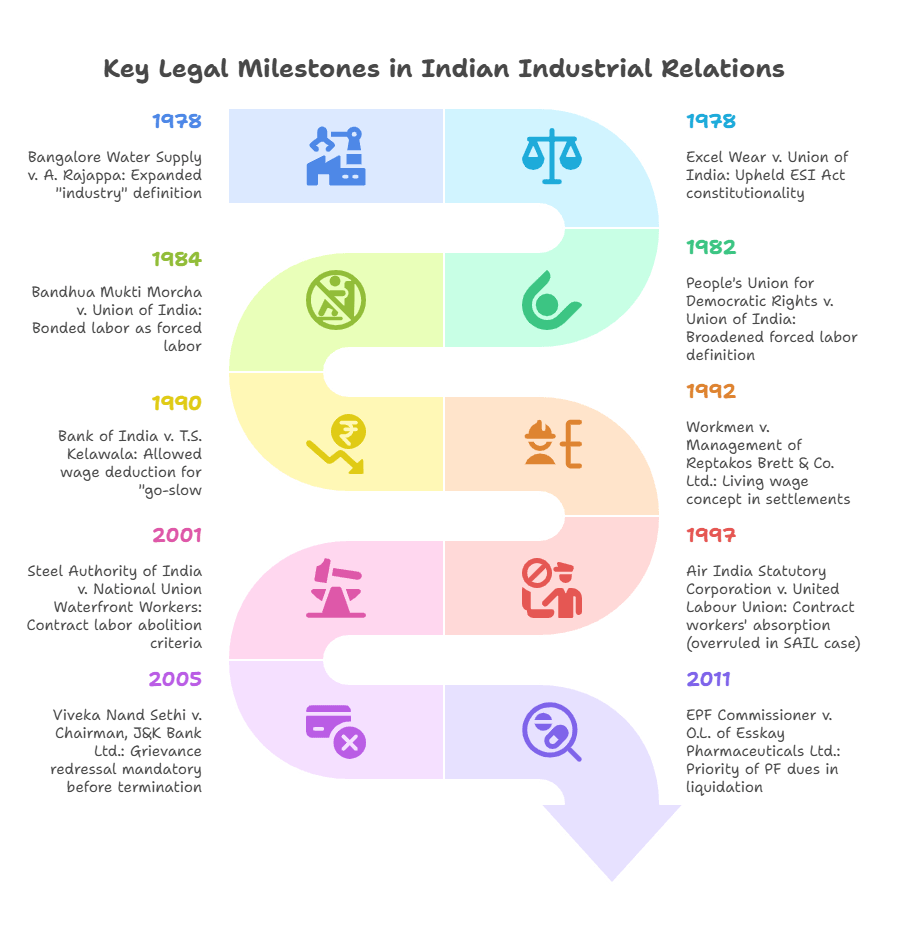
Major Case Laws in Industrial Relations
Syllabus Alignment for UPSC EPFO and ALC Exams
UPSC EPFO Syllabus (EO/AO/APFC)
- Industrial Relations: IRC Bill, labor reforms models.
- Labour Laws: Types, sectors, implementation; social security (EPF, ESI).
- Related: Polity (constitutional basis), Economy (labor market), HR development.
- Weightage: 15-20%; focus on MCQs, case studies.
UPSC ALC Syllabus
- Labour Welfare & Social Security: Acts like ESI, EPF, Maternity.
- Industrial Relations: ID Act, Trade Unions, HR development, natural justice.
- Trade Union Movement: History, role.
- New Labour Codes: All four, with emphasis on implementation.
- Weightage: 40-50%; descriptive, analytical questions.
Preparation Tips:
Read Bare Acts, Cracktarget Monthly Magazine for current affairs,
Laxmikanth for polity
. Practice PYQs; focus on 2025 code implementations.
Practice MCQs (50 for Self-Assessment)
- Which Article directs the state to secure worker participation in management?
A) Art 39
B) Art 43A
C) Art 21
D) Art 23
Ans: B (Directive Principle added by 42nd Amendment). - Under IR Code 2020, minimum membership for trade union registration is?
A) 7 members
B) 10% or 100 members
C) 5 members
D) 20%
Ans: B (Whichever is less, but min 7). - The Industrial Relations Code, 2020, replaced which acts?
A) Trade Unions Act, 1926, and Industrial Disputes Act, 1947
B) Minimum Wages Act, 1948
C) ESI Act, 1948
D) EPF Act, 1952
Ans: A. - What is the threshold for layoff without permission under IR Code 2020?
A) 100 workers
B) 200 workers
C) 300 workers
D) 50 workers
Ans: C. - In which case was the definition of “industry” expanded to include hospitals?
A) Bangalore Water Supply v. A. Rajappa (1978)
B) Excel Wear v. Union of India (1978)
C) Steel Authority of India v. National Union (2001)
D) Bank of India v. T.S. Kelawala (1990)
Ans: A. - Grievance Redressal Committees are mandatory for establishments with how many workers?
A) 10+
B) 20+
C) 50+
D) 100+
Ans: B. - Which Directive Principle mandates worker participation in management?
A) Art 39
B) Art 43A
C) Art 41
D) Art 42
Ans: B. - The Social Security Code, 2020, consolidates how many old laws?
A) 9
B) 4
C) 8
D) 12
Ans: A. - In Excel Wear v. Union of India (1978), the court upheld the constitutionality of?
A) ESI Act
B) EPF Act
C) Maternity Benefit Act
D) Gratuity Act
Ans: A. - Fixed-term employment is introduced in which code?
A) IR Code 2020
B) Social Security Code
C) Wages Code
D) OSH Code
Ans: A. - National floor wage is part of which code?
A) Code on Wages 2019
B) IR Code
C) Social Security Code
D) OSH Code
Ans: A. - Which case held that contract labor absorption is not automatic?
A) Steel Authority of India v. National Union (2001)
B) Air India v. United Labour Union (1997)
C) Bandhua Mukti Morcha (1984)
D) People’s Union (1982)
Ans: A. - ILO Convention 98 relates to?
A) Collective Bargaining
B) Child Labor
C) Forced Labor
D) Minimum Wages
Ans: A. - Works Committees are mandated for establishments with?
A) 100+ workers
B) 50+ workers
C) 20+ workers
D) 10+ workers
Ans: A. - In which case was the right to unionize held as fundamental?
A) B.R. Singh v. Union of India (1989)
B) Ram Prasad Vishwakarma (1961)
C) National Textile Workers (1983)
D) Viveka Nand Sethi (2005)
Ans: A. - The Code on Occupational Safety, Health and Working Conditions, 2020, consolidates how many laws?
A) 13
B) 9
C) 4
D) 8
Ans: A. - Gig workers are covered under which code from 2025?
A) Social Security Code
B) IR Code
C) Wages Code
D) OSH Code
Ans: A. - Which case linked bonded labor to forced labor?
A) Bandhua Mukti Morcha v. Union of India (1984)
B) People’s Union (1982)
C) Workmen v. Reptakos (1992)
D) EPF Commissioner v. Esskay (2011)
Ans: A. - Living wage concept was discussed in?
A) Workmen v. Management of Reptakos Brett (1992)
B) Unichoyi v. State of Kerala (1962)
C) Bijay Cotton Mills (1955)
D) Chandra Bhavan (1970)
Ans: A. - Priority of PF dues in liquidation was in?
A) EPF Commissioner v. O.L. of Esskay (2011)
B) Viveka Nand Sethi (2005)
C) B.R. Singh (1989)
D) National Textile (1983)
Ans: A. - Grievance redressal before termination mandated in?
A) Viveka Nand Sethi v. Chairman (2005)
B) Bharat Petroleum (1998)
C) Ram Prasad (1961)
D) Bangalore Water Supply (1978)
Ans: A. - Which code prohibits contract labor in core activities?
A) OSH Code 2020
B) IR Code
C) Social Security Code
D) Wages Code
Ans: A. - Negotiating councils require what membership?
A) 51%
B) 20%
C) 10%
D) 75%
Ans: A. - Step-ladder process is part of?
A) Grievance redressal
B) Collective bargaining
C) Worker participation
D) Social security
Ans: A. - Equity participation is a form of?
A) Worker participation
B) Grievance redressal
C) Collective bargaining
D) Trade unionism
Ans: A. - ESI contributions upheld in?
A) Excel Wear (1978)
B) Steel Authority (2001)
C) Air India (1997)
D) Bank of India (1990)
Ans: A. - Contract labor absorption overruled in?
A) Steel Authority (2001)
B) Air India (1997)
C) Bandhua (1984)
D) People’s Union (1982)
Ans: A. - Forced labor includes non-payment in?
A) People’s Union (1982)
B) Bandhua (1984)
C) Workmen (1992)
D) EPF (2011)
Ans: A. - Bonded labor as forced in?
A) Bandhua Mukti Morcha (1984)
B) People’s Union (1982)
C) Unichoyi (1962)
D) Bijay (1955)
Ans: A. - Right to life includes living wage in?
A) Workmen v. Reptakos (1992)
B) Unichoyi (1962)
C) Olga Tellis (1985)
D) Francis Coralie (1981)
Ans: A. - PF dues priority in?
A) EPF v. Esskay (2011)
B) Viveka (2005)
C) B.R. Singh (1989)
D) National Textile (1983)
Ans: A. - Grievance before termination in?
A) Viveka Nand (2005)
B) Bharat Petroleum (1998)
C) Ram Prasad (1961)
D) Bangalore (1978)
Ans: A. - Timely redressal stressed in?
A) Bharat Petroleum (1998)
B) Ram Prasad (1961)
C) National Textile (1983)
D) Viveka (2005)
Ans: A. - Collective agreements binding if fair in?
A) Ram Prasad Vishwakarma (1961)
B) B.R. Singh (1989)
C) National Textile (1983)
D) Steel Authority (2001)
Ans: A. - Worker directors advocated in?
A) National Textile Workers (1983)
B) B.R. Singh (1989)
C) Ram Prasad (1961)
D) Viveka (2005)
Ans: A. - Right to unionize fundamental in?
A) B.R. Singh (1989)
B) National Textile (1983)
C) Ram Prasad (1961)
D) Bangalore (1978)
Ans: A. - “Industry” definition expanded in?
A) Bangalore Water Supply (1978)
B) Excel Wear (1978)
C) Steel Authority (2001)
D) Bank of India (1990)
Ans: A. - Go-slow deductions in?
A) Bank of India v. T.S. Kelawala (1990)
B) Steel Authority (2001)
C) Air India (1997)
D) Excel Wear (1978)
Ans: A. - Contract abolition criteria in?
A) Steel Authority (2001)
B) Air India (1997)
C) Bandhua (1984)
D) People’s Union (1982)
Ans: A. - ESI constitutionality in?
A) Excel Wear (1978)
B) Steel Authority (2001)
C) Air India (1997)
D) Bank of India (1990)
Ans: A. - Contract absorption in?
A) Air India (1997)
B) Steel Authority (2001)
C) Bandhua (1984)
D) People’s Union (1982)
Ans: A. - Forced labor broad in?
A) People’s Union (1982)
B) Bandhua (1984)
C) Workmen (1992)
D) EPF (2011)
Ans: A. - Bonded as forced in?
A) Bandhua Mukti Morcha (1984)
B) People’s Union (1982)
C) Unichoyi (1962)
D) Bijay (1955)
Ans: A. - Living wage in settlements in?
A) Workmen v. Reptakos (1992)
B) Unichoyi (1962)
C) Olga Tellis (1985)
D) Francis Coralie (1981)
Ans: A. - PF dues in liquidation in?
A) EPF Commissioner v. Esskay (2011)
B) Viveka (2005)
C) B.R. Singh (1989)
D) National Textile (1983)
Ans: A. - Grievance mandatory in?
A) Viveka Nand Sethi (2005)
B) Bharat Petroleum (1998)
C) Ram Prasad (1961)
D) Bangalore (1978)
Ans: A. - Which code has national floor wage?
A) Code on Wages
B) IR Code
C) Social Security
D) OSH Code
Ans: A. - Gig coverage in?
A) Social Security Code
B) IR Code
C) Wages Code
D) OSH Code
Ans: A. - Minimum wages validity in?
A) Unichoyi v. State of Kerala (1962)
B) Bijay Cotton Mills (1955)
C) Chandra Bhavan (1970)
D) Workmen (1992)
Ans: A. - Minimum wages constitutionality in?
A) Bijay Cotton Mills v. State of Ajmer (1955)
B) Unichoyi (1962)
C) Chandra Bhavan (1970)
D) Excel Wear (1978)
Ans: A.

Leave a comment