
For RBI Grade B Exam and Others
1. Introduction to Time and Work
Time and Work revolves around the relationship between work rates, time, and efficiency. The core idea is that work completed equals rate multiplied by time. In RBI Grade B, questions test your ability to handle fractions, LCMs, ratios, and variables in scenarios involving multiple workers, partial contributions, or inefficiencies (e.g., leaks in pipes).
- Basic Principle: If a person completes a task in ‘n’ days, their one-day work rate is 1/n.
- Why Crucial for RBI Grade B?: Appears in direct questions (2-3 marks) or DI sets. Variations include men-women-children efficiencies, wages proportional to work, and pipes/cisterns (filling/emptying tanks).
- Assumptions: Work is uniform; total work = 1 unit (or LCM for integer units). Normalize units (days/hours) for consistency.
- Difficulty Breakdown: Easy (individual rates), Moderate (combined/alternating), Hard (MDH with wages, negative work, variables).
2. Key Concepts and Formulas
Build a strong foundation with these. Use tables for quick reference during revision.
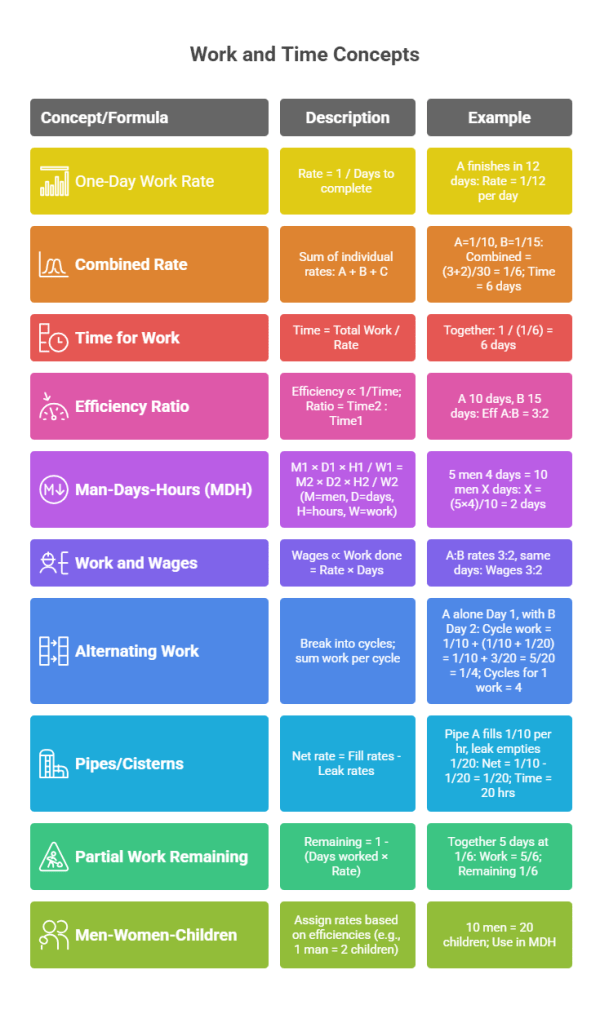
- Key Tip: Always use LCM of denominators to work with integers (e.g., times 12, 18, 36: LCM=36 units).
- Variations: For hours, convert rates to per hour. For partial days, use fractions.
3. Shortcuts and Tricks
These are compiled from YouTube teachers’ methods for speed and accuracy. Abhinay Sharma emphasizes advanced mains tricks like variable-based problems; Amar Sir focuses on building intuition with real-life analogies; Gagan Pratap excels in efficiency shortcuts for quick mental math.
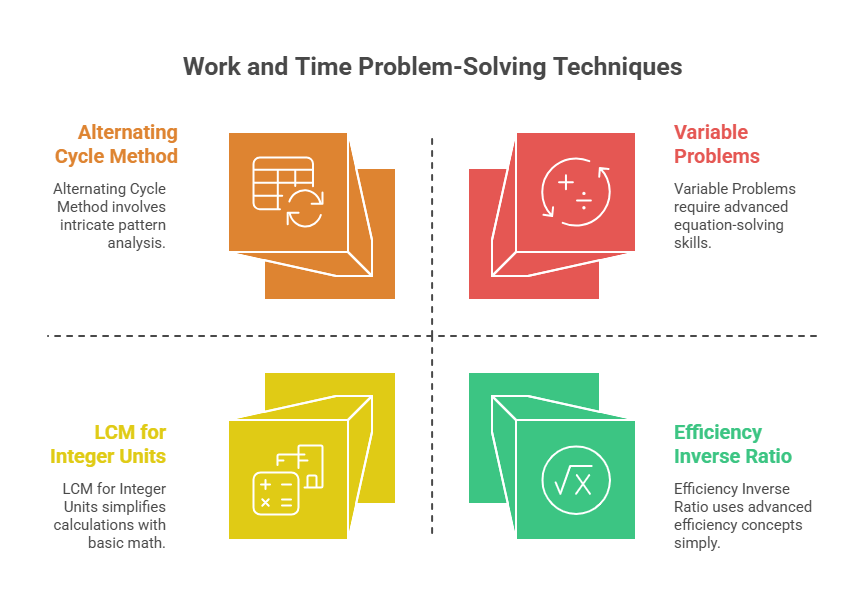
🧠 Smart Concepts & Shortcuts: Time and Work
1️⃣ LCM Approach for Work Units
- Use the LCM of given days as assumed total work to eliminate fractions.
- Example: A = 10 days (1/10), B = 15 days (1/15)
→ LCM = 30 units
→ A does 3 units/day, B does 2 units/day
→ Together = 5 units/day
→ Time = 30 ÷ 5 = 6 days
2️⃣ Efficiency and Inverse Ratio
- Time ∝ 1/Efficiency
- If time ratio = a : b → efficiency = b : a
- Example: A : B time = 4 : 6 → efficiency = 3 : 2
→ Total efficiency = 5 units/day
→ LCM(4,6) = 12 units (assumed work)
→ Time = 12 ÷ 5 = 2.4 days
3️⃣ MDH Rule (Cross Multiplication Formula)
- Formula:
D₂ = (M₁ × D₁ × W₂) / (M₂ × W₁) - M = Men, D = Days, W = Work
- More men → less time (inverse proportion)
- Example:
5 men × 10 days × 2 work / (10 men × 1 work) = 10 days
4️⃣ Alternating Day Cycle Method
- Use for cases like A works on odd days, B on even days
- Find 2-day cycle work = A + B
- Multiply by full cycles, then add leftover day’s work if needed
- Helps in irregular schedules
5️⃣ Wages Proportionality
- Wages ∝ Individual work
- Formula:
Wage = (Individual work / Total work) × Total pay - Or: Wage ∝ Efficiency × Days
- Mental Tip: Use efficiency × days ratios directly
6️⃣ Pipes & Cisterns: Net Rate Method
- Net Rate = Filling rate – Leakage rate
- Time = Work ÷ Net rate
- Example:
Pipe fills in 6 hrs (1/6), leak empties in 12 hrs (–1/12)
→ Net = (1/6 – 1/12) = 1/12
→ Time = 12 hrs
7️⃣ Partial + Additional Workers
- Step 1: Work done by initial workers
- Step 2: Remaining work ÷ new group’s rate
- Example: Fill half tank with 2 pipes, then open 3rd pipe → recalculate time for remaining work
8️⃣ Man-Equivalent Concept
- Convert all to man-units
- Example: 1 man = 2 women
→ 5 men + 10 women = 5 + 5 = 10 man-equivalents
9️⃣ Quick Approximations
- Use rounded decimals for common fractions:
1/2 = 0.5
1/3 ≈ 0.333
1/4 = 0.25
1/5 = 0.2
1/6 ≈ 0.167
1/8 = 0.125
1/9 ≈ 0.111
1/10 = 0.1 - Assume 100 units for mental math
🔟 Variable-Based Problems
Use algebraic equations for unknown values in time-work relationships
Let A = 1/a, B = 1/b → Combined rate = (1/a + 1/b)
Total time T = ab / (a + b)
Here’s a clean, copy-paste-friendly version of your “10 Moderate to Very Hard Examples with Solutions” for Time and Work, formatted for clarity:
Example 1: Combined Rates with Alternating Assistance (Moderate)
Q: A finishes in 15 days, B in 20 days, C in 30 days. They work together, but C works only every second day. How long to finish?
A:
Rates: A = 1/15, B = 1/20, C = 1/30.
LCM = 60 → A = 4, B = 3, C = 2 units/day.
Cycle (2 days):
Day 1: 4 + 3 + 2 = 9 units
Day 2: 4 + 3 = 7 units
Cycle = 16 units/2 days → Avg = 8 units/day
Total work = 60 units
Time = 60 / 8 = 7.5 days
Example 2: Partial Work Before Joining (Moderate)
Q: A alone does work in 10 days, B in 15 days. A works 4 days, then B joins. Total time?
A:
A’s 4-day work = 4/10 = 0.4
Remaining = 1 – 0.4 = 0.6
A + B rate = 1/10 + 1/15 = 1/6
Time for 0.6 = 0.6 ÷ (1/6) = 3.6 days
Total time = 4 + 3.6 = 7.6 days
Example 3: Wages Based on Partial Work (Hard)
Q: A finishes in 8 days, B in 12. They work 4 days, then C (6 days alone) joins. Total wages = ₹3300. Share?
A:
Rates: A = 1/8, B = 1/12, C = 1/6
A+B 4-day work = 4 × (1/8 + 1/12) = 5/6
Remaining = 1 – 5/6 = 1/6
A+B+C rate = 1/8 + 1/12 + 1/6 = 3/8
Time to finish = (1/6) ÷ (3/8) = 4/9 days
Work:
A = 1/8 × 40/9 = 5/9
B = 1/12 × 40/9 = 10/27
C = 1/6 × 4/9 = 2/27
Shares:
A = (5/9) × 3300 = ₹1833.33
B = (10/27) × 3300 = ₹1222.22
C = (2/27) × 3300 = ₹244.44
Example 4: MDH Format (Moderate)
Q: 8 men, 6 hours/day finish in 10 days. How many men for 5 days @ 8 hours/day?
A:
Total work = 8×6×10 = 480 man-hours
New setup: M × 8 × 5 = 480 → M = 12
Example 5: Additional Workers Added Later (Hard)
Q: 15 men finish in 20 days. 10 women in 30 days. 10 men work 12 days, then add women to finish in 8 more days. How many women?
A:
Rate per person = 1/300 (same for men/women)
Work done by 10 men in 12 days = 10×12×1/300 = 0.4
Remaining = 0.6
Let W = women added:
(10 + W)/300 × 8 = 0.6 → 80 + 8W = 180 → W = 12.5
Ans: 13 women (round up)
Example 6: Pipes with Leak (Moderate)
Q: A fills in 8 hrs, B in 12, leak empties in 24. Time to fill?
A:
Net rate = 1/8 + 1/12 – 1/24 = 4/24 = 1/6
Time = 1 ÷ (1/6) = 6 hrs
Example 7: Alternating Work with Different Rates (Hard)
Q: A (12 days), B (18 days), alternate days starting with A. Time to complete?
A:
Cycle: A + B = 1/12 + 1/18 = 5/36
Each cycle = 2 days
Work per cycle = 5/36
Total cycles = 7 (7×2=14 days) → Work = 35/36
Remaining = 1/36 by A on day 15
Time = 1/36 ÷ 1/12 = 1/3
Total = 14 + 1/3 = 14.33 days
Example 8: MDH with Variable Types (Very Hard)
Q: 4 men + 8 boys finish in 6 days. 6 men + 4 boys in 5 days. How long for 5 men + 6 boys?
A:
Let M = man rate, B = boy rate
Eq1: 4M + 8B = 1/6
Eq2: 6M + 4B = 1/5
Solve:
Multiply Eq1 by 3 → 12M + 24B = 0.5
Eq2 by 2 → 12M + 8B = 0.4
Subtract: 16B = 0.1 → B = 1/160
Plug into Eq2: 6M + 4/160 = 1/5 → M = 7/240
Required: 5M + 6B = 5×7/240 + 6×1/160 = 11/60
Time = 1 ÷ (11/60) = 60/11 ≈ 5.45 days
Example 9: Wage Split with Third Person & Variable (Very Hard)
Q: A+B finish in 4 days. A+B+C in 3 days. C’s efficiency = ½ A. Total wages ₹2250. Find share.
A:
A+B = 1/4, A+B+C = 1/3 → C = 1/12
C = ½ A → A = 1/6, then B = 1/12
In 3 days:
A = 3/6 = 0.5
B = 3/12 = 0.25
C = 3/12 = 0.25
Shares:
A = ₹1125, B = ₹562.5, C = ₹562.5
Example 10: Contractor Adds Workers (Very Hard)
Q: Project to complete in 20 days. Hires 15 workers. After 8 days, 5 leave. How many more needed to stay on schedule?
A:
Assume 1 worker = 1 unit/day, total work = 15×20 = 300 units
Work in 8 days = 15×8 = 120
Remaining = 180 units in 12 days
10 workers → 10×12 = 120 (shortfall 60 units)
Extra needed: x×12 = 60 → x = 5

Leave a comment