
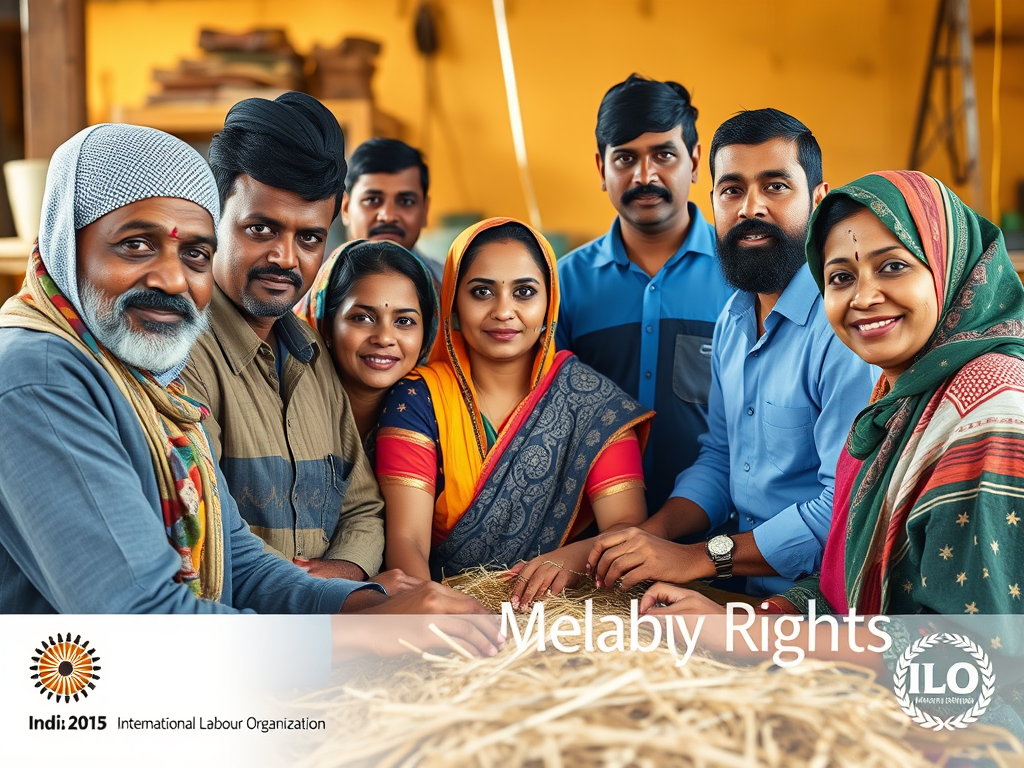
India, as a founding member of the International Labour Organization (ILO) since 1919, has actively engaged with the organization’s framework for promoting social justice and labor rights. The ILO establishes international labor standards through conventions, which are legally binding treaties upon ratification by member states, and recommendations, which provide non-binding guidelines. As of July 2015, the ILO has adopted 189 conventions and 204 recommendations, covering a wide range of labor issues, including fundamental human rights, working conditions, and social protection.
ILO Conventions Ratified by India
India has ratified 47 conventions and 1 protocol out of the 189 ILO conventions, with 39 conventions currently in force, 5 conventions denounced, and 4 instruments abrogated. Below is a detailed overview of India’s engagement with ILO conventions, focusing on the core (fundamental) conventions and other notable conventions.
Core/Fundamental ILO Conventions
The ILO’s 1998 Declaration on Fundamental Principles and Rights at Work, amended in 2022, identifies ten core conventions as fundamental to labor rights. These cover freedom of association, elimination of forced labor, abolition of child labor, elimination of discrimination, and occupational safety and health. India has ratified six of these ten core conventions:
- Forced Labour Convention, 1930 (No. 29)
- Ratified by India on November 30, 1954.
- Prohibits all forms of forced or compulsory labor, except in specific circumstances like military service or civic obligations.
- India’s commitment aligns with national laws such as the Bonded Labour System (Abolition) Act, 1976.
- Abolition of Forced Labour Convention, 1957 (No. 105)
- Ratified by India on May 18, 2000.
- Requires the abolition of forced labor as a means of political coercion, economic development, labor discipline, or punishment for participating in strikes.
- Complements Convention No. 29 and aligns with India’s constitutional provisions against forced labor.
- Equal Remuneration Convention, 1951 (No. 100)
- Ratified by India on September 25, 1958.
- Mandates equal pay for men and women for work of equal value, addressing wage discrimination.
- India’s Equal Remuneration Act, 1976, enforces this principle.
- Discrimination (Employment and Occupation) Convention, 1958 (No. 111)
- Ratified by India on June 3, 1960.
- Prohibits discrimination in employment and occupation based on race, color, sex, religion, political opinion, national extraction, or social origin.
- Supported by India’s constitutional guarantees of equality and non-discrimination.
- Minimum Age Convention, 1973 (No. 138)
- Ratified by India on June 13, 2017.
- Sets the minimum age for employment at 15 (or 14 for developing countries) and prohibits hazardous work for children under 18.
- India’s ratification aligns with the Child Labour (Prohibition and Regulation) Amendment Act, 2016, which regulates child labor in line with economic realities.
- Worst Forms of Child Labour Convention, 1999 (No. 182)
- Ratified by India on June 13, 2017.
- Targets the elimination of the worst forms of child labor, including slavery, trafficking, and hazardous work.
- This convention achieved universal ratification by all 187 ILO member states, reflecting its global significance. India’s commitment strengthens efforts to eradicate exploitative child labor practices.
Core Conventions Not Ratified by India
India has not ratified the following four core conventions:
- Freedom of Association and Protection of the Right to Organise Convention, 1948 (No. 87)
- This convention ensures workers’ and employers’ rights to form and join organizations of their choosing without prior authorization.
- India has not ratified it due to restrictions on government employees, such as prohibitions on strikes, openly criticizing government policies, accepting foreign financial contributions, or joining foreign organizations.
- Right to Organise and Collective Bargaining Convention, 1949 (No. 98)
- Protects workers against anti-union discrimination and promotes collective bargaining.
- Similar to Convention No. 87, non-ratification stems from statutory restrictions on government servants’ rights to collective action.
- Occupational Safety and Health Convention, 1981 (No. 155)
- Requires a national policy on occupational safety and health and a framework for safe working environments.
- India has not ratified this convention, though it has occupational safety laws like the Factories Act, 1948.
- Promotional Framework for Occupational Safety and Health Convention, 2006 (No. 187)
- Promotes a preventative safety and health culture through national programs.
- India has not ratified this convention but engages in occupational safety initiatives aligned with the ILO’s Decent Work Agenda.
Other Notable Conventions Ratified by India
In addition to the core conventions, India has ratified several other significant ILO conventions, including three governance (priority) conventions:
- Labour Inspection Convention, 1947 (No. 81)
- Ratified by India on April 7, 1949.
- Establishes a system of labor inspections to ensure compliance with labor laws.
- India’s labor inspection framework under the Ministry of Labour and Employment supports this convention.
- Employment Policy Convention, 1964 (No. 122)
- Ratified by India on November 17, 1998.
- Promotes policies for full, productive, and freely chosen employment.
- Aligns with India’s employment generation programs, such as the Mahatma Gandhi National Rural Employment Guarantee Act (MGNREGA).
- Tripartite Consultation (International Labour Standards) Convention, 1976 (No. 144)
- Ratified by India on February 27, 1978.
- Requires tripartite consultations between governments, employers, and workers on ILO standards and policies.
- India’s tripartite system, involving government, employer, and worker representatives, reflects this commitment.arthapedia.in
Other conventions ratified by India cover areas such as hours of work, night work, maternity protection, and conditions for specific sectors like seafaring and plantations. For example:
- Hours of Work (Industry) Convention, 1919 (No. 1): Ratified by India, regulates working hours in industrial undertakings.
- Maternity Protection Convention, 2000 (No. 183): Not ratified, but earlier conventions like No. 3 (1919) on maternity protection were influential in shaping India’s Maternity Benefit Act, 1961.
Conventions Denounced by India
India has denounced five conventions, meaning it withdrew its ratification, often due to practical challenges or supersession by newer standards:
- For example, a convention requiring quarterly unemployment statistics was denounced as it was deemed not practicable. Another was denounced after ratifying a subsequent convention (No. 89) that superseded an earlier one.
India’s Approach to Ratification
India follows a rigorous and voluntary process for ratifying ILO conventions, ensuring alignment with national laws and practices:
- Submission to Competent Authority: Under Article 19 of the ILO Constitution, adopted conventions are submitted to the Indian Parliament within 12 months for consideration.
- Detailed Examination: The Ministry of Labour and Employment consults relevant ministries, state governments, and social partners (employers and workers) to assess compatibility with national laws.
- Cabinet Approval: A Cabinet Note is prepared, and upon approval, the decision is communicated to Parliament and the ILO.
- Implementation and Reporting: Ratified conventions are incorporated into national law, and India submits periodic reports under Article 22 of the ILO Constitution on implementation, with reports on priority conventions every two years and non-priority ones every five years.
India only ratifies conventions when its legal framework and practices fully conform to the convention’s provisions, reflecting a cautious but committed approach.arthapedia.inlabour.gov.in
India’s Engagement with the ILO
- Historical Role: India has been a permanent member of the ILO Governing Body since 1922 and hosted the first ILO office in Asia in 1928.drishtiias.compib.gov.in
- Leadership: India has held significant positions, such as the Chairmanship of the ILO Governing Body (October 2020–June 2021, led by Shri Apurva Chandra) and four Indian Presidents of the International Labour Conference (1927, 1950, 1970, 1979).
- Tripartism: India’s labor policies emphasize tripartism, involving government, employers, and workers, aligning with the ILO’s structure.
- Decent Work Agenda: India’s Decent Work Country Programme (2023–2027) aligns with the ILO’s goals of promoting employment, social protection, and social dialogue, supporting the UN Sustainable Development Framework.
Reasons for Non-Ratification of Some Conventions
India’s non-ratification of certain conventions, particularly Nos. 87 and 98, is primarily due to statutory restrictions on government employees, such as prohibitions on strikes and affiliations with foreign organizations. These restrictions are seen as necessary for maintaining administrative discipline but conflict with the conventions’ provisions. For occupational safety conventions (Nos. 155 and 187), India’s existing laws, like the Factories Act, 1948, provide partial alignment, but full ratification requires further harmonization.
Conclusion
India has ratified 47 ILO conventions and 1 protocol, including six of the ten core conventions.
The country’s active participation in the ILO, through its permanent Governing Body membership and tripartite engagement, underscores its dedication to promoting decent work and social justice.
However, non-ratification of conventions like Nos. 87, 98, 155, and 187 reflects specific legal and administrative constraints, particularly concerning government employees and occupational safety frameworks.

Leave a comment