
Pre-Independence Phase (Late 19th Century to 1947)
This period marked the nascent stages of organized labor movements, driven by the growth of industries such as textiles and jute mills, poor working conditions, and inspirations from international labor developments.
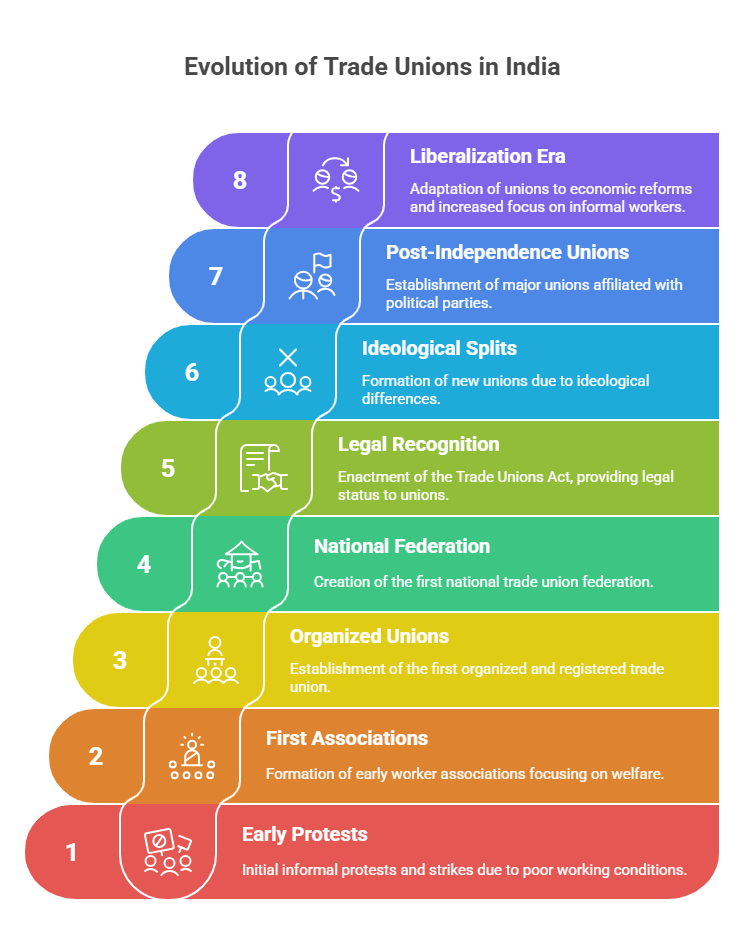
- 1850s–1880s: The establishment of textile mills in Bombay (1850s) and jute mills in Calcutta (1854) created an industrial workforce, leading to early informal protests and strikes due to exploitative conditions.byjus.com The first Factory Commission was appointed in 1879 to investigate workers’ issues.
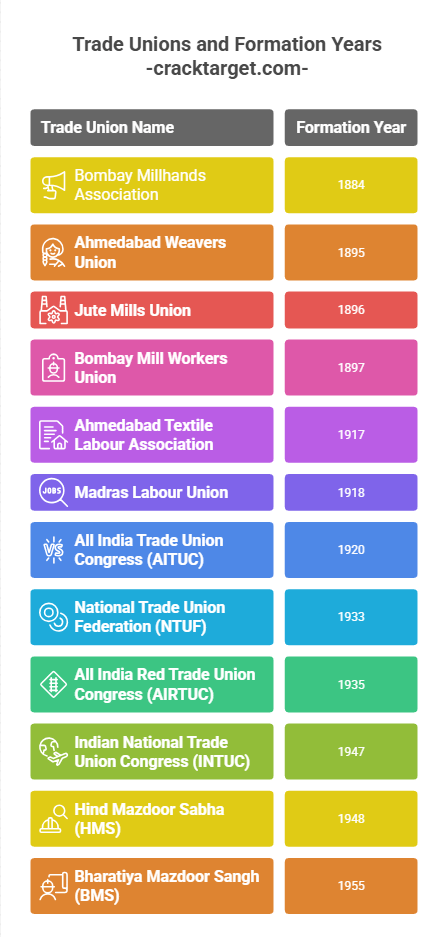
- 1884: The Bombay Millhands Association was founded by Narayan Meghji Lokhande, representing one of the earliest worker associations, though it lacked formal structure and focused on welfare rather than collective bargaining.
- 1890s–Early 1900s: Additional early unions emerged, including the Ahmedabad Weavers Union (1895), Jute Mills Union in Calcutta (1896), and Bombay Mill Workers Union (1897). These were limited in scope and often led by social reformers.
- 1917: The Ahmedabad Textile Labour Association was established, promoting Gandhian principles of non-violent negotiation.
- 1918: The Madras Labour Union, founded by B.P. Wadia, became the first organized and registered trade union in India, signaling the start of a more structured labor movement amid post-World War I economic pressures, inflation, and the influence of the Russian Revolution and the International Labour Organization (ILO).
- 1920: The All India Trade Union Congress (AITUC) was formed as the first national trade union federation, under leaders such as Lala Lajpat Rai (first president), N.M. Joshi, and others. This period saw rapid union growth, with over 1,000 strikes recorded between 1920 and 1924.
- 1924: The Cawnpore Conspiracy Case resulted in the arrest of union leaders on charges of communist activities, highlighting colonial suppression.
- 1926: The Trade Unions Act was enacted, providing legal recognition to unions, regulating their operations, and enabling registration. In its first year, 28 unions registered with over 100,000 members.
- 1929: The Trade Disputes Act was introduced to address industrial conflicts, though it imposed restrictions on strikes.byjus.com
- 1930s: Ideological splits led to the formation of the National Trade Union Federation (NTUF) and All India Red Trade Union Congress (AIRTUC) from AITUC factions, which later merged. Unions increasingly aligned with the national independence movement.
- 1940s (World War II Era): Economic hardships strengthened unions, leading to laws such as the Industrial Employment Act (1946) and Bombay Industrial Relations Act (1946). By 1947, there were 2,766 registered unions with over 1.66 million members.
Post-Independence Phase (1947 Onward)
Post-independence, unions proliferated under a socialist framework, though political affiliations and economic liberalization later influenced their trajectory.
- 1947: The Indian National Trade Union Congress (INTUC) was established, affiliated with the Indian National Congress.byjus.com
- 1948: The Hind Mazdoor Sabha (HMS) was formed as a socialist federation.
- 1955: The Bharatiya Mazdoor Sangh (BMS) emerged, linked to the Rashtriya Swayamsevak Sangh.
- 1970s–1980s: Union membership peaked, with notable events including the 1974 railway strike and the 1982 Great Bombay textile strike, reflecting tensions amid shifting economic policies.
Self Employed Women’s Association 1972 - 1991 Onward (Liberalization Era): Economic reforms reduced public sector dominance, weakening union bargaining power in the formal sector while increasing focus on informal workers. Membership in central trade union organizations grew from 13.21 million in 1989 to 24.85 million in 2002, with INTUC becoming the largest by 2013 (33.3 million members).

Leave a comment