
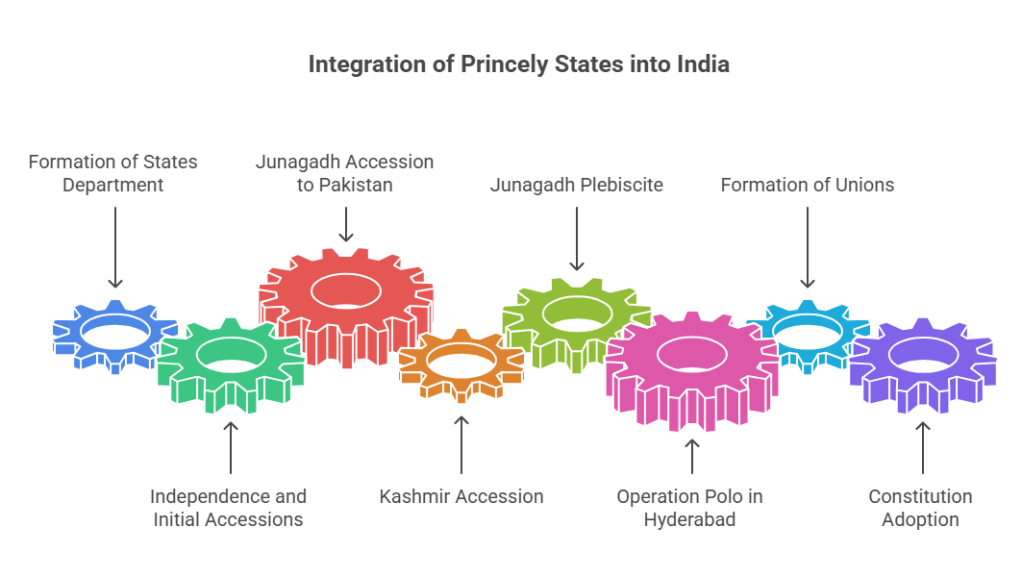
The integration of princely states into the newly independent India constituted a critical phase in the nation’s consolidation following the partition and independence in 1947. At the time of British withdrawal, approximately 565 princely states existed, covering nearly 40% of India’s territory and encompassing diverse populations. These semi-autonomous entities, previously under British paramountcy, faced the imperative to accede to either India or Pakistan. Sardar Vallabhbhai Patel, as the Deputy Prime Minister and Minister of Home Affairs, spearheaded this integration through a combination of diplomacy, negotiation, and strategic interventions. The process encountered substantial challenges, including resistance from rulers, communal tensions, and geopolitical complexities, yet it ultimately unified India into a cohesive federal structure, preventing balkanization and laying the foundation for modern governance.
Background of Princely States under British Rule
Princely states, also known as native states, operated under indirect British control through treaties and subsidiary alliances established during the colonial era. Rulers retained internal autonomy in exchange for loyalty to the British Crown, which exercised paramountcy over defense, foreign affairs, and communications. Upon independence, the lapse of paramountcy under the Indian Independence Act of 1947 left these states theoretically sovereign, compelling them to choose accession to India, Pakistan, or independence. This vacuum posed a risk of fragmentation, exacerbated by the communal divisions of partition. The Indian leadership, recognizing the urgency, established the States Department in July 1947, with Patel at its helm and V.P. Menon as Secretary, to facilitate orderly integration.
Sardar Patel’s Role in Integration
Sardar Vallabhbhai Patel, often hailed as the “Iron Man of India,” played an instrumental role in orchestrating the integration, employing persuasive diplomacy backed by firm resolve. His approach emphasized voluntary accession while preparing for contingencies.
- Diplomatic Initiatives: Patel convened conferences with princes, assuring them of privy purses (financial allowances), retention of personal properties, and preservation of titles in exchange for accession. He invoked patriotism and the inevitability of unity, framing integration as essential for India’s stability.
- Instrument of Accession: Under Patel’s guidance, states signed this legal document, surrendering control over defense, external affairs, and communications to the Indian Union. By August 15, 1947, over 500 states had acceded, with Patel personally negotiating with reluctant rulers.
- Merger and Democratization: Beyond accession, Patel promoted mergers into viable administrative units, such as unions like Saurashtra and Madhya Bharat, and introduced democratic governance by appointing chief ministers and establishing assemblies.
- Collaboration with Key Figures: Patel worked closely with V.P. Menon, who drafted accession instruments, and coordinated with Jawaharlal Nehru on foreign policy implications, ensuring a unified governmental stance.
Patel’s pragmatic leadership, blending conciliation with authority, achieved what many deemed impossible, integrating vast territories without widespread conflict.
Key Challenges in Integration
The integration process confronted multifaceted challenges, stemming from the states’ diversity, rulers’ ambitions, and external influences.
- Resistance from Rulers: Several princes sought independence or alignment with Pakistan, driven by personal interests or communal affiliations. This defiance necessitated diplomatic pressure and, in some cases, military action.
- Communal and Geopolitical Tensions: Partition’s religious divisions influenced accessions, with Muslim-majority states in Hindu-dominated regions (and vice versa) creating friction. Pakistan’s claims on certain states added international dimensions.
- Administrative and Economic Hurdles: States varied in size, from vast Hyderabad to tiny principalities, complicating mergers. Economic disparities, feudal structures, and inadequate infrastructure hindered smooth transitions.
- Internal Unrest: Peasant uprisings, such as the Telangana Rebellion in Hyderabad, and demands for democratic reforms challenged monarchical authority, requiring delicate handling to avoid escalation.
- Princely Ambitions and Foreign Intrigue: Some rulers, like the Nizam of Hyderabad, entertained notions of sovereignty or alliances with Pakistan, while others faced internal coups or public referendums.
These obstacles tested India’s nascent administration, demanding a balance between coercion and consensus.
Major Cases of Integration
Several states exemplified the challenges and Patel’s strategic interventions:
- Junagadh: A Hindu-majority state with a Muslim ruler, it initially acceded to Pakistan in 1947 despite its geographical enclave within India. Patel orchestrated a blockade and supported a provisional government, leading to a plebiscite in February 1948 where 99% voted for India, facilitating integration.
- Hyderabad: The largest princely state, ruled by the Nizam Osman Ali Khan, resisted accession, seeking independence or dominion status. Amid communal violence and the Razakar militia’s atrocities, Patel authorized “Operation Polo” in September 1948, a police action that integrated Hyderabad within days, averting a potential civil war.
- Kashmir: Maharaja Hari Singh delayed accession amid tribal invasions backed by Pakistan in October 1947. Patel coordinated military aid following the Instrument of Accession signed on October 26, 1947, though the ensuing Indo-Pakistani War led to a ceasefire and United Nations involvement, leaving the state divided.
- Other Unions: Patel facilitated the formation of entities like the Patiala and East Punjab States Union (PEPSU) and Rajasthan, merging smaller states through negotiations and incentives.
These cases highlighted Patel’s adept use of “carrot and stick” tactics to resolve impasses.
Timeline of Key Events
The following table delineates major milestones in the integration process, underscoring Patel’s contributions and the resolution of challenges.
| Year/Month | Event | Description | Outcome |
|---|---|---|---|
| July 1947 | Formation of States Department | Patel appointed to oversee integration; appeals to princes for accession. | Set framework for negotiations. |
| August 15, 1947 | Independence and Initial Accessions | Majority of states sign Instruments of Accession. | Prevented immediate fragmentation. |
| September 1947 | Junagadh Accession to Pakistan | Ruler’s decision sparks crisis; India imposes economic blockade. | Led to provisional government and referendum. |
| October 1947 | Kashmir Accession | Maharaja signs Instrument amid invasion; Indian troops deployed. | Initiated integration but sparked war. |
| February 1948 | Junagadh Plebiscite | Overwhelming vote for India. | State integrated peacefully. |
| September 1948 | Operation Polo in Hyderabad | Military action against Nizam’s resistance. | Hyderabad acceded; Nizam retained ceremonial role. |
| 1948–1949 | Formation of Unions | Mergers into provinces like Madhya Bharat and Rajasthan. | Streamlined administration. |
| 1950 | Constitution Adoption | Princely states fully integrated into the Indian Republic. | End of privy purses formalized later in 1971. |
Legacy and Impact
Sardar Patel’s role in integrating the princely states endures as a cornerstone of India’s unity, transforming a patchwork of entities into a sovereign nation-state. His efforts averted potential disintegration, fostering a federal democracy that accommodated diversity. Challenges overcome during this period informed constitutional provisions, such as Articles 370 (for Kashmir, later abrogated) and the reorganization of states in 1956. Patel’s legacy emphasizes resolute leadership in nation-building, inspiring subsequent administrative reforms and underscoring the importance of integration in maintaining territorial integrity amid internal and external pressures. This phase solidified India’s geopolitical stability, enabling focus on development and governance in the post-colonial era.

Leave a comment