
Introduction
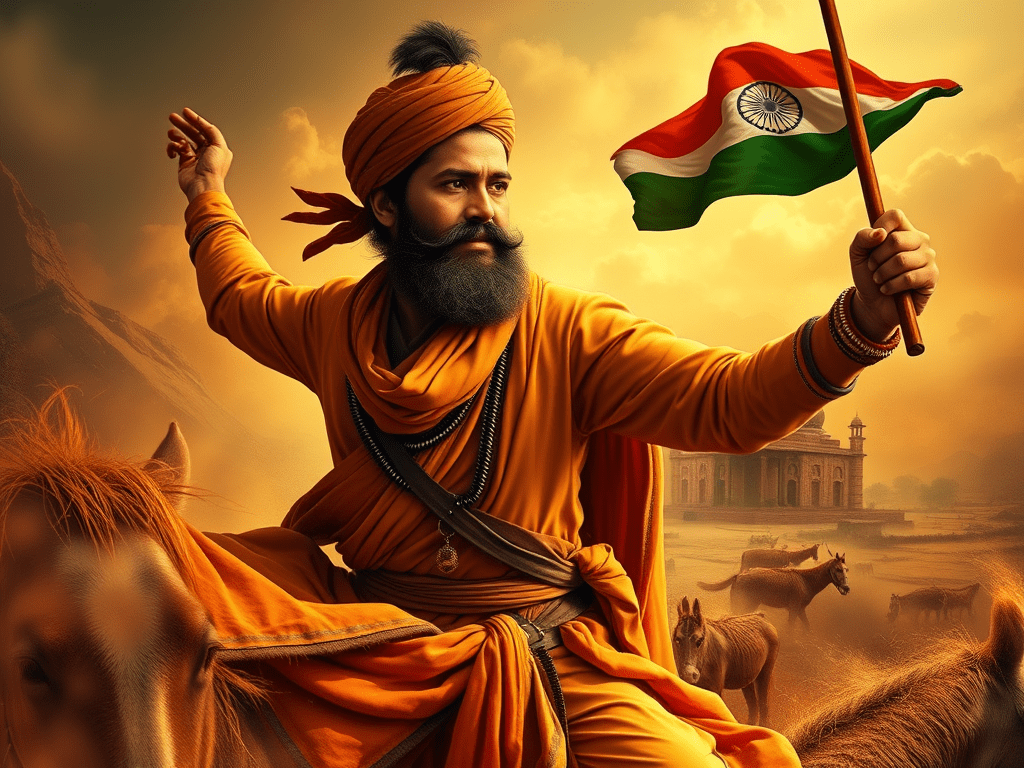
Vasudev Balwant Phadke (1845–1883) was a pioneering Indian revolutionary and freedom fighter, widely recognized as the “Father of the Indian Armed Rebellion.” He played a crucial role in initiating organized armed resistance against British colonial rule in the late 19th century, advocating for complete independence (Swaraj) through direct action rather than petitions or peaceful appeals. His efforts laid the groundwork for subsequent militant nationalism in India’s independence movement.
Early Life and Education
- Born on November 4, 1845, in Shirdhon village, Panvel taluka, Raigad district, Maharashtra, into a Marathi Chitpavan Brahmin family.
- As a child, he prioritized physical skills such as wrestling and horse riding over formal schooling, eventually discontinuing high school education. However, he pursued higher studies and graduated from Bombay University in 1862, making him one of its early alumni.
- Relocated to Pune, where he received mentorship from Krantiveer Lahuji Vastad Salve, who trained him in arms and instilled patriotic values, emphasizing the integration of marginalized castes into the freedom struggle.
Career and Awakening to Nationalism
- Began his professional career in Mumbai, working at institutions such as Grant Medical College and the Commissariat Examiner’s Office. In 1865, he joined the Military Finance Office in Pune as a clerk, serving for approximately 15 years.
- Influenced by lectures from Justice Mahadev Govind Ranade on the adverse impacts of British economic policies. The Deccan famine of 1876–1877, which caused widespread suffering among farmers due to British apathy and increased revenue demands, profoundly motivated his shift toward revolutionary activism.
- A personal grievance arose when British authorities denied him leave to attend to his dying mother and her subsequent death anniversary rituals, intensifying his resentment toward colonial rule.
- In 1870, he participated in public agitations in Pune and established the Aikya Vardhini Sabha to educate youth on national issues. In 1874, alongside Waman Prabhakar Bhave and Laxman Narhar Indapurkar, he founded the Poona Native Institution (later renamed Maharashtra Education Society), which continues to operate educational institutions.
Revolutionary Activities and the 1879 Rebellion
- Following the 1875 deposition of the Gaikwad ruler of Baroda by the British, Phadke initiated protest speeches across the Deccan, advocating for a free republic and Swaraj as the solution to societal ills. He was the first Indian leader to travel village-to-village, delivering public lectures to mobilize support.
- Facing limited response from educated classes, he formed secret groups, including physical training camps and revolutionary cells focused on patriotic songs and plots. He promoted the Swadeshi vow, encouraging youth to pursue entrepreneurship and industrialization as part of the resistance.
- In February 1879, alongside associates like Gopal Hari Karve, Vishnu Gadre, and Ganesh Deodhar, he assembled a 200–300-strong insurgent force comprising Ramoshis, Kolis, Bhils, and Dhangars—nomadic and peasant communities near Pune—forming what is considered India’s first revolutionary army.
- Employed guerrilla warfare tactics, conducting raids on wealthy English businessmen and government treasuries to fund the uprising and aid famine victims. Notable raids included the first in Dhamari village (Shirur taluka, Pune) in 1879, yielding about 400 rupees, and others near Mumbai and Konkan. Briefly controlled Pune during a surprise attack.
- In May 1879, issued a proclamation condemning British economic policies, distributing copies to officials, including the Governor of Bombay. Offered bounties for capturing British officials.
Capture, Trial, Imprisonment, and Death
- Pursued by British forces, Phadke fled to Hyderabad State (Shree Shaila Mallikarjuna temple in Andhra Pradesh) to recruit Rohillas, Arabs, and Sikhs from the Nizam’s army for a renewed effort.
- Betrayed and captured on July 20, 1879, in Devar Navadgi (Kaladgi district) after a confrontation with British Major Henry William Daniell and Abdul Haque.
- Tried in Pune, where his diary served as key evidence; sentenced to life imprisonment and transported to Aden jail.
- Escaped briefly on February 13, 1883, by removing his cell door but was recaptured. Died on February 17, 1883, at age 37, due to tuberculosis exacerbated by a hunger strike in protest.
Legacy and Contributions
- Phadke’s short but impactful career established the precedent for armed resistance in India’s freedom struggle, inspiring later revolutionaries and movements. He is credited with being the first to organize an armed insurgency against the British, emphasizing radical action over moderation.
- His patriotic acts influenced Bankim Chandra Chattopadhyay’s novel Anand Math, which incorporated elements of his struggle, leading to revisions under British pressure.
- Remembered as the “Father of militant nationalism in India,” his emphasis on Swaraj, guerrilla tactics, and inclusive mobilization across castes foreshadowed broader independence efforts. Memorial day observed on February 17.

Leave a comment