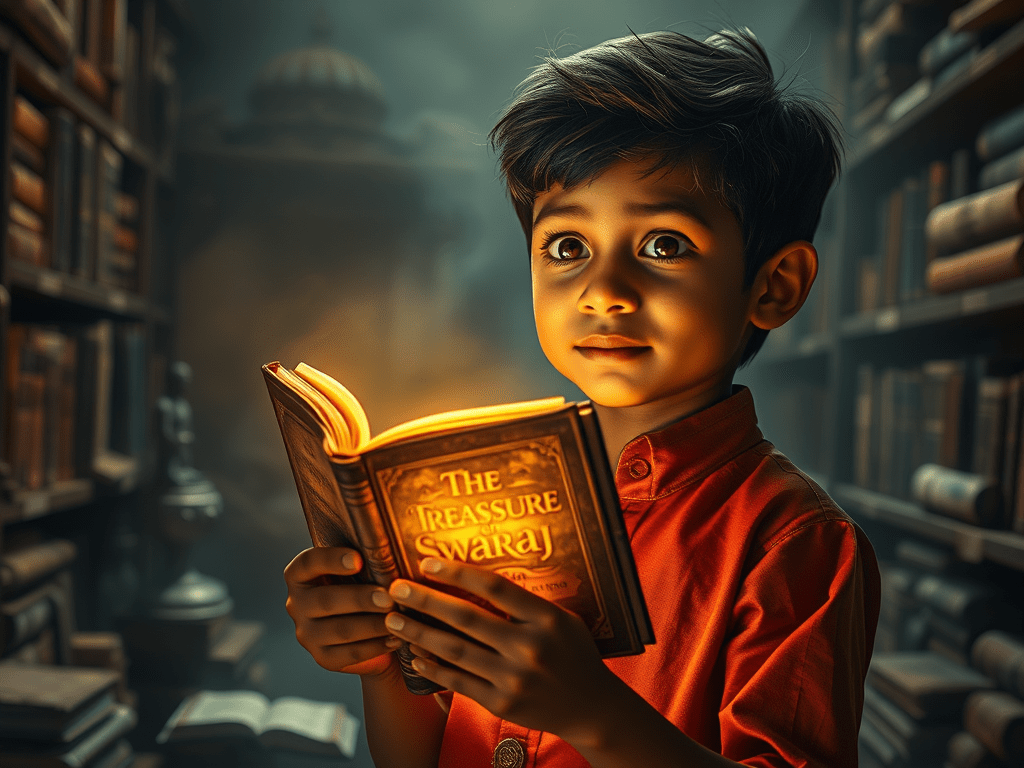
This is the story of Arav, a curious Class 10 student from a small village, who stumbles upon a mysterious diary in his grandfather’s dusty bookshelf. Titled “The Treasure of Swaraj”, the diary glows with golden light as he opens it, pulling him into a time-travel adventure. Guided by the diary’s riddles, Arav journeys through India’s history, geography, economy, environment, and science, solving puzzles that unlock the secrets of UPSC CSE Prelims 2025’s 100 questions. Each stop reveals a piece of the ultimate treasure: the true meaning of Swaraj.
Chapter 1: Gandhi’s Rebellion and Ancient India’s Secrets
Arav’s journey begins in 1930, where he sees Mahatma Gandhi leading the Dandi Salt March (Q1), defiantly breaking the British salt law with the words, “Sedition has become my religion.” He learns this was part of the Non-Cooperation Movement (Q72, Q80), where people boycotted British cloth and courts, embraced non-violence, and formed panchayats. The goal was peaceful Swaraj, with civil disobedience planned if Swaraj wasn’t achieved in a year.
The diary’s magic portal whisks him to 1922, where the Chauri Chaura incident (Q3) unfolds, leading to violence and the arrest of protesters. C.R. Das defends them in court. Next, Arav lands in 1932, witnessing the Poona Pact (Q4), which ensures better representation for Harijans, inspiring Gandhi to focus on their upliftment.
A riddle takes Arav to ancient India, where he marvels at the Dancing Girl statue from Mohenjo-Daro (Q2), crafted using lost-wax casting in bronze. He meets Pallava king Mahendravarman I (Q74), known as Vichitrachitta and Mattavilasa. Fa-Hien, a Chinese traveler, describes the grandeur of Chandragupta II’s reign (Q75). Rajendra Chola I (Q76) boasts of his navy’s attack on Srivijaya. Arav reads Ashoka’s edicts (Q79), learning about Pradeshika, Rajuka, and Yukta as district officers. He sees the Araghatta (Q73), a giant water-lifting wheel, and learns that Gandharv Mahavidyalaya (Q78) was founded in Lahore in 1901 by Vishnu Digambar Paluskar. In ancient India (600-322 BCE), Asmak (Godavari) and Kosala (Sarayu) are correctly paired, but Kamboja and Avanti rivers are not (Q77). Raja Ram Mohan Roy (Q71) inspires him with his respect for the Vedas, logic, and equality, founding the Brahmo Samaj.
Chapter 2: A World Map and Environmental Mysteries
The diary transports Arav on a global adventure. He discovers that Australia and Brazil have more than four time zones (Q6). In Anadyr (Siberia) and Nome (Alaska), the International Date Line creates different days (Q7). The Andes Mountains (Q62) span Bolivia, Colombia, Ecuador, and Venezuela. Only Lake Tanganyika lies near the equator (Q63).
In the Northern Hemisphere in January (Q67), isotherms bend toward the equator over land and toward the poles over oceans due to warmer seas. Tropical and temperate zones have more dust due to dry winds (Q66). Chalk is porous and permeable, while clay is less so (Q68).
An environmental riddle reveals that wet-bulb temperature (Q14) above 35°C prevents sweat from cooling the body. Turmeric (Q64) sees India as the top producer with over 30 varieties. Oceans produce more oxygen than land (Q100). The cement industry (Q91) emits CO2 from limestone. At COP28 (Q92), India didn’t sign the health declaration. Paris Agreement’s Article 6 (Q94) discusses cooperation and carbon markets. The ADB launched the Nature Solutions Finance Hub (Q95). Direct Air Capture (DAC) (Q96) traps CO2 for storage or fuel. The Peacock Tarantula (Q97) lives in trees in the Eastern Ghats. India’s CO2 emissions (Q98) are 2 tons per capita. Ginger (rhizome) and Malabar spinach (vine) are correct, but papaya is a tree (Q99). Earth’s rotational axis (Q93) shifts due to melting ice. Cloud seeding (Q25) uses silver iodide and potassium iodide to induce rain.
Chapter 3: The Treasure of Economics and Governance
Arav finds an economic map in the diary. He learns the Finance Commission (Q16) allocated ₹4,800 crore for education and 41% of taxes to states. The IBRD (Q17) lends to middle-income countries. RTGS settles payments instantly, unlike NEFT (Q18). UPI (Q19) operates in UAE, France, and Singapore. Fiscal deficit (Q69) is the gap between government spending and revenue, while primary deficit (Q15) excludes interest. SEBI mandated BRSR (Q54) for non-financial reporting. Rural agricultural income and land are tax-free (Q55). PNGRB (Q40) regulates refining, distribution, and gas production.
The Rashtriya Gokul Mission (Q70) supports rural poor and cattle conservation. India joined the Minerals Security Partnership (Q56). Bondholders face lower risk as creditors (Q57). India’s stock market surpassed Hong Kong’s, with SEBI warning of risks (Q58). The circular economy (Q59) reduces waste and raw material use. Capital receipts (Q60) increase debt.
In governance, the President’s pardoning power (Q26) can be judicially reviewed with limits. The Lok Sabha Speaker (Q27) stays until dissolution and can be removed with 14 days’ notice. The 10th Schedule (Q28) gives the Speaker disqualification authority. States can regulate minor minerals (Q29). The EU passed the Nature Restoration Law (Q30). An ordinance (Q31) can amend central laws and apply retrospectively. Tripura’s history is correct, but Arunachal’s capital isn’t named after a fort (Q32). Zonal and Inter-State Councils are constitutional (Q33). Governors can act independently (Q34). Judiciary-executive separation and cultural preservation are correct, but child labor is a directive principle (Q35). In Scheduled Areas, the Centre can intervene via the Governor (Q36). The National Automotive Board is under the Heavy Industries Ministry (Q37). Constitutional amendments (Q38) need half the states’ consent. Governors and MLAs have special protections (Q39). Panchayats are at the intermediate level (Q41). BIMSTEC (Q42) has seven members, with India leading tourism. The Gandhi Peace Prize (Q43) jury includes the PM, CJI, and opposition leader. GAGAN (Q44) aids navigation and air traffic. India co-chaired the AI Action Summit (Q45). Women Farmers Year 2026 is correct (Q46). The BRICS Summit (Q47) was in Kazan. No Lokpal statement was correct (Q48). The Kho-Kho World Cup (Q49) was in Delhi. Gukesh (Q50) became world chess champion.
Chapter 4: Science and the Future World
In the science realm, Arav meets Portuguese traders (Q5) who brought papaya and pineapple to India. Periyar (Q8) shares his Self-Respect Movement. He learns Botswana (diamonds), Chile (lithium), Indonesia (nickel) (Q9) and Mallorca (lithium) (Q10) are key resource hubs. The PM Surya Ghar Yojana (Q20) aims for 1 crore solar panels and 3 lakh skilled jobs. Rare earth elements (Q21) power glowing screens. The National Rail Plan targets 2030, and Kavach is Indian (Q22). Axiom-4 and Gaganyaan (Q23) research microgravity. Dornier-228 and C-17 are correct, but IL-76 is a transport plane (Q24). NATO includes Austria, Bulgaria, Croatia, Sweden, and North Macedonia (Q61). Continental drift (Q65) is proven by rocks and sediments. Alternative Investment Funds (Q51) include hedge funds and venture capital. RBI earns from bonds and forex (Q52). Enforcement Directorate and Revenue Intelligence are under the Finance Ministry (Q53).
Arav sees coal gasification (Q85) producing ethanol and urea. CL-20, HMX, LLM-105 (Q86) are military explosives. Majorana chips and deep learning (Q87) drive future tech. Monoclonal antibodies (Q88) combat Nipah and deliver targeted drugs. Viruses (Q89) don’t grow outside cells and have either DNA or RNA. Activated carbon (Q90) controls pollution and is made from waste. EV batteries (Q83) use cobalt, lithium, and nickel. Plastic is in glasses, tires, and cigarettes (Q84). Electric, hydrogen, and hybrid vehicles (Q81) are alternative powertrains. Drones (Q82) don’t always run on batteries.
Chapter 5: The True Meaning of Swaraj
As Arav completes the diary, he realizes Swaraj isn’t just freedom—it’s knowledge, equality, and environmental care. The diary advises him to visit CrackTarget.com for daily updates, PYQs, and mock tests. Inspired, Arav begins preparing for UPSC 2026, knowing each question brings him closer to a better future.
UPSC 2026 Tips:
- History: Read Spectrum, Bipin Chandra, Upinder Singh.
- Geography: NCERT, G.C. Leong.
- Economy: Ramesh Singh, Economic Survey.
- Polity: M. Laxmikanth.
- Environment: Shankar IAS, MoEFCC reports.
- Science: Science Reporter, NCERT.
- Current Affairs: The Hindu, PIB, CrackTarget.com.
- UPSC Recruitment 2026: Scientist-B (Mechanical) Vacancy in National Test House
- Central Bank of India Recruitment 2026 – 26 Specialist Officers Vacancies
- 500 One-liner Chemistry Concepts for UPSC
- 500 One-liner Concepts of Labour Laws and Industrial Relations
- One-liners covering Accountancy and Auditing, for the UPSC EPFO (EO/AO & APFC) exam.




Leave a comment