Introduction
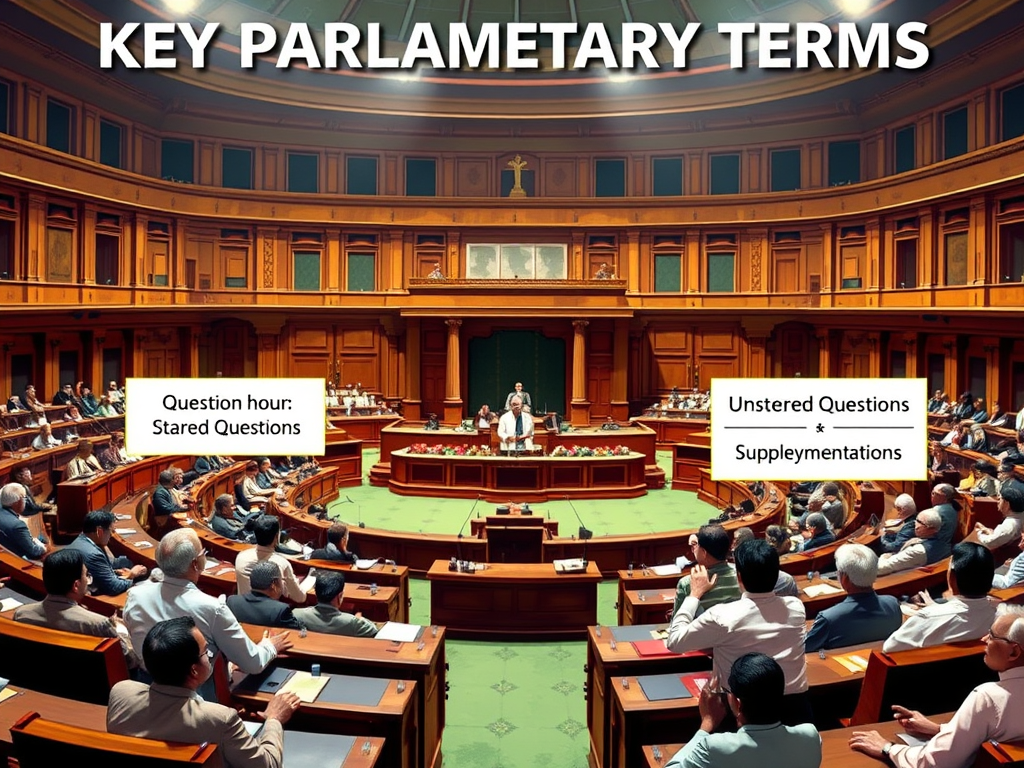
Parliamentary questions are a cornerstone of India’s parliamentary democracy, allowing Members of Parliament (MPs) to seek information, ensure government accountability, and raise public issues during the Question Hour in the Lok Sabha and Rajya Sabha. The process involves specific terminology that governs how questions are asked, processed, and answered. For the SSA/UDC exam, the syllabus emphasizes “simple questions relating to sessions of Parliament and handling of Parliament questions,” making it essential to understand key parliamentary terms like Question Hour, Starred Question, Supplementary Question, and others. This note focuses on these terms, their meanings, and their relevance to parliamentary questions, with a special emphasis on the Department of Personnel and Training (DoPT)’s role.
Key Parliamentary Terms and Their Explanations
- Question Hour:
- The first hour of every parliamentary sitting (usually 11 AM–12 PM), dedicated to MPs asking questions to ministers.
- Purpose: Seek information, clarify government policies, or highlight issues.
- Conducted in both Lok Sabha and Rajya Sabha, presided over by the Speaker (Lok Sabha) or Chairman (Vice President, Rajya Sabha).
- Example: An MP asks about delays in SSC exams, answered by the DoPT minister.
- Starred Question:
- A question answered orally by the minister during Question Hour, allowing supplementary questions from MPs.
- Requires a 15-day minimum notice period.
- Limited in number (e.g., 20 per day in Lok Sabha) due to time constraints.
- Selected via a ballot system to prioritize among submissions.
- Example: “What measures has DoPT taken to streamline UPSC recruitment?”
- Unstarred Question:
- A question answered in writing, with replies tabled in the house.
- Requires a 15-day minimum notice period.
- Higher limit (e.g., 230 per day in Lok Sabha) as no oral discussion is needed.
- No supplementary questions allowed.
- Example: “Provide data on government employee pensions in 2024–25.”
- Short Notice Question:
- A question on urgent public matters, requiring less than 15 days’ notice (usually 10 days or less).
- Answered orally, with supplementary questions allowed, if approved by the Speaker/Chairman.
- Rare, as urgency must be justified.
- Example: “What is the government’s response to a recent DoPT policy change?”
- Supplementary Question:
- A follow-up question asked by MPs during Question Hour after a starred or short notice question’s oral reply.
- Allows MPs to seek clarification or additional details.
- Typically limited to 2–3 per starred question, moderated by the Speaker/Chairman.
- Example: After a reply on UPSC exams, an MP asks, “What is the timeline for results?”
- Ballot System:
- A random selection process to prioritize starred questions for Question Hour due to limited slots.
- Conducted by the Lok Sabha/Rajya Sabha Secretariat.
- Ensures fairness in selecting questions from numerous submissions.
- Example: An MP’s starred question on DoPT training programs is selected via ballot.
- Notice Period:
- The minimum time MPs must give when submitting a question (15 days for starred/unstarred, less for short notice).
- Allows ministries (e.g., DoPT) to prepare accurate replies.
- Example: A starred question submitted on June 1 can be answered on or after June 16.
- Admissibility:
- The process of determining if a question complies with parliamentary rules (e.g., no sub-judice matters, no personal attacks).
- Decided by the Speaker (Lok Sabha) or Chairman (Rajya Sabha).
- Inadmissible questions are rejected (e.g., seeking classified information).
- Example: A question on a court case is deemed inadmissible.
- List of Business:
- The daily agenda of Parliament, listing questions, bills, and motions.
- Includes the List of Questions, specifying starred, unstarred, and short notice questions.
- Prepared by the Lok Sabha/Rajya Sabha Secretariat.
- Example: The List of Business for June 15, 2025, includes DoPT-related questions.
- List of Questions:
- A section of the List of Business detailing questions to be answered each day.
- Specifies question type, MP’s name, and ministry (e.g., DoPT for personnel issues).
- Example: Lists a starred question on SSC recruitment under DoPT.
- Table of the House:
- The formal process of placing written replies (e.g., unstarred questions) in Parliament.
- Replies are available to all MPs and recorded in the Hansard.
- Example: DoPT’s written reply on pensions is tabled in Lok Sabha.
- Hansard:
- The official record of parliamentary proceedings, including questions, answers, and debates.
- Captures oral replies to starred questions and supplementary questions.
- Example: A DoPT minister’s reply on UPSC is recorded in the Hansard.
- Zero Hour:
- The period following Question Hour (usually 12 PM onwards) where MPs raise urgent public issues without prior notice.
- Not for formal questions but related to Question Hour as a platform for issues.
- Example: An MP raises a DoPT policy issue during Zero Hour.
- Private Member’s Question:
- A question asked by an MP to another MP (not a minister) about private member bills or resolutions.
- Answered in writing or orally, less common.
- Example: A question on a private member’s bill on administrative reforms.
- Sub-Judice:
- Matters under judicial consideration, which cannot be raised in parliamentary questions.
- Ensures no interference with court proceedings.
- Example: A question on a pending DoPT lawsuit is inadmissible.
- Ministry’s Reply:
- The official response prepared by a ministry (e.g., DoPT) to a parliamentary question.
- Drafted by officials, vetted by the minister, and delivered orally or in writing.
- Example: DoPT’s reply on training programs is presented in Parliament.
- Question Branch:
- A division of the Lok Sabha/Rajya Sabha Secretariat responsible for processing questions.
- Handles submission, admissibility, and coordination with ministries.
- Example: The Question Branch forwards a DoPT question to the ministry.
- Calling Attention Motion:
- A procedure related to questions, allowing MPs to highlight urgent public issues during a session.
- Differs from questions as it seeks discussion, not just information.
- Example: An MP raises a DoPT recruitment delay via Calling Attention.
- Adjournment Motion:
- A motion to interrupt normal proceedings to discuss urgent issues, sometimes linked to questions.
- Requires Speaker’s approval and sufficient MP support.
- Example: An adjournment motion on a DoPT policy failure.
- DoPT’s Role:
- The Department of Personnel and Training answers questions on government recruitment, training, pensions, and administrative reforms.
- Coordinates with agencies like UPSC or SSC to prepare replies.
- Example: A question on SSC exam delays is handled by DoPT.
100 MCQs on Key Parliamentary Terms (Related to Parliamentary Questions)
Below are 100 MCQs divided into Easy (20 questions), Moderate (60 questions), and Hard (20 questions) levels, with answers and brief explanations. These are designed to cover the SSA/UDC exam’s focus on simple parliamentary terms.
Easy Level MCQs (20 Questions)
- Q: What is the first hour of a parliamentary sitting called?
- A) Zero Hour B) Question Hour C) Debate Hour D) Motion Hour
- A: B) Question Hour
- Explanation: MPs ask questions to ministers during this hour.
- Q: What is a Starred Question?
- A) Written question B) Oral question C) Urgent question D) Private question
- A: B) Oral question
- Explanation: Answered orally during Question Hour.
- Q: What is an Unstarred Question?
- A) Oral question B) Written question C) Urgent question D) Follow-up question
- A: B) Written question
- Explanation: Answered in writing, tabled in the house.
- Q: What is the minimum notice period for a Starred Question?
- A) 7 days B) 10 days C) 15 days D) 20 days
- A: C) 15 days
- Explanation: Allows time for preparation.
- Q: What is a Supplementary Question?
- A) First question B) Follow-up question C) Written question D) Urgent question
- A: B) Follow-up question
- Explanation: Asked after a starred question’s oral reply.
- Q: What is the Ballot System used for?
- A) Electing MPs B) Selecting questions C) Passing bills D) Preparing Budget
- A: B) Selecting questions
- Explanation: Prioritizes starred questions.
- Q: What is the List of Business?
- A) Question record B) Daily agenda C) Annual report D) Financial statement
- A: B) Daily agenda
- Explanation: Lists questions, bills, and motions.
- Q: What is the Hansard?
- A) Daily agenda B) Official record C) Question list D) Budget document
- A: B) Official record
- Explanation: Records parliamentary proceedings.
- Q: What is Zero Hour?
- A) Question time B) Urgent issue time C) Budget time D) Election time
- A: B) Urgent issue time
- Explanation: Follows Question Hour for public issues.
- Q: What is the Table of the House?
- A) Meeting room B) Placing replies C) Voting area D) Seating arrangement
- A: B) Placing replies
- Explanation: Where unstarred replies are tabled.
- Q: What does Sub-Judice mean?
- A) Admissible question B) Court matter C) Urgent issue D) Written reply
- A: B) Court matter
- Explanation: Questions on sub-judice matters are inadmissible.
- Q: What is a Short Notice Question?
- A) Routine question B) Urgent question C) Written question D) Private question
- A: B) Urgent question
- Explanation: Requires less than 15 days’ notice.
- Q: Who decides a question’s admissibility?
- A) President B) Speaker/Chairman C) Prime Minister D) Minister
- A: B) Speaker/Chairman
- Explanation: They enforce rules.
- Q: What is a Private Member’s Question?
- A) Minister’s question B) Non-minister MP question C) Public question D) Budget question
- A: B) Non-minister MP question
- Explanation: Asked to another MP.
- Q: What is the Notice Period?
- A) Voting time B) Question submission time C) Session duration D) Budget period
- A: B) Question submission time
- Explanation: E.g., 15 days for starred questions.
- Q: What is a Calling Attention Motion?
- A) Budget motion B) Urgent issue discussion C) Question type D) Bill voting
- A: B) Urgent issue discussion
- Explanation: Highlights public matters.
- Q: What is an Adjournment Motion?
- A) Question type B) Urgent issue debate C) Budget motion D) Election motion
- A: B) Urgent issue debate
- Explanation: Interrupts normal proceedings.
- Q: What is the Question Branch?
- A) Ministry division B) Secretariat division C) MP group D) Committee
- A: B) Secretariat division
- Explanation: Processes questions.
- Q: Which department answers personnel-related questions?
- A) Finance Ministry B) DoPT C) Home Ministry D) Defence Ministry
- A: B) DoPT
- Explanation: Handles recruitment, pensions, etc.
- Q: What is the List of Questions?
- A) Annual report B) Question agenda C) Budget document D) Election list
- A: B) Question agenda
- Explanation: Part of the List of Business.
Moderate Level MCQs (60 Questions)
- Q: How many Starred Questions are answered daily in Lok Sabha?
- A) 10 B) 20 C) 30 D) 40
- A: B) 20
- Explanation: Limited due to Question Hour’s duration.
- Q: How many Unstarred Questions are answered daily in Lok Sabha?
- A) 100 B) 230 C) 300 D) 50
- A: B) 230
- Explanation: Higher limit as they’re written.
- Q: What is the notice period for an Unstarred Question?
- A) 7 days B) 10 days C) 15 days D) No notice
- A: C) 15 days
- Explanation: Same as Starred Questions.
- Q: How many Supplementary Questions are typically allowed per Starred Question?
- A) 1 B) 2 C) 3 D) No limit
- A: B) 2
- Explanation: Moderated by the Speaker/Chairman.
- Q: What is the notice period for a Short Notice Question?
- A) 15 days B) Less than 15 days C) 7 days D) No notice
- A: B) Less than 15 days
- Explanation: Usually 10 days or less.
- Q: Who moderates Supplementary Questions in Lok Sabha?
- A) Speaker B) Minister C) President D) Prime Minister
- A: A) Speaker
- Explanation: Ensures orderly proceedings.
- Q: What is the role of the Question Branch in the Secretariat?
- A) Answers questions B) Processes questions C) Passes bills D) Prepares Budget
- A: B) Processes questions
- Explanation: Handles submission and admissibility.
- Q: Which rule governs Question Hour in Lok Sabha?
- A) Rule 32–54 B) Rule 55–60 C) Rule 61–70 D) Rule 71–80
- A: A) Rule 32–54
- Explanation: Covers question procedures.
- Q: What does Admissibility refer to?
- A) Question approval B) Bill passing C) Budget approval D) MP election
- A: A) Question approval
- Explanation: Ensures rule compliance.
- Q: Why are Sub-Judice questions inadmissible?
- A) Too long B) Under court consideration C) Opinion-based D) Classified
- A: B) Under court consideration
- Explanation: Avoids judicial interference.
- Q: What is the purpose of the Ballot System?
- A) Elect Speaker B) Select Starred Questions C) Pass bills D) Allocate seats
- A: B) Select Starred Questions
- Explanation: Prioritizes limited slots.
- Q: Where are Unstarred Question replies recorded?
- A) Gazette B) Hansard C) List of Business D) Budget
- A: B) Hansard
- Explanation: Part of parliamentary records.
- Q: What is the time duration of Question Hour?
- A) 30 minutes B) 1 hour C) 2 hours D) 45 minutes
- A: B) 1 hour
- Explanation: Typically 11 AM–12 PM.
- Q: Who approves Short Notice Questions?
- A) President B) Speaker/Chairman C) Prime Minister D) Minister
- A: B) Speaker/Chairman
- Explanation: They assess urgency.
- Q: What is the role of DoPT in Question Hour?
- A) Conducts proceedings B) Prepares replies C) Passes bills D) Elects MPs
- A: B) Prepares replies
- Explanation: For personnel-related questions.
- Q: What is a Calling Attention Motion related to?
- A) Budget B) Urgent issues C) Elections D) Bills
- A: B) Urgent issues
- Explanation: Highlights public matters.
- Q: What is an Adjournment Motion’s purpose?
- A) Pass bills B) Discuss urgent issues C) Prepare Budget D) Elect Speaker
- A: B) Discuss urgent issues
- Explanation: Interrupts normal business.
- Q: How many questions can an MP ask daily in Lok Sabha?
- A) 3 B) 5 C) 10 D) 15
- A: B) 5
- Explanation: Including one starred question.
- Q: What is the word limit for a Lok Sabha question?
- A) 100 words B) 150 words C) 200 words D) 250 words
- A: B) 150 words
- Explanation: Ensures conciseness.
- Q: What is the List of Questions part of?
- A) Hansard B) List of Business C) Gazette D) Budget
- A: B) List of Business
- Explanation: Details daily questions.
- Q: Who prepares the List of Business?
- A) Speaker B) Secretariat C) President D) Prime Minister
- A: B) Secretariat
- Explanation: Lok Sabha/Rajya Sabha Secretariat.
- Q: What is the role of the Minister during Question Hour?
- A) Conducts proceedings B) Answers questions C) Passes bills D) Prepares agenda
- A: B) Answers questions
- Explanation: Ministers respond to MPs.
- Q: Which questions are rare due to urgency requirements?
- A) Starred B) Unstarred C) Short Notice D) Private Member
- A: C) Short Notice
- Explanation: Need Speaker’s approval.
- Q: What is a Private Member’s Question about?
- A) Government policy B) Private member bills C) Budget D) Elections
- A: B) Private member bills
- Explanation: Asked to non-ministers.
- Q: What happens if a question is inadmissible?
- A) Answered B) Rejected C) Shortened D) Debated
- A: B) Rejected
- Explanation: Doesn’t meet rules.
- Q: Which ministry answers UPSC-related questions?
- A) Education Ministry B) DoPT C) Home Ministry D) Finance Ministry
- A: B) DoPT
- Explanation: DoPT oversees UPSC.
- Q: What is the purpose of tabling a reply?
- A) Voting B) Recording C) Debating D) Budgeting
- A: B) Recording
- Explanation: Makes replies official.
- Q: What follows Question Hour in a sitting?
- A) Budget discussion B) Zero Hour C) Bill voting D) Elections
- A: B) Zero Hour
- Explanation: For urgent issues.
- Q: Who moderates Question Hour in Rajya Sabha?
- A) Speaker B) Vice President C) Prime Minister D) President
- A: B) Vice President
- Explanation: As Chairman.
- Q: What is the maximum time for a Starred Question’s oral reply?
- A) 2 minutes B) 3 minutes C) 5 minutes D) 10 minutes
- A: B) 3 minutes
- Explanation: To allow multiple questions.
- Q: What is the role of the Lok Sabha Secretariat?
- A) Answers questions B) Processes questions C) Passes bills D) Prepares Budget
- A: B) Processes questions
- Explanation: Manages question logistics.
- Q: Which rule prohibits personal attacks in questions?
- A) Rule 41 B) Rule 51 C) Rule 61 D) Rule 71
- A: A) Rule 41
- Explanation: Ensures decorum.
- Q: Can a question seek classified information?
- A) Yes B) No C) Sometimes D) Only in writing
- A: B) No
- Explanation: Inadmissible under rules.
- Q: What is the purpose of the Hansard?
- A) Daily agenda B) Record proceedings C) Budget document D) Election list
- A: B) Record proceedings
- Explanation: Includes questions and answers.
- Q: How many questions can an MP ask in Rajya Sabha daily?
- A) 3 B) 5 C) 7 D) 10
- A: B) 5
- Explanation: Similar to Lok Sabha.
- Q: What is the role of the Question Branch?
- A) Answers questions B) Processes questions C) Passes bills D) Prepares Budget
- A: B) Processes questions
- Explanation: Secretariat division.
- Q: Which ministry answers pension-related questions?
- A) Finance Ministry B) DoPT C) Home Ministry D) Defence Ministry
- A: B) DoPT
- Explanation: Handles pension policies.
- Q: What is the notice period for a Private Member’s Question?
- A) 7 days B) 10 days C) 15 days D) No notice
- A: C) 15 days
- Explanation: Similar to other questions.
- Q: What is the purpose of a Short Notice Question?
- A) Routine query B) Urgent matter C) Budget issue D) Election query
- A: B) Urgent matter
- Explanation: Requires quick response.
- Q: What is the List of Questions used for?
- A) Budget planning B) Question scheduling C) Bill passing D) MP election
- A: B) Question scheduling
- Explanation: Details daily questions.
Hard Level MCQs (20 Questions)
- Q: Under which Lok Sabha rule is the Ballot System governed?
- A) Rule 38 B) Rule 48 C) Rule 58 D) Rule 68
- A: A) Rule 38
- Explanation: Covers starred question selection.
- Q: What is the maximum number of Short Notice Questions daily?
- A) 1–2 B) 3–5 C) 6–10 D) None
- A: A) 1–2
- Explanation: Rare due to urgency.
- Q: Which rule governs Supplementary Questions in Lok Sabha?
- A) Rule 45 B) Rule 55 C) Rule 65 D) Rule 75
- A: A) Rule 45
- Explanation: Covers follow-up questions.
- Q: What is the role of the Minister of Parliamentary Affairs?
- A) Answers all questions B) Coordinates replies C) Conducts proceedings D) Prepares Budget
- A: B) Coordinates replies
- Explanation: Ensures timely responses.
- Q: Which rule prohibits Sub-Judice questions?
- A) Rule 41 B) Rule 42 C) Rule 43 D) Rule 44
- A: A) Rule 41
- Explanation: Restricts court-related questions.
- Q: How many ministries are involved in daily Question Hour replies?
- A) 5–10 B) 10–20 C) 20–30 D) All ministries
- A: C) 20–30
- Explanation: Depends on question diversity.
- Q: What happens if a Starred Question is not answered orally?
- A) It lapses B) Written reply given C) Session extends D) MP re-asks
- A: B) Written reply given
- Explanation: Ensures response.
- Q: Which rule sets the word limit for questions?
- A) Rule 39 B) Rule 49 C) Rule 59 D) Rule 69
- A: A) Rule 39
- Explanation: Limits to 150 words.
- Q: What is the maximum time for a Supplementary Question’s reply?
- A) 1 minute B) 2 minutes C) 3 minutes D) 5 minutes
- A: B) 2 minutes
- Explanation: Keeps Question Hour efficient.
- Q: Which rule prohibits hypothetical questions?
- A) Rule 41 B) Rule 42 C) Rule 43 D) Rule 44
- A: A) Rule 41
- Explanation: Questions must be factual.
- Q: What is the role of the Speaker in Short Notice Questions?
- A) Answers them B) Approves them C) Prepares replies D) Votes
- A: B) Approves them
- Explanation: Assesses urgency.
- Q: How many questions are listed in the Lok Sabha’s List of Business daily?
- A) 50–100 B) 100–200 C) 200–250 D) 300–400
- A: C) 200–250
- Explanation: Includes starred and unstarred.
- Q: Which ministry coordinates with SSC for exam questions?
- A) Education Ministry B) DoPT C) Home Ministry D) Finance Ministry
- A: B) DoPT
- Explanation: DoPT oversees SSC.
- Q: What is the purpose of the Question Branch?
- A) Answers questions B) Processes questions C) Passes bills D) Prepares Budget
- A: B) Processes questions
- Explanation: Manages logistics.
- Q: Which rule governs the conduct of Question Hour?
- A) Rule 32–54 B) Rule 55–60 C) Rule 61–70 D) Rule 71–80
- A: A) Rule 32–54
- Explanation: Covers procedures.
- Q: What is the role of the Rajya Sabha Chairman in Question Hour?
- A) Answers questions B) Moderates proceedings C) Prepares replies D) Votes
- A: B) Moderates proceedings
- Explanation: Ensures order.
- Q: Which motion is similar to a question in raising issues?
- A) Budget Motion B) Calling Attention Motion C) No-confidence Motion D) Election Motion
- A: B) Calling Attention Motion
- Explanation: Highlights urgent matters.
- Q: What is the maximum number of Starred Questions an MP can ask daily?
- A) 1 B) 2 C) 3 D) 5
- A: A) 1
- Explanation: Limited to one.
- Q: Which ministry answers administrative reform questions?
- A) Finance Ministry B) DoPT C) Home Ministry D) External Affairs
- A: B) DoPT
- Explanation: Handles reforms.
- Q: What is the role of the Lok Sabha Secretariat in questions?
- A) Answers questions B) Processes questions C) Passes bills D) Prepares Budget
- A: B) Processes questions
- Explanation: Manages question flow.
Preparation Tips for MCQs
- Focus Areas: Memorize terms like Starred Question, Supplementary Question, Ballot System, and Admissibility, along with DoPT’s role.
- Negative Marking: Attempt only confident answers to avoid the 0.25-mark penalty.
- Revision: Use flashcards for terms like Hansard, List of Business, and Sub-Judice.
| Syllabus | Study Material Link |
| Structure of the Indian Parliament | Click Here |
| Sessions of Parliament | Click Here |
| Key Parliamentary Terms | Click Here |
| Guidelines on Noting | Click Here |
| Communication, Forms, Channels, and Procedure | Click here |
| Main Page for SSC Departmental Exam | Click Here |


From the blog
-
UPSC Recruitment 2026: Scientist-B (Mechanical) Vacancy in National Test House
27,971 views
🔬 UPSC Recruitment 2026: Scientist-B (Mechanical) Vacancy in National Test House Vacancy No.: 26040301625 The Union Public Service Commission (UPSC) has announced one vacancy for the post of Scientist-B (Mechanical) in the National Test House, under the Department of Consumer Affairs, Ministry of Consumer Affairs, Food and Public Distribution. Position Details: Pay Scale: Age Limit:…
-

Central Bank of India Recruitment 2026 – 26 Specialist Officers Vacancies
27,971 views
Central Bank of India has released the Central Bank of India Specialist Officers Recruitment 2026 notification for 26 posts in various Risk Management streams. Candidates with qualifications like B.Sc, B.Tech/B.E, MBA/PGDM, CA, and relevant experience can apply online. Online Application Started: 09 April 2026Last Date to Apply: 30 April 2026 Apply online through the official…



Leave a comment