
Overview
Ashoka (circa 304–232 BCE), the third emperor of the Mauryan Empire (321–185 BCE), is a towering figure in Indian history, renowned for his transformation from a conqueror to a champion of Dhamma (Dharma), a philosophy of ethical governance, non-violence, and universal tolerance. Ruling from Pataliputra (modern Patna, Bihar), Ashoka expanded the Mauryan Empire to its zenith and left an enduring legacy through his edicts, Buddhist patronage, and welfare policies. For UPSC, Ashoka is central to Ancient Indian History (Prelims) and Indian Heritage and Culture (Mains GS Paper I). For BPSC, his reign in Magadha and contributions to Bihar’s historical identity are critical.
1. Early Life and Ascension
- Birth and Family: Born around 304 BCE to Emperor Bindusara and Queen Subhadrangi (or Dharma, per Buddhist texts), Ashoka was a grandson of Chandragupta Maurya, the Mauryan Empire’s founder. His mother was reportedly a commoner, which influenced his empathetic policies later.
- Siblings and Succession: Ashoka had several brothers, including Susima, the eldest and heir apparent. Buddhist texts like the Ashokavadana describe a power struggle, with Ashoka allegedly eliminating rivals to secure the throne around 268 BCE after Bindusara’s death in 272 BCE.
- Early Career: As a prince, Ashoka served as governor of Taxila (modern Pakistan) and Ujjain (Madhya Pradesh). He quelled a rebellion in Taxila, showcasing his administrative and military skills.
- Titles: Known as Devānāmpriya (“Beloved of the Gods”) and Priyadarśin (“He who regards everyone with affection”) in his edicts. Buddhist texts initially called him “Chandashoka” (cruel Ashoka) due to his early ruthlessness.
- Sources: Primary sources include Ashokan edicts (rock, pillar, and cave inscriptions), Buddhist texts (Dipavamsa, Mahavamsa, Ashokavadana), and archaeological findings. Greek accounts (e.g., Megasthenes’ Indica, though not directly about Ashoka) describe Mauryan administration.
Details to Memorize:
- Birth: ~304 BCE; Death: ~232 BCE.
- Father: Bindusara; Grandfather: Chandragupta Maurya; Mother: Subhadrangi.
- Ascension: ~268 BCE after a succession struggle.
- Governorships: Taxila, Ujjain.
- Titles: Devānāmpriya, Priyadarśin.
- Key Texts: Ashokavadana (Sanskrit, Buddhist), Dipavamsa and Mahavamsa (Pali, Sri Lankan chronicles).
2. The Kalinga War and Transformation
- Kalinga War (circa 261 BCE): Ashoka waged war against Kalinga (modern Odisha), a powerful coastal kingdom. The campaign, fought around 261 BCE, was the last major military conquest of his reign.
- Casualties: Major Rock Edict XIII (Dhauli, Odisha) records over 100,000 deaths, 150,000 deportations, and widespread suffering, highlighting the war’s brutality.
- Impact: The immense bloodshed caused Ashoka profound remorse, prompting a spiritual transformation. Influenced by Buddhist monk Upagupta (or Moggaliputta Tissa, per some sources), he embraced Buddhism and adopted Dhamma as his guiding philosophy.
- Dhamma Defined: A universal ethical code, not strictly Buddhist, emphasizing non-violence (ahimsa), compassion, respect for all religions, and social responsibility. It was practical, aimed at uniting a diverse empire.
Details to Memorize:
- War Year: ~261 BCE.
- Location: Kalinga (modern Odisha).
- Edict Reference: Major Rock Edict XIII (Dhauli, Jaugada).
- Casualties: 100,000+ killed, 150,000+ deported.
- Key Influence: Upagupta or Moggaliputta Tissa.
- Dhamma Principles: Non-violence, tolerance, compassion, ethical conduct.
3. Ashoka’s Dhamma: Policies and Propagation
- Core Principles:
- Non-violence: Banned animal sacrifices, promoted vegetarianism, and protected wildlife.
- Religious Tolerance: Supported Buddhism, Jainism, Brahmanism, and Ajivikas, fostering interfaith harmony.
- Ethical Conduct: Emphasized truthfulness, respect for elders, kindness to subordinates, and charity.
- Social Welfare: Built hospitals for humans and animals, dug wells, planted banyan trees for shade, and constructed rest houses (dharamshalas).
- Environmental Conservation: Protected species like parrots and regulated hunting.
- Propagation Methods:
- Edicts: Inscribed on rocks, pillars, and caves in Prakrit (Brahmi script), Greek, and Aramaic for diverse audiences. Examples:
- Major Rock Edicts (14 in total): Found at Girnar (Gujarat), Dhauli (Odisha), Shahbazgarhi (Pakistan).
- Pillar Edicts (7 major): Sarnath (UP), Lauriya Nandangarh (Bihar), Delhi-Topra (Delhi).
- Minor Rock Edicts: Bairat (Rajasthan), Maski (Karnataka, mentions Ashoka’s name explicitly).
- Cave Inscriptions: Barabar Caves (Bihar, donated to Ajivikas).
- Dhamma Yatras: Replaced military campaigns with pilgrimages to Buddhist sites like Bodh Gaya, Sarnath, Lumbini, and Kushinagar.
- Dhamma Mahamatras: Special officers appointed from the 13th year of his reign to enforce Dhamma and oversee welfare programs.
- Buddhist Missions: Sent emissaries to spread Buddhism to:
- Sri Lanka: Led by son Mahendra and daughter Sanghamitra, who carried a Bodhi tree sapling to Anuradhapura.
- Southeast Asia: Burma (Myanmar), Thailand.
- Central Asia: Gandhara, Bactria.
- Mediterranean: Egypt, Greece, Syria (mentioned in Rock Edict XIII as Antiochus II of Seleucid Empire).
- Edicts: Inscribed on rocks, pillars, and caves in Prakrit (Brahmi script), Greek, and Aramaic for diverse audiences. Examples:
- Third Buddhist Council: Convened in Pataliputra (~250 BCE) under Moggaliputta Tissa to purify Buddhist teachings, strengthening Ashoka’s role as a Buddhist patron.
Details to Memorize:
- Dhamma Principles: Non-violence, tolerance, charity, environmental care.
- Edict Types: Major Rock (14), Pillar (7), Minor Rock, Cave.
- Key Edict Locations: Girnar, Dhauli, Sarnath, Lauriya Nandangarh, Barabar Caves.
- Dhamma Mahamatras: Appointed in 13th regnal year.
- Missions: Sri Lanka (Mahendra, Sanghamitra), Southeast Asia, Mediterranean (Antiochus II).
- Third Buddhist Council: Pataliputra, ~250 BCE, Moggaliputta Tissa.
4. Administration and Governance
- Mauryan Administrative Structure:
- Centralized monarchy with Pataliputra as the capital.
- Provincial divisions: Four provinces (Ujjain, Taxila, Suvarnagiri, Tosali) governed by kumara (princes) or aryaputra (nobles).
- Officials: Rajukas (revenue and judicial officers), yuktas (subordinate officials), mahapurohitas (priests).
- Welfare Measures:
- Infrastructure: Built roads, rest houses, and wells along trade routes (e.g., Uttarapatha, connecting Pataliputra to Taxila).
- Healthcare: Established hospitals for humans and animals, mentioned in Rock Edict II.
- Environmental Initiatives: Planted banyan and mango trees, protected species, and regulated fisheries.
- Social Reforms: Promoted education, banned cruel punishments, and encouraged charity (dana).
- Judicial System: Emphasized fairness, reduced torture, and offered reprieves for prisoners (Rock Edict V).
- Economic Policies: Maintained Mauryan taxation system (e.g., bhaga, land revenue) but focused on equitable distribution and welfare.
- Bihar Connection: Pataliputra, the Mauryan capital, was a global hub of trade, culture, and administration. Ashoka’s edicts in Bihar (e.g., Lauriya Nandangarh, Barabar Caves) highlight the region’s historical significance.
Details to Memorize:
- Capital: Pataliputra (Patna, Bihar).
- Provinces: Ujjain, Taxila, Suvarnagiri, Tosali.
- Officials: Rajukas, yuktas, Dhamma Mahamatras.
- Infrastructure: Roads (Uttarapatha), rest houses, wells.
- Healthcare: Hospitals for humans and animals (Rock Edict II).
- Bihar Sites: Lauriya Nandangarh (Pillar Edict), Barabar Caves (Ajivika donation).
5. Contributions to Art and Architecture
- Stupas: Ashoka built or expanded 84,000 stupas (per Buddhist tradition) to enshrine Buddha’s relics. Notable examples:
- Sanchi Stupa (Madhya Pradesh): Expanded by Ashoka, with intricate gateways added later.
- Bharhut Stupa (Madhya Pradesh): Early Buddhist art.
- Dharmarajika Stupa (Taxila): Reflects Mauryan influence.
- Pillars: Polished sandstone pillars, 12–15 meters tall, with animal capitals:
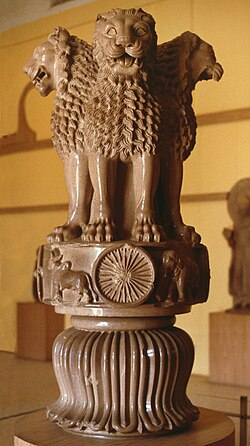
- Sarnath Pillar (Uttar Pradesh): Four-lion capital, India’s national emblem.
- Lauriya Nandangarh (Bihar): Single-lion capital.
- Delhi-Topra Pillar: Relocated by Firoz Shah Tughlaq in the 14th century.
- Caves: Barabar Caves (Bihar), donated to Ajivika monks, feature polished interiors (e.g., Lomas Rishi Cave).
- Artistic Features: Mauryan art is characterized by polished stone, animal motifs (lion, bull, elephant), and Buddhist symbolism. Ashoka’s patronage set the foundation for later Buddhist art (e.g., Gandhara, Mathura schools).
- Cultural Impact: His architectural legacy influenced Gupta and post-Mauryan art, while the Sarnath Lion Capital symbolizes modern India’s sovereignty.
Details to Memorize:
- Stupas: Sanchi, Bharhut, Dharmarajika (Taxila).
- Pillars: Sarnath (four lions), Lauriya Nandangarh (single lion), Delhi-Topra.
- Caves: Barabar (Bihar), Lomas Rishi.
- Features: Polished sandstone, animal capitals, Buddhist symbolism.
- National Emblem: Sarnath Lion Capital.
6. Decline and Legacy
- Death: Ashoka died around 232 BCE in Pataliputra. His later years focused on Buddhist patronage, possibly straining the empire’s resources.
- Successors: Weak rulers like Dasharatha, Samprati, and Brihadratha led to the empire’s decline by 185 BCE, with the last Mauryan king killed by Pushyamitra Shunga.
- Legacy:
- Buddhism’s Spread: Ashoka’s missions established Buddhism in Sri Lanka (Anuradhapura), Southeast Asia, and Central Asia, making it a world religion.
- Ethical Governance: Dhamma’s principles of non-violence, tolerance, and welfare inspired modern concepts of secularism and social justice.
- National Symbol: The Sarnath Lion Capital, adopted in 1950, symbolizes India’s unity and sovereignty.
- Bihar’s Pride: As ruler of Magadha, Ashoka elevated Pataliputra’s status as a global center, with archaeological sites like Lauriya Nandangarh and Barabar Caves underscoring Bihar’s historical significance.
- Cultural Integration: His support for multiple religions fostered unity in a diverse empire, a model for modern India’s pluralism.
Details to Memorize:
- Death: ~232 BCE, Pataliputra.
- Successors: Dasharatha,
Samprati,
Brihadratha
(killed ~185 BCE by Pushyamitra Shunga). - Legacy Sites: Sarnath (national emblem), Sanchi, Barabar Caves.
- Missions: Sri Lanka (Bodhi tree, Anuradhapura), Southeast Asia, Mediterranean.
- Bihar Legacy: Pataliputra, Lauriya Nandangarh, Barabar Caves.
7. Key Memorization Points
- Chronology:
- Birth: ~304 BCE.
- Ascension: ~268 BCE.
- Kalinga War: ~261 BCE.
- Third Buddhist Council: ~250 BCE.
- Death: ~232 BCE.
- Edicts:
- Major Rock Edicts: 14, e.g., XIII (Kalinga), II (welfare), V (Dhamma Mahamatras).
- Pillar Edicts: 7, e.g., Sarnath, Lauriya Nandangarh, Delhi-Topra.
- Minor Rock Edicts: Maski (mentions Ashoka’s name), Bairat.
- Cave Inscriptions: Barabar Caves (Bihar).
- Languages: Prakrit (Brahmi), Greek, Aramaic.
- Locations:
- Edicts: Girnar (Gujarat), Dhauli (Odisha), Shahbazgarhi (Pakistan), Sarnath (UP), Lauriya Nandangarh (Bihar).
- Stupas: Sanchi (MP), Bharhut (MP), Dharmarajika (Taxila).
- Caves: Barabar (Bihar).
- Buddhist Missions:
- Sri Lanka: Mahendra, Sanghamitra, Bodhi tree.
- Others: Burma, Thailand, Central Asia, Egypt, Greece (Antiochus II).
- Bihar Connections:
- Capital: Pataliputra (Patna).
- Edicts: Lauriya Nandangarh, Barabar Caves.
- Council: Third Buddhist Council (~250 BCE, Pataliputra).
- Art and Architecture:
- Stupas: Sanchi, Bharhut.
- Pillars: Sarnath (national emblem), Lauriya Nandangarh.
- Caves: Barabar (Ajivika donation).
8. Practice Questions for Retention
- Prelims (MCQ):
- Q: In which Ashokan edict is the Kalinga War described?
A: Major Rock Edict XIII. - Q: The Sarnath Pillar is associated with:
A: Dhamma policy and India’s national emblem. - Q: Ashoka donated the Barabar Caves to which sect?
A: Ajivikas. - Q: Who led the Buddhist mission to Sri Lanka?
A: Mahendra and Sanghamitra.
- Q: In which Ashokan edict is the Kalinga War described?
- Mains:
- Q: Discuss Ashoka’s Dhamma and its impact on Mauryan governance and society. (15 marks)
- Q: Evaluate Ashoka’s contributions to Indian art and architecture, with reference to his Bihar legacy. (10 marks, BPSC-focused)
- Q: Analyze how Ashoka’s policies shaped the global spread of Buddhism. (15 marks)
9. Recommended Resources
NCERT:
- Our Past-I (Class 6): Chapter 7, “Ashoka, The Emperor Who Gave Up War.”
- Themes in Indian History-I (Class 11): Chapter 2, “Kings, Farmers and Towns.”
- Download: ncert.nic.in.
- NIOS:
- Indian Culture and Heritage (Code 223): Covers Mauryan culture and Ashoka’s contributions.
- Download: nios.ac.in.
- IGNOU:
- EHI-02 (India: Earliest Times to 8th Century AD): Detailed Mauryan history.
- Download: egyankosh.ac.in.
- Other Books:
- India’s Ancient Past by R.S. Sharma: Ashoka’s reign and Dhamma.
- Ashoka and the Decline of the Mauryas by Romila Thapar: Analytical perspective.
- The Edicts of Asoka by N.A. Nikam and R. McKeon: English translations of edicts.
- NCERT: ncert.nic.in.
- NIOS: nios.ac.in.
- IGNOU: egyankosh.ac.in.
10. Why This Topic Matters
- UPSC: Ashoka is a high-yield topic for Prelims (edicts, locations, Buddhist missions) and Mains (Dhamma, governance, cultural contributions). His policies are relevant for GS Paper I (History, Culture) and GS Paper IV (Ethics).
- BPSC: Ashoka’s reign in Pataliputra, edicts in Bihar (Lauriya Nandangarh, Barabar Caves), and the Third Buddhist Council make him central to Bihar’s historical identity.
- Memorization Value: The factual density (dates, edicts, locations, missions) and analytical depth (Dhamma, governance) make Ashoka a versatile topic for both objective and descriptive questions.


Leave a comment