
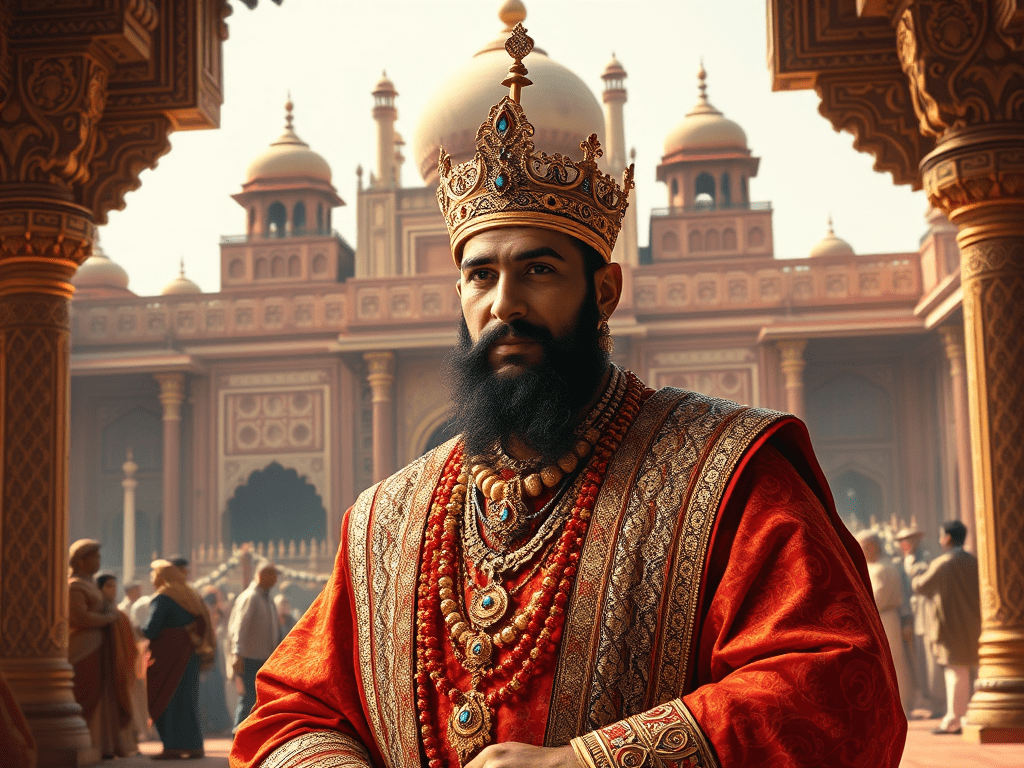
1. Introduction to Akbar and the Mughal Empire
Jalal-ud-Din Muhammad Akbar (1542–1605 CE), the third Mughal emperor, reigned from 1556 to 1605 CE and is considered the architect of the Mughal Empire’s golden age. Ascending the throne at age 13 after his father Humayun’s death, Akbar transformed the fragile empire inherited from Babur into a centralized, prosperous, and culturally vibrant state. His reign is renowned for administrative reforms, religious tolerance, cultural patronage, and military conquests, making the Mughal Empire a dominant power in the Indian subcontinent.
The provided text emphasizes the importance of interpreting literary and archaeological sources to reconstruct history, each with its strengths and limitations. For Akbar’s period, literary sources like Akbarnama and foreign accounts provide detailed narratives, while archaeological evidence, including forts, mosques, and artifacts, offers tangible insights into material culture. Corroborating both sources is crucial for a comprehensive understanding, as literary sources may be biased, and archaeological evidence focuses on cultural processes rather than specific events.
2. Chronology and Key Events
Akbar’s reign is marked by three distinct phases: early consolidation, territorial expansion, and administrative-cultural development.
- Early Reign and Regency (1556–1560 CE):
- Ascended the throne at 13 under the regency of Bairam Khan.
- Second Battle of Panipat (1556 CE): Bairam Khan defeated Hemu, a general of the Suri dynasty, securing Mughal control over Delhi and Agra.
- Ended Bairam Khan’s regency in 1560, assuming direct control.
- Territorial Expansion (1560–1580 CE):
- Conquered Malwa (1561), Chittor (1568), Ranthambore (1569), and Gujarat (1572–73), consolidating northern and western India.
- Conquest of Bengal (1574–76): Defeated Daud Khan Karrani, extending Mughal influence to eastern India.
- Subdued Rajput kingdoms through conquest and diplomacy (e.g., alliances with Amber, Bikaner, and Jodhpur).
- Consolidation and Reforms (1580–1605 CE):
- Introduced the mansabdari system, a military and administrative ranking system.
- Implemented revenue reforms under Todar Mal, standardizing land assessment (zabt).
- Promulgated Din-i-Ilahi (1582), a syncretic religious doctrine, though limited in adoption.
- Expanded to the Deccan (1590s), capturing parts of Ahmadnagar and Berar.
Akbar’s Akbarnama details these events, while forts and inscriptions corroborate his conquests and governance.
3. Archaeological Sources for Akbar’s Reign
Archaeological evidence, including monuments, artifacts, and inscriptions, provides insights into Akbar’s administration, architecture, and cultural patronage. The text classifies these as structures, artifacts, and inscriptions, emphasizing their role in understanding socio-cultural contexts.
Key Archaeological Findings:
- Structures:
- Fatehpur Sikri (1571–1585 CE): Akbar’s capital, a UNESCO World Heritage Site, showcases Mughal architecture with structures like the Buland Darwaza, Jama Masjid, and Diwan-i-Khas. Its planned layout reflects administrative and cultural sophistication.
- Agra Fort: Expanded by Akbar, it served as a military and administrative center with features like the Jahangiri Mahal.
- Lahore Fort: Strengthened during Akbar’s reign, it reflects strategic fortification.
- The text notes that monuments provide reliable socio-cultural information, evident in Fatehpur Sikri’s blend of Persian, Indian, and Islamic architectural styles.
- Artifacts:
- Coins: Akbar’s coinage, including gold mohurs and silver rupiyas, featured calligraphy and standardized weights, reflecting economic reforms. The text classifies coins as durable economic indicators.
- Weapons: Excavations reveal matchlocks, cannons, and swords, showcasing advancements in military technology.
- Manuscripts and Paintings: Miniature paintings from Akbar’s atelier (e.g., Hamzanama) illustrate court life and cultural patronage.
- Inscriptions:
- Inscriptions on Fatehpur Sikri’s Buland Darwaza and mosques proclaim Akbar’s titles (e.g., Shahanshah) and victories, aligning with the text’s classification of inscriptions as socio-cultural and commercial sources.
- Revenue records on stone (e.g., land grants) corroborate administrative reforms described in literary sources.
- Significance of Archaeological Sources:
- The text emphasizes archaeology’s role in reconstructing man-land relationships and cultural processes. Fatehpur Sikri’s layout and artifacts reflect Akbar’s vision of a cosmopolitan empire.
- Scientific techniques like radiocarbon dating and GIS mapping (noted in the text) help date structures and map trade routes, enhancing historical accuracy.
4. Literary Sources and Their Limitations
Akbar’s reign is well-documented through Mughal chronicles, foreign accounts, and administrative records. The text divides literary sources into religious and secular, noting their historical value but cautioning against biases due to patronage or oral transmission.
Key Literary Sources:
- Akbarnama:
- Written by Abu’l Fazl, Akbar’s court historian, it provides a detailed account of his reign, including battles, reforms, and policies.
- The text praises court chronicles for their event-based history. Akbarnama glorifies Akbar but is a primary source for administrative and cultural details.
- Its supplement, Ain-i-Akbari, details Akbar’s administration, revenue system, and court culture.
- Foreign Accounts:
- Jesuit accounts (e.g., Monserrate, 1580s) describe Akbar’s court, religious discussions, and tolerance, offering an outsider’s perspective.
- Travelers like Ralph Fitch (English) and Anthony Monson (Portuguese) document trade and urban life. The text notes foreign accounts as valuable but potentially biased due to cultural differences.
- Rajput and Other Chronicles:
- Rajput texts (e.g., Prithviraj Raso) describe interactions with Akbar but are biased against Mughal rule.
- Afghan chronicles (e.g., Tabaqat-i-Nasiri) provide limited insights due to their decline during Akbar’s reign.
- Religious Texts:
- The text notes that religious texts are less relevant for Akbar’s period, as Din-i-Ilahi was not widely adopted. However, translations of Hindu texts (e.g., Mahabharata into Persian as Razmnama) reflect his cultural policy.
Limitations:
- Bias in Akbarnama: The text warns that court chronicles may idealize rulers. Abu’l Fazl’s loyalty to Akbar leads to exaggeration of his achievements.
- Oral Transmission: Rajput accounts, initially oral, risk distortion, as noted in the text’s caution about Shruti traditions.
- Foreign Bias: European accounts may misinterpret Indian culture, aligning with the text’s note on the reliability of foreign perceptions.
- Limited Non-Mughal Sources: Few independent accounts survive, making corroboration with archaeology essential.
5. Socio-Economic and Cultural Features
Akbar’s reign is distinguished by its administrative innovations, economic prosperity, and cultural syncretism, as reconstructed from archaeological and literary sources. The text emphasizes archaeology’s role in revealing lifestyles and literary sources’ contribution to event-based history.
Social Organization:
- Stratification: The mansabdari system assigned ranks (mansabs) to nobles, integrating Rajputs, Persians, and Afghans into the administration, reducing ethnic divides.
- Diverse Society: Akbar’s policy of sulh-i-kul (universal tolerance) fostered coexistence among Hindus, Muslims, Jains, and Christians.
- The text notes that archaeology reveals social life, evident in diverse burial practices and multi-religious structures at Fatehpur Sikri.
Economy:
- Agriculture: Todar Mal’s zabt system standardized land revenue based on productivity, as detailed in Ain-i-Akbari. Irrigation improvements boosted agriculture.
- Trade: Mughal control over Gujarat and Bengal facilitated trade with Europe, Central Asia, and the Middle East. Coins and port artifacts (e.g., Surat) confirm economic activity.
- Craftsmanship: Textiles, jewelry, and metalwork flourished, with workshops (karkhanas) producing luxury goods, as noted in Akbarnama.
- The text highlights commercial inscriptions (e.g., on coins) as economic indicators, relevant to Akbar’s reforms.
Religion and Culture:
- Religious Policy: Akbar’s sulh-i-kul promoted religious tolerance, abolishing jizya (1579) and encouraging interfaith debates in the Ibadat Khana. Din-i-Ilahi was a limited experiment in syncretism.
- Cultural Patronage: Akbar commissioned translations of Sanskrit texts (Mahabharata, Ramayana) into Persian and supported miniature painting (Hamzanama, Akbarnama).
- Architecture: Fatehpur Sikri’s Indo-Islamic style (e.g., Panch Mahal) reflects cultural synthesis. The text classifies religious structures as didactic, evident in Akbar’s mosques and tombs.
- Literature and Music: Patronage of poets like Faizi and musicians like Tansen enriched Mughal culture.
Technology:
- Military Technology: Akbar improved artillery and cavalry, with arquebuses and heavy cannons used in sieges (e.g., Chittor). Archaeological finds of weapons confirm this.
- Architecture and Engineering: Fatehpur Sikri’s water systems and Agra Fort’s fortifications showcase engineering prowess.
- The text highlights archaeology’s role in understanding technology, evident in Akbar’s monumental constructions.
6. Decline and Legacy of Akbar’s Reign
Akbar died in 1605 CE, leaving a robust empire to his son Jahangir. The text notes that archaeology informs about cultural shifts, while literary sources detail events.
Factors of Transition:
- Succession: Jahangir faced rebellions (e.g., Prince Khusrau’s revolt), but Akbar’s administrative framework ensured stability.
- Regional Challenges: Unresolved Deccan campaigns and Rajput unrest persisted, as noted in Akbarnama.
- Archaeological Evidence: The shift of the capital back to Agra after Fatehpur Sikri reflects changing priorities under Jahangir.
Legacy:
- Administrative Foundation: The mansabdari and revenue systems shaped Mughal governance until the 18th century.
- Cultural Syncretism: Akbar’s sulh-i-kul and patronage of arts influenced Mughal identity, seen in later reigns.
- Territorial Expansion: His conquests provided a vast empire for successors to build upon.
7. Integration of Literary and Archaeological Sources
The text stresses corroborating literary and archaeological evidence for a holistic historical reconstruction. For Akbar:
- Literary Dominance: Akbarnama and Ain-i-Akbari provide detailed accounts of events, policies, and court life, unmatched by other sources.
- Archaeological Support: Fatehpur Sikri, Agra Fort, and coins corroborate literary descriptions of Akbar’s administration and cultural patronage.
- Challenges: The text notes the difficulty of integrating biased literary sources with anonymous archaeological data. Akbarnama’s glorification requires cross-verification with artifacts like inscriptions.
- Complementary Insights: Literary sources detail events (e.g., reforms, conquests), while archaeology reveals cultural processes (e.g., architecture, trade). Together, they reconstruct Akbar’s multifaceted reign.
8. Relevance for Competitive Exams
Akbar’s reign is a high-weightage topic in UPSC, BPSC, and other competitive exams, appearing in Prelims (factual recall) and Mains (analytical depth). Focus areas include:
- Battles: Second Battle of Panipat, Chittor, Gujarat, Bengal.
- Administrative Reforms: Mansabdari system, zabt revenue system.
- Religious Policy: Sulh-i-kul, abolition of jizya, Din-i-Ilahi.
- Cultural Patronage: Fatehpur Sikri, miniature paintings, translations.
- Sources: Akbarnama, Ain-i-Akbari, foreign accounts, archaeological sites.
The text’s emphasis on critical source analysis aligns with Mains’ requirements for evaluating historical evidence. For Prelims, memorize key reforms, sites, and events.
9. Recent Developments (as of June 7, 2025)
- Fatehpur Sikri Conservation: UNESCO-led restoration (2023–24) preserves Akbar’s capital, revealing new details about its water systems and urban planning.
- Archaeological Surveys: ASI excavations at Agra Fort (2024) uncovered administrative quarters, supporting Ain-i-Akbari’s descriptions.
- Digital Archiving: Digitized Akbarnama manuscripts and miniature paintings enhance research access, aligning with the text’s emphasis on scientific techniques.
10. Conclusion
Akbar’s reign (1556–1605 CE) transformed the Mughal Empire into a centralized, culturally vibrant state through military conquests, administrative reforms, and religious tolerance. Literary sources like Akbarnama and Ain-i-Akbari provide detailed event-based history, while archaeological evidence (Fatehpur Sikri, coins, inscriptions) reveals cultural and technological achievements. The text’s advocacy for corroborating both sources is critical, given the biases in court chronicles and the anonymous nature of archaeology. For competitive exams, mastering Akbar’s reforms, cultural contributions, and recent archaeological findings is essential for factual recall and analytical depth.
Key Points for Quick Revision
- Reign: 1556–1605 CE; architect of Mughal golden age.
- Key Battles: Second Battle of Panipat (1556), Chittor (1568), Gujarat (1572–73), Bengal (1574–76).
- Reforms: Mansabdari system, zabt revenue system, sulh-i-kul.
- Literary Sources: Akbarnama, Ain-i-Akbari, Jesuit accounts.
- Archaeological Evidence: Fatehpur Sikri, Agra Fort, coins, paintings.
- Cultural Contributions: Indo-Islamic architecture, miniature paintings, translations (Razmnama).
- Legacy: Centralized empire, cultural syncretism, administrative framework.
- Exam Tips: Focus on reforms, religious policy, cultural patronage, and recent findings.

Leave a comment