
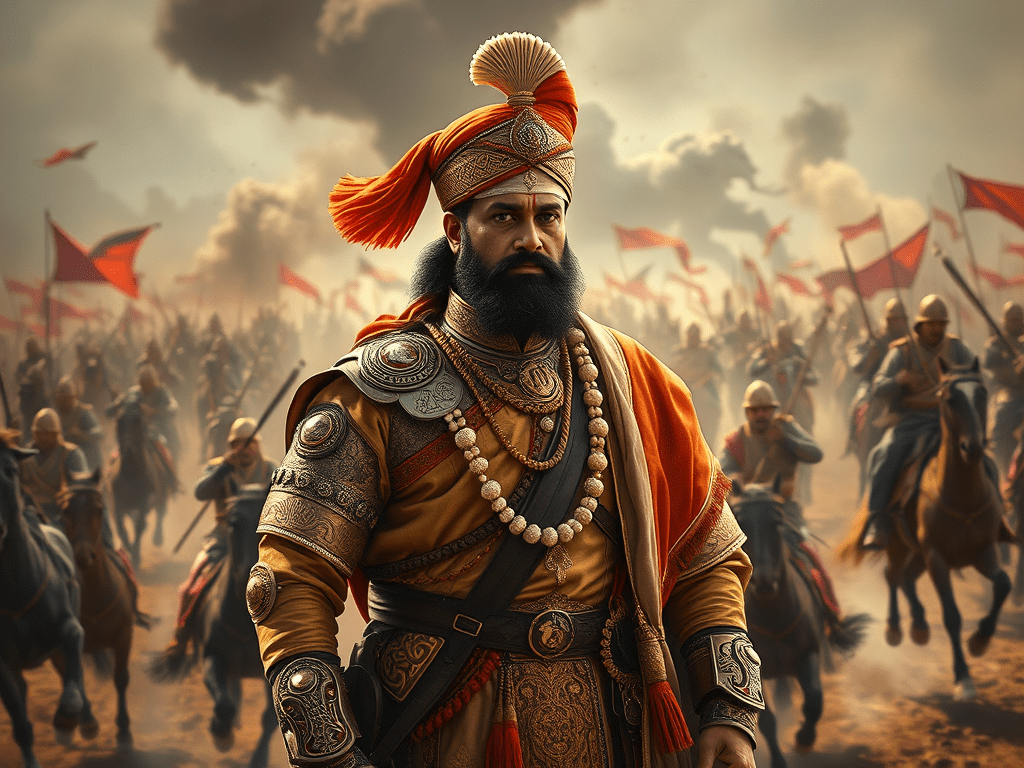
1. Introduction to Babur and the Mughal Empire
The Mughal Empire (1526–1857 CE) was one of the most significant dynasties in Indian history, known for its political, cultural, and architectural contributions. Founded by Zahir-ud-Din Muhammad Babur, a descendant of Timur (Tamerlane) and Genghis Khan, the empire marked the beginning of a centralized, culturally syncretic rule in India. Babur, born in 1483 in Farghana (modern-day Uzbekistan), established the Mughal dynasty after defeating Ibrahim Lodi at the First Battle of Panipat in 1526. His reign (1526–1530 CE) laid the foundation for Mughal dominance, characterized by military innovation, administrative reforms, and cultural integration.
For Babur’s period, literary sources like his autobiography, Tuzuk-i-Baburi (Baburnama), provide detailed insights into his life, campaigns, and administration, while archaeological evidence, such as forts and inscriptions, complements these accounts. Corroborating both sources is essential for a comprehensive understanding, as literary sources may reflect personal biases, and archaeological evidence offers tangible but limited cultural insights.
2. Chronology and Key Events
Babur’s reign is a short but pivotal phase in Mughal history, marking the transition from Central Asian warlord to Indian emperor. Key events include:
Pre-India Phase (1483–1526 CE):Born in Farghana,
Born in Farghana, Babur inherited the throne at age 12 but faced constant threats from Uzbeks and internal rivals.Captured and lost Samarkand multiple times, showcasing his ambition to emulate Timur.
Driven out of Central Asia by the Uzbeks, he established a base in Kabul (1504 CE), which became a springboard for his Indian campaigns.
Establishment of Mughal Rule (1526–1530 CE:
First Battle of Panipat (1526 CE): Defeated Ibrahim Lodi, the Delhi Sultan, using gunpowder, artillery, and tactical cavalry maneuvers (e.g., tulughma). This victory established Mughal rule in North India.Battle of Khanwa (1527 CE): Defeated Rana Sanga of Mewar, consolidating Mughal control over Rajput territories.
Battle of Chanderi (1528 CE): Defeated Medini Rai, further weakening Rajput resistance.
Battle of Ghaghra (1529 CE): Defeated Afghan chieftains, securing eastern territories like Bihar.
.
3. Archaeological Sources for Babur’s Reign
Archaeological evidence for Babur’s period is limited due to his short reign but includes forts, mosques, and material remains. The text classifies archaeological sources as structures, artifacts, and inscriptions, which provide insights into cultural and technological contexts.
Key Archaeological Findings:
- Structures:
- Babri Masjid (Ayodhya): Commissioned by Babur’s general Mir Baqi in 1528–29 CE, this mosque is a key architectural legacy, though controversial. Its construction reflects early Mughal architectural style with Central Asian influences.
- Kabul Bagh Mosque (Panipat): Built to commemorate the victory at Panipat, it showcases simple yet functional architecture.
- The text notes that monuments provide reliable socio-cultural information. These structures indicate Babur’s efforts to establish a Mughal presence through religious and commemorative architecture.
- Babri Masjid (Ayodhya): Commissioned by Babur’s general Mir Baqi in 1528–29 CE, this mosque is a key architectural legacy, though controversial. Its construction reflects early Mughal architectural style with Central Asian influences.
- Artifacts:
- Weapons and Artillery: Excavations at Panipat reveal remnants of matchlocks, cannons, and swords, reflecting Babur’s use of gunpowder technology, a novelty in Indian warfare.
- Coins: Silver shahrukhi coins minted during Babur’s reign bear his name and titles, indicating economic standardization. The text highlights coins as durable sources for understanding economic systems.
- Artifacts like pottery and tools from Mughal camps reflect Central Asian influences blended with local craftsmanship.
- Inscriptions:
- Inscriptions on the Babri Masjid and coins provide chronological and administrative details. The text classifies inscriptions as commercial or socio-cultural, and Babur’s inscriptions often proclaim his titles (e.g., Ghazi after Khanwa).
- Limited epigraphic evidence exists due to Babur’s short reign, but these inscriptions corroborate his Baburnama accounts.
- Inscriptions on the Babri Masjid and coins provide chronological and administrative details. The text classifies inscriptions as commercial or socio-cultural, and Babur’s inscriptions often proclaim his titles (e.g., Ghazi after Khanwa).
- Significance of Archaeological Sources:
- The text emphasizes archaeology’s role in reconstructing man-land relationships and cultural processes. Excavations at Panipat and Khanwa reveal battle strategies and encampments, supporting Babur’s military innovations.
- Scientific techniques like radiocarbon dating and GIS mapping (noted in the text) help date artifacts and map campaign routes, enhancing historical accuracy.
- The text emphasizes archaeology’s role in reconstructing man-land relationships and cultural processes. Excavations at Panipat and Khanwa reveal battle strategies and encampments, supporting Babur’s military innovations.
4. Literary Sources and Their Limitations
Babur’s reign is uniquely well-documented due to his autobiography, Tuzuk-i-Baburi (Baburnama), written in Chagatai Turkish. The text divides literary sources into religious and secular, with Baburnama being a secular, primary source. Other contemporary accounts and later Mughal chronicles also provide insights.
Key Literary Sources:
- Tuzuk-i-Baburi (Baburnama):
- A detailed memoir covering Babur’s life, campaigns, observations of India’s flora, fauna, and society, and administrative policies.
- The text praises autobiographical accounts for their direct perspective. Baburnama offers unparalleled insights into Babur’s strategies, personality, and cultural observations (e.g., his dislike for India’s climate but admiration for its resources).
- Translated into Persian during Akbar’s reign, it became a key historical text.
- Contemporary Chronicles:
- Afghan accounts, like those of Ibrahim Lodi’s court, provide limited perspectives due to their defeat and fragmentation.
- Rajput oral traditions (e.g., Mewar chronicles) describe Rana Sanga’s resistance but are biased against Babur.
- Later Mughal Chronicles:
- Works like Akbarnama (by Abu’l Fazl) and Tabaqat-i-Nasiri reference Babur’s reign but are retrospective and may idealize his achievements.
- Religious Texts:
- The text notes that religious texts (e.g., Islamic theological works) are less relevant for Babur’s period, as his reign focused on conquest and consolidation rather than religious codification.
Limitations:
- Bias in Baburnama: The text warns that literary sources reflect personal biases. Babur’s memoir, while detailed, portrays him favorably and may exaggerate victories or downplay setbacks.
- Oral Transmission: Rajput and Afghan accounts were initially oral, risking distortion, as noted in the text’s caution about Shruti traditions.
- Limited Contemporary Accounts: Few non-Mughal sources survive, limiting alternative perspectives. The text highlights the need to corroborate literary sources with archaeology.
- Language Barrier: Baburnama’s Chagatai Turkish was inaccessible to most Indian subjects, and translations (e.g., Persian) introduced potential errors.
5. Socio-Economic and Cultural Features
Babur’s short reign laid the groundwork for Mughal socio-economic and cultural systems, as reconstructed from archaeological and literary sources. The text emphasizes archaeology’s role in revealing lifestyles and literary sources’ contribution to event-based history.
Social Organization:
- Stratification: Babur maintained a Central Asian tribal hierarchy, with loyal nobles (amirs) and soldiers forming the elite. Baburnama describes rewarding followers with land grants, a precursor to the mansabdari system.
- Diverse Society: Babur ruled over a heterogeneous population of Muslims, Hindus, and tribal groups, with limited integration due to his short reign.
- The text notes that archaeology reveals social life, evident in varied burial practices (Islamic and local) found in early Mughal sites.
Economy:
- Agriculture: Babur’s Baburnama describes India’s fertile lands, with crops like wheat, rice, and sugarcane supporting the economy. He introduced Central Asian irrigation techniques.
- Trade: Control over Delhi-Agra routes facilitated trade in textiles, spices, and horses. Coins and seals indicate economic activity, aligning with the text’s mention of commercial inscriptions.
- Taxation: Babur retained Lodi taxation systems but introduced reforms for military funding, as noted in Baburnama.
Religion and Culture:
- Religious Policy: Babur, a Sunni Muslim, adopted a pragmatic approach, avoiding forced conversions. His construction of mosques (e.g., Babri Masjid) reflects Islamic identity, but Baburnama shows respect for local traditions.
- Cultural Syncretism: Babur’s Central Asian background influenced early Mughal art, seen in geometric patterns on mosques. Baburnama describes his love for gardens, laying the foundation for Mughal garden architecture (charbagh).
- The text classifies religious artifacts as didactic, and Babur’s mosques served as symbols of authority.
Technology:
- Military Technology: Babur’s use of gunpowder, cannons, and matchlocks (noted in Baburnama and archaeological finds) revolutionized Indian warfare.
- Architecture: Baked-brick mosques and temporary fortifications reflect Central Asian techniques adapted to Indian conditions.
- The text highlights archaeology’s role in understanding technology, evident in Babur’s artillery remnants.
6. Decline and Legacy of Babur’s Reign
Babur died in 1530 CE, and his reign ended abruptly, with his son Humayun inheriting a fragile empire. The text notes that archaeology informs about cultural shifts, while literary sources detail events.
Factors of Transition:
- Succession Challenges: Baburnama and Akbarnama describe Humayun’s struggles to consolidate power, facing Afghan and Rajput resistance.
- Fragile Empire: Babur’s short reign left limited administrative infrastructure, making the empire vulnerable to rebellion.
- Archaeological Evidence: Limited monumental construction reflects the brevity of Babur’s rule, with most structures attributed to later Mughals.
Legacy:
- Foundation of Mughal Rule: Babur’s victories established Mughal legitimacy, paving the way for Akbar’s consolidation.
- Military Innovation: His use of gunpowder influenced subsequent Indian warfare.
- Cultural Contributions: His love for gardens and literature (Baburnama) shaped Mughal cultural identity.
7. Integration of Literary and Archaeological Sources
The text stresses corroborating literary and archaeological evidence for a holistic historical reconstruction. For Babur:
- Literary Dominance: Baburnama provides detailed event-based history, unmatched by contemporary Indian sources. It covers battles, administration, and personal reflections.
- Archaeological Support: Mosques, coins, and weapon remnants corroborate Baburnama’s accounts of conquests and governance. For example, Panipat excavations confirm artillery use.
- Challenges: The text notes the difficulty of integrating biased literary sources with anonymous archaeological data. Baburnama’s personal perspective requires cross-verification with artifacts to avoid over-reliance.
- Complementary Insights: Literary sources detail events (e.g., battles), while archaeology reveals cultural processes (e.g., architecture, trade). Together, they reconstruct Babur’s reign comprehensively.
8. Relevance for Competitive Exams
Babur’s reign is a key topic in UPSC, BPSC, and other competitive exams, appearing in Prelims (factual recall) and Mains (analytical depth). Focus areas include:
- Battles: First Battle of Panipat, Khanwa, Chanderi, Ghaghra.
- Literary Source: Tuzuk-i-Baburi (Baburnama) as a primary source.
- Archaeological Evidence: Babri Masjid, coins, artillery.
- Military Innovations: Use of gunpowder and tulughma tactics.
- Legacy: Foundation of Mughal Empire, cultural contributions.
The text’s emphasis on critical source analysis aligns with Mains’ requirements for evaluating historical evidence. For Prelims, memorize key battles, dates, and Babur’s contributions.
9. Recent Developments (as of June 7, 2025)
- Babri Masjid Archaeological Surveys: Ongoing ASI surveys (post-2019) at Ayodhya clarify the mosque’s construction phases, supporting its attribution to Babur’s period.
- Panipat Excavations: Recent discoveries of cannon fragments and matchlocks (2023–24) confirm Babur’s use of gunpowder, aligning with Baburnama.
- Digital Archiving of Baburnama: Manuscript translations and digital archives enhance access to Babur’s memoir for researchers.
These align with the text’s emphasis on scientific techniques (e.g., archaeology, digital humanities) enhancing historical research.
10. Conclusion
Babur’s reign (1526–1530 CE) marked the establishment of the Mughal Empire in India, characterized by military conquests, early administrative reforms, and cultural contributions. Literary sources, particularly Tuzuk-i-Baburi, provide detailed event-based history, while archaeological evidence (mosques, coins, weapons) offers insights into cultural and technological contexts. The text’s advocacy for corroborating both sources is critical for understanding Babur’s era, given the biases in Baburnama and the limited scope of archaeology. For competitive exams, mastering Babur’s battles, innovations, and legacy, alongside recent archaeological findings, is essential for both factual and analytical responses.
Key Points for Quick Revision
- Reign: 1526–1530 CE; founded Mughal Empire.
- Key Battles: Panipat (1526), Khanwa (1527), Chanderi (1528), Ghaghra (1529).
- Literary Source: Tuzuk-i-Baburi (Baburnama), a detailed autobiography.
- Archaeological Evidence: Babri Masjid, Kabul Bagh Mosque, coins, artillery.
- Innovations: Gunpowder, cannons, tulughma tactics.
- Economy: Agriculture, trade routes, early taxation reforms.
- Culture: Central Asian influence in architecture (mosques, gardens).
- Legacy: Foundation for Mughal Empire, military and cultural contributions.
- Exam Tips: Focus on battles, Baburnama, archaeological evidence, and recent findings.

Leave a comment