
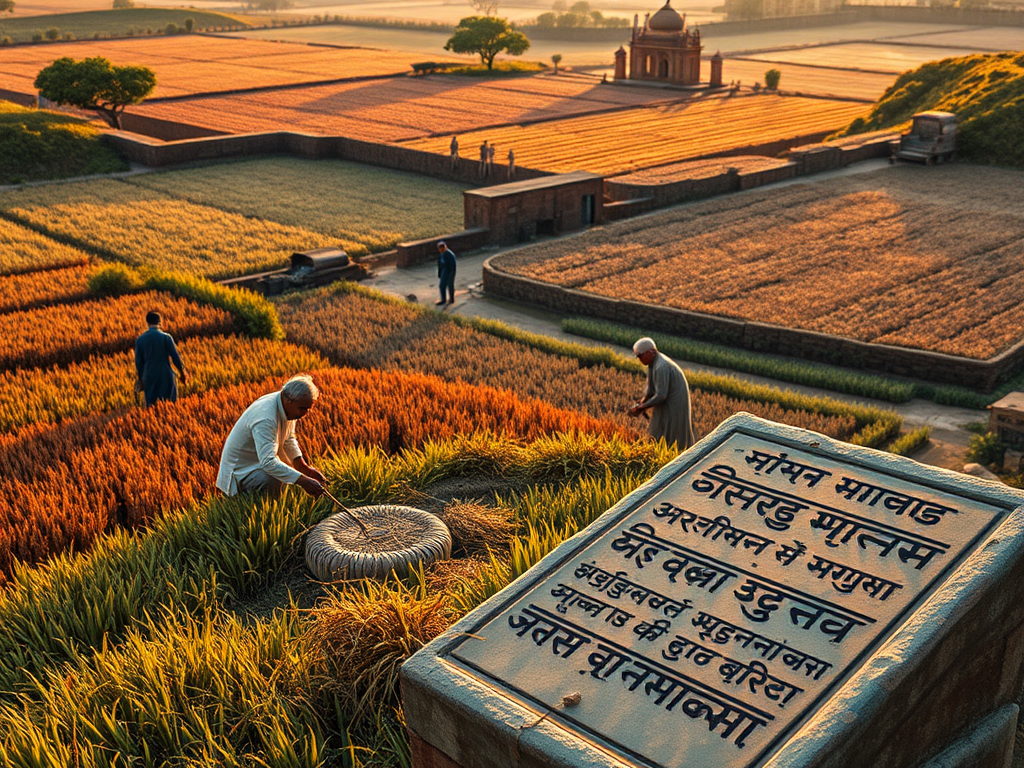
1. Introduction to the Mughal Land Revenue System
The Mughal Empire (1526–1857 CE) relied heavily on its land revenue system as the backbone of its economy, funding military campaigns, administration, and imperial projects. The system evolved significantly over time, with notable reforms under emperors like Akbar, Shah Jahan, and Aurangzeb. It was designed to extract surplus agricultural produce while maintaining productivity and social stability. The system’s complexity, involving land measurement, tax assessment, and collection mechanisms, reflected the Mughal state’s administrative sophistication.
The provided text emphasizes the importance of corroborating literary and archaeological sources for historical reconstruction. For the Mughal land revenue system, literary sources like Ain-i-Akbari and European accounts provide detailed descriptions of policies and practices, while archaeological evidence, such as revenue records inscribed on stone and artifacts, offers tangible insights into implementation. Integrating both sources is crucial, as literary accounts may reflect courtly biases, and archaeological evidence focuses on material and cultural contexts.
2. Chronology and Evolution of the Land Revenue System
The Mughal land revenue system evolved through distinct phases under different emperors, shaped by administrative needs and regional challenges:
- Babur (1526–1530 CE):
- Adopted the existing Lodi revenue system, based on crop-sharing and customary taxes.
- Tuzuk-i-Baburi mentions ad-hoc assessments due to his short reign and focus on conquests.
- Humayun (1530–1556 CE):
- Attempted to streamline revenue collection but faced disruptions due to his exile and conflicts with the Suris.
- Limited reforms due to political instability.
- Akbar (1556–1605 CE):
- Introduced the zabt system under Raja Todar Mal, standardizing land measurement and tax assessment.
- Implemented the dahsala system (1570s), a 10-year average of crop yields to fix revenue rates.
- Classified land into categories (polaj, parauti, chachar, banjar) based on fertility and cultivation status.
- Jahangir and Shah Jahan (1605–1658 CE):
- Continued Akbar’s zabt system with minor modifications.
- Shah Jahan emphasized revenue collection to fund architectural projects (e.g., Taj Mahal), increasing pressure on peasants.
- Aurangzeb (1658–1707 CE):
- Expanded the zabt system to newly conquered Deccan territories but faced challenges due to rebellions and overextension.
- Increased revenue demand to fund wars, leading to peasant distress, as noted in European accounts.
The text highlights that literary sources provide event-based history, while archaeology reveals cultural processes. Chronicles like Ain-i-Akbari detail revenue policies, while inscriptions and artifacts corroborate their implementation.
3. Archaeological Sources for the Land Revenue System
Archaeological evidence, including inscriptions, revenue records, and material remains, provides insights into the Mughal land revenue system’s implementation. The text classifies these as inscriptions, artifacts, and structures, emphasizing their role in understanding economic and administrative contexts.
Key Archaeological Findings:
- Inscriptions:
- Stone事例: Stone inscriptions of farmans (royal decrees) and revenue grants detail tax rates and land assignments (jagirs). These align with the text’s classification of inscriptions as socio-cultural and commercial sources.
- Examples include sanad inscriptions granting jagirs to mansabdars, reflecting revenue distribution.
- Artifacts:
- Coins: Mughal silver rupiyas and gold mohurs reflect standardized currency used in revenue payments. The text notes coins as durable economic indicators.
- Revenue Records: Preserved land measurement tools and tax documents (on paper or stone) indicate systematic assessments, especially under Akbar’s zabt system.
- Structures:
- Administrative buildings, such as diwankhanas (revenue offices) in Agra and Lahore, reflect centralized revenue collection.
- Irrigation systems (e.g., canals in Punjab) supported agricultural productivity, indirectly aiding revenue collection.
- Significance of Archaeological Sources:
- The text emphasizes archaeology’s role in reconstructing man-land relationships. Inscriptions and irrigation remains highlight the Mughal focus on agricultural surplus extraction.
- Scientific techniques like GIS mapping (noted in the text) help trace land use patterns, confirming the extent of cultivated areas under Mughal rule.
4. Literary Sources and Their Limitations
Literary sources provide detailed insights into the Mughal land revenue system, but their biases require archaeological corroboration. The text divides literary sources into religious and secular, noting their historical value but cautioning against biases.
Key Literary Sources:
- Ain-i-Akbari:
- Written by Abu’l Fazl, this text details Akbar’s zabt and dahsala systems, land classifications, and revenue rates (e.g., 1/3 of produce as tax).
- The text praises court chronicles for administrative details but notes their bias toward glorifying rulers.
- European Accounts:
- Travelers like Francois Bernier and Jean-Baptiste Tavernier describe revenue collection, noting peasant burdens under Shah Jahan and Aurangzeb.
- The text cautions that foreign accounts may misinterpret local systems due to cultural differences.
- Regional Records:
- Rajput, Maratha, and Deccan records mention revenue demands but are often biased against Mughal policies.
- The text notes that regional accounts, sometimes oral, risk distortion.
- Administrative Documents:
- Mughal farmans and revenue ledgers detail jagirdari (land grant) and khalisa (crown land) systems, providing procedural insights.
Limitations:
- Courtly Bias: Ain-i-Akbari glorifies Akbar’s reforms, potentially understating implementation challenges.
- Foreign Misinterpretations: European accounts may exaggerate peasant oppression, as noted in the text’s caution about foreign perceptions.
- Regional Bias: Non-Mughal records may reflect anti-Mughal sentiments, requiring archaeological validation.
- Limited Rural Perspective: Most sources focus on state policies, with little insight into peasant experiences.
5. Socio-Economic and Cultural Features of the Land Revenue System
The Mughal land revenue system was a cornerstone of its socio-economic structure, influencing agriculture, administration, and social hierarchy. The text emphasizes archaeology’s role in revealing economic contexts and literary sources’ contribution to policy details.
Key Features:
- Land Classification and Assessment:
- Akbar’s zabt system involved measuring land (jarib method) and assessing taxes based on productivity. Land was classified as:
- Polaj: Continuously cultivated, high-yielding.
- Parauti: Fallow for a year, moderately productive.
- Chachar: Fallow for 3–4 years, less productive.
- Banjar: Uncultivated, minimally taxed.
- The dahsala system used 10-year yield averages to fix taxes, ensuring predictability, as detailed in Ain-i-Akbari.
- Akbar’s zabt system involved measuring land (jarib method) and assessing taxes based on productivity. Land was classified as:
- Revenue Collection:
- Taxes were collected in cash (zabt) or kind (batai), with rates typically 1/3 to 1/2 of the produce.
- Jagirdars (land grant holders) collected revenue for the state, retaining a portion for themselves. Khalisa lands were directly managed by the crown.
- The text notes that inscriptions (e.g., farmans) document these arrangements, reflecting economic organization.
- Social Impact:
- The system supported a hierarchical society, with jagirdars and zamindars (local landlords) acting as intermediaries, often exploiting peasants.
- Heavy taxation under Shah Jahan and Aurangzeb led to peasant unrest, as noted in European accounts.
- The text highlights archaeology’s role in revealing social life, evident in rural settlement patterns and irrigation systems.
- Economic Impact:
- Revenue funded military campaigns, infrastructure (e.g., canals, roads), and imperial projects (e.g., Taj Mahal).
- Over-taxation under Aurangzeb strained the economy, contributing to decline, as evidenced by reduced coin minting in later years.
- Cultural Context:
- The system reinforced Mughal authority through jagirdari assignments, integrating regional elites into the imperial framework.
- Religious policies (e.g., Aurangzeb’s jizya) intersected with revenue, as non-Muslims faced additional taxes, impacting social cohesion.
Technological Aspects:
- Land Measurement: Tools like ropes and chains (jarib) ensured accurate assessments, as evidenced by archaeological finds.
- Irrigation: Canals and wells, supported by state funds, boosted productivity, with remains found in Punjab and Agra.
- The text highlights archaeology’s role in understanding technology, evident in these irrigation and measurement artifacts.
6. Decline and Legacy of the Land Revenue System
The Mughal land revenue system began to falter under Aurangzeb and collapsed in the 18th century due to several factors. The text notes that archaeology informs about economic shifts, while literary sources detail administrative challenges.
Factors of Decline:
- Over-Taxation: Aurangzeb’s high revenue demands to fund Deccan wars caused peasant distress and rebellions, as noted in Bernier’s accounts.
- Administrative Inefficiencies: Overextended jagirdari systems led to corruption and reduced remittances to the crown, as documented in later Mughal records.
- Regional Resistance: Maratha, Sikh, and Jat uprisings disrupted revenue collection, particularly in the Deccan and Punjab.
- Archaeological Evidence: Declining mint activity and abandoned irrigation systems post-1707 reflect economic decline.
Legacy:
- Influence on Later Systems: The Mughal revenue system influenced British colonial land revenue policies (e.g., zamindari and ryotwari systems).
- Economic Foundation: It sustained Mughal power for two centuries, funding their military and cultural achievements.
- Social Impact: The system entrenched rural hierarchies, shaping India’s agrarian structure for centuries.
7. Integration of Literary and Archaeological Sources
The text stresses corroborating literary and archaeological evidence for a comprehensive historical reconstruction. For the Mughal land revenue system:
- Literary Dominance: Ain-i-Akbari and European accounts provide detailed policy descriptions, such as zabt and dahsala mechanics.
- Archaeological Support: Inscriptions, coins, and irrigation remains corroborate literary accounts of revenue collection and agricultural support.
- Challenges: The text notes the difficulty of integrating biased literary sources with anonymous archaeological data. Ain-i-Akbari’s idealized descriptions require validation from inscriptions and settlement patterns.
- Complementary Insights: Literary sources detail policies and events, while archaeology reveals implementation and economic impacts (e.g., irrigation systems, coin circulation).
8. Relevance for Competitive Exams
The Mughal land revenue system is a key topic in UPSC, BPSC, and other competitive exams, appearing in Prelims (factual recall) and Mains (analytical depth). Focus areas include:
- Key Reforms: Akbar’s zabt and dahsala systems, Todar Mal’s role.
- Land Classifications: Polaj, parauti, chachar, banjar.
- Revenue Collection: Jagirdari, khalisa, cash vs. kind taxes.
- Literary Sources: Ain-i-Akbari, European accounts, farmans.
- Archaeological Evidence: Inscriptions, coins, irrigation systems.
- Decline: Over-taxation, rebellions, administrative inefficiencies.
The text’s emphasis on critical source analysis aligns with Mains’ requirements for evaluating historical evidence. For Prelims, memorize key reforms, classifications, and impacts.
9. Recent Developments (as of June 7, 2025)
- Archaeological Surveys: ASI excavations (2024) in Punjab uncovered Mughal-era irrigation canals, confirming state investment in agriculture.
- Digital Archiving: Digitized Ain-i-Akbari and farman records enhance research access, aligning with the text’s emphasis on scientific techniques.
- Revenue Record Studies: Recent analyses of Mughal sanad inscriptions (2023–24) clarify jagirdari land grants, supporting literary accounts.
10. Conclusion
The Mughal land revenue system was a sophisticated mechanism that sustained the empire’s economic and military power for over two centuries. Evolving from Babur’s ad-hoc taxes to Akbar’s zabt and dahsala systems, it maximized agricultural surplus but faced challenges under Aurangzeb due to over-taxation and rebellions. Literary sources like Ain-i-Akbari provide policy details, while archaeological evidence (inscriptions, coins, irrigation remains) reveals implementation and economic impacts. The text’s advocacy for corroborating both sources is critical, given literary biases and archaeology’s anonymous nature. For competitive exams, mastering the system’s reforms, impacts, and decline, alongside recent findings, is essential for factual recall and analytical depth.
Key Points for Quick Revision
- Evolution: From Lodi crop-sharing to Akbar’s zabt and dahsala systems.
- Land Classifications: Polaj, parauti, chachar, banjar.
- Revenue Collection: Jagirdari, khalisa, 1/3–1/2 produce as tax.
- Literary Sources: Ain-i-Akbari, European accounts, farmans.
- Archaeological Evidence: Inscriptions, coins, irrigation systems.
- Decline: Over-taxation, rebellions, administrative inefficiencies under Aurangzeb.
- Legacy: Influenced British revenue systems, shaped agrarian hierarchy.
- Exam Tips: Focus on reforms, classifications, sources, decline, and recent findings.

Leave a comment