
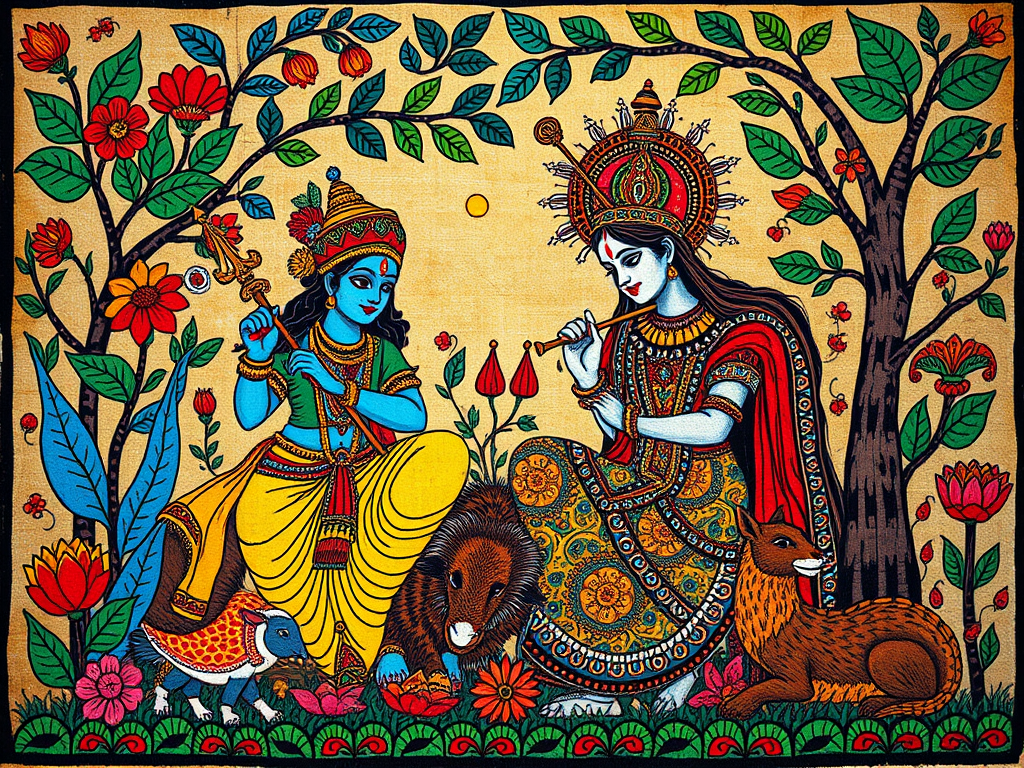
Introduction to Bihar’s Art and Culture
Bihar, a state with a rich historical and cultural heritage, has contributed significantly to Indian art and culture. Its artistic traditions, deeply rooted in history, reflect the socio-cultural, religious, and mythological ethos of the region. For UPSC and BPSC aspirants, understanding Bihar’s art forms, particularly Madhubani painting, Patna Kalam, Manjusha, and others, is crucial due to their frequent appearance in the syllabus under Indian Art and Culture (UPSC GS-I) and Bihar-specific culture (BPSC).This note provides a detailed overview of Madhubani art and other prominent art forms of Bihar, their historical context, characteristics, and significance, along with probable questions for Prelims and Mains examinations.
1. Madhubani Art (Mithila Painting)Madhubani painting, also known as Mithila painting, is one of the most celebrated folk art forms of India, originating from the Mithila region of Bihar. It is recognized globally for its vibrant colors, intricate patterns, and cultural symbolism.Origin and History
- Geographical Origin: Madhubani painting hails from the Mithila region, primarily in the districts of Madhubani, Darbhanga, Sitamarhi, Muzaffarpur, Saharsa, Madhepura, and Supaul in Bihar, and parts of Nepal.
- Historical Context:
- Traces of Madhubani art are linked to the Ramayana, where King Janaka is said to have commissioned artists to decorate his palace for Sita’s wedding to Lord Rama.
- Traditionally practiced by women, it was used to decorate homes during festivals, weddings, and rituals.
- Gained international recognition in the 1930s after British officials discovered it during an earthquake survey in Bihar.
- GI Tag: Received a Geographical Indication (GI) tag in 2010, recognizing its unique cultural heritage.
Characteristics
- Themes: Depict mythological stories (Hindu deities like Krishna, Rama, Shiva, Durga, Lakshmi, Saraswati), nature (sun, moon, plants, animals), social events (weddings, festivals), and philosophical dualisms.
- Materials:
- Traditionally done on freshly plastered mud walls; now also on cloth, handmade paper, and canvas for commercial purposes.
- Natural dyes and pigments derived from plants, soot, cow dung, rice powder, and other organic sources.
- Tools include fingers, twigs, matchsticks, and bamboo brushes. Modern brushes are also used.
- Styles: Madhubani painting has five distinct styles:StylePracticed ByFeaturesBharniBrahmana communityBright colors filling mythological figures with bold black outlines.KachniKayastha communityDominated by intricate line work rather than filled colors.TantrikVarious communitiesDepicts religious and tantric themes, including snake worship.GodnaLower caste communitiesTattoo-like designs with simple patterns.GeruLower caste communitiesEarthy tones with folk motifs.
- Patterns: Geometric designs, floral, animal, and bird motifs, with no empty spaces left on the canvas.
- Kohbar: A special form of Madhubani painting made for wedding ceremonies, depicting fertility symbols and marital bliss.
Significance
- Cultural Importance: Reflects the socio-religious life of Mithila, symbolizing prosperity, fertility, and spiritual beliefs.
- Economic Impact: Provides livelihood to rural artists, especially women, and has gained commercial popularity globally.
- Modern Adaptations: Used in contemporary products like masks, sarees, and home decor. For example, Madhubani artists created masks with traditional motifs during the COVID-19 pandemic.
- Recognition: Promoted by initiatives like painting the Madhubani Railway Station and Sampark Kranti Express with Madhubani designs.
2. Other Prominent Art Forms of Bihar
Bihar’s artistic heritage extends beyond Madhubani to include several other unique forms, each with distinct characteristics and historical significance.2.1 Patna Kalam (Patna School of Painting)
- Origin: An offshoot of Mughal miniature painting, flourishing from the early 18th to mid-20th century in Patna, Danapur, and Arrah.
- History:
- Developed under the patronage of local aristocracy and East India Company officials.
- Emerged when Mughal artists migrated to Patna after facing persecution under Aurangzeb’s anti-art policies.
- Characteristics:
- Combines Persian and Indian styles, focusing on everyday life, festivals (e.g., Holi, Durga Puja), and portraits of common people.
- Painted on paper, ivory, or mica using watercolors.
- Known for realistic depictions and fine detailing, unlike the symbolic nature of Madhubani.
- Significance:
- Less commercialized than Madhubani but considered superior by some art historians.
- Preserved in institutions like Patna Museum and Khuda Bakhsh Library.
- Challenges: Faces competition from the more popular Madhubani art due to its folk appeal and professional marketing.
2.2 Manjusha Art (Snake Painting)
- Origin: Originated in Bhagalpur, Bihar, associated with the Bihula-Bishari legend, a folk tale about snake worship.
- Characteristics:
- Depicts mythological narratives, particularly the Bihula-Bishari story, with snake motifs.
- Uses vibrant colors (pink, green, yellow) and simple, bold lines.
- Traditionally painted on paper or cloth, often during the Bishari Puja festival.
- Significance:
- A sacred art form linked to local religious practices.
- Gaining recognition through government efforts to promote it alongside Madhubani.
2.3 Tikuli Art
- Origin: A traditional craft from Patna, derived from the practice of decorating bindis (forehead dots).
- Characteristics:
- Miniature paintings on glazed tiles or hardboard, depicting scenes from mythology, nature, and daily life.
- Uses enamel paint and intricate detailing, similar to miniature paintings.
- Significance:
- A lesser-known art form, now being revived through commercial products like coasters and wall hangings.
- Represents the delicate craftsmanship of Bihar’s artisans.
2.4 Sujni Embroidery
- Origin: Originated in Bhusura village, Bihar, practiced by women as a form of quilt-making.
- Characteristics:
- Embroidery on layered cloth, depicting social themes, folklore, and daily life.
- Uses simple running stitches with vibrant threads.
- Received a GI tag for its cultural uniqueness.
- Significance:
- Empowers women artisans by providing economic opportunities.
- Reflects social issues like education, women’s rights, and environmental awareness.
2.5 Mauryan and Pala Art
While not folk arts, these historical art forms are significant for BPSC aspirants due to their relevance to Bihar’s ancient heritage.
- Mauryan Art:
- Period: 4th–2nd century BCE, under Ashoka and his successors.
- Features:
- Polished stone pillars (e.g., Sarnath Pillar) with animal sculptures and Dhamma inscriptions.
- Yakshini statue from Didarganj, Patna, showcasing realistic sculptural art.
- Rock-cut caves like Barabar and Nagarjuni in Gaya, used by Ajivikas and Buddhists.
- Significance: Reflects the influence of Buddhism and Persian art, marking Bihar as a center of early Indian art.
- Pala Art:
- Period: 8th–12th century CE, under the Pala dynasty.
- Features:
- Mahaviharas (e.g., Vikramshila, Nalanda) with rectangular courtyards and Buddhist motifs.
- Bronze sculptures and illuminated manuscripts with intricate designs.
- Patronized both Buddhist and Hindu art.
- Significance: Represents Bihar’s contribution to medieval Indian art and Buddhist education.
3. Comparative Table of Bihar’s Art Forms
| Art Form | Origin | Key Features | Themes | Materials/Tools | Significance |
|---|---|---|---|---|---|
| Madhubani | Mithila region (Madhubani, etc.) | Vibrant colors, geometric patterns, no empty spaces, five styles (Bharni, Kachni, etc.) | Mythology, nature, social events | Natural dyes, fingers, twigs, bamboo | Cultural heritage, GI tag, global fame |
| Patna Kalam | Patna, Danapur, Arrah | Realistic depictions, Mughal influence, fine detailing | Daily life, festivals | Watercolors, paper, ivory, mica | Historical art, less commercialized |
| Manjusha | Bhagalpur | Bold lines, vibrant colors, snake motifs | Bihula-Bishari legend, mythology | Paper, cloth, natural colors | Religious and cultural significance |
| Tikuli | Patna | Miniature paintings on tiles/hardboard, delicate designs | Mythology, nature, daily life | Enamel paint, tiles | Revival of traditional craftsmanship |
| Sujni Embroidery | Bhusura village | Running stitches, layered cloth, social themes | Social issues, folklore | Thread, cloth | Women empowerment, GI tag |
4. Probable Questions for UPSC and BPSC ExaminationsPrelims Questions (Objective Type)
- Which of the following is a characteristic of Madhubani painting?
- A) Use of synthetic colors only
- B) Geometric patterns and no empty spaces
- C) Exclusive use of modern brushes
- D) Depiction of abstract art only
- Answer: B) Geometric patterns and no empty spaces
- The Madhubani painting tradition is associated with which region of Bihar?
- A) Magadha
- B) Mithila
- C) Anga
- D) Vaishali
- Answer: B) Mithila
- Which art form of Bihar received a GI tag in 2010?
- A) Patna Kalam
- B) Manjusha
- C) Madhubani
- D) Tikuli
- Answer: C) Madhubani
- Which of the following art forms is an offshoot of Mughal painting?
- A) Madhubani
- B) Patna Kalam
- C) Sujni Embroidery
- D) Manjusha
- Answer: B) Patna Kalam
- What is the primary theme of Manjusha art in Bihar?
- A) Hindu deities
- B) Bihula-Bishari legend
- C) Mauryan sculptures
- D) Buddhist architecture
- Answer: B) Bihula-Bishari legend
Mains Questions and Model Answers
- Question: Discuss the salient features of Madhubani painting and its significance in preserving the cultural heritage of Bihar. (150 words)
- Answer: Madhubani painting, originating from Bihar’s Mithila region, is a vibrant folk art known for its intricate geometric patterns, vivid colors, and symbolic motifs. Traditionally practiced by women, it adorns mud walls, cloth, and paper, depicting Hindu deities, nature, and social events like weddings. Its five styles—Bharni, Kachni, Tantrik, Godna, and Geru—reflect diverse community influences. Natural dyes from plants and tools like fingers and twigs are used, emphasizing its eco-friendly nature. Madhubani received a GI tag in 2010, affirming its cultural uniqueness. Its global recognition, seen in initiatives like painting railway stations, highlights its economic potential for rural artisans. By preserving mythological and social narratives, Madhubani serves as a living tradition, fostering cultural continuity and women’s empowerment in Bihar.
- Answer: Madhubani painting, originating from Bihar’s Mithila region, is a vibrant folk art known for its intricate geometric patterns, vivid colors, and symbolic motifs. Traditionally practiced by women, it adorns mud walls, cloth, and paper, depicting Hindu deities, nature, and social events like weddings. Its five styles—Bharni, Kachni, Tantrik, Godna, and Geru—reflect diverse community influences. Natural dyes from plants and tools like fingers and twigs are used, emphasizing its eco-friendly nature. Madhubani received a GI tag in 2010, affirming its cultural uniqueness. Its global recognition, seen in initiatives like painting railway stations, highlights its economic potential for rural artisans. By preserving mythological and social narratives, Madhubani serves as a living tradition, fostering cultural continuity and women’s empowerment in Bihar.
- Question: Compare and contrast Madhubani painting and Patna Kalam painting, highlighting their historical evolution and artistic styles. (250 words)
- Answer: Madhubani and Patna Kalam paintings are two distinct art forms from Bihar, each with unique historical roots and stylistic features. Madhubani, originating from the Mithila region, traces its history to the Ramayana era, where it was used to decorate homes during festivals. It is a folk art practiced primarily by women, characterized by vibrant colors, geometric patterns, and mythological themes (e.g., Hindu deities, nature). Its five styles (Bharni, Kachni, etc.) use natural dyes and traditional tools like twigs, leaving no empty spaces on the canvas. It gained global fame post-1930s and received a GI tag in 2010.
Patna Kalam, an offshoot of Mughal miniature painting, flourished in the 18th–20th centuries in Patna under local and East India Company patronage. It focuses on realistic depictions of daily life and festivals, using watercolors on paper or mica with fine detailing, blending Persian and Indian styles.
While Madhubani is symbolic and folk-based, Patna Kalam is realistic and Mughal-inspired. Madhubani enjoys greater commercial success, while Patna Kalam remains less recognized but historically significant. Both reflect Bihar’s rich artistic heritage, with Madhubani emphasizing cultural rituals and Patna Kalam documenting social life.
- Answer: Madhubani and Patna Kalam paintings are two distinct art forms from Bihar, each with unique historical roots and stylistic features. Madhubani, originating from the Mithila region, traces its history to the Ramayana era, where it was used to decorate homes during festivals. It is a folk art practiced primarily by women, characterized by vibrant colors, geometric patterns, and mythological themes (e.g., Hindu deities, nature). Its five styles (Bharni, Kachni, etc.) use natural dyes and traditional tools like twigs, leaving no empty spaces on the canvas. It gained global fame post-1930s and received a GI tag in 2010.
- Question: Evaluate the role of Bihar’s folk arts in promoting socio-economic development and cultural preservation. (200 words)
- Answer: Bihar’s folk arts, including Madhubani, Manjusha, Tikuli, and Sujni embroidery, play a pivotal role in socio-economic development and cultural preservation. Madhubani, a globally recognized art with a GI tag, empowers rural women artisans by providing economic opportunities through commercial products like sarees, masks, and decor. Its promotion on railway stations and trains enhances tourism and local economies. Similarly, Sujni embroidery, with its GI tag, supports women’s livelihoods by addressing social themes, fostering economy independence.Manjusha art preserves the Bihula-Bishari legend, reinforcing cultural identity during festivals, while Tikuli art’s revival through modern products promotes traditional craftsmanship. These arts sustain Bihar’s intangible cultural heritage, passing down mythological and social narratives across generations. Government initiatives and NGO support have boosted their global visibility, creating markets for artisans. However, challenges like lack of marketing for Patna Kalam and limited awareness of lesser-known arts need addressing. By integrating these arts into education and tourism, Bihar can enhance socio-economic growth while preserving its rich cultural legacy for future generations.


Leave a comment