
Subject: Chemistry, Hydrogen Production, Renewable Energy
Topic: Steam Methane Reforming (SMR) and Hydrogen Types
1. Overview of Hydrogen Production
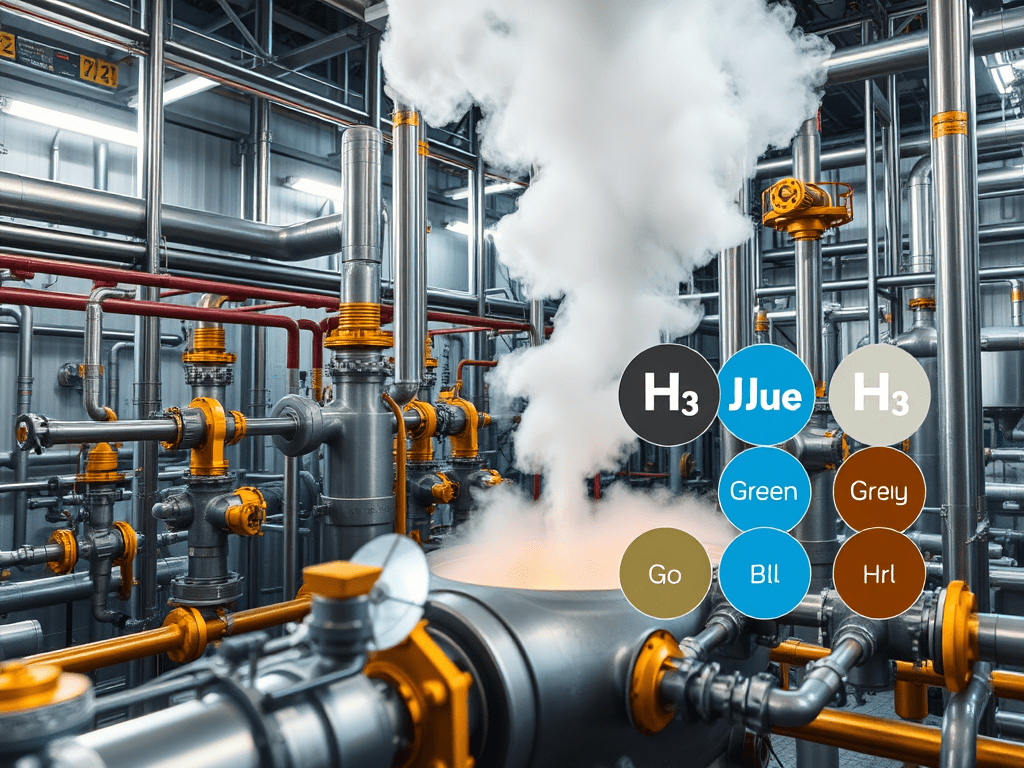
Hydrogen is a clean energy carrier used in industries, fuel cells, and energy storage. It is classified based on its production method and environmental impact into categories like Green, Grey, Blue, and Brown Hydrogen. The Steam Methane Reforming (SMR) technique is a widely used industrial process for hydrogen production.
2. Steam Methane Reforming (SMR) Process
- Definition: SMR is a chemical process that produces hydrogen by reacting natural gas (primarily methane, CH₄) with steam (H₂O) under high temperatures and pressure.
- Process:
- Reforming Reaction: Methane reacts with steam in the presence of a catalyst (usually nickel-based) at 700–1000°C and 20–30 bar pressure.
- Reaction: CH₄ + H₂O → CO + 3H₂ (Endothermic)
- Water-Gas Shift Reaction: Carbon monoxide (CO) reacts with additional steam to produce more hydrogen and carbon dioxide.
- Reaction: CO + H₂O → CO₂ + H₂ (Exothermic)
- Reforming Reaction: Methane reacts with steam in the presence of a catalyst (usually nickel-based) at 700–1000°C and 20–30 bar pressure.
- Output: Hydrogen (H₂) and Carbon Dioxide (CO₂).
- Byproduct: Significant CO₂ emissions, making SMR environmentally impactful.
3. Types of Hydrogen
| Type | Production Method | Environmental Impact | CO₂ Emissions |
|---|---|---|---|
| Green Hydrogen | Electrolysis using renewable energy (solar, wind) | Environmentally friendly, zero CO₂ emissions | None |
| Grey Hydrogen | SMR or gasification of fossil fuels (natural gas) | High CO₂ emissions, non-renewable | High |
| Blue Hydrogen | SMR with carbon capture and storage (CCS) | Reduced CO₂ emissions due to CCS | Low |
| Brown Hydrogen | Gasification of coal | High CO₂ emissions, highly polluting | Very High |
Key Point for MCQ:
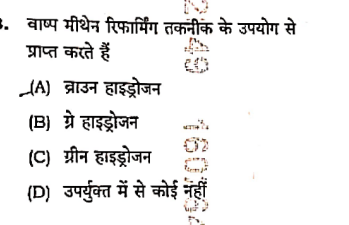
Question: Steam methane reforming technique is used to obtain:
(A) Brown Hydrogen
(B) Grey Hydrogen
(C) Green Hydrogen
(D) None of the above
Answer: (B) Grey Hydrogen
Explanation: SMR produces hydrogen from natural gas, resulting in Grey Hydrogen, which generates significant CO₂ emissions as a byproduct.
4. Advantages and Disadvantages of SMR
| Aspect | Details |
|---|---|
| Advantages | Cost-effective and widely used. – High hydrogen yield. – Established technology. |
| Disadvantages | High CO₂ emissions (8–12 kg CO₂ per kg H₂). – Relies on non-renewable natural gas. – Not sustainable in the long term. |
5. Environmental and Policy Relevance
- Environmental Concern: SMR contributes to greenhouse gas emissions, making it less sustainable compared to green hydrogen.
- Policy Context: Governments worldwide are promoting Green Hydrogen (via electrolysis using renewable energy) to meet net-zero targets (e.g., India’s National Hydrogen Mission launched in 2021).
- UPSC Relevance: Questions on hydrogen economy, renewable energy, and climate change mitigation are common in UPSC and BPSC exams.
6. Probable MCQs for UPSC/BPSC
- Which of the following processes is used to produce Grey Hydrogen?
(A) Electrolysis
(B) Steam Methane Reforming
(C) Biomass Gasification
(D) Photolysis
Answer: (B) Steam Methane Reforming - What is the primary byproduct of Steam Methane Reforming?
(A) Oxygen
(B) Carbon Dioxide
(C) Nitrogen
(D) Sulfur Dioxide
Answer: (B) Carbon Dioxide - Which type of hydrogen production is most environmentally friendly?
(A) Grey Hydrogen
(B) Blue Hydrogen
(C) Green Hydrogen
(D) Brown Hydrogen
Answer: (C) Green Hydrogen - India’s National Hydrogen Mission primarily focuses on promoting:
(A) Grey Hydrogen
(B) Blue Hydrogen
(C) Green Hydrogen
(D) Brown Hydrogen
Answer: (C) Green Hydrogen
7. Mains Questions and Answers
Question 1: Discuss the significance of Steam Methane Reforming in hydrogen production and its environmental implications. How does it compare to Green Hydrogen production?
Answer:
- Introduction: Hydrogen is a versatile energy carrier critical for decarbonizing industries. Steam Methane Reforming (SMR) is the dominant method for hydrogen production globally, accounting for ~50% of the world’s hydrogen supply.
- SMR Process: SMR involves reacting methane with steam to produce hydrogen and CO₂. It is cost-effective but generates 8–12 kg CO₂ per kg of hydrogen, classifying the output as Grey Hydrogen.
- Environmental Implications:
- High CO₂ emissions contribute to climate change.
- Dependence on natural gas, a non-renewable resource, limits sustainability.
- Alternatives like Blue Hydrogen (SMR with carbon capture) reduce emissions but are costlier.
- Comparison with Green Hydrogen:
- Green Hydrogen is produced via electrolysis using renewable energy, resulting in zero CO₂ emissions.
- It is more sustainable but currently expensive due to high energy costs and infrastructure needs.
- SMR is cheaper and widely used but environmentally detrimental.
- Conclusion: Transitioning to Green Hydrogen is crucial for sustainable development. Policies like India’s National Hydrogen Mission aim to scale up green hydrogen production to meet climate goals.
Question 2: Evaluate the role of hydrogen as a clean energy source in India’s energy transition. How can technologies like SMR and electrolysis contribute?
Answer:
- Introduction: Hydrogen is pivotal for India’s energy transition, supporting net-zero goals by 2070. It can decarbonize sectors like transport, industry, and power generation.
- Role of Hydrogen:
- Acts as an energy storage medium for renewable energy.
- Replaces fossil fuels in hard-to-abate sectors (e.g., steel, ammonia production).
- India’s National Hydrogen Mission aims to produce 5 million tonnes of green hydrogen by 2030.
- Contribution of SMR:
- Provides a cost-effective, large-scale hydrogen supply (Grey Hydrogen).
- Can be paired with carbon capture (Blue Hydrogen) for lower emissions.
- Limitations: High CO₂ emissions and reliance on fossil fuels.
- Contribution of Electrolysis:
- Produces Green Hydrogen using renewable energy, aligning with sustainability goals.
- Challenges: High costs and need for renewable energy infrastructure.
- Conclusion: While SMR can meet immediate hydrogen demands, scaling up electrolysis for Green Hydrogen is critical for long-term sustainability. Investments in R&D, renewable energy, and policy support are essential.
8. Key Points for Quick Revision
- SMR: Produces Grey Hydrogen using natural gas; high CO₂ emissions.
- Green Hydrogen: Produced via electrolysis with renewable energy; zero emissions.
- India’s Focus: National Hydrogen Mission promotes Green Hydrogen for sustainability.
- UPSC/BPSC Tip: Focus on environmental impact, hydrogen types, and policy initiatives for MCQs and mains.


Leave a reply to Bpsc 70th solved question re-exam – cracktarget Cancel reply