
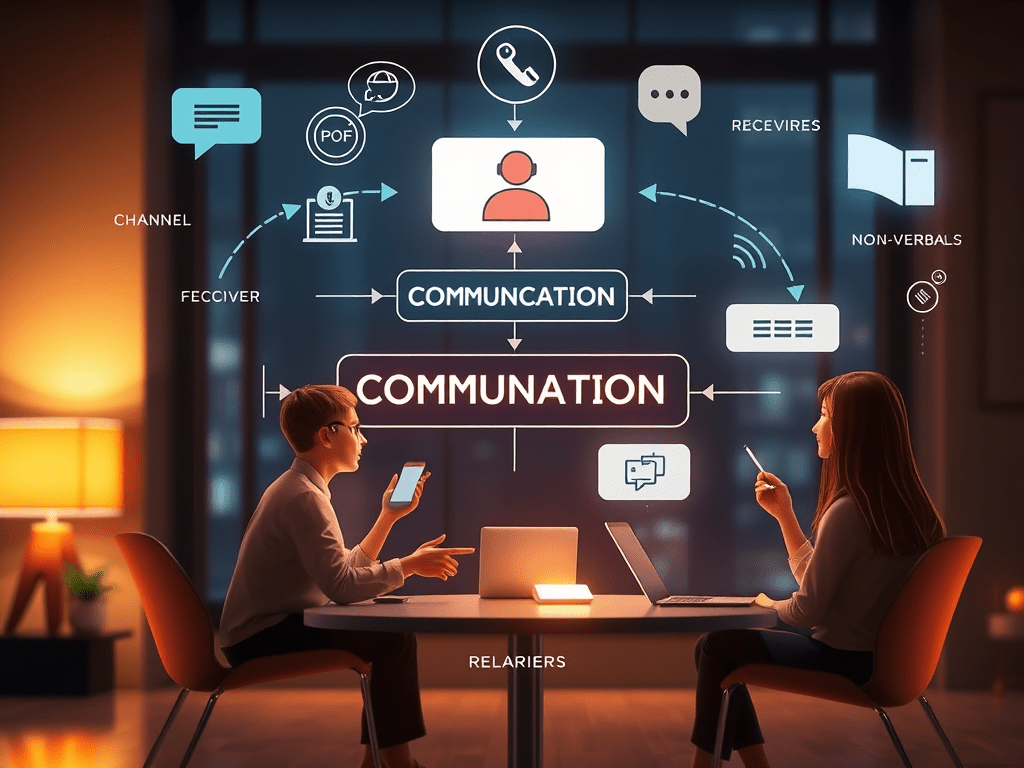
Chapter 1: The Communication Process – Foundations and Dynamics
Communication, the lifeblood of human interaction and organizational functioning, is the process of exchanging information, ideas, feelings, or meanings between individuals or groups through a shared system of symbols. As defined by Harold Lasswell in his seminal model (1948), communication answers “Who says what, in which channel, to whom, with what effects?” This process is not merely transactional but relational, influencing decision-making, relationships, and outcomes. In organizational contexts, effective communication drives efficiency, innovation, and morale, while breakdowns lead to conflicts and failures.
The communication process, formalized by Claude Shannon and Warren Weaver in The Mathematical Theory of Communication (1949), involves several interdependent elements:
- Sender (Encoder): The originator who formulates the message, encoding thoughts into symbols (words, gestures). In regulatory bodies like India’s Pension Fund Regulatory and Development Authority (PFRDA), a manager encodes policy updates on the National Pension System (NPS) for stakeholders.
- Message: The content conveyed, which can be verbal, non-verbal, or visual. Clarity and relevance are key to avoiding distortion.
- Channel: The medium of transmission (detailed in Chapter 2), selected based on context—e.g., email for formal updates versus face-to-face for sensitive feedback.
- Receiver (Decoder): The recipient who interprets the message, decoding symbols back into meaning. Cultural and perceptual differences can alter interpretation.
- Feedback: The response loop, confirming understanding or seeking clarification. Essential for two-way communication, as in Berlo’s SMCR model (1960), which adds source, message, channel, receiver factors.
- Noise/Barriers: Interferences disrupting the process (explored in Chapter 3), such as semantic misunderstandings or physical distractions.
- Context/Environment: The situational backdrop, including cultural, social, or organizational norms. In 2025’s hybrid work era, digital contexts amplify virtual noise.
The process is cyclical and iterative, not linear—feedback refines future exchanges. Models like Schramm’s (1954) emphasize shared fields of experience for effective decoding. In financial sectors like RBI or SEBI, precise communication ensures regulatory compliance; missteps, as in the 2016 demonetization rollout, highlight process flaws. Benefits include enhanced collaboration; challenges stem from globalization’s diverse interpretations. In 2025, AI tools augment the process, automating encoding/decoding for efficiency.
Chapter 2: Channels of Communication – Pathways and Classifications
Channels are the conduits through which messages travel, influencing speed, accuracy, and reception. Selection depends on message complexity, urgency, and audience—formal channels follow hierarchies, informal (grapevine) spread rumors. Wilbur Schramm in The Process and Effects of Mass Communication (1954) classified channels by sensory modes and formality.
Oral vs. Written Channels:
- Oral: Verbal exchanges like meetings, calls, or speeches. Advantages: Immediate feedback, tone conveyance; drawbacks: No permanent record, misinterpretation risks. In PFRDA, oral channels facilitate subscriber queries via helplines.
- Written: Documents like emails, reports, memos. Benefits: Tangible, referenceable; challenges: Time-consuming, lacks non-verbal cues. RBI uses written channels for policy circulars, ensuring audit trails.
Verbal vs. Non-Verbal Channels:
- Verbal: Language-based, oral or written. Includes semantics and syntax; prone to jargon barriers in technical fields like NABARD’s agri-finance communications.
- Non-Verbal: Body language, gestures, facial expressions, proxemics (space), haptics (touch), and paralinguistics (tone). Albert Mehrabian’s 7-38-55 rule (1971) suggests 55% of emotional communication is non-verbal, 38% vocal, 7% words—crucial in cross-cultural India, where gestures vary regionally.
Other Classifications:
- Formal vs. Informal: Formal (downward/upward/horizontal) follows structures; informal builds relationships but spreads misinformation.
- Digital vs. Traditional: In 2025, digital channels (apps, VR) dominate, blending oral/written (e.g., video calls).
- Mass vs. Interpersonal: Mass for broad reach (e.g., SEBI public notices); interpersonal for personalized feedback.
Channels evolve with technology; 2025 trends include AI chatbots for real-time oral simulations. Effective use minimizes barriers, as in PFRDA’s multichannel approach for pension education.
Chapter 3: Barriers to Communication – Obstacles and Mitigation Strategies
Barriers, or noise in Shannon-Weaver’s model, impede message fidelity, leading to misunderstandings. Classified as physical, semantic, psychological, organizational, and cultural, they reduce efficiency—studies show poor communication costs U.S. firms $1.2 trillion yearly (Grammarly 2023, projected higher in 2025).
Physical Barriers: Environmental distractions like noise, distance, or tech failures. In hybrid setups, poor internet hampers RBI video conferences; solutions: Reliable infrastructure, noise-cancellation tools.
Semantic Barriers: Language issues—jargon, ambiguity, translation errors. In multilingual India, RBI’s Hindi-English policies address this; mitigation: Clear, simple language and glossaries.
Psychological Barriers: Perceptions, biases, emotions (e.g., stress reducing listening). Halo effect distorts feedback; 2025 mental health focus aids via mindfulness training.
Organizational Barriers: Hierarchical rigidity, overload. In PSUs, bureaucracy delays; flatten structures and open-door policies help.
Cultural Barriers: Differences in norms (Hofstede’s dimensions)—high-context India vs. low-context West. Global teams in SEBI face this; cross-cultural training resolves.
Emerging Barriers in 2025: Digital overload (info fatigue), AI misinterpretations (e.g., biased chatbots). Overcome via digital literacy and ethical AI design. In PFRDA, barriers risk misinforming subscribers on NPS; proactive audits ensure clarity.
Chapter 4: The Role of IT in Communication – Transformations and Trends in 2025
Information Technology (IT) revolutionizes communication, enabling instant, global connectivity and data-driven interactions. From ARPANET’s origins (1969) to today’s cloud ecosystems, IT shifts paradigms—McLuhan’s “global village” (1964) realized via digital channels.
Key Roles:
- Efficiency and Accessibility: Tools like email, Slack, and Zoom facilitate seamless oral/written exchanges, reducing barriers. In RBI, IT enables real-time policy dissemination.
- Collaboration Enhancement: Platforms (Microsoft Teams) support verbal/non-verbal cues via video, fostering morale in remote teams.
- Data Analytics and Personalization: AI analyzes patterns for targeted messaging; in PFRDA, chatbots personalize pension queries.
- Security and Compliance: Encryption and blockchain protect sensitive data, vital for SEBI’s market communications.
2025 Trends: AI as standard for automation and personalization 0 , enhanced security 0 , hybrid work tech (UCaaS convergence) 12 , AI-driven transcription/summarization 6 , hyper-personalization against misinformation 9 , and employee experience focus in internal comms 1 . Challenges: Digital divide, privacy concerns (GDPR-like laws). In India, IT’s role in Digital India initiative amplifies financial communication, as in NABARD’s rural apps.
Chapter 5: Integration and Applications in Organizational Contexts
Communication’s process, channels, barriers, and IT role interlink for holistic efficacy. In 2025, regulatory bodies like PFRDA leverage IT to overcome barriers, enhancing channels for stakeholder engagement. Future: VR for immersive non-verbal comms, AI ethics in processes.
Multiple-Choice Questions for Self-Assessment
- In Lasswell’s model, communication answers:
A) How and why
B) Who says what, to whom
C) Where and when
D) Cost and benefit - The sender in the communication process is also known as:
A) Decoder
B) Encoder
C) Noise
D) Feedback - Which channel allows immediate feedback but lacks records?
A) Written
B) Oral
C) Non-verbal
D) Digital - Mehrabian’s rule attributes 55% of emotional communication to:
A) Words
B) Tone
C) Body language
D) Context - Semantic barriers primarily involve:
A) Physical noise
B) Language issues
C) Emotional stress
D) Hierarchical structures - In 2025, a key IT trend in communication is:
A) Manual typing
B) AI-driven personalization
C) Ignoring security
D) Offline modes - Psychological barriers include:
A) Internet failures
B) Biases and perceptions
C) Jargon
D) Distance - IT’s role in overcoming barriers includes:
A) Increasing noise
B) Encryption for security
C) Reducing accessibility
D) Limiting channels - Which model emphasizes shared experience for effective communication?
A) Shannon-Weaver
B) Schramm’s
C) Berlo’s
D) Lasswell’s - Hybrid work in 2025 amplifies which barrier?
A) Semantic
B) Physical (connectivity)
C) Cultural
D) Organizational
Correct Answers for Verification
- B) Who says what, to whom
- B) Encoder
- B) Oral
- C) Body language
- B) Language issues
- B) AI-driven personalization
- B) Biases and perceptions
- B) Encryption for security
- B) Schramm’s
- B) Physical (connectivity)


Leave a comment