
Basic 100 Rules Prepared By Cracktarget.com for Competitive Exams
A. Subject-Verb Agreement (Tricks 1-10)
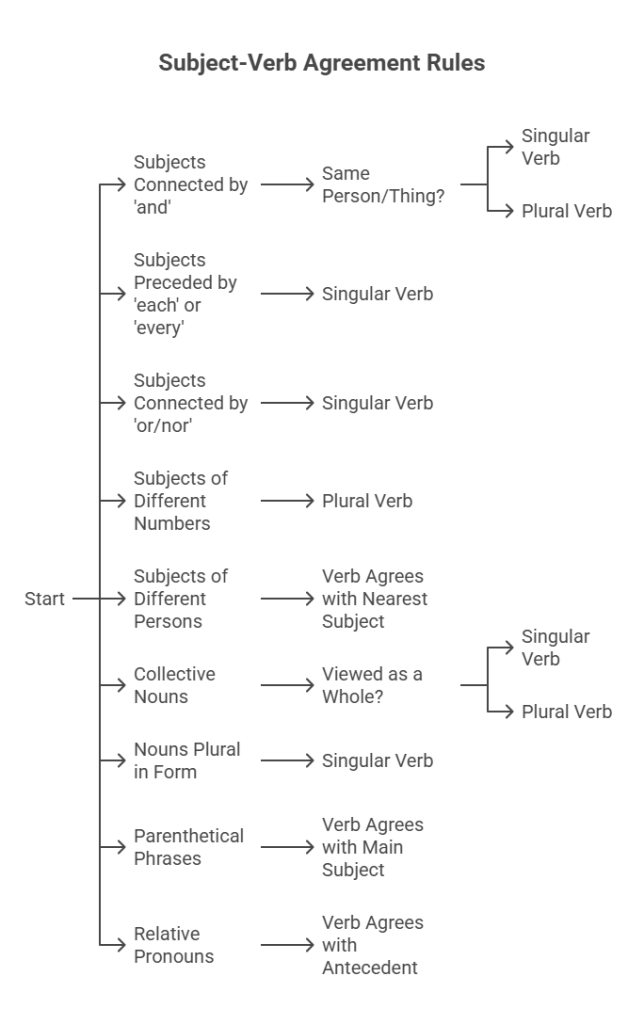
- Two or More Singular Subjects Connected by ‘and’: When two or more singular subjects are connected by ‘and’, they typically form a plural unit, requiring a plural verb. This treats the subjects as separate entities acting together. However, if they refer to the same thing or a single unit, use singular.
- Example 1: Incorrect – Hari and Ram is here. Correct – Hari and Ram are here.
- Example 2: Incorrect – The pen and the paper is on the table. Correct – The pen and the paper are on the table.
- Example 3: Incorrect – My friend and mentor is arriving. Correct – My friend and mentor is arriving (same person).
- Singular Nouns Referring to the Same Person or Thing:
If two singular nouns connected by ‘and’ refer to the same person or thing, the verb must be singular, as they are not separate entities.
- Example 1: Incorrect – The Secretary and Principal are coming. Correct – The Secretary and Principal is coming.
- Example 2: Incorrect – The captain and leader are guiding the team. Correct – The captain and leader is guiding the team.
- Example 3: Incorrect – The poet and artist are famous. Correct – The poet and artist is famous.
- Singular Subjects Preceded by ‘each’ or ‘every’: When singular subjects are preceded by ‘each’ or ‘every’, the verb is usually singular, emphasizing individual action.
- Example 1: Incorrect – Every boy and girl were ready. Correct – Every boy and girl was ready.
- Example 2: Incorrect – Each student and teacher were present. Correct – Each student and teacher was present.
- Example 3: Incorrect – Every man and woman were invited. Correct – Every man and woman was invited.
- Singular Subjects Connected by ‘or’, ‘nor’, ‘either…or’, ‘neither…nor’: Such connections take a singular verb, as they indicate alternatives or exclusions.
- Example 1: Incorrect – Neither he nor I were there. Correct – Neither he nor I was there.
- Example 2: Incorrect – Either the cat or the dog were barking. Correct – Either the cat or the dog was barking.
- Example 3: Incorrect – Nor the teacher nor the student were aware. Correct – Nor the teacher nor the student was aware.
- Subjects of Different Numbers Joined by ‘or/nor’: The verb must be plural, and the plural subject should be placed closest to the verb for agreement.
- Example 1: Incorrect – Neither the Assistant Masters nor the Headmaster was present. Correct – Neither the Headmaster nor the Assistant Masters were present.
- Example 2: Incorrect – Either the books or the pen was lost. Correct – Either the pen or the books were lost.
- Example 3: Incorrect – Nor the child nor the parents was happy. Correct – Nor the parents nor the child were happy.
- Subjects of Different Persons Joined by ‘or/nor’: The verb agrees in person with the subject nearest to it.
- Example 1: Incorrect – Either he or I is mistaken. Correct – Either he or I am mistaken.
- Example 2: Incorrect – Neither you nor she is responsible. Correct – Neither you nor she is responsible.
- Example 3: Incorrect – Either they or I is going. Correct – Either they or I am going.
- Collective Nouns: A collective noun takes a singular verb when viewed as a whole unit, but a plural verb when individuals are emphasized.
- Example 1: The Council has chosen the President.
- Example 2: The military were called out.
- Example 3: The family is united in its decision.
- Nouns Plural in Form but Singular in Meaning: Some nouns that appear plural but are singular in meaning take a singular verb (note: the original rule statement was misphrased; corrected here based on the example).
- Example 1: Incorrect – Mathematics are a branch of study in every school. Correct – Mathematics is a branch of study in every school.
- Example 2: Incorrect – Physics are interesting. Correct – Physics is interesting.
- Example 3: Incorrect – News are good today. Correct – News is good today.
- Parenthetical Phrases with Singular Subjects: Words like ‘with’, ‘together with’, ‘in addition to’, ‘as well as’ do not affect the verb; the verb agrees with the main singular subject.
- Example 1: Incorrect – The Chief, with all his men, were massacred. Correct – The Chief, with all his men, was massacred.
- Example 2: Incorrect – The teacher, along with the students, were excited. Correct – The teacher, along with the students, was excited.
- Example 3: Incorrect – The book, as well as the pen, were missing. Correct – The book, as well as the pen, was missing.
- Relative Pronouns and Verb Agreement: The verb must agree in number and person with the antecedent of the relative pronoun.
- Example 1: Incorrect – I, who is your friend, will guard your interests. Correct – I, who am your friend, will guard your interests.
- Example 2: Incorrect – You, who is responsible, must fix it. Correct – You, who are responsible, must fix it.
- Example 3: Incorrect – The dog that are barking is mine. Correct – The dog that is barking is mine.
B. Uses of Participles and Infinitives (Tricks 11-20)
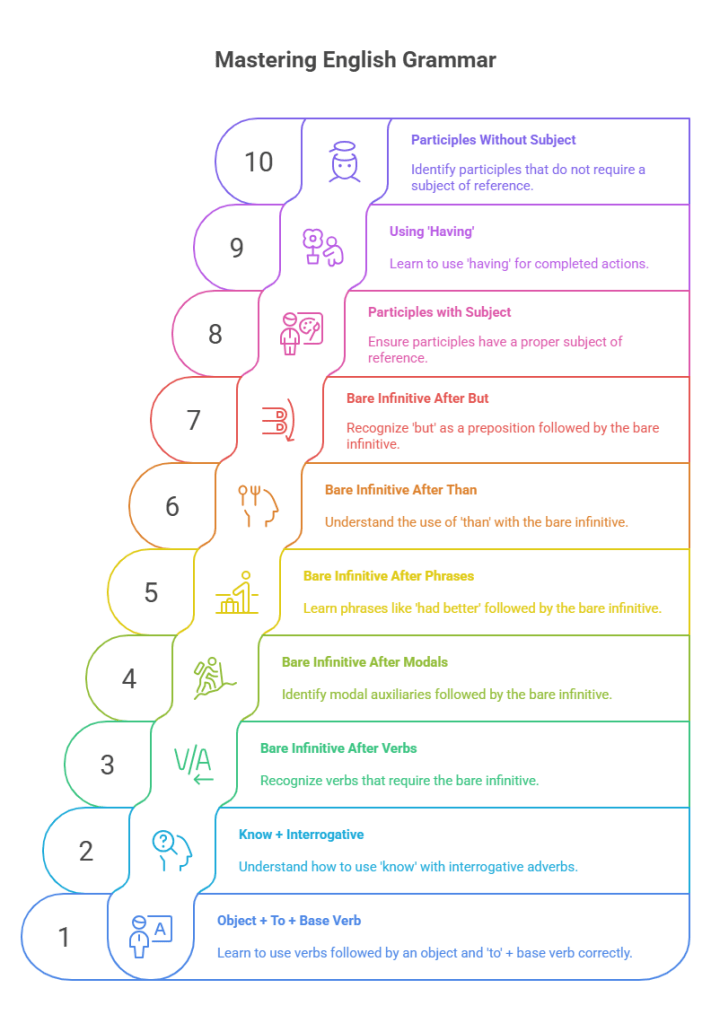
- Verbs Followed by Object + To + Base Verb: Verbs like ask, advise, allow, command, etc., are followed by an object and ‘to’ + base verb. In passive, it’s ‘to’ + base verb.
- Example 1: Incorrect – He advised to do it by me. Correct – He advised me to do it.
- Example 2: Incorrect – She allowed to play outside by the child. Correct – She allowed the child to play outside.
- Example 3: Incorrect – They were permitted to leave early. Correct – They were permitted to leave early (passive).
- ‘Know’ Followed by How/Where/When/Why + Infinitive: ‘Know’ requires an interrogative adverb before the infinitive to indicate manner or reason.
- Example 1: Incorrect – I know to write a letter. Correct – I know how to write a letter.
- Example 2: Incorrect – He knows to find the place. Correct – He knows where to find the place.
- Example 3: Incorrect – She knows to start the machine. Correct – She knows when to start the machine.
- Bare Infinitive After Certain Verbs: Verbs like let, bid, behold, watch, see, feel, make require the bare infinitive (without ‘to’).
- Example 1: Incorrect – I heard him to speak on several subjects. Correct – I heard him speak on several subjects.
- Example 2: Incorrect – Let her to go home. Correct – Let her go home.
- Example 3: Incorrect – Make the child to eat. Correct – Make the child eat.
- Bare Infinitive After Modal Auxiliaries: Modals like can, could, may, might, shall, should, will, would, must, dare not, need not are followed by the bare infinitive.
- Example 1: Incorrect – You need not to work hard. Correct – You need not work hard.
- Example 2: Incorrect – She must to finish now. Correct – She must finish now.
- Example 3: Incorrect – He could to help us. Correct – He could help us.
- Bare Infinitive After ‘Had Better’, ‘Had Rather’, etc.: Phrases like ‘had better’, ‘had rather’, ‘had as soon as’, ‘had sooner’ are followed by the bare infinitive.
- Example 1: Incorrect – He had better to go now. Correct – He had better go now.
- Example 2: Incorrect – I had rather to stay home. Correct – I had rather stay home.
- Example 3: Incorrect – She had sooner to leave than argue. Correct – She had sooner leave than argue.
- Bare Infinitive After ‘Than’: The conjunction ‘than’ is followed by the bare infinitive in comparisons.
- Example 1: Incorrect – He had better read than to write. Correct – He had better read than write.
- Example 2: Incorrect – It is better to walk than to drive in traffic. Correct – It is better to walk than drive in traffic.
- Example 3: Incorrect – She prefers to sing than to dance. Correct – She prefers to sing than dance.
- Bare Infinitive After ‘But’ as Preposition: When ‘but’ acts as a preposition after forms of ‘do’, it is followed by the bare infinitive.
- Example 1: Incorrect – He did nothing but to wander. Correct – He did nothing but wander.
- Example 2: Incorrect – She does nothing but to complain. Correct – She does nothing but complain.
- Example 3: Incorrect – They did everything but to succeed. Correct – They did everything but succeed.
- Participles Must Have a Subject of Reference: Every participle requires a proper subject of reference to avoid dangling modifiers.
- Example 1: Incorrect – Being a rainy day Vijay decided to stay at home. Correct – It being a rainy day Vijay decided to stay at home.
- Example 2: Incorrect – Walking home, the rain started. Correct – Walking home, I saw the rain start.
- Example 3: Incorrect – Tired from work, the bed looked inviting. Correct – Tired from work, she found the bed inviting.
- Using ‘Having’ for Completed Actions: For completed actions, use ‘having’ + past participle in active voice, or ‘having been’ + past participle in passive. Avoid ‘after’.
- Example 1: Incorrect – After the leader having been killed, the followers ran away. Correct – The leader having been killed, the followers ran away.
- Example 2: Incorrect – After having finished the meal, we left. Correct – Having finished the meal, we left.
- Example 3: Incorrect – After being warned, he stopped. Correct – Having been warned, he stopped.
- Participles Without Subject of Reference: Certain participles like considering, judging, referring, concerning, regarding, viewing, broadly speaking do not require a subject of reference.
- Example 1: Considering the case, I took the decision.
- Example 2: Regarding your request, we approve it.
- Example 3: Broadly speaking, the plan is good.
C. Uses of Verbs (Tricks 21-36)
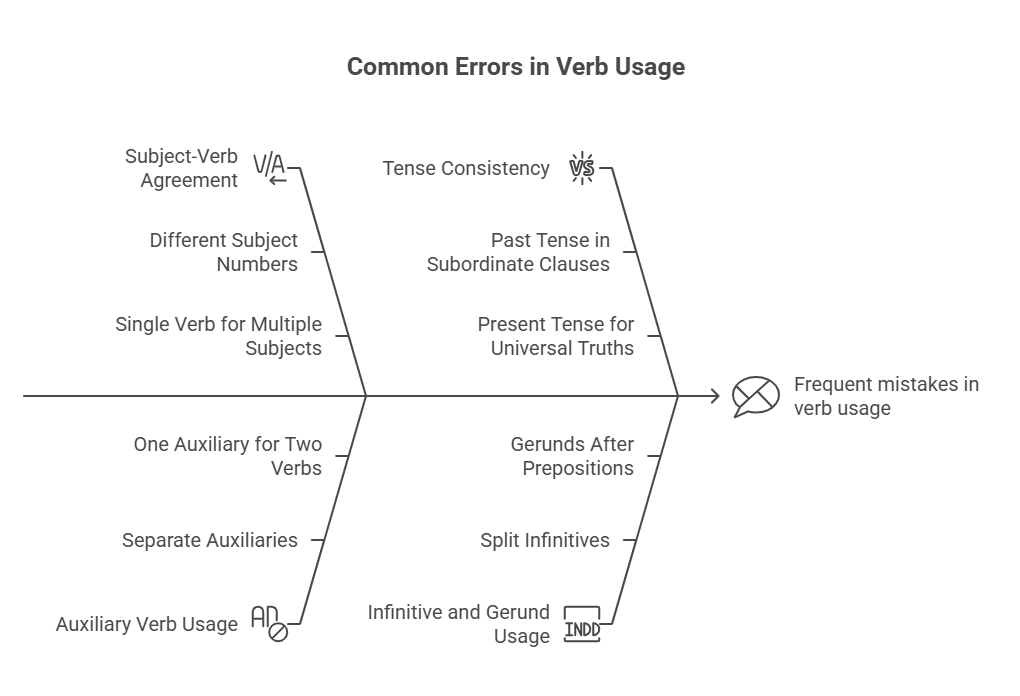
- Separate Auxiliaries for Subjects of Different Numbers: When two subjects differ in number, use separate auxiliaries for each.
- Example 1: Incorrect – Three killed and one were injured. Correct – Three were killed and one was injured.
- Example 2: Incorrect – Two students and the teacher is absent. Correct – Two students are and the teacher is absent.
- Example 3: Incorrect – The dogs and the cat was playing. Correct – The dogs were and the cat was playing.
- Single Verb for Two Subjects with Same Form: A single verb can serve two subjects if it fits both in form.
- Example 1: Incorrect – I am seventeen years old and my sister fourteen. Correct – I am seventeen years old and my sister is fourteen.
- Example 2: Incorrect – He is tall and his brother short. Correct – He is tall and his brother is short.
- Example 3: Incorrect – The car is new and the bike old. Correct – The car is new and the bike is old.
- Two Auxiliaries with One Principal Verb: Two auxiliaries can be used if the principal verb fits both in form.
- Example 1: Incorrect – He never has, and never will take such strong measures. Correct – He never has taken, and never will take such strong measures.
- Example 2: Incorrect – She has, and will continue to support us. Correct – She has supported, and will continue to support us.
- Example 3: Incorrect – They could, and would help if asked. Correct – They could help, and would help if asked.
- One Auxiliary for Two Principal Verbs: The auxiliary should be correctly associated with both verbs.
- Example 1: Incorrect – Ten candidates have passed one failed. Correct – Ten candidates have passed, one has failed.
- Example 2: Incorrect – Some arrived others left. Correct – Some have arrived, others have left.
- Example 3: Incorrect – He ran she walked. Correct – He has run, she has walked.
- Past Tense in Main Clause Followed by Past in Subordinate: A past tense in the main clause is usually followed by past tense in the subordinate clause for consistency.
- Example 1: Incorrect – He succeeded because he works hard. Correct – He succeeded because he worked hard.
- Example 2: Incorrect – She said that she knows him. Correct – She said that she knew him.
- Example 3: Incorrect – I went there because I want to see it. Correct – I went there because I wanted to see it.
- Past in Main, Present in Subordinate for Universal Truths: A past tense in the main clause can be followed by present tense in the subordinate if it expresses a universal truth.
- Example 1: Incorrect – Our teacher said that the earth moved round the sun. Correct – Our teacher said that the earth moves round the sun.
- Example 2: Incorrect – He told me that honesty was the best policy. Correct – He told me that honesty is the best policy.
- Example 3: Incorrect – The scientist proved that water boiled at 100°C. Correct – The scientist proved that water boils at 100°C.
- ‘Lest’ Followed by ‘Should’: The subordinate clause after ‘lest’ uses ‘should’, regardless of the main clause tense, to express fear or prevention.
- Example 1: Incorrect – We start early lest we shall miss the train. Correct – We start early lest we should miss the train.
- Example 2: Incorrect – Speak softly lest she hears us. Correct – Speak softly lest she should hear us.
- Example 3: Incorrect – Work hard lest you fails. Correct – Work hard lest you should fail.
- Avoid Split Infinitives: An adverb or adverbial phrase should not be placed between ‘to’ and the verb in an infinitive.
- Example 1: Incorrect – I hoped to immediately reply to your letter. Correct – I hoped to reply immediately to your letter.
- Example 2: Incorrect – She tried to quickly finish the task. Correct – She tried to finish the task quickly.
- Example 3: Incorrect – He wanted to carefully examine the evidence. Correct – He wanted to examine the evidence carefully.
- Infinitive in Present Tense Unless Prior Action: The infinitive should be in the present tense unless it represents an action prior to the governing verb.
- Example 1: Incorrect – I should have liked to have gone there. Correct – I should have liked to go there.
- Example 2: Incorrect – We are happy to have met you. Correct – We are happy to have met you (prior).
- Example 3: Incorrect – He seems to have forgotten. Correct – He seems to have forgotten (prior).
- Possessive Pronoun with Gerund: A gerund preceded by a pronoun must use the possessive case.
- Example 1: Incorrect – He emphasised me going there. Correct – He emphasised my going there.
- Example 2: Incorrect – I appreciate him helping us. Correct – I appreciate his helping us.
- Example 3: Incorrect – She disliked them arriving late. Correct – She disliked their arriving late.
- Present Perfect Continuous for Ongoing Actions with Duration: Use for actions starting in the past and continuing, with ‘since’, ‘for’, ‘how long’.
- Example 1: Incorrect – How long are you working in this office? Correct – How long have you been working in this office?
- Example 2: Incorrect – I am living here for five years. Correct – I have been living here for five years.
- Example 3: Incorrect – How long is it raining? Correct – How long has it been raining?
- Gerund After Preposition: A verb after a preposition must be in gerund form.
- Example 1: Incorrect – They were punished for come late. Correct – They were punished for coming late.
- Example 2: Incorrect – He is good at solve problems. Correct – He is good at solving problems.
- Example 3: Incorrect – She insisted on see the manager. Correct – She insisted on seeing the manager.
- No Future Tense in Clauses of Time, Place, Condition: Use present indefinite in such clauses, even for future actions.
- Example 1: Incorrect – I shall wait for you till you will finish your work. Correct – I shall wait for you till you finish your work.
- Example 2: Incorrect – If it will rain, we won’t go. Correct – If it rains, we won’t go.
- Example 3: Incorrect – Stay where you will be safe. Correct – Stay where you are safe.
- No Present Perfect with Past Time Adverbs: Use past indefinite with adverbs like yesterday, in 1990.
- Example 1: Incorrect – I have bought a cycle yesterday. Correct – I bought a cycle yesterday.
- Example 2: Incorrect – She has left last week. Correct – She left last week.
- Example 3: Incorrect – They have arrived in the morning. Correct – They arrived in the morning.
- No Direct Combination of Modal Auxiliaries: Modals cannot be used together; connect with a conjunction if needed.
- Example 1: Incorrect – He should must do it. Correct – He should and must do it.
- Example 2: Incorrect – You can might help. Correct – You can and might help.
- Example 3: Incorrect – She will can come. Correct – She will and can come.
- ‘Need’ or ‘Dare’ as Modals When Negative: When followed by ‘not’, they act as modals and take bare infinitive.
- Example 1: Incorrect – He needs not do it. Correct – He need not do it.
- Example 2: Incorrect – She dares not speak. Correct – She dare not speak.
- Example 3: Incorrect – They needs not worry. Correct – They need not worry.
D. Uses of Adjectives (Tricks 37-53)

- Adjectives of Quantity for Uncountable Nouns: Adjectives like some, much, little, enough, all, no, any, great, half, sufficient, whole are used with uncountable nouns to show quantity.
- Example 1: Incorrect – I ate a few rice. Correct – I ate some rice.
- Example 2: Incorrect – There is few water left. Correct – There is little water left.
- Example 3: Incorrect – He has many milk. Correct – He has much milk.
- Numeral Adjectives for Countable Nouns: Numeral adjectives show number or order and are used with countable nouns.
- Example 1: Incorrect – I have taught you little things. Correct – I have taught you a few things.
- Example 2: Incorrect – There are much books. Correct – There are many books.
- Example 3: Incorrect – She bought little apples. Correct – She bought a few apples.
- Ordinal Before Cardinal Adjectives: When cardinal and ordinal adjectives are used together, the ordinal comes first.
- Example 1: Incorrect – The four first boys will be given the chance. Correct – The first four boys will be given the chance.
- Example 2: Incorrect – The three second places were awarded. Correct – The second three places were awarded.
- Example 3: Incorrect – The five last students arrived. Correct – The last five students arrived.
- ‘Later/Latest’ for Time, ‘Latter/Last’ for Position: ‘Later’ and ‘latest’ refer to time, while ‘latter’ and ‘last’ refer to position or order.
- Example 1: Incorrect – I reached at 10 am. But he was latter than I expected. Correct – I reached at 10 am. But he was later than I expected.
- Example 2: Incorrect – The latest chapter is interesting. Correct – The last chapter is interesting (position).
- Example 3: Incorrect – She is the later one in the line. Correct – She is the latter one in the line.
- ‘Farther’ for Distance, ‘Further’ for Additional: ‘Farther’ indicates physical distance, ‘further’ means additional or advanced.
- Example 1: Incorrect – He insisted on farther improvement. Correct – He insisted on further improvement.
- Example 2: Incorrect – The town is further away. Correct – The town is farther away.
- Example 3: Incorrect – No farther questions were asked. Correct – No further questions were asked.
- ‘Each’ for Two or More, ‘Every’ for More Than Two: ‘Each’ can refer to two or more, ‘every’ is for more than two.
- Example 1: Incorrect – Every of the two boys will get a prize. Correct – Each of the two boys will get a prize.
- Example 2: Incorrect – Every of the three options is valid. Correct – Each of the three options is valid.
- Example 3: Incorrect – Each student in the class of five participated. Correct – Every student in the class of five participated (more than two).
- ‘Some’ in Affirmative, ‘Any’ in Negative/Interrogative: ‘Some’ is used in positive sentences, ‘any’ in negative or questions for quantity.
- Example 1: Incorrect – Have you bought some mangoes? Correct – Have you bought any mangoes?
- Example 2: Incorrect – I don’t have some money. Correct – I don’t have any money.
- Example 3: Incorrect – Is there some problem? Correct – Is there any problem?
- Comparative for Two Things: Use comparative for comparing two; avoid superlative.
- Example 1: Incorrect – Which is the best of the two? Correct – Which is the better of the two?
- Example 2: Incorrect – He is the tallest of the two brothers. Correct – He is the taller of the two brothers.
- Example 3: Incorrect – This is the easiest of the two tasks. Correct – This is the easier of the two tasks.
- ‘More’ for Comparing Two Qualities: When comparing two qualities of the same person or thing, use ‘more’ instead of -er comparative.
- Example 1: Incorrect – He is wiser than brave. Correct – He is more wise than brave.
- Example 2: Incorrect – She is kinder than intelligent. Correct – She is more kind than intelligent.
- Example 3: Incorrect – The plan is cheaper than effective. Correct – The plan is more cheap than effective.
- Exclude Compared Item in Comparative: Use ‘other’ to exclude the compared item from the class.
- Example 1: Incorrect – He is cleverer than any boy in the class. Correct – He is cleverer than any other boy in the class.
- Example 2: Incorrect – This car is faster than any car on the road. Correct – This car is faster than any other car on the road.
- Example 3: Incorrect – She is taller than any girl in the team. Correct – She is taller than any other girl in the team.
- Include Compared Item in Superlative: The compared item should be included in the class for superlative.
- Example 1: Incorrect – He is the strongest of all other men. Correct – He is the strongest of allmen.
- Example 2: Incorrect – This is the best of all other options. Correct – This is the best of all options.
- Example 3: Incorrect – She is the smartest of all other students. Correct – She is the smartest of all students.
- Compare Same Parts: When comparing two persons or things, ensure the same parts or aspects are compared.
- Example 1: Incorrect – The population of Bombay is greater than Delhi. Correct – The population of Bombay is greater than that of Delhi.
- Example 2: Incorrect – The climate of Mumbai is better than Chennai. Correct – The climate of Mumbai is better than that of Chennai.
- Example 3: Incorrect – The price of gold is higher than silver. Correct – The price of gold is higher than that of silver.
- No Double Comparatives or Superlatives: Avoid using ‘most’ with -est or ‘more’ with -er.
- Example 1: Incorrect – He is the most cleverest boy in the class. Correct – He is the cleverest boy in the class.
- Example 2: Incorrect – She is more wiser than her sister. Correct – She is wiser than her sister.
- Example 3: Incorrect – This is the most fastest car. Correct – This is the fastest car.
- Comparative Adjectives Like ‘Superior’ Followed by ‘To’: Adjectives like superior, inferior, senior, junior, prior, etc., are followed by ‘to’ not ‘than’.
- Example 1: Incorrect – He is senior than me. Correct – He is senior to me.
- Example 2: Incorrect – This quality is inferior than that. Correct – This quality is inferior to that.
- Example 3: Incorrect – The event is prior than the meeting. Correct – The event is prior to the meeting.
- No Comparison for Absolute Adjectives: Adjectives like unique, ideal, perfect, complete, universal, entire, extreme, chief, full, square, round do not admit degrees of comparison.
- Example 1: Incorrect – It is the most unique thing. Correct – It is a unique thing.
- Example 2: Incorrect – This is more perfect than that. Correct – This is perfect.
- Example 3: Incorrect – The circle is rounder. Correct – The circle is round.
- Same Degree for Adjectives Referring to Same Noun: All adjectives modifying the same noun should be in the same degree.
- Example 1: Incorrect – He is the wisest and honest worker in the office. Correct – He is the wisest and most honest worker in the office.
- Example 2: Incorrect – She is the smartest and kind person. Correct – She is the smartest and kindest person.
- Example 3: Incorrect – It is the biggest and cheap option. Correct – It is the biggest and cheapest option.
- ‘Elder/Eldest’ for Family Members, ‘Older/Oldest’ for General: ‘Elder’ and ‘eldest’ are used for persons in the same family; ‘older’ and ‘oldest’ for persons or things generally.
- Example 1: Incorrect – He is my older brother. Correct – He is my elder brother.
- Example 2: Incorrect – The eldest tree in the garden. Correct – The oldest tree in the garden.
- Example 3: Incorrect – She is elder than her friend. Correct – She is older than her friend.
E. Uses of Adverbs (Tricks 54-70)
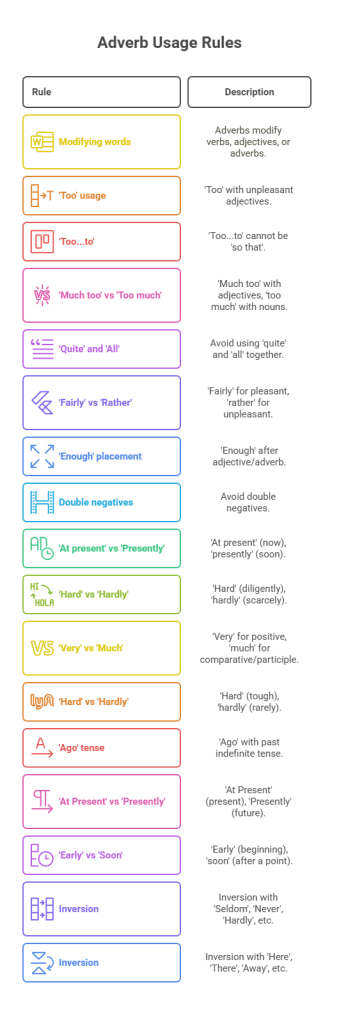
- Adverb to Modify Verb, Adjective, or Adverb: Use an adverb to modify a verb, adjective, or another adverb for precision.
- Example 1: Incorrect – She writes very careful. Correct – She writes very carefully.
- Example 2: Incorrect – He is extreme happy. Correct – He is extremely happy.
- Example 3: Incorrect – The car runs smooth. Correct – The car runs smoothly.
- ‘Too’ with Unpleasant Adjectives: ‘Too’ implies excess and is used with unpleasant adjectives; avoid with pleasant ones like glad, happy.
- Example 1: Incorrect – I am too glad to meet you. Correct – I am very glad to meet you.
- Example 2: Incorrect – The news is too pleasant. Correct – The news is very pleasant.
- Example 3: Incorrect – She is too happy about it. Correct – She is very happy about it.
- ‘Too…To’ Structure Not Replaceable with ‘So That’: The ‘too…to’ format cannot be replaced with ‘so that’ without restructuring to ‘so…that’.
- Example 1: Incorrect – He is too weak so that he cannot walk. Correct – He is too weak to walk.
- Example 2: Incorrect – It is too hot so that we can go out. Correct – It is too hot to go out.
- Example 3: Incorrect – The box is too heavy so that she can lift it. Correct – The box is too heavy to lift.
- ‘Much Too’ with Unpleasant Adjective, ‘Too Much’ with Noun: ‘Much too’ precedes unpleasant adjectives; ‘too much’ precedes nouns.
- Example 1: Incorrect – His failure is too much painful for me. Correct – His failure is much too painful for me.
- Example 2: Incorrect – There is much too noise. Correct – There is too much noise.
- Example 3: Incorrect – The movie is too much boring. Correct – The movie is much too boring.
- No ‘Quite’ and ‘All’ Together: ‘Quite’ and ‘all’ are not used together; use one or the other.
- Example 1: Incorrect – He is quite all right. Correct – He is quite right.
- Example 2: Incorrect – She is quite all ready. Correct – She is all ready.
- Example 3: Incorrect – It is quite all complete. Correct – It is quite complete.
- ‘Fairly’ with Pleasant Adjectives, ‘Rather’ with Unpleasant: Use ‘a/an + fairly + adjective + noun’ for positive connotation, ‘rather + a + adjective’ for negative; avoid reverse.
- Example 1: Incorrect – It was a rather good book. Correct – It was a fairly good book.
- Example 2: Incorrect – He is fairly difficult to deal with. Correct – He is rather difficult to deal with.
- Example 3: Incorrect – The weather is fairly bad. Correct – The weather is rather bad.
- ‘Enough’ After Positive Degree Adjective/Adverb: ‘Enough’ follows the positive degree adjective or adverb as an adverb.
- Example 1: Incorrect – He is greater enough to pardon you. Correct – He is great enough to pardon you.
- Example 2: Incorrect – The room is larger enough for us. Correct – The room is large enough for us.
- Example 3: Incorrect – She sings good enough. Correct – She sings well enough.
- Avoid Double Negatives: Two negatives cancel each other and turn the sentence positive; use one for negation unless affirming.
- Example 1: Incorrect – I have not got none. Correct – I have not got any.
- Example 2: Incorrect – She doesn’t need no help. Correct – She doesn’t need any help.
- Example 3: Incorrect – He can’t see nothing. Correct – He can’t see anything.
- ‘At Present’ for Current Time, ‘Presently’ for Shortly: ‘At present’ means now, ‘presently’ means soon; do not confuse.
- Example 1: Incorrect – Nothing more can be done presently. Correct – Nothing more can be done at present.
- Example 2: Incorrect – He will come back at present. Correct – He will come back presently.
- Example 3: Incorrect – The meeting is happening presently. Correct – The meeting is happening at present.
- ‘Hard’ for Diligently, ‘Hardly’ for Scarcely: ‘Hard’ means strenuously, ‘hardly’ means barely; distinguish.
- Example 1: Incorrect – He tried hardly to win the race. Correct – He tried hard to win the race.
- Example 2: Incorrect – She has eaten hard anything today. Correct – She has eaten hardly anything today.
- Example 3: Incorrect – Work hardly to succeed. Correct – Work hard to succeed.
- ‘Very’ for Positive Degree, ‘Much’ for Comparative/Past Participle: ‘Very’ modifies positive adjectives/adverbs, ‘much’ modifies comparatives or past participles.
- Example 1: Incorrect – The news is much surprising. Correct – The news is very surprising.
- Example 2: Incorrect – I was very surprised at hearing the news. Correct – I was much surprised at hearing the news.
- Example 3: Incorrect – He is very better now. Correct – He is much better now.
- ‘Hard’ as Adjective, ‘Hardly’ as Adverb: ‘Hard’ is an adjective meaning tough, ‘hardly’ is an adverb meaning rarely.
- Example 1: Incorrect – It is a hardly job. Correct – It is a hard job.
- Example 2: Incorrect – The test was hardly. Correct – The test was hard.
- Example 3: Incorrect – She hard studies. Correct – She hardly studies.
- ‘Ago’ with Past Indefinite Tense: ‘Ago’ indicates past time and requires past indefinite tense.
- Example 1: Incorrect – He has come a month ago. Correct – He came a month ago.
- Example 2: Incorrect – They have met two years ago. Correct – They met two years ago.
- Example 3: Incorrect – The event has happened long ago. Correct – The event happened long ago.
- ‘At Present’ with Present Tense, ‘Presently’ with Future: ‘At present’ uses present tense for current actions, ‘presently’ for future.
- Example 1: Incorrect – Presently he is in the room. Correct – At present he is in the room.
- Example 2: Incorrect – He is coming at present. Correct – He is coming presently.
- Example 3: Incorrect – Presently the show starts. Correct – At present the show is starting.
- ‘Early’ for Beginning, ‘Soon’ for After a Point: ‘Early’ means just after the start, ‘soon’ means shortly after a time.
- Example 1: Roses blossomed early this spring.
- Example 2: The train will arrive soon.
- Example 3: He woke early in the morning.
- Inversion with ‘Seldom’, ‘Never’, ‘Hardly’, etc.: Sentences starting with these take inverted structure (verb before subject).
- Example 1: Incorrect – Seldom I had seen such a beautiful sight. Correct – Seldom had I seen such a beautiful sight.
- Example 2: Incorrect – Never I will forget this. Correct – Never will I forget this.
- Example 3: Incorrect – Hardly she spoke. Correct – Hardly did she speak.
- Inversion with ‘Here’, ‘There’, ‘Away’, etc.: Sentences starting with these and a main verb use inversion.
- Example 1: Incorrect – Away Sita went. Correct – Away went Sita.
- Example 2: Incorrect – Here the bus comes. Correct – Here comes the bus.
- Example 3: Incorrect – There the children played. Correct – There played the children.
F. Uses of Conjunctions (Tricks 71-77)
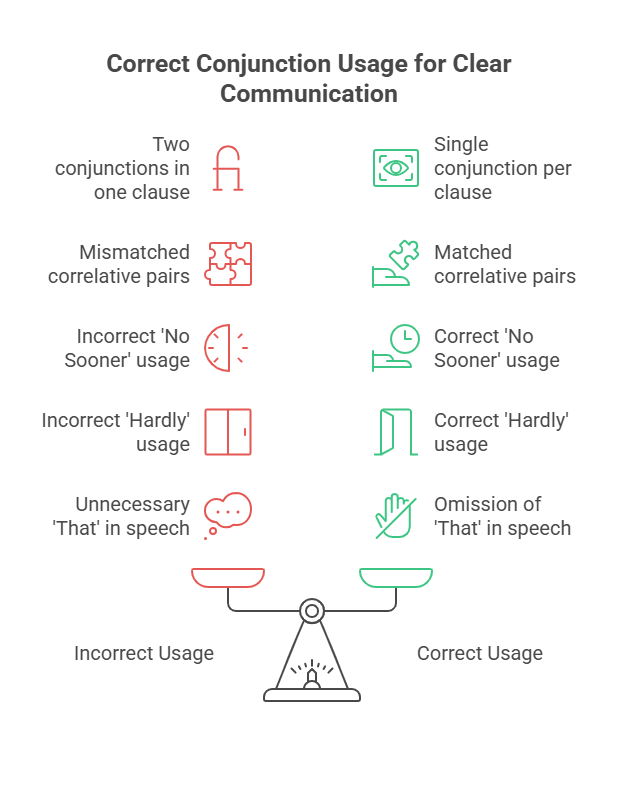
- No Two Conjunctions in One Sentence: Avoid using two conjunctions for the same clause.
- Example 1: Incorrect – Although she was tired, but she still went on working. Correct – Although she was tired, she still went on working.
- Example 2: Incorrect – Because it rained, so we stayed home. Correct – Because it rained, we stayed home.
- Example 3: Incorrect – If you study, then you will pass. Correct – If you study, you will pass.
- ‘Both’ Followed by ‘And’, ‘Neither…Nor’ for Negative: ‘Both’ is positive and followed by ‘and’; use ‘neither…nor’ for negative.
- Example 1: Incorrect – Both Ravi as well as Raja were present there. Correct – Both Ravi and Raja were present there.
- Example 2: Incorrect – Both not here nor there. Correct – Neither here nor there.
- Example 3: Incorrect – Both the options is wrong. Correct – Both the options are wrong.
- Parallel Parts of Speech with Correlative Conjunctions: Correlatives like ‘either…or’, ‘neither…nor’, ‘not only…but also’ must be followed by the same parts of speech.
- Example 1: Incorrect – He not only lost his ticket, but also his luggage. Correct – He lost not only his ticket but also his luggage.
- Example 2: Incorrect – Neither running nor to swim. Correct – Neither running nor swimming.
- Example 3: Incorrect – Either to go or staying. Correct – Either to go or to stay.
- ‘Neither’ Followed by ‘Nor’, ‘Either’ by ‘Or’: Do not mix ‘neither…or’ or ‘either…nor’.
- Example 1: Incorrect – He washed neither his hands or his face. Correct – He washed neither his hands nor his face.
- Example 2: Incorrect – Either tea nor coffee. Correct – Either tea or coffee.
- Example 3: Incorrect – Neither happy or sad. Correct – Neither happy nor sad.
- ‘No Sooner’ Followed by ‘Than’: ‘No sooner’ is followed by ‘than’, not ‘but’ or ‘then’.
- Example 1: Incorrect – No sooner do I finish this book then I shall begin another. Correct – No sooner do I finish this book than I shall begin another.
- Example 2: Incorrect – No sooner had he arrived but the meeting started. Correct – No sooner had he arrived than the meeting started.
- Example 3: Incorrect – No sooner she spoke then everyone listened. Correct – No sooner she spoke than everyone listened.
- ‘Hardly’ and ‘Scarcely’ Followed by ‘When’ or ‘Before’: These are followed by ‘when’ or ‘before’, not ‘than’ or ‘that’.
- Example 1: Incorrect – Hardly did I reach the station, than the train left it. Correct – Hardly did I reach the station when the train left it.
- Example 2: Incorrect – Scarcely had she finished that he arrived. Correct – Scarcely had she finished when he arrived.
- Example 3: Incorrect – Hardly he opened the door before the guest entered. Correct – Hardly had he opened the door before the guest entered.
- No ‘That’ Before Direct Speech or Interrogative in Indirect: Omit ‘that’ before direct quotes or interrogative adverbs/pronouns in indirect speech.
- Example 1: Incorrect – He said that, “I shall go there.” Correct – He said, “I shall go there.”
- Example 2: Incorrect – He asked me that who I was. Correct – He asked me who I was.
- Example 3: Incorrect – She wondered that where he went. Correct – She wondered where he went.
G. Uses of Prepositions (Tricks 78-84)
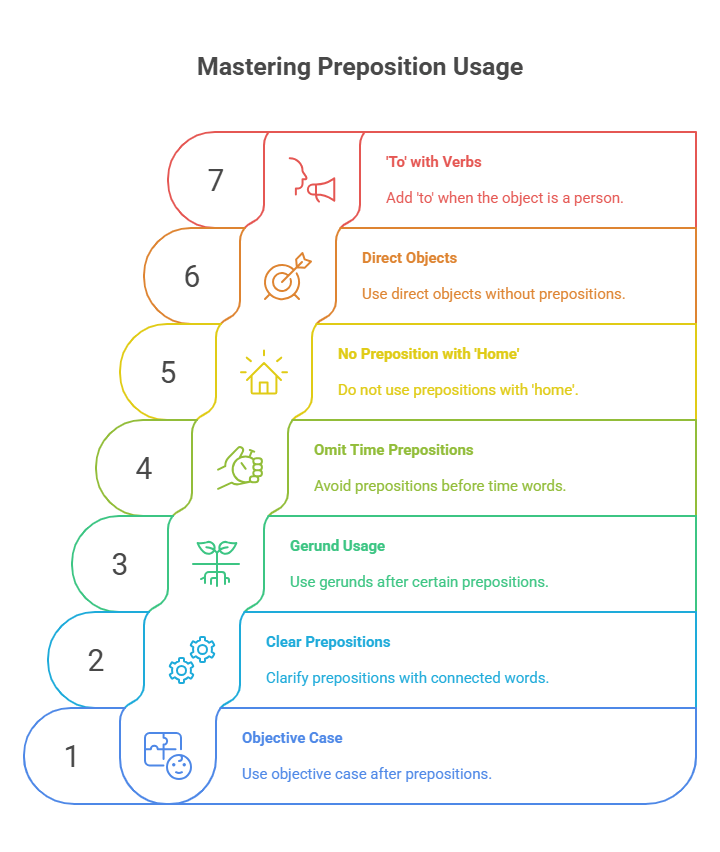
- Objective Case After Preposition: Nouns or pronouns after prepositions must be in objective case.
- Example 1: Incorrect – I do not depend on he. Correct – I do not depend on him.
- Example 2: Incorrect – The gift is for she. Correct – The gift is for her.
- Example 3: Incorrect – Talk to we about it. Correct – Talk to us about it.
- Clear Prepositions After Connected Words: When two words are connected by ‘and’ or ‘or’, clarify the prepositions if different.
- Example 1: Incorrect – She is conscious and engaged in her work. Correct – She is conscious of and engaged in her work.
- Example 2: Incorrect – Interested and fond of music. Correct – Interested in and fond of music.
- Example 3: Incorrect – Angry and disappointed with him. Correct – Angry with and disappointed in him.
- Gerund After Certain Prepositions in Verbs: After prepositions like about, after, at, before, for, from, in, on, to in certain verb phrases, use gerund.
- Example 1: Incorrect – You prevented me from do it. Correct – You prevented me from doing it.
- Example 2: Incorrect – Look forward to meet you. Correct – Look forward to meeting you.
- Example 3: Incorrect – He is good at draw. Correct – He is good at drawing.
- No Preposition Before Time Words Like ‘Today’: Omit prepositions before today, tomorrow, yesterday, the following day, etc.
- Example 1: Incorrect – He will go there on tomorrow. Correct – He will go there tomorrow.
- Example 2: Incorrect – I saw him in yesterday. Correct – I saw him yesterday.
- Example 3: Incorrect – We meet on the following day. Correct – We meet the following day.
- No Preposition Before ‘Home’: ‘Home’ does not take a preposition; ‘at home’ is a phrase for being home.
- Example 1: Incorrect – Bring a T.V. set at home. Correct – Bring a T.V. set home.
- Example 2: Incorrect – Go to home now. Correct – Go home now.
- Example 3: Incorrect – He is in home. Correct – He is at home.
- No Preposition After Certain Transitive Verbs: Verbs like discuss, describe, reach, order, tell, demand, attack, resemble, ridicule take direct objects without prepositions.
- Example 1: Incorrect – The poet describes about the beauty of nature in this poem. Correct – The poet describes the beauty of nature in this poem.
- Example 2: Incorrect – We discussed about the plan. Correct – We discussed the plan.
- Example 3: Incorrect – She resembles to her mother. Correct – She resembles her mother.
- ‘To’ After Verbs Like Say, Suggest When Object is Person: Verbs like say, suggest, speak, reply, explain, talk, listen, write add ‘to’ if the object is a person, but not if no person.
- Example 1: Incorrect – He did not reply me. Correct – He did not reply to me.
- Example 2: Incorrect – She wrote to a letter. Correct – She wrote a letter.
- Example 3: Incorrect – Talk me about it. Correct – Talk to me about it.
H. Uses of Pronouns (Tricks 85-100)
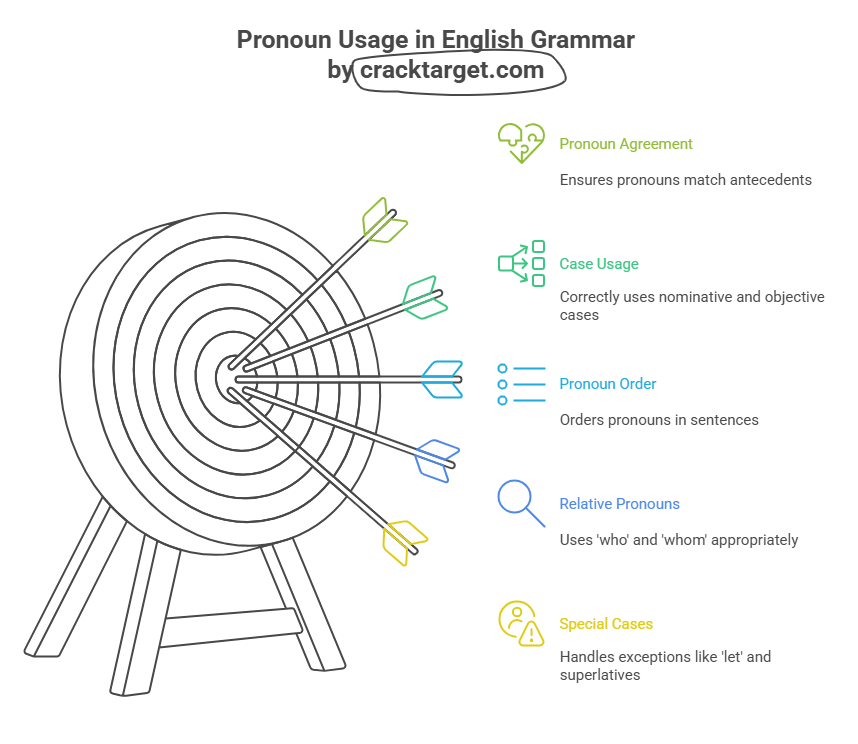
- Nominative Case as Complement of ‘To Be’: Pronouns as complements of ‘to be’ must be nominative.
- Example 1: Incorrect – If I were him, I would not do it. Correct – If I were he, I would not do it.
- Example 2: Incorrect – It is her. Correct – It is she.
- Example 3: Incorrect – The winner is him. Correct – The winner is he.
- Objective Case for Object of Verb or Preposition: Pronouns as objects must be objective.
- Example 1: Incorrect – Let you and I do it. Correct – Let you and me do it.
- Example 2: Incorrect – These presents are for you and I. Correct – These presents are for you and me.
- Example 3: Incorrect – The teacher called he and she. Correct – The teacher called him and her.
- Emphatic Pronouns Cannot Stand Alone as Subjects: Emphatic pronouns like himself must accompany a subject.
- Example 1: Incorrect – Himself did it. Correct – He himself did it.
- Example 2: Incorrect – Herself cooked the meal. Correct – She herself cooked the meal.
- Example 3: Incorrect – Themselves solved the problem. Correct – They themselves solved the problem.
- Consistent Use of ‘One’: If ‘one’ is used as an indefinite pronoun, maintain it throughout.
- Example 1: Incorrect – One must not boast of his own success. Correct – One must not boast of one’s own success.
- Example 2: Incorrect – One should help his friends. Correct – One should help one’s friends.
- Example 3: Incorrect – One can improve his skills. Correct – One can improve one’s skills.
- ‘Either/Neither’ for Two, ‘Any/No One/None’ for More Than Two: Limit ‘either/neither’ to two; use others for more.
- Example 1: Incorrect – Anyone of these two roads leads to the railway station. Correct – Either of these two roads leads to the railway station.
- Example 2: Incorrect – Neither of these three boys did his homework. Correct – No one of these three boys did his homework.
- Example 3: Incorrect – Either of the four options is correct. Correct – Any of the four options is correct.
- ‘Each Other’ for Two, ‘One Another’ for More Than Two: Use ‘each other’ for reciprocal actions between two, ‘one another’ for more.
- Example 1: Incorrect – The two brothers loved one another. Correct – The two brothers loved each other.
- Example 2: Incorrect – The team members support each other. Correct – The team members support one another.
- Example 3: Incorrect – The couple helped one another. Correct – The couple helped each other.
- Possessive Case for Noun/Pronoun Governing Gerund: The noun or pronoun before a gerund should be possessive.
- Example 1: Incorrect – Please excuse me being late. Correct – Please excuse my being late.
- Example 2: Incorrect – I mind him smoking. Correct – I mind his smoking.
- Example 3: Incorrect – We appreciate the child singing. Correct – We appreciate the child’s singing.
- Pronoun Agreement with Antecedent: Pronouns must agree in person, number, and gender with their antecedents.
- Example 1: Incorrect – Each of these boys has done their homework. Correct – Each of these boys has done his homework.
- Example 2: Incorrect – The team celebrated their victory. Correct – The team celebrated its victory.
- Example 3: Incorrect – Everyone should bring their book. Correct – Everyone should bring his or her book.
- Plural Pronoun for Singular Nouns Joined by ‘And’: When two singular nouns joined by ‘and’ are separate, use plural pronoun.
- Example 1: Incorrect – Both Raju and Ravi have done his homework. Correct – Both Raju and Ravi have done their homework.
- Example 2: Incorrect – The boy and girl lost his way. Correct – The boy and girl lost their way.
- Example 3: Incorrect – Cat and dog chased its tail. Correct – Cat and dog chased their tails.
- Singular Pronoun for Same Person/Thing Joined by ‘And’: If the nouns refer to the same person or thing, use singular pronoun.
- Example 1: Incorrect – The collector and District Magistrate is not negligent in their duty. Correct – The collector and District Magistrate is not negligent in his duty.
- Example 2: Incorrect – The teacher and mentor shared their knowledge. Correct – The teacher and mentor shared his knowledge.
- Example 3: Incorrect – The king and warrior fought their battle. Correct – The king and warrior fought his battle.
- Singular Pronoun for Singular Nouns Joined by ‘Or/Nor’: Use singular pronoun for such constructions.
- Example 1: Incorrect – Neither Ravi nor Raju has done their homework. Correct – Neither Ravi nor Raju has done his homework.
- Example 2: Incorrect – Either she or he lost their keys. Correct – Either she or he lost her or his keys.
- Example 3: Incorrect – Nor the manager nor the assistant submitted their report. Correct – Nor the manager nor the assistant submitted his report.
- Order of Singular Pronouns: You, He, I: When combining different persons, order is second, third, first.
- Example 1: Incorrect – I, You and he must work together. Correct – You, he and I must work together.
- Example 2: Incorrect – He, I and you will go. Correct – You, he and I will go.
- Example 3: Incorrect – She, you and I are friends. Correct – You, she and I are friends.
- Order of Plural Pronouns: We, You, They: For plural pronouns of different persons, order is first, second, third.
- Example 1: Incorrect – You, they and we must work together. Correct – We, you and they must work together.
- Example 2: Incorrect – They, we and you participated. Correct – We, you and they participated.
- Example 3: Incorrect – You, we and they won. Correct – We, you and they won.
- ‘Who’ for Subjective, ‘Whom’ for Objective: ‘Who’ is subject, ‘whom’ is object; ensure finite verb matches.
- Example 1: Incorrect – The doctor whom came here was Ram’s brother. Correct – The doctor who came here was Ram’s brother.
- Example 2: Incorrect – The man whom I met is kind. Correct – The man who I met is kind.
- Example 3: Incorrect – Whom is at the door? Correct – Who is at the door?
- ‘That’ as Relative Pronoun with Superlatives: Use ‘that’ instead of ‘which’ or ‘who’ after superlatives, only, none, all.
- Example 1: Incorrect – All which glitters is not gold. Correct – All that glitters is not gold.
- Example 2: Incorrect – This is the best which we can do. Correct – This is the best that we can do.
- Example 3: Incorrect – He is the only one who survived. Correct – He is the only one that survived.
- Objective Pronoun After ‘Let’: Pronouns after ‘let’ must be objective.
- Example 1: Incorrect – Let he go there. Correct – Let him go there.
- Example 2: Incorrect – Let she decide. Correct – Let her decide.
- Example 3: Incorrect – Let they play. Correct – Let them play.


Leave a reply to Study Planner for UPSC EPFO APFC 2025 Exam – cracktarget Cancel reply