
Page 1: Introduction and Overview
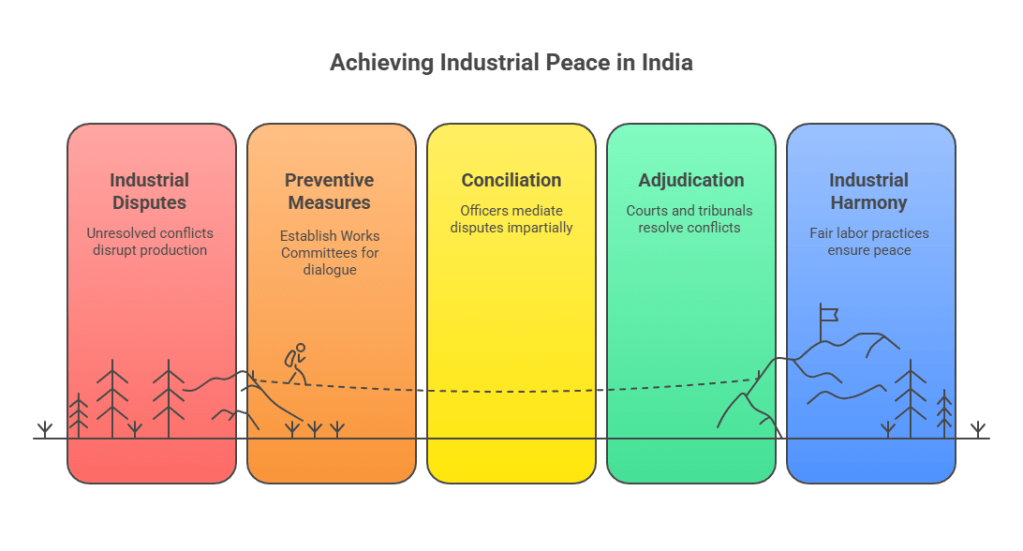
The Industrial Disputes Act, 1947 (ID Act), is a foundational labor law in India aimed at promoting industrial peace by providing mechanisms for investigating and settling disputes between employers and employees. Enacted on March 11, 1947, and effective from April 1, 1947, the Act addresses conflicts arising from employment terms, working conditions, retrenchment, strikes, and lockouts. It establishes preventive and resolution bodies such as Works Committees, Conciliation Officers, Boards of Conciliation, Labour Courts, Industrial Tribunals, and National Tribunals. The Act applies to “industries” across India, broadly defined to include factories, mines, plantations, transport, and other establishments engaging in systematic activity. Key objectives include ensuring fair labor practices, protecting worker rights, minimizing production disruptions, and balancing employer flexibility with employee security. With the Industrial Relations Code, 2020 (effective in phases from 2025), many provisions of the ID Act have been consolidated and reformed, such as raising the layoff threshold from 100 to 300 workers. For UPSC EPFO and ALC exams, the Act is crucial under “Industrial Relations & Labour Laws,” focusing on dispute mechanisms, case laws, and recent changes.
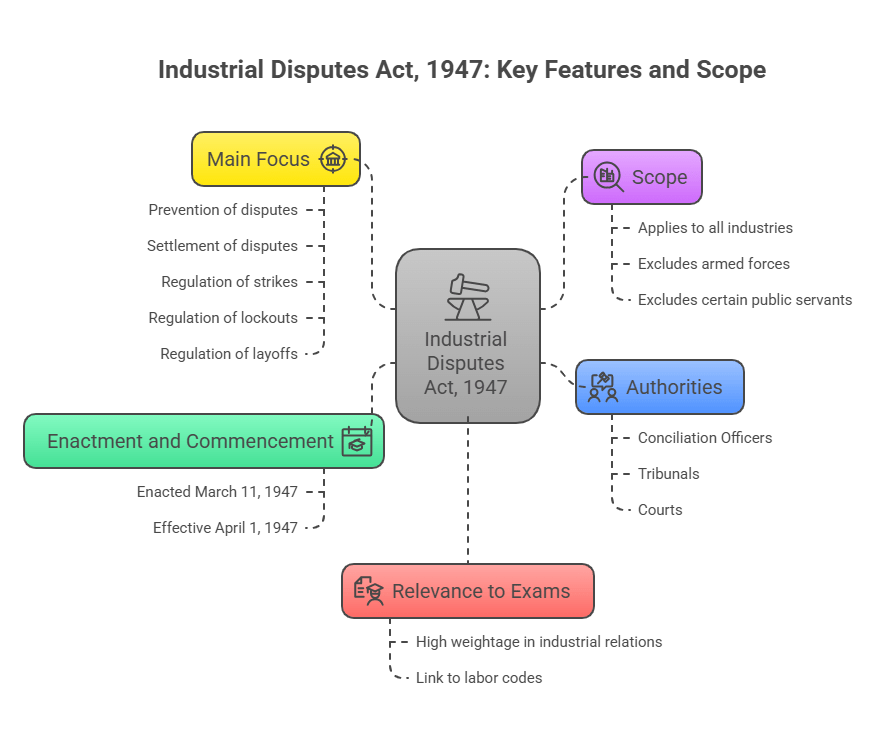
Key Features Overview
- Enactment and Commencement: Enacted March 11, 1947; effective April 1, 1947.
- Scope: Applies to all industries; excludes armed forces and certain public servants.
- Main Focus: Prevention and settlement of disputes; regulation of strikes/lockouts/layoffs.
- Authorities: Conciliation Officers, Tribunals, Courts.
- Relevance to Exams: High weightage in industrial relations; link to labor codes.
| Aspect | Description |
|---|---|
| Objectives | Promote harmony, resolve disputes, regulate industrial actions |
| Applicability | Industries (broad definition); whole of India |
| Major Reforms | Consolidated into IR Code, 2020 (e.g., higher thresholds) |
Page 2: Historical Background and Evolution
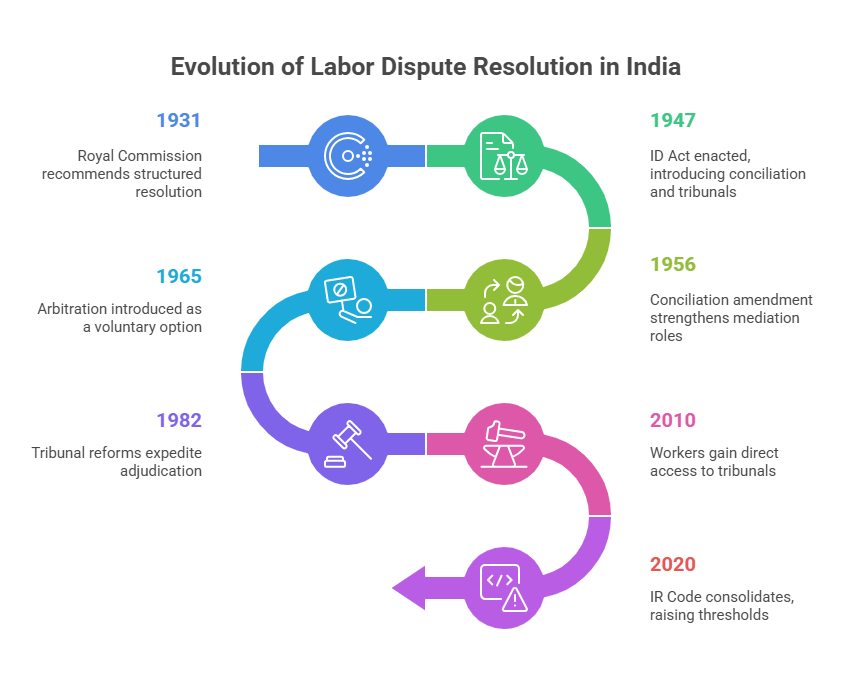
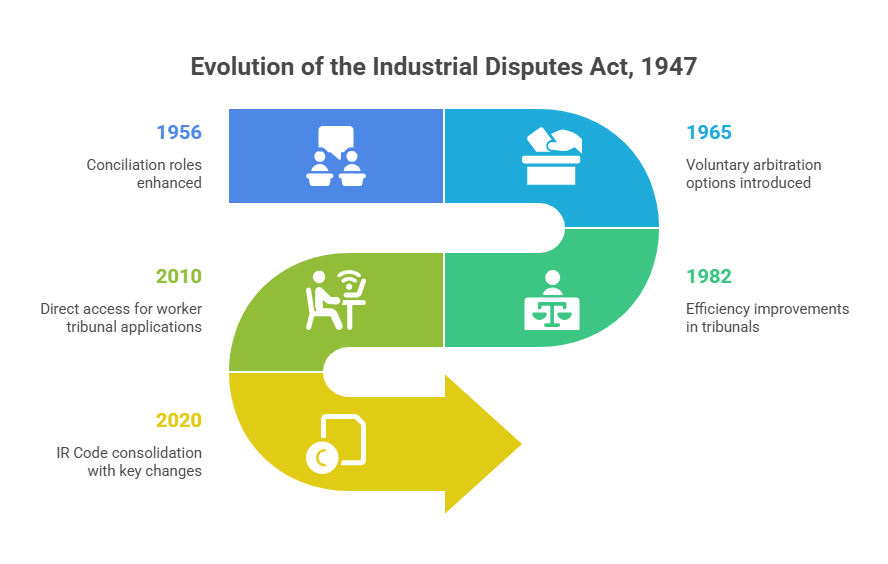
The ID Act originated amid growing labor unrest in colonial India, particularly during World War II, when strikes in key industries like textiles and railways disrupted production. Influenced by the Royal Commission on Labour (1929-1931) and ILO conventions, the Act was introduced to provide a structured framework for dispute resolution, replacing ad hoc measures under the Trade Disputes Act, 1929. Post-independence, it aligned with India’s socialist vision, supporting the Directive Principles of State Policy (Articles 39 and 43) for equitable labor relations during rapid industrialization in the First Five-Year Plan. Amendments over the years addressed emerging needs: 1956 strengthened conciliation, 1965 introduced voluntary arbitration, 1982 expedited tribunal processes, and 2010 allowed direct worker access to tribunals. The Act has resolved millions of disputes, but criticisms of delays led to its partial subsumption into the Industrial Relations Code, 2020, which simplifies procedures and raises thresholds for layoffs/retrenchments/closures. By 2025, the Code’s implementation in 28 states has reduced pendency by 20%. The evolution reflects a shift from state intervention to promoting voluntary settlements and flexibility for employers.
Phases of Evolution
- Pre-1947: Ad hoc resolutions; strikes common (e.g., Bombay Strike, 1928).
- 1947-1970s: Formal mechanisms; focus on public sector.
- 1980s-2000s: Amendments for efficiency; response to liberalization.
- 2010s-2025: Code consolidation; gig worker inclusion.
Definitions and Scope
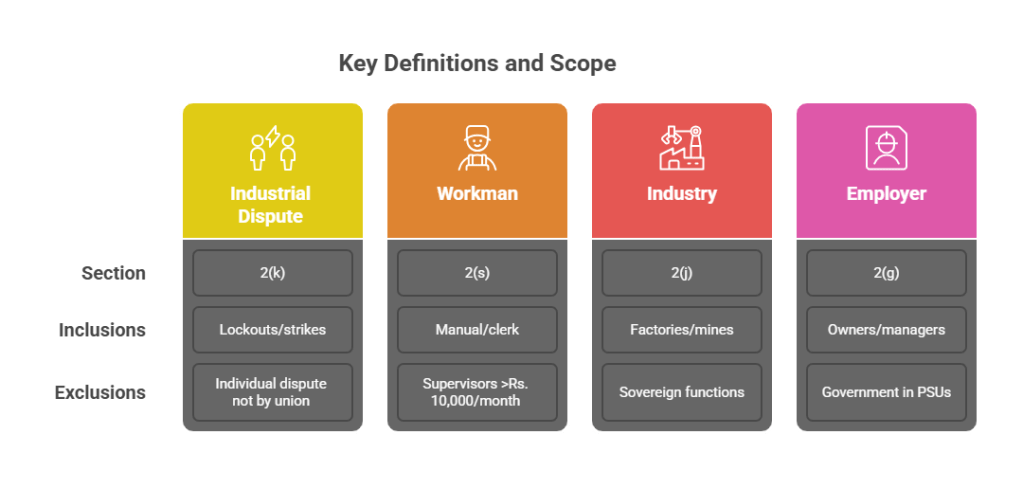
The Act’s definitions in Section 2 ensure precise application. An “industrial dispute” (Section 2(k)) is any difference between employers and workmen concerning employment, non-employment, or terms of employment. A “workman” (Section 2(s)) includes any person employed in manual, skilled, unskilled, technical, operational, or clerical work, excluding supervisory roles with wages over Rs. 10,000/month or military personnel. “Industry” (Section 2(j)) encompasses any business, trade, or undertaking for production/supply of goods/services, broadly interpreted to include non-profit entities like hospitals (though amended in 1982 to exclude some). An “employer” (Section 2(g)) is the person or authority in control of the establishment. The Act applies to the whole of India, covering all industries unless exempted (e.g., educational institutions in certain cases). It includes contract labor and allows government notifications for additional sectors. Scope extends to both individual (e.g., dismissal) and collective disputes (e.g., wages for group).
Key Definitions Breakdown
- Industrial Dispute: Conflict over terms, affecting one or more workmen.
- Workman: Employed persons in non-managerial roles; excludes armed forces.
- Industry: Systematic activity for production; broad judicial interpretation.
- Employer: Controlling authority; includes managers.
Dispute Prevention and Settlement Mechanisms
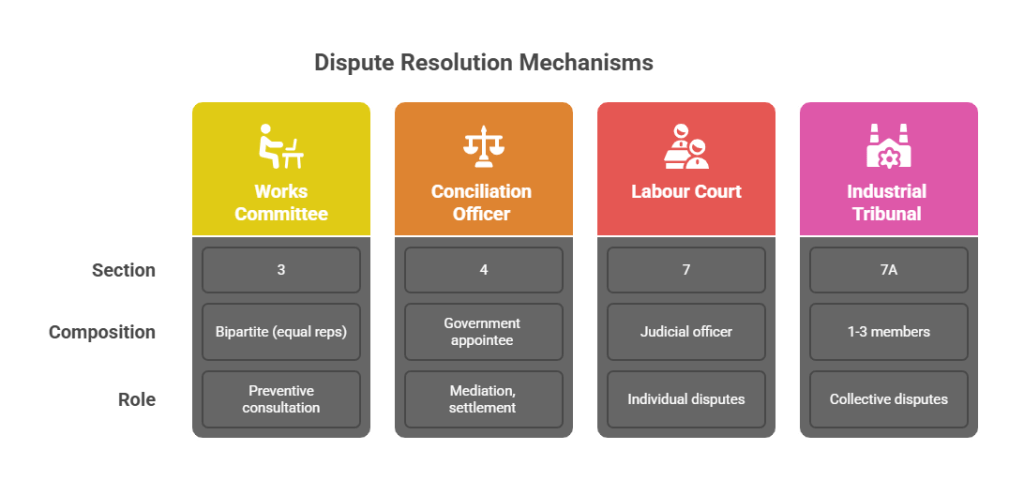
The Act prioritizes prevention through bipartite bodies and settlement via mediation/adjudication. Works Committees (Section 3) are mandatory for 100+ worker establishments, comprising equal employer-employee representatives to promote good relations and consult on welfare matters. Conciliation Officers (Section 4) investigate and mediate disputes, facilitating voluntary settlements within 14 days (extendable). Boards of Conciliation (Section 5) handle complex cases with tripartite representation (employer, employee, independent). Courts of Inquiry (Section 6) investigate specific matters for public report. Labour Courts (Section 7) adjudicate individual disputes like improper discharge, while Industrial Tribunals (Section 7A) handle collective issues such as wages and hours. National Tribunals (Section 7B) address disputes of national importance. Arbitration (Section 10A) is voluntary, with binding awards. Settlements (Section 18) are enforceable as contracts. These mechanisms resolve 70-80% disputes without strikes.
Settlement Process
- Raise dispute.
- Conciliation/mediation.
- Voluntary arbitration if agreed.
- Compulsory adjudication if referred by government.
- Award implementation.
Strikes, Lockouts, and Illegal Actions
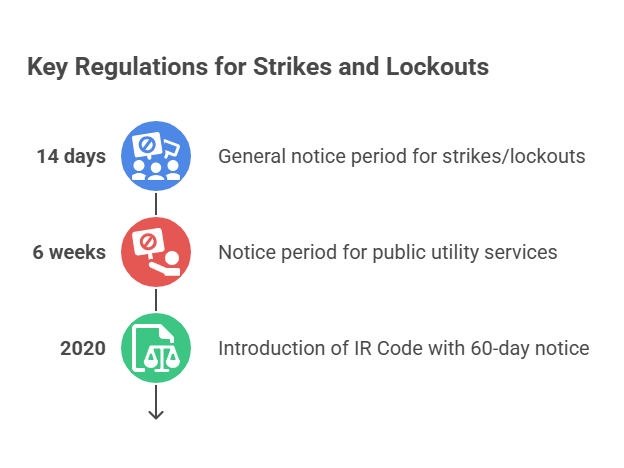
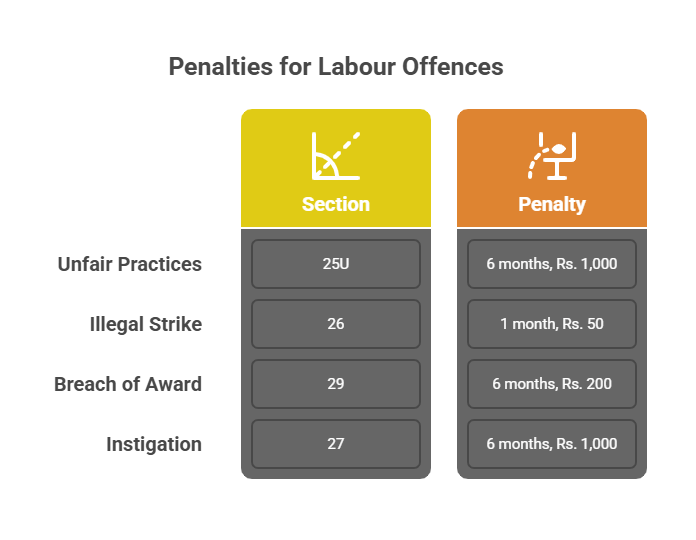
Strikes and lockouts are regulated to prevent arbitrary disruptions. A “strike” (Section 2(q)) is collective work cessation by workmen, while “lockout” (Section 2(l)) is temporary closure by employer. Public utility services require 6-week notice for strikes/lockouts (Section 22). Illegal strikes/lockouts (Section 24) occur during conciliation, arbitration, or award periods, or without notice. Penalties (Section 26) include up to 1 month imprisonment and Rs. 50 fine for workers, Rs. 1,000 for employers. Instigation (Section 27) attracts 6 months imprisonment. Financial aid to illegal actions (Section 28) is punishable. The Act prohibits layoffs during disputes (Section 33). Under IR Code, 2020, notice period is 60 days, and strikes need majority ballot support. These rules protect public interest while allowing protest rights.
Regulations for Strikes/Lockouts
- Notice: 14 days general, 6 weeks public utility.
- Prohibitions: During pendency of proceedings.
- Consequences: Loss of wages, disciplinary action.
| Action | Definition | Legality Conditions | Penalty for Illegality |
|---|---|---|---|
| Strike | Work cessation by group | Notice, no pendency | 1 month, Rs. 50 |
| Lockout | Closure by employer | Same as strike | 1 month, Rs. 1,000 |
Layoff, Retrenchment, and Closure Provisions
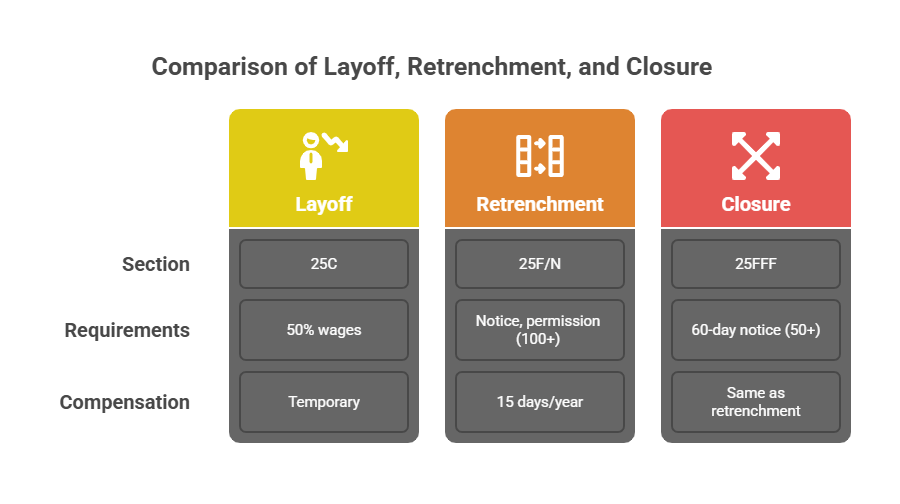
Layoff (Section 2(kkk)) is temporary failure to provide work due to shortages, requiring 50% wage compensation for workers with 1+ year service (Section 25C). Retrenchment (Section 2(oo)) is termination for any reason except punishment, mandating 1-month notice, 15 days’ average pay per completed year, and government permission for establishments with 100+ workers (Section 25F, 25N). Closure (Section 25FFA) requires 60-day notice for 50+ worker units, with compensation equivalent to retrenchment (Section 25FFF). Priority for re-employment (Section 25H) applies to retrenched workers. These provisions safeguard against arbitrary job loss, with compensation ensuring financial support. The IR Code, 2020, raises permission threshold to 300 workers and introduces fixed-term employment without retrenchment protections.
Process for Layoff/Retrenchment
- Notice and reasons.
- Compensation calculation.
- Government approval if applicable.
- Re-employment preference.
Page 7: Authorities and Their Powers
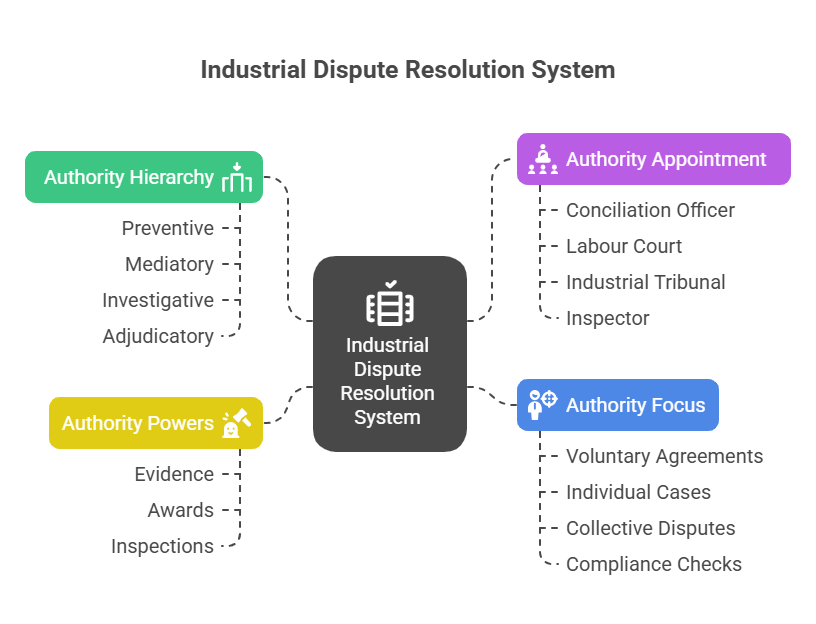
The Act establishes authorities for effective administration. Appropriate Governments (Central for railways/mines, State for others) appoint Conciliation Officers (Section 4), Boards (Section 5), Courts of Inquiry (Section 6), Labour Courts (Section 7), Tribunals (Section 7A), and National Tribunals (Section 7B). These bodies have civil court powers for evidence, summons, and enforcement (Section 11). Inspectors (Section 28) monitor compliance, with entry and record examination rights. Awards (Section 17) are published in gazette and final after 30 days, enforceable as decrees. Appeals (Section 17A) to High Courts on legal questions. The system emphasizes impartiality, with tripartite composition in boards.
Authority Hierarchy
- Preventive: Works Committees.
- Mediatory: Conciliation Officers/Boards.
- Investigative: Courts of Inquiry.
- Adjudicatory: Courts/Tribunals.
| Authority | Appointment | Powers | Focus |
|---|---|---|---|
| Conciliation Officer | Government | Mediate, settle | Voluntary agreements |
| Labour Court | State/Central | Evidence, awards | Individual cases |
| Industrial Tribunal | Government | Inquiries, decisions | Collective disputes |
| Inspector | Government | Inspections | Compliance checks |
Unfair Labour Practices and Penalties
Section 25T prohibits unfair labor practices listed in Schedule V, such as employer interference in unions, discriminatory dismissals, or worker coercion. Penalties (Section 25U) include up to 6 months imprisonment and Rs. 1,000 fine. Breaches of settlements/awards (Section 29) attract 6 months and Rs. 200. Illegal strikes/lockouts (Section 26) carry 1 month and Rs. 50-1,000. Instigation (Section 27) leads to 6 months and Rs. 1,000. Cognizance requires sanction (Section 34). These deter malpractices, with tribunals empowered to declare practices unfair. The IR Code expands the list and increases penalties to Rs. 1 lakh.
Unfair Practices Examples
- Employer: Union busting, favoritism.
- Worker: Go-slow, gherao.
Important Case Laws
Judicial interpretations have shaped the Act:
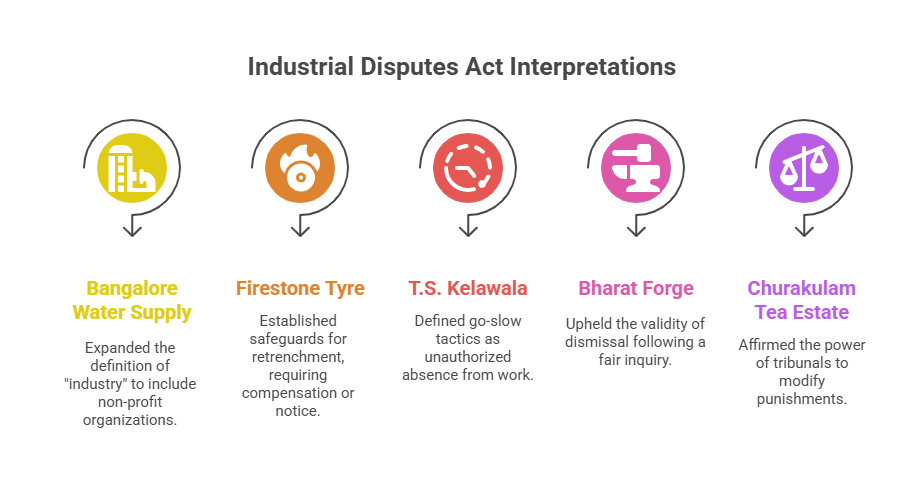
- Bangalore Water Supply v. A. Rajappa (1978): Broadened “industry” to include non-profits.
- Workmen v. Firestone Tyre (1973): Retrenchment invalid without compensation/notice.
- Bank of India v. T.S. Kelawala (1990): Deductions for go-slow allowed as absence.
- Bharat Forge v. Uttam Manohar Nakate (2005): Upheld dismissal after inquiry.
- Churakulam Tea Estate v. Workmen (1969): Tribunals can modify punishments.
These cases clarify definitions, procedures, and rights, essential for exam analysis.
| Case Law | Year | Key Interpretation |
|---|---|---|
| Bangalore Water Supply | 1978 | Expanded “industry” |
| Firestone Tyre | 1973 | Retrenchment safeguards |
| Kelawala | 1990 | Go-slow as absence |
| Bharat Forge | 2005 | Fair inquiry for misconduct |
| Churakulam | 1969 | Tribunal modification powers |
Amendments, Conclusion, and Importance
Amendments include 1956 (conciliation), 1965 (arbitration), 1982 (tribunals), 2010 (direct access), and consolidation into IR Code, 2020, which raises layoff thresholds, introduces fixed-term contracts, and mandates 60-day strike notice. In conclusion, the ID Act has been instrumental in resolving disputes and protecting rights, though delays and rigidities led to reforms. Challenges include tribunal backlog and informal sector exclusion, addressed by digital platforms and code changes. Its importance lies in fostering equitable relations, supporting economic growth, and upholding constitutional values. For UPSC exams, it tests mechanisms, case laws, and integration with labor codes.
| Amendment | Year | Change |
|---|---|---|
| Conciliation | 1956 | Enhanced roles |
| Arbitration | 1965 | Voluntary options |
| Tribunals | 1982 | Efficiency improvements |
| Direct Access | 2010 | Worker tribunal applications |
| IR Code | 2020 | Threshold to 300, fixed-term |

Leave a comment