
What is a Partnership?
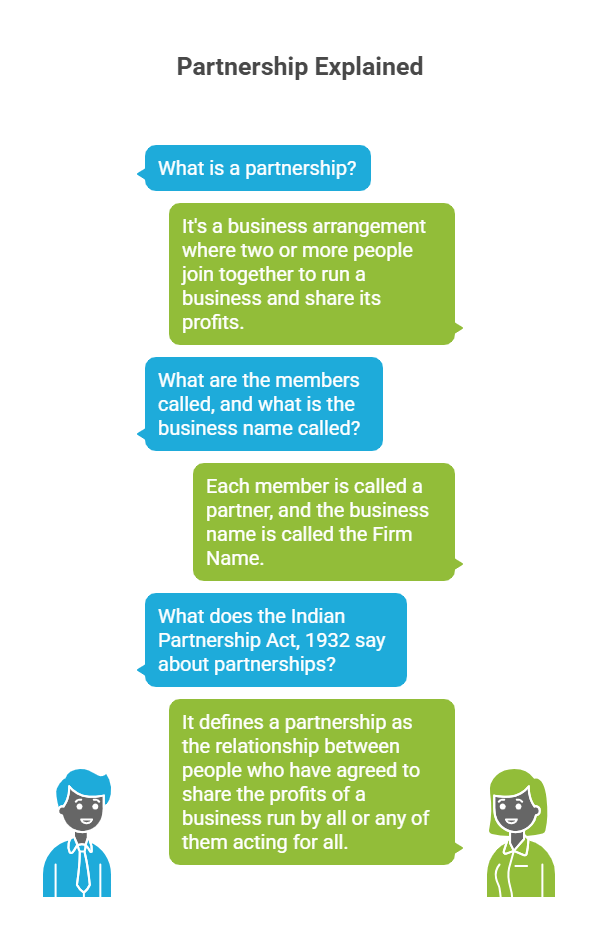
- Partnership is a business arrangement where two or more people join together to run a business and share its profits.
- Each member is called a partner. The business name is called the Firm Name.
- Indian Partnership Act, 1932: A partnership is the relationship between people who have agreed to share the profits of a business run by all or any of them acting for all.
Key Features of Partnership
- Minimum Two Persons: At least two people are needed to form a partnership.
- Agreement: Partnership is created by an agreement (written or oral) among partners.
- Business Activity: There must be a business—just owning property together is not enough.
- Mutual Agency: Each partner is both an agent (can act on behalf of others) and principal (bound by others’ actions).
- Liability: All partners have unlimited liability—they are personally responsible for the firm’s debts.
Partnership Deed
- Definition: A document listing all rules, regulations, terms, and conditions among partners.
- It’s best to have it written and registered (to avoid disputes).
Contents Include:
- Firm name & address
- Partners’ names & addresses
- Partners’ capital
- Accounting period & start date
- Rules on bank accounts
- Profit/loss sharing ratio
- Interest rates (capital, loans, drawings)
- Appointment of auditors (if needed)
- Salaries/commissions (if any)
- Roles, rights, and duties of each partner
- What happens on insolvency or dissolution
Rules if There is No Partnership Deed
If there’s no written deed, default rules are:
- Profits/Losses: Shared equally, no matter capital invested.
- Interest on Capital: Not allowed.
- Interest on Drawings: Not charged.
- Salary: No salary for partners.
- Interest on Loan: Paid at 6% per annum.
- Participation: All partners can take part in business.
Interest on Capital
- Paid by the firm to partners for their investment, only if mentioned in the deed. If not mentioned, no interest is paid.
- Why? To compensate partners whose capital contribution is higher but profits are shared equally.
Goodwill
- Goodwill: The value of a firm’s reputation, expected to bring future profits.
- Types:
- Purchased Goodwill: Arises when a business is bought.
- Inherent Goodwill: Built over time through business reputation and customer loyalty.
Methods of Valuing Goodwill
- Average Profit Method:
- Super Profit Method:
- Capitalisation Method:
- Find capital needed to earn average profit at normal return. Goodwill is the excess of this value over the firm’s actual capital.


Types of Capital Accounts
- Fixed Capital Account: Two separate accounts—one for capital, one for current business transactions (interest, profits, etc.).
- Fluctuating Capital Account: Only one account showing all transactions; balances change throughout the year.
Admission of a Partner
- New partner needs consent from all existing partners.
- Why admit?:
- More funds Reputation
- Special skills
Main Points on Admission
- Calculate new profit-sharing ratio.
- Gaining Ratio: New Ratio – Old Ratio.
- Sacrificing Ratio: Old Ratio – New Ratio.
- Incoming partner brings goodwill to compensate old partners.
- Revaluation of assets and liabilities must be done.
Retirement and Death of Partner
- Retirement: A partner can leave after notice and agreement.
- Entitled to: Share of reserves, goodwill, profit/loss on revaluation, profit up to retirement.
- Deductions: Any accumulated losses, revaluation loss, drawings, interest on drawings.
- Death: Similar treatment as retirement; payment goes to the partner’s executor.
Dissolution of Partnership vs. Dissolution of Partnership Firm
- Dissolution of Partnership: Change in partnership agreement (e.g. by admission, retirement, death), but business continues.
- Dissolution of Firm: Business ends; assets are sold off, liabilities paid.
Ways Firm Can Be Dissolved
- By agreement: All partners consent
- Compulsory: By law (insolvency or illegality)
- By notice: In a partnership at will, any partner may dissolve firm
- By court: Court orders dissolution for various reasons
- Contingencies: Expiry of agreed term, project completion, etc.
Realisation Account
- Prepared at dissolution to record sale of assets and payment of liabilities.
- The result (profit or loss) is shared among partners.
Capital Receipts vs Revenue Receipts
| Criteria | Capital Receipts | Revenue Receipts |
| Nature | Non-recurring; not regular business | Recurring; normal business activity |
| Shown In | Balance Sheet (liability side) | Trading/Profit & Loss Account (credit) |
| Examples | Sale of fixed assets, loans, capital | Sale of goods, rent, interest |
USPC level 20 MCQS
Question 1:
According to Section 4 of the Indian Partnership Act, 1932, partnership is defined as:
A) A relation between persons agreeing to share losses only, carried on by one partner.
B) The relation between persons who have agreed to share profits of a business carried on by all or any of them acting for all.
C) An association for non-business purposes with limited liability.
D) A sole proprietorship with perpetual succession.
Correct Answer: B
Detailed Explanation:
Partnership, as per the Act, involves a mutual agreement among individuals to conduct business and distribute profits, with each partner representing the others (mutual agency). For non-commerce students, think of it as a team sport where players share goals and decisions—actions by one affect all. Option A ignores profit-sharing and collective action. Option C misrepresents it as non-business with limited liability (partnerships have unlimited liability). Option D describes sole proprietorships or companies, not partnerships.
Question 2:
Which of the following is NOT a characteristic of a partnership firm?
A) Minimum of two persons required.
B) Unlimited liability of partners.
C) Separate legal entity from partners.
D) Mutual agency among partners.
Correct Answer: C
Detailed Explanation:
Unlike companies, partnerships do not have a separate legal identity; the firm and partners are one, leading to unlimited personal liability. Imagine a partnership as a group hike—each member’s actions bind the group, but there’s no “group shield” protecting personal belongings. Option A is essential (at least two partners). Option B highlights joint and several liability. Option D emphasizes that one partner’s acts bind all.
Question 3:
In the absence of a partnership deed, profits and losses are shared:
A) In the ratio of capital contributions.
B) Equally among all partners.
C) Based on seniority of partners.
D) Only among active partners.
Correct Answer: B
Detailed Explanation:
Default rules under the Act mandate equal sharing, irrespective of capital or involvement, to ensure fairness without explicit agreement. Like dividing a pizza equally among friends unless specified otherwise. Option A applies only if stated in the deed. Options C and D are not statutory defaults.
Question 4:
A partnership deed typically includes:
A) Only the names of partners.
B) Profit-sharing ratio, interest rates on capital and drawings, and dispute resolution methods.
C) Details of competitors’ businesses.
D) Personal family matters of partners.
Correct Answer: B
Detailed Explanation:
The deed is a comprehensive contract covering operational, financial, and relational aspects to prevent conflicts. Think of it as a rulebook for a club, outlining shares, rewards, and conflict handling. Option A is too limited. Options C and D are irrelevant to partnership governance.
Question 5:
Interest on capital is provided to partners primarily to:
A) Increase the firm’s tax liability.
B) Compensate for unequal capital contributions when profits are shared equally.
C) Reward drawings made by partners.
D) Substitute for salaries in all cases.
Correct Answer: B
Detailed Explanation:
It adjusts for disparities, ensuring higher contributors are not disadvantaged. Like extra points for bringing more equipment to a team project. If the deed is silent, no interest is allowed. Option C confuses it with interest on drawings (a penalty). Option D overlooks that salaries are separate.
Question 6:
If a partnership deed is silent on interest on loans advanced by partners, the rate applicable is:
A) 0%, as no interest is payable.
B) 6% per annum, even in case of losses.
C) 12% per annum, only if profits exist.
D) Variable based on bank rates.
Correct Answer: B
Detailed Explanation:
The Act mandates 6% p.a. on partner loans as a debt obligation, payable regardless of profits, treating it like external borrowing. Imagine lending money to a friend’s venture—you expect fixed returns. Option A applies to capital, not loans. Option C is incorrect on rate and condition.
Question 7:
Purchased goodwill arises when:
A) A firm generates it internally over time.
B) Excess purchase consideration over net assets in business acquisition.
C) Profits are averaged without super profits.
D) Capital is capitalized at normal rates.
Correct Answer: B
Detailed Explanation:
It is recorded as the premium paid for an existing business’s reputation during takeover. Like buying a popular café and paying extra for its loyal customers. Inherent goodwill (Option A) is self-built. Options C and D relate to valuation methods, not types.
Question 8:
Under the super profit method, goodwill is calculated as:
A) Average profits multiplied by years’ purchase.
B) Super profits (actual minus normal) multiplied by years’ purchase.
C) Capitalized average profits minus actual capital.
D) Normal rate of return divided by super profits.
Correct Answer: B
Detailed Explanation:
Super profits represent excess earnings over industry norms, valued over agreed years. Like valuing a star player’s extra goals. Option A is average profit method. Option C is capitalization of average profits. Option D reverses the formula.
Question 9:
In a fixed capital account system:
A) All transactions like interest and drawings affect the capital balance directly.
B) Capital remains constant; adjustments go to a separate current account.
C) Only one account is maintained for all entries.
D) Fluctuations occur due to profit distribution only.
Correct Answer: B
Detailed Explanation:
Fixed method separates stable capital from variable items (e.g., profits/drawings in current A/c), aiding clarity. Like a savings account (fixed) vs. checking account (current). Option A and C describe fluctuating method. Option D is partial.
Question 10:
The sacrificing ratio in admission of a partner is:
A) New ratio minus old ratio.
B) Old ratio minus new ratio.
C) Equal to gaining ratio.
D) Always equal among existing partners.
Correct Answer: B
Detailed Explanation:
It measures the share existing partners forgo for the new one. Like slicing a pie smaller for a new guest. Gaining ratio (Option A) is the opposite. Option C is incorrect; they differ. Option D assumes equality, not always true.
Question 11:
Upon admission of a partner, revaluation account is prepared to:
A) Distribute reserves equally.
B) Adjust assets and liabilities to current values, with profits/losses to old partners.
C) Calculate new capital contributions only.
D) Transfer goodwill to new partner directly.
Correct Answer: B
Detailed Explanation:
It ensures fair asset/liability reflection before PSR change, crediting/debiting old partners in old ratio. Like appraising a house before adding a co-owner. Option A is for reserves separately. Option D confuses with goodwill treatment.
Question 12:
Treatment of accumulated profits during admission involves:
A) Crediting to new partner’s capital.
B) Transferring to old partners in old profit-sharing ratio.
C) Ignoring them entirely.
D) Debiting to revaluation account.
Correct Answer: B
Detailed Explanation:
Old partners claim pre-admission profits. Like dividing saved team funds before a new member joins. Option A benefits the new partner unfairly. Option D mixes with asset revaluation.
Question 13:
A retiring partner is entitled to:
A) No share in goodwill or revaluation profits.
B) Share in reserves, goodwill, and profits up to retirement date.
C) Unlimited liability post-retirement.
D) Only return of capital without adjustments.
Correct Answer: B
Detailed Explanation:
Settles all dues, including valuation gains. Like cashing out chips in a game. Liability ends post-retirement (Option C wrong). Option D ignores entitlements.
Question 14:
In case of a partner’s death, the amount due is:
A) Forfeited to the firm.
B) Credited to the executor’s account after similar adjustments as retirement.
C) Distributed equally among survivors.
D) Used only for goodwill valuation.
Correct Answer: B
Detailed Explanation:
Treats like retirement, paying heirs. Like inheriting a team member’s share. Option A is forfeiture (non-payment cases). Option C overlooks ratios.
Question 16: Dissolution of partnership differs from dissolution of firm as:
A) Partnership dissolution ends the business entirely.
B) Firm dissolution changes relations but business continues; partnership dissolution ends the firm.
C) Partnership dissolution changes relations (e.g., admission); firm dissolution ends business.
D) Both are identical processes.
Correct Answer: C
Detailed Explanation:
The distinction between dissolution of partnership and dissolution of the firm is a critical concept under Section 39 of the Indian Partnership Act, 1932, which defines the latter as the termination of partnership relations among all partners, leading to the complete cessation of the business entity. Dissolution of partnership, however, refers to a reconfiguration in the existing partners’ relationships without necessarily ending the business operations. This occurs in scenarios such as a change in the profit-sharing ratio, admission of a new partner, retirement or death of a partner, or completion of a specific project or expiry of a fixed term, as outlined in Sections 32, 33, and 42 of the Act. In these cases, the firm continues under revised terms, with the business assets and liabilities potentially reallocated but not liquidated.
For instance, if a new partner is admitted, the old partnership dissolves in terms of the prior relational structure, but the firm persists with the new composition. In contrast, dissolution of the firm (per Section 39) involves winding up the entire enterprise, realizing assets, settling liabilities, and distributing any surplus to partners, effectively bringing the business to an end. This might arise from mutual agreement, court order, or compulsory events like insolvency.
Option A incorrectly attributes business termination to partnership dissolution, which is the opposite. Option B reverses the definitions, conflating the two. Option D overlooks the Act’s nuanced separation, which is essential for legal and accounting purposes, such as preparing realization accounts only in firm dissolution. Understanding this prevents misapplication in scenarios like partner exits, where continuity is often intended.
Question 16 : Compulsory dissolution of a firm occurs when:
A) Partners mutually agree.
B) Business becomes illegal or all partners become insolvent.
C) A new partner is admitted.
D) Profit-sharing ratio changes.
Correct Answer: B
Detailed Explanation:
Compulsory dissolution, as governed by Section 41 of the Indian Partnership Act, 1932, is an involuntary termination triggered by external circumstances beyond the partners’ control, rendering the continuation of the firm untenable. Key triggers include the business becoming unlawful (e.g., due to a change in legislation prohibiting the firm’s activities, such as a ban on certain trades) or the insolvency of all partners (or all but one, as a single partner cannot sustain a partnership under Section 4). Insolvency implies that partners are adjudged bankrupt under the Insolvency and Bankruptcy Code, 2016, making them incapable of meeting firm obligations.
This form of dissolution is “compulsory” because it arises by operation of law, without requiring partner consent or court intervention in the initial stage. For example, if a firm dealing in prohibited substances faces a legal ban, dissolution is automatic to avoid further illegality. Similarly, widespread insolvency halts operations as partners lose capacity to contract or manage debts.
Option A pertains to dissolution by mutual agreement under Section 40, which is voluntary. Option C relates to admission under Section 31, causing only partnership dissolution (relational change) while the firm continues. Option D involves a mere adjustment in ratios, not triggering any dissolution. This distinction is vital for accountants, as compulsory dissolution necessitates immediate asset realization and liability settlement, often under judicial oversight if disputes arise.
Question 17: Realisation account in firm dissolution is prepared to:
A) Record daily profits.
B) Ascertain profit/loss on asset sale and liability settlement.
C) Distribute capital only.
D) Value goodwill internally.
Correct Answer: B
Detailed Explanation:
The realization account is a nominal account specifically created during the dissolution of a partnership firm (under Section 39) to systematically record the outcomes of converting assets into cash and discharging liabilities. Its primary objective is to determine the net profit or loss from these processes, which is then transferred to partners’ capital accounts in their profit-sharing ratio. The account is debited with book values of assets (excluding cash and bank balances) and realization expenses, and credited with external liabilities transferred and actual proceeds from asset sales. Any unrecorded assets or liabilities are also incorporated.
For example, if machinery valued at ₹1,00,000 sells for ₹1,20,000, the ₹20,000 gain is credited to the realization account. Conversely, unsettled liabilities or losses on sales are debited. The closing balance (profit or loss) reflects the efficiency of the winding-up process. This account ensures transparency and equitable distribution, as partners share the outcomes proportionally.
Option A misapplies it to ongoing operations, which use profit and loss accounts. Option C limits it to capital, ignoring asset/liability aspects. Option D confuses it with goodwill valuation, handled separately via methods like average profits. Proper use of the realization account is essential to comply with accounting standards and avoid disputes in settlements.:
Question 18 : Capital receipts are:
A) Recurring from normal operations, treated as income.
B) Non-recurring, like asset sales, shown on liabilities side of balance sheet.
C) Always from sales of goods.
D) Deducted from expenses.
Correct Answer: B
Detailed Explanation:
Capital receipts are inflows of funds that do not stem from the routine trading or operational activities of the business but instead relate to long-term financing or asset disposals. Examples include proceeds from selling fixed assets (e.g., land or machinery), capital contributions by partners, or loans raised. These are non-recurring in nature, meaning they do not occur regularly, and are not treated as revenue income under accounting principles (e.g., as per AS-9 on Revenue Recognition). Instead, they are recorded on the liabilities side of the balance sheet, either increasing capital (e.g., additional partner contributions) or creating liabilities (e.g., loans).
This classification ensures that such receipts do not inflate operational profits, maintaining the integrity of financial statements. For instance, selling a building for ₹5,00,000 would be a capital receipt, reducing the asset base while providing funds for reinvestment.
Option A describes revenue receipts, which are recurring and income-generating. Option C limits to goods sales, a revenue item. Option D incorrectly positions them as expense reductions. Accurate differentiation is crucial for preparing balance sheets and assessing a firm’s true earning capacity.
MCQ 19:
Question 19: Revenue receipts differ from capital receipts in that they:
A) Are non-recurring and not income.
B) Arise from normal business, credited to trading/profit and loss account.
C) Increase liabilities permanently.
D) Are shown only in reserves.
Correct Answer: B
Detailed Explanation:
Revenue receipts encompass inflows generated from the core, day-to-day operations of the business, such as sales of goods, services rendered, rent received, or interest earned on investments. These are recurring, directly contributing to the firm’s income and profitability, and are credited to the trading account (for trading revenues like sales) or profit and loss account (for non-trading incomes like commissions). This treatment aligns with the matching principle in accounting, where revenues are matched against related expenses to compute net profit.
The key differentiation from capital receipts lies in their operational origin and frequency: revenue receipts sustain ongoing activities and are taxable as business income. For example, daily sales revenue of ₹10,000 is credited to the trading account, enhancing gross profit.
Option A reverses the attributes, describing capital receipts. Option C applies to capital items like loans, which create long-term liabilities. Option D confuses with reserves, derived from profits. This distinction is fundamental for income statement preparation and tax compliance, preventing misclassification that could distort financial health.
MCQ 20:
Question 20: An example of a capital receipt is:
A) Rent received from tenants.
B) Sale of fixed assets like machinery.
C) Dividend on investments.
D) Interest on loans advanced.
Correct Answer: B
Detailed Explanation:
The sale of fixed assets, such as machinery or buildings, constitutes a capital receipt because it involves disposing of long-term assets not held for resale, thereby realizing funds outside the normal trading cycle. This inflow is non-recurring, reduces the asset base on the balance sheet, and may result in a capital gain or loss (computed as sale proceeds minus book value). The proceeds are not treated as operational income but are used for purposes like debt repayment or new investments, appearing indirectly on the liabilities side if they increase capital reserves.
For illustration, if machinery with a book value of ₹2,00,000 is sold for ₹2,50,000, the ₹50,000 gain is a capital profit, not revenue. This aligns with the capital-revenue distinction to preserve the going concern assumption.
Option A (rent) is revenue from property use. Option C (dividends) and D (interest) are investment incomes, recurring and credited to profit and loss. Correct identification ensures proper financial reporting and avoids inflating revenue figures, which could mislead stakeholders on sustainable earnings.

Leave a comment