
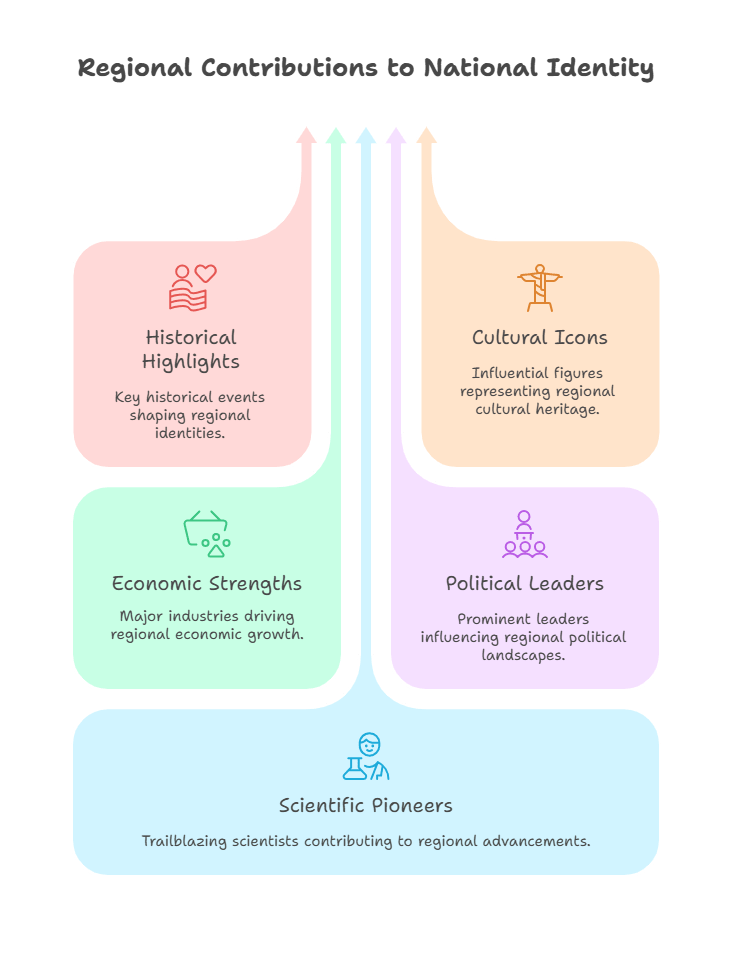
These study notes provide a detailed examination of the historical, cultural, economic, political, and scientific contributions of Bengal, Maharashtra, Tamil Nadu, and Bihar to India. Each region has played a pivotal role in shaping the nation’s identity, with contributions spanning ancient civilizations, colonial resistance, modern development, and intellectual advancements. The notes are organized by region, with subsections for clarity, focusing on key aspects while integrating interconnected elements such as freedom struggle participation and societal reforms.
Bengal (Historical Bengal Region, Primarily West Bengal in Modern Context)
Bengal has been a cradle of intellectual, cultural, and revolutionary movements, influencing India’s socio-political fabric through its rich heritage and strategic location.
- Historical Contributions:
- Bengal served as a key province under ancient empires, including the Gupta Empire (circa 320–550 CE), where archaeological evidence like coins indicates a monetized economy and administrative prowess.
- During the medieval period, it was a center of maritime trade in the Bay of Bengal, facilitating exchanges between India, China, and European powers.
- In the colonial era, Bengal was the initial base for British East India Company expansion, leading to events like the Battle of Plassey (1757) and the Partition of Bengal (1905), which sparked widespread anti-colonial protests.
- The region endured the devastating Bengal Famine of 1943, attributed partly to colonial policies, highlighting economic vulnerabilities under British rule.
- Post-independence, Bengal’s division into West Bengal and East Pakistan (now Bangladesh) shaped modern geopolitical boundaries.
- Cultural Contributions:
- The Bengal Renaissance (19th–early 20th century) fostered intellectual and social reforms, promoting modern education, women’s rights, and literature, with figures like Raja Ram Mohan Roy advocating against practices such as sati.
- Bengal has enriched Indian arts through literature (e.g., Rabindranath Tagore’s works), music, and theater, influencing national cultural identity.
- It is home to diverse traditions, including Durga Puja festivals, which blend religious and communal elements, and has produced numerous Nobel laureates in literature and economics.
- Economic Contributions:
- Historically, Bengal was a hub for textiles, jute, and tea industries, contributing significantly to India’s export economy during colonial times.
- Kolkata (formerly Calcutta) developed as a major port and commercial center, linking India to global trade routes.
- In modern times, West Bengal contributes through industries like steel, information technology, and agriculture, though it has faced challenges in sustaining industrial growth.
- Political Contributions:
- Bengal was instrumental in India’s freedom struggle, with leaders like Subhas Chandra Bose (founder of the Indian National Army) and Aurobindo Ghosh driving revolutionary activities.
- The region pioneered ideological movements, including leftist politics, with a history of communist governance influencing labor reforms and land redistribution.
- Events like the Swadeshi Movement (1905) promoted economic self-reliance and nationalism across India.
- Scientific Contributions:
- Bengal has produced pioneers such as Jagadish Chandra Bose (advances in radio waves and plant physiology) and Satyendra Nath Bose (Bose-Einstein statistics in quantum mechanics).
- The region has contributed to economic and social sciences, with scholars like Amartya Sen advancing theories on welfare economics and famine studies.
- Institutions like the Indian Statistical Institute in Kolkata have shaped national research in statistics and planning.
- Other Notable Contributions:
- Bengal’s role in environmental sustainability is evident in the Sundarbans delta ecosystem management.
- It has influenced Indian cuisine through dishes like rosogolla and fish preparations, and sports via cricket and football traditions.
Maharashtra
Maharashtra stands as a powerhouse of industrial and cultural dynamism, with a legacy of warrior traditions and modern economic leadership.
- Historical Contributions:
- The Maratha Empire (17th–19th century), led by Shivaji Maharaj, challenged Mughal dominance and established decentralized governance, influencing Indian military strategies.
- Ancient roots trace back to 1300–700 BCE, with the region evolving through dynasties like the Satavahanas, fostering trade along the western coast.
- Colonial history includes the Peshwa rule and the formation of the Bombay Presidency, which became a focal point for British administration.
- The state’s creation in 1960, following linguistic reorganization, marked a milestone in India’s federal structure.
- Cultural Contributions:
- Maharashtra has preserved Marathi literature, poetry, and theater, with saints like Tukaram and Dnyaneshwar contributing to Bhakti movements that emphasized social equality.
- Mumbai (formerly Bombay) is the epicenter of Bollywood, shaping India’s film industry and global cultural exports.
- Festivals like Ganesh Chaturthi and traditional arts such as Lavani dance reflect communal harmony and regional identity.
- Economic Contributions:
- Maharashtra leads India’s industrial output (contributing about 20% nationally), with sectors like automobiles, pharmaceuticals, and information technology thriving in cities like Pune and Mumbai.
- Mumbai serves as India’s financial capital, housing the Bombay Stock Exchange and Reserve Bank of India, driving national economic policies.
- The state accounts for nearly 46% of its own gross state domestic product from industry, making it a model for balanced agricultural-industrial growth.
- Political Contributions:
- Leaders like Bal Gangadhar Tilak and Gopal Krishna Gokhale were key in the freedom struggle, advocating swaraj (self-rule) and moderate reforms.
- Maharashtra has influenced national politics through parties like the Indian National Congress and Shiv Sena, addressing regional issues like linguistic rights.
- Social reformers such as Jyotirao Phule and B.R. Ambedkar (drafter of India’s Constitution) advanced anti-caste movements, impacting equality laws.
- Scientific Contributions:
- The region has fostered innovations in vaccine production, with historical figures like Waldemar Haffkine developing plague and cholera vaccines in the late 19th century.
- Modern contributions include advancements in nuclear science (e.g., via the Bhabha Atomic Research Centre) and engineering, supporting India’s space and defense programs.
- Institutions like the Indian Institute of Technology Bombay drive research in technology and sustainable development.
- Other Notable Contributions:
- Maharashtra’s cooperative movements in sugar and dairy have modeled rural economic empowerment.
- It has shaped Indian sports through cricket icons and wrestling traditions.
Tamil Nadu
Tamil Nadu exemplifies ancient Dravidian heritage blended with modern innovation, contributing profoundly to India’s linguistic and technological landscape.
- Historical Contributions:
- Ancient dynasties like the Cholas, Pallavas, and Pandyas (Sangam era, circa 300 BCE–300 CE) built grand temples and expanded maritime trade to Southeast Asia.
- The region was a center of early iron technology, with recent archaeological finds dating back over 4,000 years, potentially predating other global sites.
- Colonial history includes resistance against British rule, with the South Indian Rebellion (1800s) challenging annexation policies.
- Post-independence, linguistic reorganization in 1956–1967 solidified state boundaries, influencing federalism.
- Cultural Contributions:
- Tamil literature, including the Thirukkural (ancient ethical treatise), has enriched moral philosophy and classical language status.
- Arts like Bharatanatyam dance, Carnatic music, and temple architecture (e.g., Brihadeeswarar Temple) define South Indian heritage.
- Social reforms under the Dravidian movement promoted rationalism and anti-caste equality, shaping inclusive cultural norms.
- Economic Contributions:
- Tamil Nadu is a leader in manufacturing (automobiles, textiles) and information technology, with Chennai as an IT hub contributing to India’s software exports.
- Ancient trade networks evolved into modern ports and infrastructure, supporting national growth.
- The state ranks high in human development, with investments in education and health driving economic equity.
- Political Contributions:
- The Dravidian parties (DMK, AIADMK) pioneered welfare-oriented governance, influencing policies on education, reservations, and language rights (e.g., anti-Hindi agitations in the 1960s).
- Leaders like C.N. Annadurai and M. Karunanidhi advanced federalism and social justice, impacting national affirmative action.
- Participation in the freedom struggle included figures like V.O. Chidambaram Pillai, who promoted indigenous shipping.
- Scientific Contributions:
- Ancient Tamil texts contributed to mathematics (e.g., concepts influencing algebra) and medicine (Siddha system).
- Modern figures like Srinivasa Ramanujan (number theory) and C.V. Raman (physics Nobel) hailed from the region.
- Tamil Nadu leads in renewable energy research and space technology, with institutions like the Indian Institute of Technology Madras.
- Other Notable Contributions:
- The state’s cuisine (dosas, idlis) and festivals like Pongal have integrated into national traditions.
- Archaeological sites like Keeladi reveal early urban civilizations, reshaping Indian history narratives.
Bihar
Bihar represents India’s ancient intellectual and spiritual core, despite modern challenges, with foundational contributions to governance and philosophy.
- Historical Contributions:
- Birthplace of the Maurya Empire (under Chandragupta and Ashoka, 4th–3rd century BCE), which unified much of India and promoted non-violence.
- The Gupta Empire (4th–6th century CE) originated here, marking India’s “Golden Age” with advancements in administration and arts.
- Ancient universities like Nalanda (5th century CE) attracted global scholars, influencing education systems worldwide.
- Colonial resistance included the 1857 Revolt and Quit India Movement (1942), with Bihar as a key theater.
- Cultural Contributions:
- Origins of Buddhism (Buddha’s enlightenment at Bodh Gaya) and Jainism (Mahavira’s teachings), shaping global spiritual traditions.
- Folk arts like Madhubani painting and Sujni embroidery preserve tribal heritage, fostering community identity.
- Literature and festivals, such as Chhath Puja, reflect agrarian and devotional cultures.
- Economic Contributions:
- Historically, Bihar was an agricultural and trade hub, with rich mineral resources supporting early industrialization.
- Ancient trade routes connected it to Central Asia, influencing economic networks.
- Modern efforts focus on revival through tourism (heritage sites) and agriculture, though it remains one of India’s less developed states.
- Political Contributions:
- Leaders like Jayaprakash Narayan spearheaded the 1970s anti-corruption movement, leading to the Emergency (1975) and democratic reforms.
- Bihar contributed to caste-based politics, with reservations and social justice initiatives influencing national policies.
- Ancient republican confederacies (e.g., Vajji) provided early models of democratic governance.
- Scientific Contributions:
- Nalanda and Vikramshila universities advanced astronomy, mathematics, and medicine in ancient times.
- Figures like Aryabhata (5th century CE) contributed to zero and trigonometry, foundational to global science.
- Modern research in agriculture and hydrology addresses Ganges basin challenges.
- Other Notable Contributions:
- Bihar’s migration patterns have supplied skilled labor to India and abroad, preserving cultural ties.
- It has influenced Indian philosophy through texts like the Upanishads composed in the region.

Leave a comment