
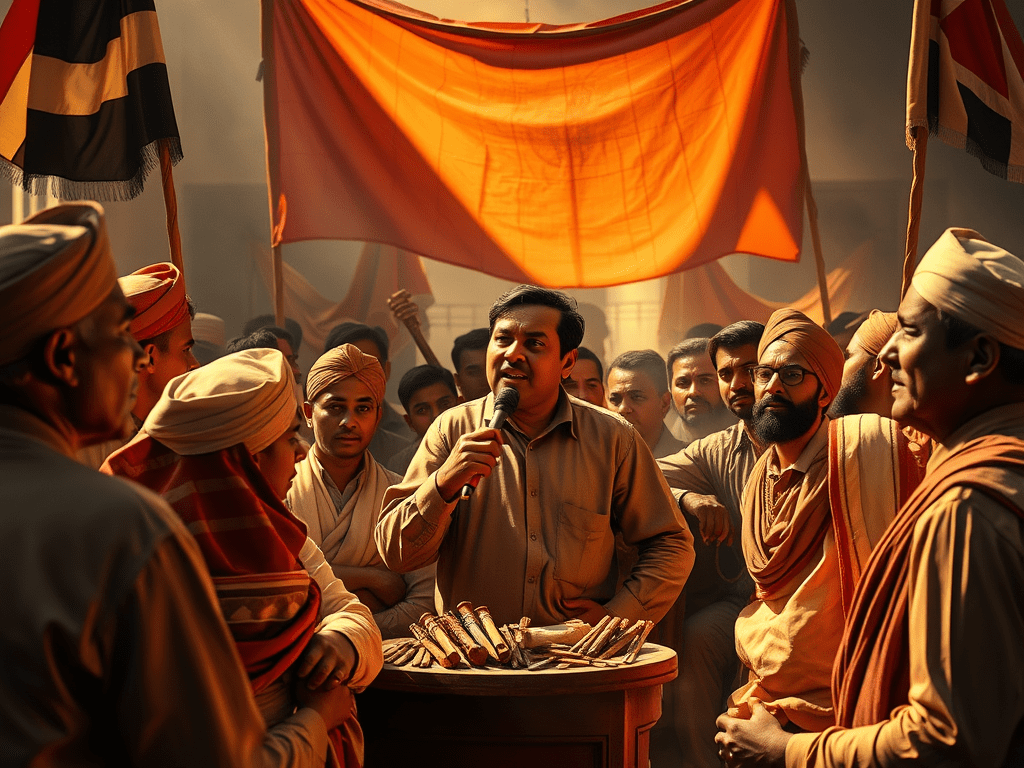
Trade unions represent organized associations of workers formed to safeguard and promote their economic and social interests, particularly in relation to wages, working conditions, and employment security. In India, the labor movement emerged as a response to industrial exploitation during the colonial era, influenced by global events such as the Industrial Revolution, the Russian Revolution, and the establishment of the International Labour Organization (ILO) in 1919. The movement evolved through phases marked by increasing militancy, political affiliations, and legislative reforms. Key legislation, such as the Trade Unions Act of 1926, provided legal recognition and protections for unions. The All India Trade Union Congress (AITUC), established in 1920, played a pivotal role as the first national federation, advocating for workers’ rights amid nationalist struggles. This study material structures the history chronologically, highlights major trade unions, and details demands, with a focus on AITUC.
Chronological History of Trade Unions in India
The development of trade unions in India can be divided into distinct phases: pre-1918 (early beginnings), 1918-1924 (formation and growth), 1924-1934 (militancy and splits), 1934-1939 (unity and consolidation), 1939-1947 (wartime and pre-independence), and post-1947 (post-independence evolution). The following table presents key milestones in chronological order.
| Year(s) | Key Events and Developments |
|---|---|
| Late 19th Century (1870s-1890s) | Initial stirrings of labor organization amid industrial growth in textiles and railways. Early associations like the Bombay Millhands Association (1890), led by Narayan Meghaji Lokhande, focused on welfare rather than confrontation. Influenced by social reformers addressing exploitative conditions such as long hours and low wages. No formal unions yet due to lack of legal framework. |
| 1900-1917 | Sporadic strikes in Bombay and Calcutta mills. Formation of printer unions (1905) and postal unions (1907). World War I (1914-1918) intensified exploitation, leading to rising discontent. Russian Revolution (1917) inspired Indian workers, boosting morale for organized action. |
| 1918 | Establishment of the first formal trade union, the Madras Labour Union, by B.P. Wadia in April, representing textile workers. Marked the beginning of structured labor movements with demands for better wages and reduced hours. Influenced by ILO’s formation in 1919. |
| 1919-1920 | Wave of strikes across industries, involving over 1.5 million workers. Bombay textile strike (1919) highlighted demands for bonus and shorter hours. All India Trade Union Congress (AITUC) founded on October 31, 1920, in Bombay under Lala Lajpat Rai’s presidency, uniting workers nationally. |
| 1921-1923 | AITUC represented India at ILO conferences. Buckingham Mill Case (1921) in Madras led to legal recognition of unions’ right to strike. Trade Unions Act drafted (enacted in 1926), providing registration and immunity from civil suits. |
| 1924-1926 | Increasing militancy with communist influences. AITUC’s Kanpur session (1925) adopted radical resolutions. Trade Unions Act, 1926, formalized union registration, defining trade unions and allowing collective bargaining. |
| 1927-1929 | Splits within AITUC due to ideological differences. Formation of All India Trade Union Federation (AITUF) in 1929 by moderates like N.M. Joshi. Trade Disputes Act, 1929, introduced to resolve industrial disputes. Great Depression (1929) exacerbated labor issues, leading to more strikes. |
| 1930-1934 | Period of repression under British rule. AITUC affiliated with Red International of Labour Unions (1930). Multiple splits: National Trade Union Federation (NTUF) formed in 1929, Red Trade Union Congress (RTUC) in 1931. Reunification efforts in 1935 merged RTUC back into AITUC. |
| 1935-1939 | Unity phase: NTUF merged with AITUC in 1938. Provincial labor legislations improved conditions. Bombay Industrial Disputes Act, 1938, enhanced dispute resolution. World War II (1939) brought wartime controls, restricting strikes. |
| 1940-1946 | Wartime strikes despite bans. AITUC split in 1941 over war support. Industrial Disputes Act, 1947, established adjudication mechanisms. Pre-independence surge in membership and strikes. |
| 1947 | Post-independence: Formation of Indian National Trade Union Congress (INTUC) on May 3, 1947, affiliated with Indian National Congress. AITUC remained communist-led. Industrial Truce Resolution promoted harmony. |
| 1948-1950 | Hind Mazdoor Sabha (HMS) formed in 1948 by socialists. United Trade Union Congress (UTUC) established in 1949. Code of Discipline (1958) later guided industrial relations. |
| 1950s-1960s | Growth of public sector unions. Bharatiya Mazdoor Sangh (BMS) founded in 1955, affiliated with RSS. Centre of Indian Trade Unions (CITU) split from AITUC in 1970 due to ideological rifts. |
| 1970s-1980s | Militant phase: 1974 railway strike and 1982 Bombay textile strike. Economic liberalization (1991) shifted focus to job security amid privatization. |
| 1990s-2000s | Decline in union density due to informal sector growth. New unions like Self-Employed Women’s Association (SEWA, 1972) addressed unorganized workers. Labour Codes (2019-2020) consolidated laws. |
| 2010s-Present | Ongoing challenges: Informalization, gig economy. Unions advocate against labor code dilutions. National strikes in 2020-2021 protested farm and labor laws. As of 2025, unions continue to push for social security and minimum wages. |
Major Trade Unions in India
India’s trade union landscape is fragmented along political lines, with affiliations to parties influencing their ideologies. The following table lists major central trade unions, their formation years, political affiliations, and key features.
| Trade Union Name | Formation Year | Political Affiliation | Key Features and Membership (Approximate, as per Latest Available Data) |
|---|---|---|---|
| All India Trade Union Congress (AITUC) | 1920 | Communist Party of India (CPI) | Oldest federation; focuses on anti-imperialist and class struggles. Membership: Around 14 million. |
| Indian National Trade Union Congress (INTUC) | 1947 | Indian National Congress | Largest union; promotes harmonious industrial relations. Membership: Over 33 million. |
| Bharatiya Mazdoor Sangh (BMS) | 1955 | Rashtriya Swayamsevak Sangh (RSS)/Bharatiya Janata Party (BJP) | Emphasizes nationalism and worker welfare without strikes. Membership: Around 17 million. |
| Hind Mazdoor Sabha (HMS) | 1948 | Socialist (independent) | Advocates democratic socialism; focuses on unorganized sectors. Membership: About 9 million. |
| Centre of Indian Trade Unions (CITU) | 1970 | Communist Party of India (Marxist) (CPI(M)) | Militant approach; split from AITUC. Membership: Around 6 million. |
| United Trade Union Congress (UTUC) | 1949 | Revolutionary Socialist Party | Leftist orientation; active in eastern India. Membership: About 1.5 million. |
| Self-Employed Women’s Association (SEWA) | 1972 | Independent (women-focused) | Targets informal women workers; affiliated with international bodies. Membership: Over 2 million. |
Detailed Focus on All India Trade Union Congress (AITUC)
History of AITUC
The All India Trade Union Congress (AITUC) stands as the foundational pillar of India’s organized labor movement. Founded on October 31, 1920, in Bombay (now Mumbai) amid post-World War I strikes and nationalist fervor, it was initiated by leaders including Lala Lajpat Rai (first president), N.M. Joshi, Joseph Baptista, and Diwan Chaman Lal. The inaugural session, attended by 500 delegates from 64 unions, aimed to unify workers against colonial exploitation. Influenced by the ILO and Russian Revolution, AITUC initially represented diverse ideologies but leaned radical post-1925 under communist influence.
Key historical phases:
- 1920-1929: Rapid growth; represented India at ILO. Faced internal debates, leading to the 1929 split and formation of AITUF by moderates.
- 1930-1939: Affiliated with international leftist bodies; endured British repression during the Meerut Conspiracy Case (1929). Reunified in 1935 and 1938.
- 1940-1947: Split over World War II stance; communist faction opposed the war, leading to bans. Post-1945, it aligned with CPI.
- Post-1947: Remained CPI-affiliated after splits forming INTUC (1947) and CITU (1970). Focused on anti-capitalist struggles.
- Modern Era: As of 2025, AITUC, led by President Ramendra Kumar and General Secretary Amarjeet Kaur, publishes “Trade Union Record” and affiliates with the World Federation of Trade Unions (WFTU). It organizes in sectors like textiles, mining, and unorganized labor.
Demands of AITUC in Detail
AITUC’s demands have evolved from colonial-era welfare to contemporary social justice, emphasizing class struggle and workers’ rights. They are articulated through resolutions, strikes, and policy advocacy. The following table categorizes key demands chronologically, highlighting their focus areas.
| Period | Key Demands | Details and Context |
|---|---|---|
| 1920-1929 (Foundational) | 8-hour workday; Minimum wages; Maternity benefits; Abolition of child labor; Right to strike and organize. | Aimed at countering colonial exploitation in mills and railways. 1920 founding charter demanded representation at ILO and end to indentured labor. Influenced by global standards, these led to partial successes like the 1926 Act. |
| 1930-1939 (Militant Phase) | Living wages indexed to cost of living; Unemployment insurance; Nationalization of key industries; Anti-fascist solidarity; Freedom from colonial rule. | Amid Depression and repression, demands included debt relief for peasants (linked to workers) and opposition to wage cuts. 1938 unity congress emphasized collective bargaining and social security. |
| 1940-1947 (Wartime and Pre-Independence) | Withdrawal of wartime ordinances restricting strikes; Bonus and dearness allowance; Independence and workers’ role in governance; Equal pay for equal work. | Opposed war profiteering; demanded release of political prisoners. Post-war, focused on industrial peace with justice, influencing 1947 Industrial Disputes Act. |
| 1948-1969 (Post-Independence) | Implementation of minimum wages; Social security schemes; Land reforms for rural workers; Opposition to automation without safeguards; National wage policy. | Advocated for public sector expansion; strikes for bonus (e.g., 1960s coal miners). Demanded tripartite consultations (government, employers, unions). |
| 1970-1989 (Liberalization Onset) | Job security amid mechanization; Inflation-adjusted wages; Pension and provident funds; Rights for contract workers; Anti-privatization. | Post-CITU split, AITUC led strikes against Emergency (1975-1977). Demanded reversal of anti-labor policies in textiles and railways. |
| 1990-2009 (Economic Reforms) | Protection against globalization-induced layoffs; Universal social security; Gender equality in wages; Regulation of informal sector; Minimum wage of INR 10,000 (adjusted over time). | Opposed WTO policies; demanded employment guarantees like MGNREGA (influenced its 2005 enactment). Focused on unorganized workers’ rights. |
| 2010-Present (Contemporary) | Repeal of anti-labor codes (e.g., 2020 reforms); Universal minimum wage (INR 26,000 proposed); Comprehensive social security including health and pension; Climate justice for workers; Rights for gig and migrant workers; Gender-sensitive policies like paid maternity leave extension. | Recent strikes (e.g., 2020-2021) protested farm laws and labor dilutions. Demands include ratification of ILO conventions on violence and harassment; opposition to fixed-term employment; and digital rights for platform workers. As of 2025, AITUC pushes for inflation-linked wages and anti-discrimination measures. |

Leave a comment