
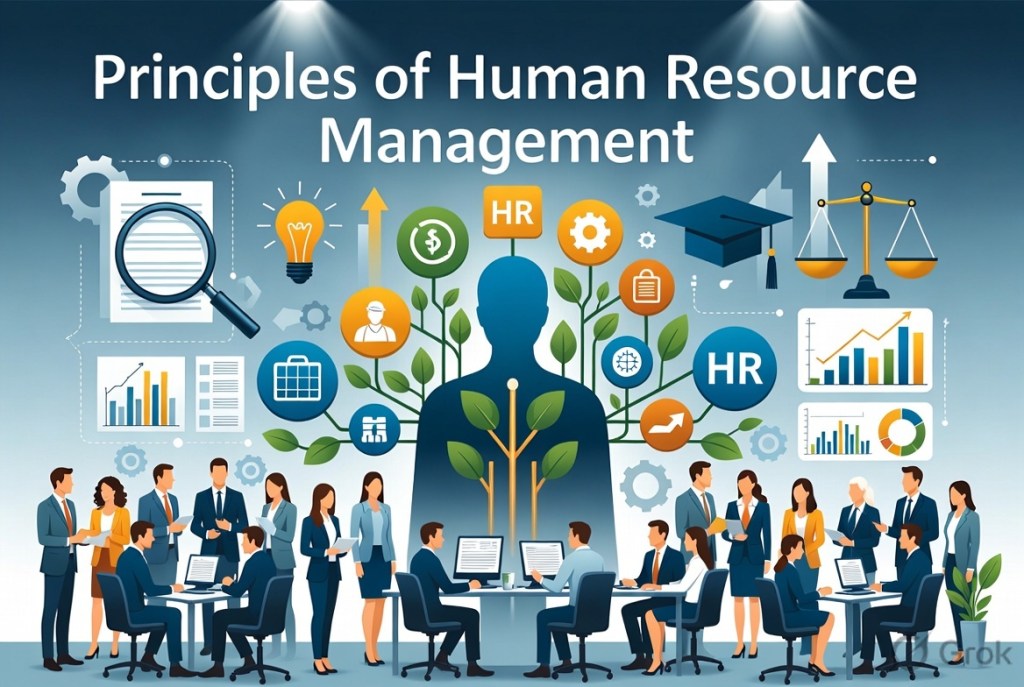
Principles of Human Resource Management (HRM)
HRM is the strategic approach to managing an organization’s most valuable asset—its people—to achieve organizational goals while fostering employee well-being, development, and engagement. It involves planning, organizing, directing, and controlling human resources effectively.
1. Introduction to HRM
- Definition: HRM encompasses acquiring, developing, motivating, and retaining talent while ensuring compliance with laws and alignment with business strategy.
- Scope: From recruitment to retirement, covering the entire employee lifecycle.
- Importance: Helps maximize productivity, build competitive advantage, ensure legal compliance, promote diversity and inclusion, and adapt to changes like globalization and technology.
Evolution of HRM:
- Early 20th Century: Welfare and administrative focus (personnel management during Industrial Revolution).
- Mid-20th Century: Human Relations Movement (emphasis on motivation and behavior post-Hawthorne studies).
- 1980s Onward: Shift to Strategic HRM, integrating with business goals.
- Modern Era: Digital HRM, data analytics, remote work, DEI (Diversity, Equity, Inclusion), and people analytics.
2. Objectives of HRM
HRM objectives are typically classified into four categories:
| Category | Description | Examples |
|---|---|---|
| Organizational | Support overall business goals and efficiency | Productivity, profitability, growth |
| Functional | Ensure HR department operates smoothly | Efficient recruitment, training systems |
| Personal | Meet individual employee needs and aspirations | Career growth, job satisfaction |
| Societal | Contribute to society (e.g., ethical practices, diversity) | Compliance with labor laws, CSR |
Key Objectives:
- Maximize employee performance and engagement.
- Align workforce with organizational strategy.
- Promote learning, development, and retention.
- Foster a positive, inclusive work environment.
- Ensure legal compliance and ethical practices.
3. Core Principles of HRM
Principles guide HR decisions for fairness, effectiveness, and strategic impact. Common frameworks include:
Guiding Principles (often cited as 6 core ones):
- Strategic Alignment — HR practices must support organizational goals.
- Partnership & Engagement — Collaborate with leaders and employees.
- Fairness & Equality — Equal opportunity, non-discrimination.
- Communication — Open, transparent dialogue.
- Adaptability — Flexibility in response to change.
- Ethics & Integrity — Moral decision-making.
Other Key Principles:
- Commitment: Provide job security and support through training and evaluations.
- Competence: Build skills via continuous development.
- Individual Development: Recognize unique employee potential and growth opportunities.
- Fair Selection & Remuneration: Merit-based hiring and equitable pay.
- Participation: Involve employees in decision-making.
- People as Assets: Invest in human capital for long-term value.
7 Basic Principles/Functions (commonly referenced operational cornerstones):
- Recruitment & Selection
- Performance Management
- Learning & Development
- Succession Planning
- Compensation & Benefits
- HR Information Systems (HRIS)
- HR Data & Analytics
4. Major Functions of HRM
HR functions are divided into Managerial (planning, organizing, directing, controlling) and Operative (specific activities).
Key Operative Functions:
- Human Resource Planning (HRP): Forecasting future needs, analyzing supply/demand, job analysis.
- Recruitment & Selection: Sourcing candidates (internal/external), screening, interviews, onboarding.
- Training & Development: Orientation, skill enhancement, leadership programs.
- Performance Appraisal & Management: Setting goals (e.g., SMART), feedback, 360-degree reviews, rewards.
- Compensation & Benefits: Salary structures, incentives, perks, benefits administration.
- Employee Relations & Welfare: Grievance handling, conflict resolution, health & safety, motivation.
- Career & Succession Planning: Talent pipelines, promotions.
- Compliance & Records: Labor laws, documentation, HRIS management.
5. Detailed Coverage of Key Areas
Recruitment and Selection
- Process: Job analysis → Sourcing → Screening → Interviews → Offer → Onboarding.
- Principles: Fair, merit-based, diversity-focused.
- Challenges: Talent shortages, bias reduction.
Training and Development
- Types: On-the-job, off-the-job, e-learning.
- Methods: Workshops, mentoring, simulations.
- Principle: Continuous learning for competence and adaptability.
Performance Management
- Cycle: Planning → Monitoring → Reviewing → Rewarding.
- Tools: KPIs, balanced scorecard, feedback apps.
- Focus: Developmental rather than purely evaluative.
Compensation Management
- Components: Base pay, variable pay, benefits, non-monetary rewards.
- Principles: Equity (internal/external), motivation (expectancy theory).
Employee Relations
- Includes union management, engagement surveys, culture building.
- Emphasis on psychological safety and inclusion.
6. Emerging Trends in HRM (as of 2026)
- AI & Technology: Predictive analytics for hiring, chatbots for queries.
- Hybrid/Remote Work: Focus on outcomes over presence.
- DEI & Belonging: Stronger emphasis on equity.
- Well-being & Mental Health: Holistic support programs.
- Sustainability & ESG: HR role in ethical workforce practices.
- Gig Economy & Flexible Workforce: Managing contingent workers.
7. Challenges in HRM
- Talent retention in competitive markets.
- Adapting to technological disruption.
- Managing generational diversity (Gen Z, Millennials).
- Legal and ethical compliance (data privacy, AI ethics).
- Balancing cost control with employee investment.
8. Best Practices and Models
- Harvard Model: Emphasizes stakeholder interests.
- Michigan Model: Focuses on resource utilization for strategy.
- Ulrich’s HR Business Partner Model: HR as strategic partner, change agent, administrative expert, employee champion.
- Measure success via metrics: Turnover rate, engagement scores, ROI on training, time-to-hire.

Leave a comment