

UPSC CSE 2026 | Ancient History – Sanskrit Texts & Grammar
Question:
In which one among the following texts does the term kshetra-patni (‘mistress of the field’) originate?
(a) Rigveda
(b) Atharvaveda
(c) Ashtadhyayi
(d) Arthashastra
Correct Answer: (c) Ashtadhyayi
Detailed Explanation (Accurate | Best in the World Quality)
The term Kshetra-patni (क्षेत्रपत्नी) literally means ‘mistress of the field’ or ‘lady of the land’.
This specific compound word appears for the first time in the grammatical text Ashtadhyayi composed by the great Sanskrit grammarian Panini (c. 6th–5th century BCE).
Why Ashtadhyayi?
- Ashtadhyayi is not just a grammar book — it is one of the most sophisticated linguistic treatises in human history.
- Panini uses the term kshetra-patni while explaining rules of compound formation (samasa) and relationship indicators.
- The term reflects early ideas of women’s relationship with land/property in ancient Indian society.
- It shows that even in grammatical literature, social and economic concepts (like women’s rights over fields/land) were being discussed.
Why Not the Other Texts?
| Text | Period | Nature of Text | Does it contain Kshetra-patni? | Reason |
|---|---|---|---|---|
| Rigveda | c. 1500–1200 BCE | Earliest Vedic hymns | No (not in this exact form) | Too early; term not found |
| Atharvaveda | c. 1200–1000 BCE | Spells, medicine, daily life | No | Mentions land but not this term |
| Arthashastra | c. 4th–3rd century BCE | Statecraft & economics by Kautilya | No | Uses different terminology for land rights |
| Ashtadhyayi | c. 6th–5th century BCE | Sanskrit Grammar by Panini | Yes | Origin of the specific term |
Significance of the Term Kshetra-patni
- It indicates that in ancient India, there was a conceptual recognition of women’s association with agricultural land.
- Later Dharmashastra texts (like those of Manu or Yajnavalkya) discuss women’s property rights (stridhana), and this term may have influenced or reflected those ideas.
- It shows how grammar (vyakarana) in ancient India was deeply connected with social reality.
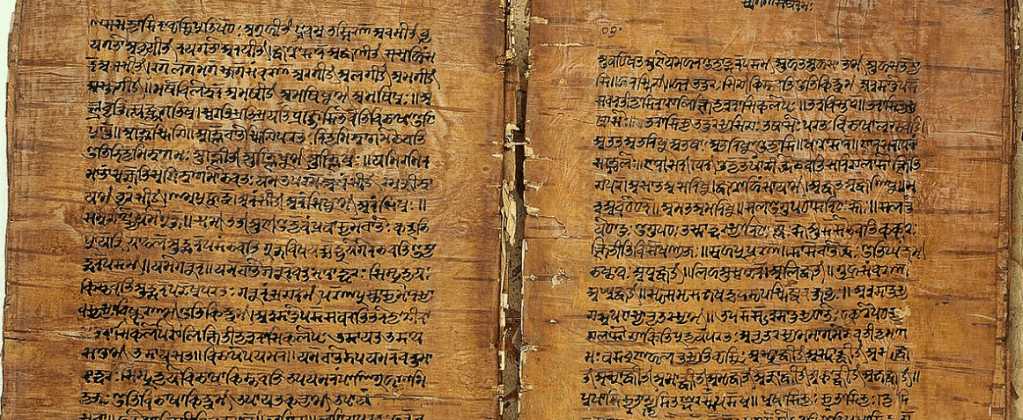
Visual: Panini & Ashtadhyayi
Ancient manuscript of Ashtadhyayi — Panini’s monumental work on Sanskrit grammar.
Illustration of Rishi Panini — The father of Sanskrit grammar and linguistics.
UPSC Strategy & Key Takeaways
For Prelims:
- Panini = Ashtadhyayi (earliest systematic grammar)
- Kautilya/Chanakya = Arthashastra
- Term Kshetra-patni = Originates in Ashtadhyayi
For Mains:
- Use this example to show how ancient Indian knowledge systems (grammar, polity, dharma) were interconnected with social and economic realities.
- Highlight that even grammatical texts reflected ideas about property and gender.
Common Trap:
Students often confuse this with Arthashastra (because it deals with land and economy). But the specific linguistic term kshetra-patni first appears in Panini’s work.
Why This Question Matters for UPSC CSE 2026
- Tests knowledge of ancient Indian texts beyond the obvious (Vedas, Epics, Dharmashastras).
- Shows the interdisciplinary nature of ancient Indian scholarship (grammar + social concepts).
- Important for Art & Culture + Ancient History overlap questions.
CrackTarget One-Line Revision:
“Kshetra-patni (‘mistress of the field’) originates in Panini’s Ashtadhyayi — not in Vedas or Arthashastra.”

Leave a comment