
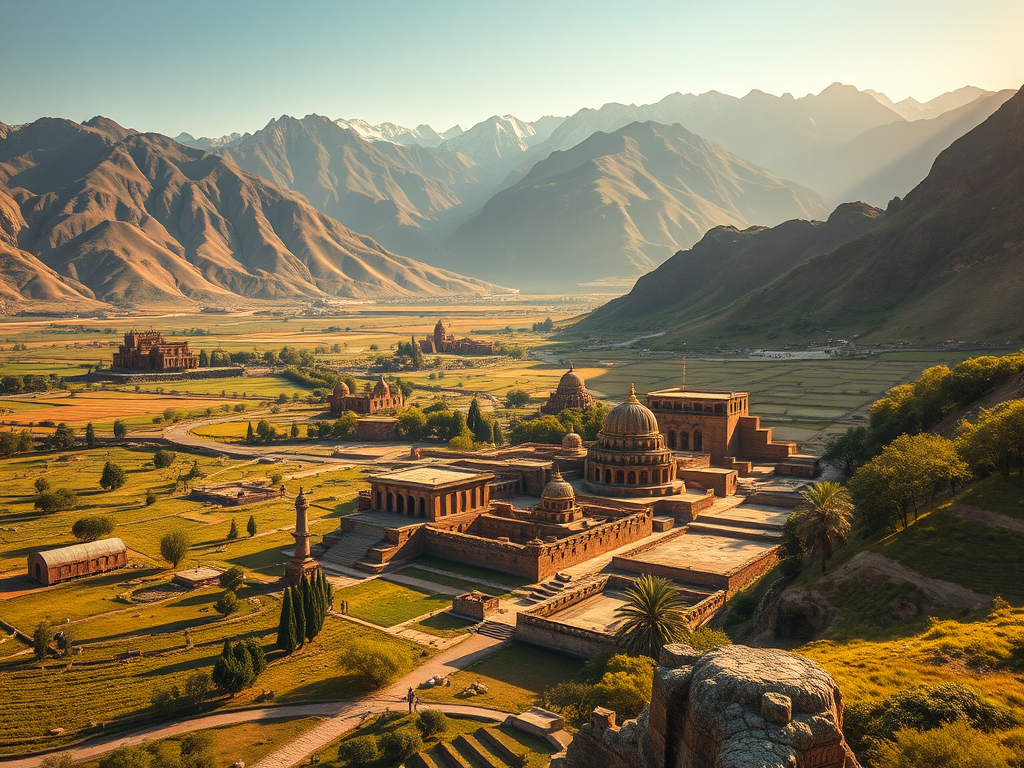
Gandhara was an ancient region and Mahajanapada in the northwestern Indian subcontinent, encompassing parts of modern-day northern Pakistan and eastern Afghanistan. Renowned for its strategic location, cultural synthesis, and contributions to art, religion, and learning, Gandhara played a pivotal role in ancient Indian and global history. This study material explores Gandhara’s historical context, political evolution, cultural significance, and legacy, with a focus on its role as a Mahajanapada and its broader impact.
1. Historical and Geographical Context
Gandhara was located in the Peshawar Valley, along the upper Indus River, with key cities like Taxila (Takshashila) and Pushkalavati (modern Charsadda). Its strategic position made it a crossroads of trade and cultural exchange between India, Central Asia, Persia, and the Mediterranean.
Key Features:
- Geography: Bounded by the Hindu Kush mountains, Swat Valley, and Kabul River, with fertile plains supporting agriculture.
- Timeline: References to Gandhara appear in Vedic texts (c. 1500 BCE), with prominence as a Mahajanapada (c. 6th century BCE) and later as a cultural hub until the 11th century CE.
- Cultural Synthesis: Influenced by Indian, Persian, Greek, and Central Asian traditions due to invasions and trade.
2. Gandhara in the Vedic and Mahajanapada Period
a) Early References
- Gandhara is mentioned in the Rigveda (c. 1500–1000 BCE) as a region associated with pastoral tribes and rivers like the Kubha (Kabul).
- The Atharvaveda and Brahmanas refer to Gandhara’s people and their cultural practices, indicating their integration into Vedic society.
- By the Later Vedic period (c. 1000–500 BCE), Gandhara was a recognized janapada (tribal territory).
b) As a Mahajanapada (c. 6th Century BCE)
- Gandhara was one of the sixteen Mahajanapadas listed in Buddhist texts like the Anguttara Nikaya.
- Capital: Taxila, a major center of trade, learning, and administration.
- Governance: Initially a monarchy, with kings supported by councils. Later, it experienced periods of oligarchic or republican rule.
- Economy: Relied on agriculture (wheat, barley), pastoralism, and trade. Its location on the Uttarapatha (northern trade route) facilitated commerce with Central Asia and Persia.
- Military: Known for skilled warriors and cavalry, often mentioned in Vedic texts and later epics.
c) Political Dynamics
- Gandhara maintained alliances and rivalries with neighboring Mahajanapadas like Kamboja and Kuru.
- Its proximity to Persia made it vulnerable to external influence, particularly during the Achaemenid conquest (c. 6th century BCE).
3. Political History and Foreign Invasions
Gandhara’s strategic location attracted numerous conquerors, shaping its political and cultural trajectory.
a) Achaemenid Rule (c. 550–330 BCE)
- The Persian Achaemenid Empire, under Cyrus the Great and Darius I, annexed Gandhara, making it a satrapy (province).
- Gandhara paid tribute to Persia, as noted in Herodotus’ accounts and the Behistun Inscription.
- Persian rule introduced administrative systems, coinage, and Aramaic script, influencing local governance.
b) Greek and Macedonian Conquest (c. 327–325 BCE)
- Alexander the Great invaded Gandhara, capturing Taxila and defeating local rulers like King Ambhi (Omphis).
- Greek influence persisted briefly, with Hellenistic elements blending into local culture (e.g., coin designs).
c) Mauryan Empire (c. 321–185 BCE)
- Gandhara became part of the Mauryan Empire under Chandragupta Maurya, who reclaimed it from the Greeks.
- Ashoka (r. 268–232 BCE) promoted Buddhism in Gandhara, establishing stupas and edicts (e.g., at Mansehra).
- Taxila remained a key administrative and educational center.
d) Later Dynasties
- Indo-Greeks (c. 2nd century BCE): Rulers like Menander (Milinda) patronized Buddhism and Greco-Indian culture.
- Kushans (c. 1st–3rd century CE): Under Kanishka, Gandhara became a hub of Buddhist art and trade along the Silk Road.
- Sassanians, Huns, and Decline: Gandhara faced invasions by Sassanians (3rd century CE) and White Huns (5th century CE), leading to its decline by the 11th century under Islamic conquests.
4. Social and Economic Structure
a) Social Organization
- Varna System: Followed the Vedic fourfold system (Brahmins, Kshatriyas, Vaishyas, Shudras), but with flexibility due to diverse populations.
- Ethnic Diversity: Included Indo-Aryans, Persians, Greeks, and Central Asians, fostering a cosmopolitan society.
- Women’s Roles: Limited public roles, though elite women occasionally influenced politics or religion (e.g., Buddhist nuns).
- Education: Taxila was a renowned university, attracting scholars like Panini (grammarian) and Chanakya (political theorist). Subjects included Vedic studies, medicine, astronomy, and statecraft.
b) Economy
- Agriculture: Fertile lands supported crops like wheat, rice, and barley, with irrigation systems enhancing productivity.
- Trade: Gandhara was a key node on the Silk Road, exporting textiles, spices, and gems to Persia, Central Asia, and Rome.
- Craftsmanship: Skilled artisans produced pottery, jewelry, and metalwork, as seen in archaeological finds.
- Currency: Persian and Mauryan coins, followed by Indo-Greek and Kushan coinage, facilitated trade.
5. Cultural and Religious Significance
Gandhara was a melting pot of cultures, with profound contributions to art, religion, and intellectual life.
a) Gandhara Art
- Greco-Buddhist Art (c. 1st–5th century CE): A unique blend of Indian, Greek, and Persian styles, characterized by:
- Realistic human figures with Hellenistic features (e.g., wavy hair, draped robes).
- Iconic Buddhist imagery, including the first anthropomorphic depictions of the Buddha.
- Stupas, monasteries, and sculptures at sites like Taxila, Swat, and Bamiyan.
- Key Sites: Sirkap, Dharmarajika Stupa, and Butkara Stupa.
- Influence: Spread to Central Asia, China, and Southeast Asia via the Silk Road.
b) Religion
- Vedic Religion: Early Gandhara followed Vedic rituals, with reverence for deities like Indra and Agni.
- Buddhism: Flourished under Mauryan and Kushan patronage, with monasteries and stupas dotting the region. Gandhara was a major center for Mahayana Buddhism.
- Jainism and Other Faiths: Limited presence of Jainism; Zoroastrianism and Greek cults coexisted due to foreign rule.
- Syncretism: Blending of Buddhist, Vedic, and Hellenistic elements, as seen in art and philosophy.
c) Intellectual Hub
- Taxila University: One of the world’s earliest universities, offering education in diverse fields. Notable alumni included Jivaka (physician) and Kautilya.
- Literary Contributions: Panini’s Ashtadhyayi (Sanskrit grammar) and early Buddhist texts were composed or transmitted here.
6. Gandhara as a Mahajanapada
As a Mahajanapada, Gandhara stood out for:
- Strategic Importance: Its location made it a buffer between India and Central Asia, attracting conquerors and traders.
- Cultural Exchange: Early interactions with Persia and Central Asia shaped its cosmopolitan character.
- Economic Prosperity: Trade and agriculture supported a wealthy elite and urban centers.
- Political Fluidity: Alternated between monarchical and republican governance, reflecting its tribal roots.
7. Decline and Legacy
a) Decline
- Repeated invasions by Huns (5th century CE) and later Islamic rulers (10th–11th century CE) weakened Gandhara.
- Buddhist monasteries declined due to reduced patronage and shifting trade routes.
- By the 11th century, Gandhara was absorbed into Islamic polities, ending its distinct identity.
b) Legacy
- Artistic Influence: Gandhara art inspired Buddhist iconography across Asia, notably in China, Korea, and Japan.
- Cultural Bridge: Facilitated the spread of Buddhism and Indian culture to Central Asia and beyond.
- Historical Significance: Gandhara’s role as a Mahajanapada and cultural hub underscores the diversity of ancient India.
- Archaeological Sites: Taxila and Swat Valley are UNESCO World Heritage Sites, preserving Gandhara’s heritage.
8. Challenges in Studying Gandhara
- Textual Bias: Vedic and Buddhist sources focus on religious aspects, with limited details on social life.
- Archaeological Fragmentation: Many sites are damaged or looted, complicating reconstruction of history.
- Foreign Perspectives: Greek and Persian accounts (e.g., Herodotus, Arrian) provide external views but lack local nuance.
9. Suggested Further Reading
- Primary Sources:
- Rigveda, Atharvaveda (for early references).
- Buddhist texts (e.g., Jataka stories).
- Arrian’s Anabasis of Alexander for Greek accounts.
- Secondary Sources:
- The Art and Architecture of the Indian Subcontinent by J.C. Harle.
- Gandhara: The Memory of Afghanistan by Berenice Geoffroy-Schneiter.
- A History of Ancient and Early Medieval India by Upinder Singh.
- Online Resources:
- UNESCO World Heritage Centre (Taxila).
- Archaeological Survey of Pakistan reports.
10. Conclusion
Gandhara was a dynamic region that bridged India with the wider world, excelling as a Mahajanapada, a center of learning, and a cradle of Greco-Buddhist art. Its strategic location fostered a unique cultural synthesis, blending Vedic, Buddhist, Persian, and Greek influences. From its Vedic origins to its Kushan zenith, Gandhara’s contributions to art, religion, and intellectual life remain a testament to its historical significance. Despite its decline, Gandhara’s legacy endures in global Buddhist heritage and the archaeological treasures of Taxila and beyond.

Leave a comment