
Overview
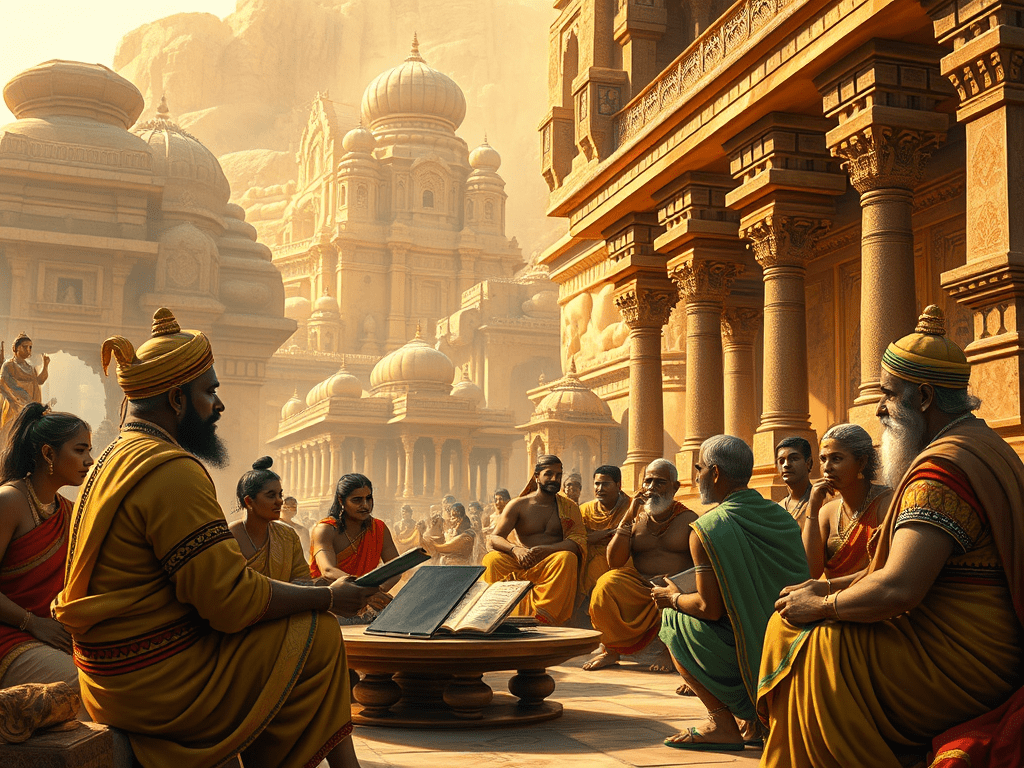
The Gupta Empire (circa 320–550 CE), often referred to as the Golden Age of India, was a period of remarkable achievements in art, science, literature, and governance, centered in northern India with its capital at Pataliputra (modern Patna, Bihar). Founded by Sri Gupta and consolidated by rulers like Chandragupta I, Samudragupta, and Chandragupta II, the Guptas unified much of northern India, fostering economic prosperity, cultural synthesis, and intellectual advancements. The era’s legacy includes iconic art (Ajanta caves, Mathura sculptures), scientific breakthroughs (Aryabhata’s astronomy), and literary masterpieces (Kalidasa’s works).
For UPSC, it is a core topic in Ancient Indian History (Prelims) and Indian Heritage and Culture (Mains GS Paper I).
For BPSC, its significance is amplified by Pataliputra’s role and Bihar’s contributions to Gupta culture (e.g., Nalanda University).
1. Historical Context and Political Significance
- Timeline: 320–550 CE, peak under Chandragupta II (375–415 CE).
- Origins: Founded by Sri Gupta (~early 4th century CE), a feudatory possibly in Magadha or Bengal. The dynasty rose to prominence under Chandragupta I.
- Key Rulers:
- Chandragupta I (~320–335 CE): Unified Magadha through marriage to Kumaradevi (Lichchhavi princess), adopted title Maharajadhiraja. Issued coins commemorating marriage.
- Samudragupta (~335–375 CE): Known as “Napoleon of India” (per historian V.A. Smith). Expanded empire through conquests (Allahabad Pillar inscription by Harishena lists victories):
- Defeated 9 north Indian kings (e.g., Nagas, Vakatakas).
- Subdued 12 southern kings (e.g., Pallavas, Cholas, released them as vassals).
- Performed Ashvamedha sacrifice, patronized arts (lyre player coins).
- Chandragupta II Vikramaditya (~375–415 CE): Greatest Gupta ruler.
- Defeated Western Kshatrapas (Sakas, ~400 CE), annexing Gujarat and Malwa.
- Established Ujjain as second capital.
- Patronized “Nine Gems” (Navratna), including Kalidasa and Amarasimha.
- Kumaragupta I (415–455 CE): Founded Nalanda University (425 CE, Bihar). Faced Huna invasions.
- Skandagupta (~455–467 CE): Repelled early Huna invasions but weakened empire.
- Geographical Extent: Covered northern India (Punjab to Bengal, Malwa to Magadha), with influence over southern vassals (Vakatakas).
- Capitals:
- Pataliputra (Patna, Bihar): Primary political and cultural hub.
- Ujjain (Madhya Pradesh): Secondary capital under Chandragupta II.
- Decline: By ~550 CE, weakened by Huna invasions (Toramana, Mihirakula), internal rebellions, and rise of regional powers (e.g., Maukharis, Pushyabhutis).
- Sources:
- Inscriptions: Allahabad Pillar (Samudragupta, by Harishena), Mehrauli Iron Pillar (Chandragupta II), Bhitari Pillar (Skandagupta).
- Coins: Gold (dinara, with Garuda, lyre), silver, copper.
- Texts: Puranas, Kalidasa’s works, Chinese traveler Faxian’s accounts (405–411 CE).
- Archaeological Sites: Nalanda, Ajanta, Mathura, Sarnath.
Details to Memorize:
- Timeline: ~320–550 CE.
- Rulers: Sri Gupta, Chandragupta I (320–335 CE), Samudragupta (335–375 CE), Chandragupta II (375–415 CE), Kumaragupta I (415–455 CE), Skandagupta (~455–467 CE).
- Capitals: Pataliputra, Ujjain.
- Extent: North India, southern vassals.
- Decline: ~550 CE, Hunas, Maukharis.
- Sources: Allahabad Pillar, Mehrauli Iron Pillar, coins, Faxian, Nalanda.
2. Golden Age: Why It’s Called So
The Gupta period is dubbed the “Golden Age” due to its unparalleled achievements:
- Political Stability: Unified northern India under strong rulers (Samudragupta, Chandragupta II), with efficient administration.
- Economic Prosperity: Flourishing trade (Silk Road, Roman trade), gold coinage, and agricultural surplus.
- Cultural Flourishing: Patronage of art (Ajanta, Sarnath), literature (Kalidasa), and science (Aryabhata).
- Religious Harmony: Supported Hinduism, Buddhism, and Jainism, fostering syncretism.
- Intellectual Advancements: Establishment of Nalanda University, contributions by scholars like Varahamihira and Vagbhata.
- Bihar’s Role: Pataliputra as capital and Nalanda as a global learning center underscored Magadha’s prominence.
Details to Memorize:
- Factors: Stability, prosperity, culture, harmony, intellect.
- Bihar: Pataliputra (capital), Nalanda (university).
3. Art and Architecture
Gupta art and architecture represent a high point in Indian cultural expression, blending indigenous traditions with Mauryan, Kushana, and regional influences.
- Architecture:
- Temples:
- Marked the rise of Hindu temple architecture (Nagara style prototype).
- Dashavatara Temple (Deogarh, Uttar Pradesh): Early Vishnu temple (~5th century CE), square sanctum (garbhagriha), shikhara precursor.
- Bhitargaon Temple (Kanpur, Uttar Pradesh): Brick temple with terracotta panels, arched niches.
- Features: Simple plans, mandapa (hall), shikhara (tower), and decorative motifs (lotus, amalaka).
- Rock-Cut Caves:
- Ajanta Caves (Maharashtra, ~2nd–5th century CE, Gupta patronage):
- Caves 1, 2, 16, 17, 19: Buddhist viharas and chaityas with frescoes.
- Features: Paintings of Buddha’s life, Jataka tales, Bodhisattvas; intricate carvings.
- Ellora Caves (Maharashtra): Early Gupta influence in Buddhist caves (e.g., Cave 10, Vishvakarma chaitya).
- Udayagiri Caves (Madhya Pradesh): Hindu caves under Chandragupta II, with Vishnu (Varaha) and Shiva sculptures.
- Ajanta Caves (Maharashtra, ~2nd–5th century CE, Gupta patronage):
- Stupas:
- Sarnath (Uttar Pradesh): Expanded under Guptas, with Dhamek Stupa and iconic Buddha statues.
- Ratnagiri (Odisha): Buddhist stupa with Gupta-era sculptures.
- Temples:
- Sculpture:
- Mathura School (refined under Guptas):
- Materials: Red sandstone.
- Features: Graceful, idealized figures; transparent drapery; serene expressions.
- Examples: Standing Buddha (Mathura), Vishnu (Caturvyuha), Yaksha figures.
- Sarnath School:
- Materials: Chunar sandstone.
- Features: Polished, elegant Buddhas with halo, folded robes, and meditative poses.
- Examples: Seated Buddha (first sermon, Sarnath), Bodhisattva statues.
- Iconography:
- Hindu: Vishnu (Varaha, Narasimha), Shiva (linga), Durga (Mahishasuramardini).
- Buddhist: Buddha, Bodhisattvas, Jataka tales.
- Jain: Tirthankara sculptures (Mathura, Kankali Tila).
- Painting:
- Ajanta Frescoes: Vibrant murals in Caves 1, 2, 16, 17 depicting Buddha’s life, Jataka stories, and royal courts.
- Features: Naturalistic figures, vivid colors, expressive gestures.
- Terracotta and Metalwork:
- Terracotta plaques (Bhitargaon) with mythological scenes.
- Bronze Buddha statues (Sarnath, Nalanda).
- Mathura School (refined under Guptas):
Details to Memorize:
- Temples: Dashavatara (Deogarh), Bhitargaon (Kanpur).
- Caves: Ajanta (frescoes), Ellora (Vishvakarma), Udayagiri (Vishnu).
- Stupas: Sarnath (Dhamek), Ratnagiri.
- Sculptures: Mathura (red sandstone), Sarnath (Chunar sandstone).
- Iconography: Vishnu, Shiva, Buddha, Tirthankaras.
- Paintings: Ajanta (Jataka tales).
- Materials: Terracotta, bronze.
4. Science and Technology
The Gupta period saw groundbreaking advancements in mathematics, astronomy, medicine, and metallurgy, establishing India as a global intellectual hub.
- Mathematics:
- Aryabhata (~476–550 CE, possibly Pataliputra):
- Aryabhatiya: Introduced zero as a numeral, place-value system, and decimal notation.
- Calculated pi (π) as ~3.1416, sine tables, and quadratic equations.
- Proposed Earth’s rotation and spherical shape.
- Brahmagupta (~598–668 CE, post-Gupta influence):
- Brahmasphutasiddhanta: Rules for negative numbers, zero, and quadratic equations.
- Aryabhata (~476–550 CE, possibly Pataliputra):
- Astronomy:
- Aryabhata: Explained solar and lunar eclipses, Earth’s circumference (~39,968 km, close to modern value).
- Varahamihira (~505–587 CE, Ujjain):
- Pancha-Siddhantika: Summarized five astronomical systems.
- Brihat Samhita: Covered astrology, planetary motions, and eclipses.
- Observatories: Ujjain as a key center for astronomical studies.
- Medicine:
- Sushruta Samhita (revised under Guptas): Advanced surgical techniques, including plastic surgery (rhinoplasty), cataract operations, and 300+ procedures.
- Charaka Samhita (revised): Focused on internal medicine, diagnostics, and herbal treatments.
- Vagbhata: Ashtanga Hridaya, synthesized medical knowledge.
- Metallurgy:
- Mehrauli Iron Pillar (Delhi, ~400 CE, Chandragupta II):
- 7.2 meters tall, rust-resistant due to high phosphorus content.
- Demonstrates advanced iron forging techniques.
- Bronze casting: Nalanda Buddha statues.
- Mehrauli Iron Pillar (Delhi, ~400 CE, Chandragupta II):
- Engineering:
- Irrigation systems (canals, wells) and urban planning (e.g., Pataliputra’s drainage).
- Temple architecture (e.g., Deogarh) showed structural innovation.
Details to Memorize:
- Mathematics: Aryabhata (Aryabhatiya, zero, pi), Brahmagupta (negatives).
- Astronomy: Aryabhata (Earth’s rotation), Varahamihira (Pancha-Siddhantika).
- Medicine: Sushruta Samhita (surgery), Charaka Samhita (diagnostics), Vagbhata.
- Metallurgy: Mehrauli Iron Pillar, bronze Buddhas.
- Engineering: Irrigation, temples.
5. Literature
Gupta literature, primarily in Sanskrit, marked a high point in Indian literary tradition, with contributions in poetry, drama, prose, and technical texts.
- Poetry and Drama:
- Kalidasa (~4th–5th century CE, Chandragupta II’s court):
- Plays: Abhijnanashakuntalam (Shakuntala’s love story, UNESCO-recognized), Malavikagnimitra (Satavahana king Agnimitra), Vikramorvashiyam (mythological romance).
- Epics: Raghuvamsha (Rama’s lineage), Kumarasambhava (Shiva-Parvati’s marriage).
- Features: Lyrical style, rasa (emotion), nature imagery.
- Bhasa: Revived earlier plays like Swapnavasavadatta (Udayana’s romance).
- Kalidasa (~4th–5th century CE, Chandragupta II’s court):
- Prose and Lexicography:
- Amarasimha: Amarakosha, a Sanskrit thesaurus, organized synonyms by categories.
- Vishakhadatta: Mudrarakshasa, political drama on Chandragupta Maurya and Chanakya.
- Dandin: Kavyadarsha, treatise on poetics; Dashakumaracharita, prose tales.
- Technical Literature:
- Aryabhata: Aryabhatiya (mathematics, astronomy).
- Varahamihira: Brihat Samhita (astrology, architecture).
- Sushruta and Charaka Samhitas (medicine).
- Religious Texts:
- Puranas (e.g., Vishnu, Shiva, Markandeya) compiled, codifying Hindu mythology.
- Buddhist and Jain texts: Arya Shura’s Jatakamala (Buddhist), *Hemachandra’s Jain works.
- Bihar’s Role:
- Nalanda University (~425 CE, Kumaragupta I) was a hub for literary and Buddhist studies, attracting scholars like Nagarjuna and Faxian.
Details to Memorize:
- Kalidasa: Abhijnanashakuntalam, Raghuvamsha, Kumarasambhava.
- Others: Amarasimha (Amarakosha), Vishakhadatta (Mudrarakshasa), Dandin (Kavyadarsha).
- Technical: Aryabhata, Varahamihira, Sushruta/Charaka Samhitas.
- Religious: Puranas, Jatakamala.
- Bihar: Nalanda University.
6. Administration and Society (Context for Achievements)
- Administration:
- Centralized monarchy with Maharajadhiraja as supreme ruler.
- Provinces (bhuktis) governed by uparikas, districts (vishayas) by vishayapatis.
- Revenue: Land tax (bhaga, 1/6th), trade duties, fines.
- Military: Large army with cavalry, elephants; navy under Chandragupta II.
- Local: Village councils (gramasabhas), guilds (srenis).
- Society:
- Varna system: Brahmins and Kshatriyas dominant; Vaishyas in trade, Shudras in agriculture.
- Women: Educated elites (e.g., Kumaradevi), but patriarchal norms (per Smritis).
- Religious harmony: Hinduism (Vaishnavism, Shaivism), Buddhism, Jainism coexisted.
- Bihar’s Role:
- Pataliputra: Administrative and cultural hub.
- Nalanda: Global center for Buddhist and secular learning.
Details to Memorize:
- Administration: Maharajadhiraja, bhuktis (uparikas), vishayas (vishayapatis).
- Revenue: Bhaga, trade duties.
- Society: Varna, patriarchy, religious harmony.
- Bihar: Pataliputra, Nalanda.
7. Bihar’s Connection
- Pataliputra:
- Capital under Chandragupta I, Samudragupta, and early rulers.
- Hub for art (terracotta, sculptures), administration, and trade.
- Nalanda University (~425 CE, Kumaragupta I):
- World-renowned center for Buddhist studies, mathematics, and medicine.
- Scholars: Aryabhata (possibly), Nagarjuna, Dignaga.
- Visited by Faxian (405–411 CE) and Xuanzang (630–645 CE).
- Sarnath:
- Gupta-era Buddhist sculptures (Mathura/Sarnath schools).
- Linked to Magadha’s Buddhist heritage (Bodh Gaya, Nalanda).
- Trade and Culture:
- Magadha’s trade routes (Uttarapatha, Silk Road) supported Gupta prosperity.
- Buddhist patronage (Nalanda, Sarnath) reinforced Bihar’s spiritual legacy.
Details to Memorize:
- Pataliputra: Capital, art, trade.
- Nalanda: ~425 CE, Aryabhata, Faxian, Xuanzang.
- Sarnath: Gupta sculptures.
- Trade: Uttarapatha, Silk Road.
8. Significance and Legacy
- Golden Age Legacy:
- Art: Gupta sculptures (Mathura, Sarnath) and Ajanta paintings influenced medieval Indian art (Pala, Chola).
- Science: Aryabhata’s zero and decimal system shaped global mathematics; Indian numerals spread to Arabia and Europe.
- Literature: Kalidasa’s works remain classics; Sanskrit literature influenced regional languages.
- Cultural Synthesis:
- Blended Vedic, Buddhist, and Jain traditions with Hellenistic and Kushana influences.
- Hindu temple architecture (Deogarh) set standards for later styles (Nagara, Dravida).
- Global Impact:
- Nalanda attracted scholars from China, Korea, and Central Asia.
- Buddhist art and texts spread to East Asia via Silk Road.
- Bihar’s Legacy:
- Pataliputra and Nalanda cemented Magadha’s role as a cultural and intellectual hub.
- Gupta-era Buddhist sites (Sarnath, Nalanda) link to Bihar’s heritage.
Details to Memorize:
- Art Legacy: Mathura, Sarnath, Ajanta.
- Science: Zero, decimal system, astronomy.
- Literature: Kalidasa, Sanskrit influence.
- Global: Nalanda, Buddhist spread.
- Bihar: Pataliputra, Nalanda, Sarnath.
9. Key Memorization Points
- Timeline: ~320–550 CE.
- Rulers:
- Chandragupta I (~320–335 CE, Kumaradevi).
- Samudragupta (~335–375 CE, Allahabad Pillar).
- Chandragupta II (~375–415 CE, Sakas, Navratna).
- Kumaragupta I (~415–455 CE, Nalanda).
- Skandagupta (~455–467 CE, Hunas).
- Art:
- Temples: Dashavatara (Deogarh), Bhitargaon.
- Caves: Ajanta (frescoes), Udayagiri (Vishnu).
- Sculptures: Mathura (red sandstone), Sarnath (Chunar).
- Paintings: Ajanta (Jataka tales).
- Science:
- Aryabhata: Zero, pi, Earth’s rotation (Aryabhatiya).
- Varahamihira: Pancha-Siddhantika, Brihat Samhita.
- Medicine: Sushruta, Charaka, Vagbhata.
- Metallurgy: Mehrauli Iron Pillar.
- Literature:
- Kalidasa: Abhijnanashakuntalam, Raghuvamsha.
- Amarasimha: Amarakosha.
- Vishakhadatta: Mudrarakshasa.
- Bihar:
- Pataliputra: Capital.
- Nalanda: ~425 CE, global university.
- Sarnath: Sculptures.
- Sources:
- Inscriptions: Allahabad, Mehrauli, Bhitari.
- Coins: Gold dinara.
- Texts: Faxian, Kalidasa, Puranas.
10. Practice Questions for Retention
- Prelims (MCQ):
- Q: The Gupta capital was:
A: Pataliputra. - Q: Who authored Aryabhatiya?
A: Aryabhata. - Q: The Dashavatara Temple is located at:
A: Deogarh. - Q: Nalanda University was founded by:
A: Kumaragupta I.
- Q: The Gupta capital was:
- Mains:
- Q: Discuss why the Gupta period is called the Golden Age of India. (15 marks)
- Q: Evaluate the contributions of the Gupta Empire to Indian art and architecture. (10 marks)
- Q: Analyze the scientific and literary achievements of the Gupta period, with reference to Bihar’s role. (15 marks)
11. Recommended Resources
- NCERT:
- Themes in Indian History-I (Class 11): Chapter 2, Gupta Empire.
- Download: ncert.nic.in.
- NIOS:
- Indian Culture and Heritage (Code 223): Gupta art and literature.
- Download: nios.ac.in.
- IGNOU:
- EHI-02: Gupta period.
- Download: egyankosh.ac.in.
- Books:
- India’s Ancient Past by R.S. Sharma.
- The Wonder That Was India by A.L. Basham.
- The Art of Ancient India by S. Huntington.
12. Why This Topic Matters
- UPSC: Essential for Prelims (rulers, art, science) and Mains (GS I: culture, GS III: science heritage).
- BPSC: Critical for Pataliputra’s role, Nalanda’s global significance, and Bihar’s Buddhist legacy.
- Memorization Value: Factual (rulers, sites, texts) and analytical (Golden Age, synthesis) aspects suit both exams.


Leave a comment