
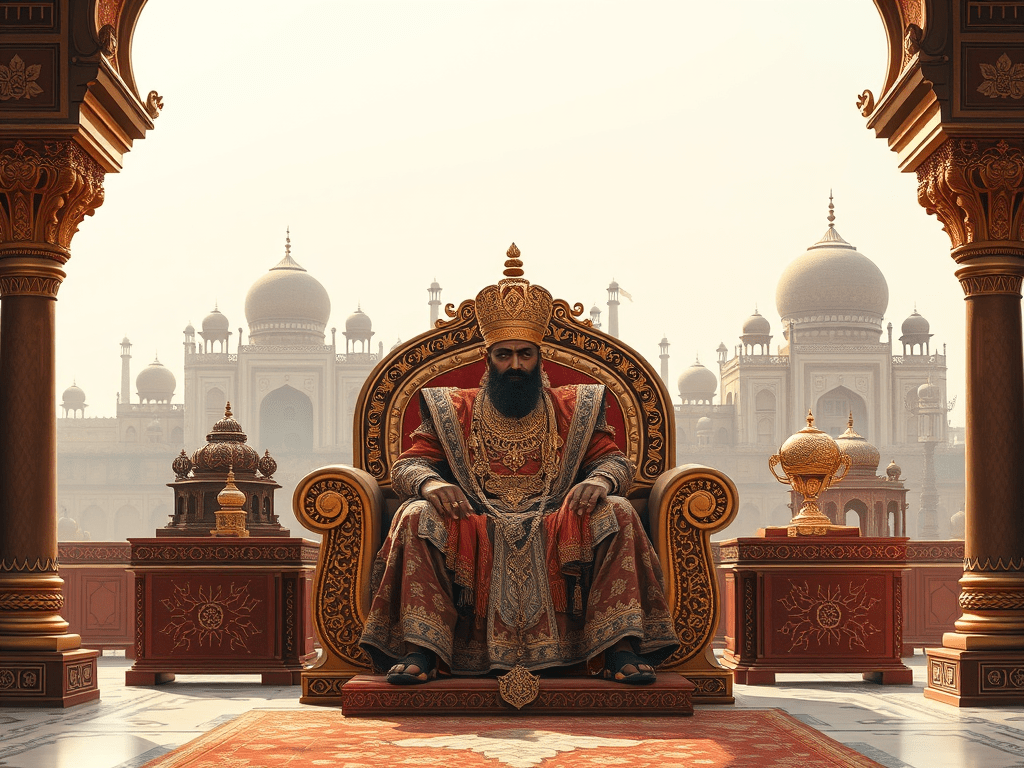
1. Introduction to Aurangzeb and the Mughal Empire
Muhi-ud-Din Muhammad Aurangzeb (1618–1707 CE), the sixth Mughal emperor, reigned from 1658 to 1707 CE, representing the territorial zenith of the Mughal Empire but also the onset of its decline. Ascending the throne after a brutal war of succession against his brothers, Aurangzeb expanded the empire to cover nearly the entire Indian subcontinent. His reign was marked by military campaigns, orthodox Islamic policies, and centralized administration, contrasting with the syncretic policies of his predecessors like Akbar. While his rule achieved unprecedented territorial control, it also led to rebellions, economic strain, and social tensions that weakened the empire.
The provided text emphasizes the need to corroborate literary and archaeological sources for historical reconstruction, noting their strengths and limitations. For Aurangzeb’s era, literary sources like Maasir-i-Alamgiri and European accounts provide detailed narratives, while archaeological evidence, such as forts, mosques, and inscriptions, offers insights into material culture. Integrating both is crucial, as literary sources may reflect courtly biases, and archaeological evidence focuses on cultural processes rather than specific events.
2. Chronology and Key Events
Aurangzeb’s 49-year reign can be divided into three phases: consolidation of power, northern campaigns, and Deccan expansion.
- Consolidation and Succession (1658–1668 CE):
- Seized the throne after defeating his brothers Dara Shikoh, Shuja, and Murad in the war of succession (1657–59 CE), imprisoning his father, Shah Jahan, in Agra Fort.
- Battle of Samugarh (1658 CE): Defeated Dara Shikoh, securing his claim to the throne.
- Battle of Khajwa (1659 CE): Defeated Shuja, consolidating Mughal authority.
- Centralized administration and enforced Islamic law (Sharia), marking a shift from Akbar’s policies.
- Northern Campaigns (1668–1680 CE):
- Suppressed rebellions, including Jat uprisings (1669–70) and Afghan revolts in the northwest (1672–76, e.g., Khushal Khan Khattak’s rebellion).
- Sikh Conflicts: Ordered the execution of Guru Tegh Bahadur (1675), escalating tensions with the Sikhs, leading to Guru Gobind Singh’s formation of the Khalsa (1699).
- Alienated Rajput allies (e.g., Jaipur, Jodhpur) by withdrawing privileges, sparking rebellions (1679–80).
- Deccan Expansion and Decline (1680–1707 CE):
- Focused on conquering the Deccan, annexing Bijapur (1686) and Golconda (1687) after prolonged sieges.
- Engaged in a 25-year war against the Marathas, led by Shivaji (d. 1680) and later Sambhaji and Rajaram, which drained resources.
- Moved the capital to Aurangabad to oversee Deccan campaigns, reflecting a strategic shift.
- Died in 1707, leaving an overstretched empire vulnerable to internal rebellions and external pressures.
The text highlights that literary sources provide event-based history, while archaeology reveals cultural processes. Chronicles like Maasir-i-Alamgiri detail Aurangzeb’s campaigns, while forts and mosques corroborate his territorial and religious priorities.
3. Archaeological Sources for Aurangzeb’s Reign
Archaeological evidence, including structures, artifacts, and inscriptions, provides insights into Aurangzeb’s governance, religious policies, and military campaigns. The text classifies these as monuments, artifacts, and inscriptions, emphasizing their role in understanding socio-cultural contexts.
Key Archaeological Findings:
- Structures:
- Badshahi Mosque (Lahore, 1673 CE): A monumental mosque, one of the largest of its time, reflecting Aurangzeb’s emphasis on Islamic architecture and piety.
- Bibi ka Maqbara (Aurangabad, 1660–61 CE): Built for his wife Dilras Banu Begum, it resembles the Taj Mahal but is smaller, indicating economic constraints and austere aesthetics.
- Forts: Strengthened Deccan forts like Daulatabad, Golconda, and Raigad reflect military priorities during prolonged campaigns.
- The text notes that monuments provide reliable socio-cultural information, evident in Aurangzeb’s functional, Islamic-focused architecture, contrasting with Shah Jahan’s opulence.
- Artifacts:
- Coins: Aurangzeb’s silver rupiyas and gold mohurs bore Islamic inscriptions, reflecting his orthodoxy and economic standardization. The text classifies coins as durable economic indicators.
- Weapons: Excavations in the Deccan reveal cannons, matchlocks, and swords, confirming the scale of military engagements.
- Manuscripts: Preserved religious texts (e.g., Fatawa-i-Alamgiri) and administrative records reflect Aurangzeb’s focus on Sharia and governance.
- Inscriptions:
- Inscriptions on the Badshahi Mosque and Bibi ka Maqbara proclaim Aurangzeb’s titles (e.g., Alamgir, “Conqueror of the World”) and religious decrees, aligning with the text’s classification of inscriptions as socio-cultural and commercial sources.
- Farman inscriptions and revenue grants on stone document administrative policies, such as tax collection and land grants.
- Significance of Archaeological Sources:
- The text emphasizes archaeology’s role in reconstructing man-land relationships and cultural processes. Deccan forts and mosques reflect Aurangzeb’s strategic and religious priorities.
- Scientific techniques like radiocarbon dating and GIS mapping (noted in the text) help date structures and map campaign routes, enhancing historical accuracy. Recent ASI surveys (2024) at Golconda Fort confirm its use during Aurangzeb’s sieges.
4. Literary Sources and Their Limitations
Aurangzeb’s reign is well-documented through Mughal chronicles, European accounts, and regional records. The text divides literary sources into religious and secular, cautioning against biases due to patronage, oral transmission, or cultural differences.
Key Literary Sources:
- Maasir-i-Alamgiri:
- Written by Saqi Mustaid Khan, this official chronicle details Aurangzeb’s reign, campaigns, and policies, serving as a primary source.
- The text praises court chronicles for event-based history but notes their bias. Maasir-i-Alamgiri emphasizes Aurangzeb’s piety and victories, often downplaying failures like Maratha resistance.
- European Accounts:
- Travelers like Francois Bernier (French), Niccolao Manucci (Italian), and Jean-Baptiste Tavernier (French) describe Aurangzeb’s court, policies, and wars, offering critical perspectives on his orthodoxy and economic challenges.
- The text notes foreign accounts as valuable but potentially biased due to cultural misunderstandings or anti-Islamic sentiments.
- Regional Chronicles:
- Maratha accounts (e.g., Bakhar literature) narrate Shivaji’s and Sambhaji’s resistance, portraying Aurangzeb as an oppressor.
- Sikh texts, like Bachitar Natak by Guru Gobind Singh, document conflicts post-Guru Tegh Bahadur’s execution (1675), reflecting anti-Mughal sentiment.
- Rajput chronicles (e.g., from Mewar) describe rebellions but are biased against Aurangzeb.
- Religious Texts:
- Aurangzeb’s farmans and Fatawa-i-Alamgiri (a compilation of Islamic law) emphasize his Sharia-based governance.
- The text notes religious texts as reflective of ideological contexts, relevant to Aurangzeb’s orthodox policies.
Limitations:
- Bias in Maasir-i-Alamgiri: The text warns that court chronicles idealize rulers. This chronicle glorifies Aurangzeb’s piety, understating rebellions and economic strain.
- Oral Transmission: Maratha, Sikh, and Rajput accounts, initially oral, risk distortion, aligning with the text’s caution about Shruti traditions.
- Foreign Bias: European accounts may exaggerate Aurangzeb’s orthodoxy or misinterpret Indian customs, as noted in the text’s discussion of foreign perceptions.
- Limited Non-Mughal Sources: Few independent accounts survive, necessitating corroboration with archaeological evidence to balance biases.
5. Socio-Economic and Cultural Features
Aurangzeb’s reign is characterized by territorial expansion, religious orthodoxy, and economic challenges, as reconstructed from archaeological and literary sources. The text emphasizes archaeology’s role in revealing lifestyles and literary sources’ contribution to event-based history.
Social Organization:
- Stratification: The mansabdari system was expanded, but overextension led to inefficiencies, with nobles (mansabdars) struggling to meet military obligations.
- Diverse Society: Aurangzeb’s orthodox policies, including temple destructions (e.g., Kashi Vishwanath, Mathura) and reimposition of jizya (1679), alienated Hindus, Sikhs, and Rajputs, fueling rebellions.
- The text notes that archaeology reveals social life, evident in Islamic burial practices and the absence of new Hindu temples during this period.
Economy:
- Agriculture: Land revenue, based on Akbar’s zabt system, remained the primary income source, but heavy taxation to fund wars strained peasants, as noted in Bernier’s accounts.
- Trade: Control over ports like Surat and Machilipatnam sustained trade with Europe and the Middle East, evidenced by coins and port artifacts. Maratha raids, however, disrupted commerce.
- Fiscal Strain: Prolonged Deccan campaigns depleted the treasury, as documented in Maasir-i-Alamgiri and European accounts. The text highlights commercial inscriptions (e.g., on coins) as economic indicators.
Religion and Culture:
- Religious Policy: Aurangzeb enforced Sharia, reimposed jizya, and destroyed several Hindu temples, reversing Akbar’s sulh-i-kul. His patronage of Islamic scholars and texts (Fatawa-i-Alamgiri) reflects orthodoxy.
- Cultural Patronage: Unlike his predecessors, Aurangzeb curtailed patronage of arts, banning music in court and limiting painting. His focus was on religious architecture (e.g., Badshahi Mosque).
- The text classifies religious structures as didactic, evident in Aurangzeb’s mosques as symbols of Islamic authority.
Technology:
- Military Technology: Aurangzeb’s armies used advanced cannons, matchlocks, and siege tactics, as seen in Deccan campaigns. Archaeological finds of weapons corroborate this.
- Architecture: Functional mosques and forts (e.g., Badshahi Mosque, Daulatabad) reflect austerity, contrasting with Shah Jahan’s lavish constructions.
- The text highlights archaeology’s role in understanding technology, evident in Deccan fortifications and artillery remnants.
6. Decline and Legacy of Aurangzeb’s Reign
Aurangzeb’s death in 1707 CE marked the beginning of the Mughal Empire’s decline. The text notes that archaeology informs about cultural shifts, while literary sources detail events.
Factors of Decline:
- Overextension: Prolonged Deccan campaigns drained resources, weakening central authority, as noted in Maasir-i-Alamgiri and European accounts.
- Rebellions: Maratha, Sikh, Jat, and Rajput uprisings eroded Mughal control, exacerbated by Aurangzeb’s orthodox policies.
- Economic Strain: Heavy taxation and war expenses depleted the treasury, leading to administrative inefficiencies.
- Archaeological Evidence: The lack of new monumental constructions post-1680s reflects economic constraints, with resources diverted to military efforts.
Legacy:
- Territorial Peak: Aurangzeb’s conquests made the Mughal Empire the largest in Indian history, but overextension sowed seeds of collapse.
- Religious Orthodoxy: His policies reversed Mughal syncretism, alienating non-Muslims and weakening imperial cohesion.
- Administrative Continuity: The mansabdari system persisted but became unsustainable under his successors.
7. Integration of Literary and Archaeological Sources
The text stresses corroborating literary and archaeological evidence for a holistic historical reconstruction. For Aurangzeb:
- Literary Dominance: Maasir-i-Alamgiri and European accounts provide detailed event-based history, covering campaigns, policies, and court life.
- Archaeological Support: Badshahi Mosque, Bibi ka Maqbara, Deccan forts, and coins corroborate literary descriptions of Aurangzeb’s religious and military priorities.
- Challenges: The text notes the difficulty of integrating biased literary sources with anonymous archaeological data. Maasir-i-Alamgiri’s glorification requires cross-verification with artifacts like inscriptions to assess economic and social realities.
- Complementary Insights: Literary sources detail events (e.g., battles, policies), while archaeology reveals cultural processes (e.g., architecture, trade disruptions). Together, they reconstruct Aurangzeb’s complex reign.
8. Relevance for Competitive Exams
Aurangzeb’s reign is a high-weightage topic in UPSC, BPSC, and other competitive exams, appearing in Prelims (factual recall) and Mains (analytical depth). Focus areas include:
- Battles: Samugarh (1658), Khajwa (1659), Bijapur (1686), Golconda (1687).
- Policies: Jizya reimposition, temple destructions, Sharia-based governance.
- Rebellions: Maratha, Sikh, Rajput, Jat uprisings.
- Archaeological Evidence: Badshahi Mosque, Bibi ka Maqbara, Deccan forts, coins.
- Literary Sources: Maasir-i-Alamgiri, European accounts, Fatawa-i-Alamgiri.
- Decline: Overextension, economic strain, rebellions.
The text’s emphasis on critical source analysis aligns with Mains’ requirements for evaluating historical evidence. For Prelims, memorize key events, policies, and archaeological sites.
9. Recent Developments (as of June 7, 2025)
- Golconda Fort Excavations: ASI surveys (2024) uncovered siege-related artifacts, confirming Aurangzeb’s military tactics in the Deccan.
- Badshahi Mosque Conservation: UNESCO-led restoration (2023–24) revealed construction techniques, supporting its attribution to Aurangzeb’s reign.
- Digital Archiving: Digitized Maasir-i-Alamgiri and Fatawa-i-Alamgiri manuscripts enhance research access, aligning with the text’s emphasis on scientific techniques.
10. Conclusion
Aurangzeb’s reign (1658–1707 CE) marked the Mughal Empire’s territorial peak but also its decline, driven by relentless military campaigns, orthodox policies, and economic strain. Literary sources like Maasir-i-Alamgiri and European accounts provide detailed event-based history, while archaeological evidence (Badshahi Mosque, Deccan forts, coins) reveals cultural and technological contexts. The text’s advocacy for corroborating both sources is critical, given the biases in court chronicles and the anonymous nature of archaeology. For competitive exams, mastering Aurangzeb’s policies, rebellions, and recent archaeological findings is essential for factual recall and analytical depth.
Key Points for Quick Revision
- Reign: 1658–1707 CE; territorial peak and decline of Mughal Empire.
- Key Battles: Samugarh (1658), Khajwa (1659), Bijapur (1686), Golconda (1687).
- Policies: Jizya reimposition (1679), temple destructions, Sharia enforcement.
- Rebellions: Maratha (Shivaji, Sambhaji), Sikh (Guru Tegh Bahadur, Khalsa), Rajput, Jat.
- Literary Sources: Maasir-i-Alamgiri, European accounts (Bernier, Manucci), Fatawa-i-Alamgiri.
- Archaeological Evidence: Badshahi Mosque, Bibi ka Maqbara, Deccan forts, coins.
- Decline: Overextension, economic strain, rebellions.
- Legacy: Territorial expansion, religious orthodoxy, weakened empire.
- Exam Tips: Focus on policies, rebellions, sources, and recent findings.


Leave a comment