
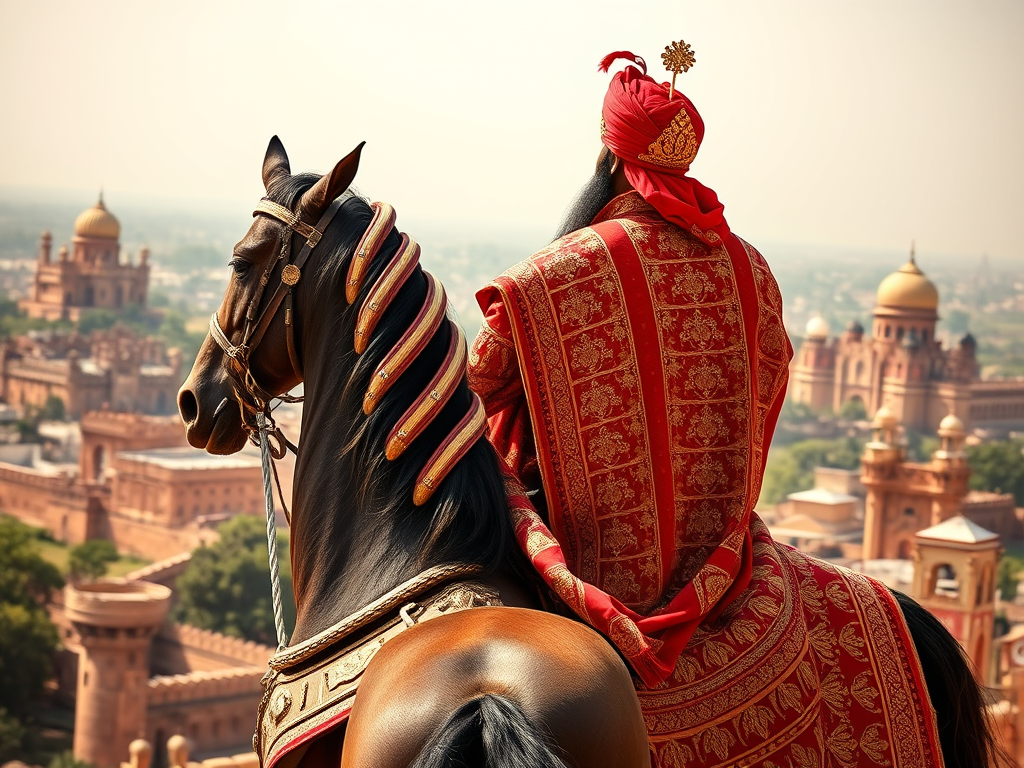
1. Introduction to Ranjit Singh and the Sikh Empire
Maharaja Ranjit Singh (1780–1839 CE), known as the “Lion of Punjab,” was the founder and most prominent ruler of the Sikh Empire (1799–1849 CE). Born in Gujranwala, he unified the Sikh misls (militias) to establish a centralized, secular state in Punjab, extending its influence across northwest India, including parts of modern-day Pakistan, Jammu, and Kashmir. His reign (1799–1839) marked the zenith of Sikh power, characterized by military reforms, administrative efficiency, and cultural patronage. Ranjit Singh’s inclusive governance and modernized army enabled the Sikh Empire to resist Mughal remnants, Afghan invasions, and early British expansion, earning him a legacy as a visionary ruler.
The provided text emphasizes corroborating literary and archaeological sources for historical reconstruction, noting their strengths and limitations. For Ranjit Singh’s era, literary sources like Sikh chronicles, European accounts, and court records provide detailed narratives, while archaeological evidence, including forts, coins, and inscriptions, offers insights into material culture. Integrating both is crucial, as literary sources may reflect courtly or colonial biases, and archaeological evidence focuses on cultural processes rather than specific events.
2. Chronology and Key Events
Ranjit Singh’s reign is divided into three phases: unification of the misls, territorial expansion, and consolidation of power.
- Unification and Early Rule (1799–1810 CE):
- Unified the 12 Sikh misls by diplomacy and force, consolidating power under his leadership.
- Capture of Lahore (1799): Seized the Mughal stronghold, declaring himself Maharaja and establishing the Sikh Empire’s capital.
- Captured Amritsar (1802), the spiritual center of Sikhism, consolidating religious and political authority.
- Territorial Expansion (1810–1830 CE):
- Conquest of Multan (1818): Defeated the Afghan governor, securing southern Punjab.
- Annexation of Kashmir (1819): Captured Srinagar, extending Sikh influence into the Himalayas.
- Battle of Shopian (1819): Defeated Afghan forces, solidifying control over Kashmir.
- Annexation of Peshawar (1834): Captured the Afghan stronghold, marking the empire’s westernmost extent.
- Formed alliances with regional powers (e.g., Dogras of Jammu) and maintained diplomatic relations with the British.
- Consolidation and Decline (1830–1839 CE):
- Modernized the Sikh army (Khalsa Dal) with European-style training under generals like Jean-Francois Allard and Ventura, incorporating artillery and disciplined infantry.
- Strengthened administration through revenue reforms and a merit-based bureaucracy.
- Died in 1839, leaving the empire to his son Kharak Singh, whose weak rule led to succession disputes and British intervention.
The text highlights that literary sources provide event-based history, while archaeology reveals cultural processes. Sikh chronicles and European accounts detail Ranjit Singh’s campaigns, while forts and coins corroborate his territorial and administrative achievements.
3. Archaeological Sources for Ranjit Singh’s Reign
Archaeological evidence, including forts, coins, and inscriptions, provides insights into Ranjit Singh’s military, administrative, and cultural contributions. The text classifies these as structures, artifacts, and inscriptions, emphasizing their role in understanding socio-cultural contexts.
Key Archaeological Findings:
- Structures:
- Lahore Fort: Renovated by Ranjit Singh, it served as the administrative and military headquarters, reflecting Sikh architectural grandeur.
- Amritsar Fort (Gobindgarh): Built to protect the Golden Temple, it showcases military fortification.
- Summer Palace (Ramnagar, Amritsar): A royal residence, blending Sikh and Mughal styles.
- The text notes that monuments provide reliable socio-cultural information, evident in the forts’ strategic designs and the palace’s cultural synthesis.
- Artifacts:
- Coins: Sikh Nanakshahi coins, minted in gold, silver, and copper, bore inscriptions like “Deg Tegh Fateh” (Victory to Charity and Arms), reflecting economic autonomy and Sikh ideology. The text classifies coins as durable economic indicators.
- Weapons: Excavations at Lahore and Multan reveal advanced artillery, muskets, and swords, confirming the modernized Khalsa Dal.
- Jewelry and Relics: Artifacts like the Koh-i-Noor diamond (acquired by Ranjit Singh) and royal ornaments reflect courtly opulence.
- Inscriptions:
- Inscriptions at the Golden Temple and Lahore Fort proclaim Ranjit Singh’s titles (e.g., Maharaja) and patronage, aligning with the text’s classification of inscriptions as socio-cultural sources.
- Revenue grants and sanads on stone or copper plates document land assignments and administrative policies.
- Significance of Archaeological Sources:
- The text emphasizes archaeology’s role in reconstructing man-land relationships. Forts and coins reflect Ranjit Singh’s strategic control and economic stability.
- Scientific techniques like GIS mapping (noted in the text) help trace fort networks and trade routes, confirming territorial extent. Recent ASI surveys (2024) at Gobindgarh Fort uncovered artillery depots, supporting accounts of military modernization.
4. Literary Sources and Their Limitations
Literary sources for Ranjit Singh’s era include Sikh chronicles, European accounts, and court records. The text divides literary sources into religious and secular, cautioning against biases due to courtly patronage or colonial perspectives.
Key Literary Sources:
- Sikh Chronicles:
- Texts like Umdat-ut-Tawarikh by Sohan Lal Suri, Ranjit Singh’s court historian, detail his campaigns, administration, and diplomacy.
- The text praises court chronicles for event-based history but notes their bias toward glorifying the ruler.
- European Accounts:
- British travelers (e.g., Alexander Burnes, William Moorcroft) and East India Company records describe Ranjit Singh’s court, army, and relations with the British.
- French accounts by generals like Allard and Ventura highlight military reforms.
- The text cautions that foreign accounts may misinterpret Sikh culture or reflect colonial ambitions.
- Mughal and Afghan Records:
- Limited Afghan chronicles (e.g., from Peshawar) and Mughal remnants describe Sikh conquests as threats, reflecting bias against Ranjit Singh.
- Administrative Documents:
- Court farmans, revenue records, and diplomatic letters detail governance, taxation, and alliances.
- The text notes such documents as valuable for administrative insights.
- Religious Texts:
- Sikh texts, including Gur Bilas and references in Guru Granth Sahib commentaries, emphasize Ranjit Singh’s patronage of Sikhism, framing him as a protector of the faith.
Limitations:
- Bias in Sikh Chronicles: The text warns that court chronicles idealize rulers. Umdat-ut-Tawarikh glorifies Ranjit Singh, potentially downplaying internal challenges.
- Foreign Bias: European accounts may exaggerate Sikh military strength or portray Ranjit Singh as a barrier to British expansion, as noted in the text’s caution about foreign perceptions.
- Limited Non-Sikh Sources: Few independent accounts survive, necessitating archaeological validation.
- Oral Transmission: Some Sikh narratives were initially oral, risking distortion, as noted in the text’s caution about Shruti traditions.
5. Socio-Economic and Cultural Features
Ranjit Singh’s reign is characterized by military modernization, administrative efficiency, and cultural inclusivity, as reconstructed from archaeological and literary sources. The text emphasizes archaeology’s role in revealing lifestyles and literary sources’ contribution to event-based history.
Social Organization:
- Unified Society: Ranjit Singh centralized the Sikh misls, integrating Sikhs, Hindus, and Muslims into a merit-based administration. Key officials included Dogra brothers (e.g., Dhian Singh) and Muslim generals (e.g., Fakir Azizuddin).
- Egalitarian Ideals: The Khalsa’s egalitarian principles, rooted in Guru Gobind Singh’s reforms, persisted, fostering social cohesion.
- The text notes that archaeology reveals social life, evident in diverse burial practices and multi-religious structures like mosques and temples patronized by Ranjit Singh.
Economy:
- Agriculture: Ranjit Singh reformed land revenue, adopting a lighter taxation system than the Mughals to ensure peasant loyalty, as noted in Umdat-ut-Tawarikh.
- Trade: Control over Punjab trade routes (e.g., Lahore to Peshawar) and markets like Amritsar boosted commerce with Central Asia and Europe. Nanakshahi coins confirm economic stability.
- Revenue: Taxes like nazrana (tribute) from subordinate states funded the army and infrastructure, as documented in court records.
- The text highlights commercial inscriptions (e.g., on coins) as economic indicators, relevant to Sikh fiscal policies.
Religion and Culture:
- Religious Policy: Ranjit Singh practiced secular governance, patronizing Sikh, Hindu, and Muslim institutions. He donated gold to the Golden Temple, restored mosques, and supported Hindu shrines.
- Cultural Patronage: Promoted Punjabi culture, art, and architecture. The Golden Temple’s embellishment and Shaniwar Wada-inspired palaces reflect cultural opulence.
- The text classifies religious artifacts (e.g., temple and mosque donations) as didactic, evident in Ranjit Singh’s inclusive patronage.
Technology:
- Military Technology: The Khalsa Dal was modernized with European-style artillery, infantry, and cavalry, trained by French and Italian generals. Excavations at Lahore Fort reveal advanced cannons.
- Architecture: Forts (e.g., Gobindgarh) and irrigation canals (e.g., in Punjab) supported military and economic needs.
- The text highlights archaeology’s role in understanding technology, evident in fort designs and weapon caches.
6. Decline and Legacy of Ranjit Singh’s Reign
Ranjit Singh’s death in 1839 triggered the Sikh Empire’s decline. The text notes that archaeology informs about cultural shifts, while literary sources detail events.
Factors of Decline:
- Succession Disputes: Weak successors (Kharak Singh, Nau Nihal Singh) and court intrigues destabilized the empire, as noted in Umdat-ut-Tawarikh.
- British Intervention: The East India Company exploited divisions, defeating the Sikhs in the First Anglo-Sikh War (1845–1846) and Second Anglo-Sikh War (1848–1849), annexing Punjab.
- Archaeological Evidence: Damaged forts (e.g., Multan) and reduced coin minting post-1839 reflect decline.
Legacy:
- Sikh Empire: Ranjit Singh’s unified state was a high point of Sikh political power, resisting Afghan and British threats.
- Cultural Syncretism: His secular governance and patronage left a lasting Punjabi identity.
- Military Modernization: The Khalsa Dal influenced Indian military traditions, inspiring later resistance movements.
7. Integration of Literary and Archaeological Sources
The text stresses corroborating literary and archaeological evidence for a holistic historical reconstruction. For Ranjit Singh:
- Literary Dominance: Umdat-ut-Tawarikh and European accounts provide detailed event-based history, covering campaigns and governance.
- Archaeological Support: Lahore Fort, Nanakshahi coins, and inscriptions corroborate literary descriptions of territorial control and administration.
- Challenges: The text notes the difficulty of integrating biased literary sources with anonymous archaeological data. Umdat-ut-Tawarikh’s glorification requires validation from forts and inscriptions.
- Complementary Insights: Literary sources detail events (e.g., conquests, reforms), while archaeology reveals cultural processes (e.g., architecture, trade).
8. Relevance for Competitive Exams
Ranjit Singh’s reign is a high-weightage topic in UPSC, BPSC, and other competitive exams, appearing in Prelims (factual recall) and Mains (analytical depth). Focus areas include:
- Key Conquests: Lahore (1799), Multan (1818), Kashmir (1819), Peshawar (1834).
- Military Reforms: Modernization of Khalsa Dal with European training.
- Administration: Revenue reforms, secular governance, merit-based bureaucracy.
- Literary Sources: Umdat-ut-Tawarikh, European accounts, court records.
- Archaeological Evidence: Lahore Fort, Gobindgarh Fort, Nanakshahi coins, inscriptions.
- Decline: Succession disputes, Anglo-Sikh Wars.
The text’s emphasis on critical source analysis aligns with Mains’ requirements for evaluating historical evidence. For Prelims, memorize key events, reforms, and sites.
9. Recent Developments (as of June 7, 2025)
- Lahore Fort Conservation: UNESCO-led restoration (2024) uncovered administrative and military structures, confirming its role as Ranjit Singh’s capital.
- Gobindgarh Fort Excavations: ASI surveys (2023–24) revealed artillery depots, supporting accounts of military modernization.
- Digital Archiving: Digitized Umdat-ut-Tawarikh and court records enhance research access, aligning with the text’s emphasis on scientific techniques.
10. Conclusion
Ranjit Singh’s reign (1799–1839 CE) marked the Sikh Empire’s zenith, unifying Punjab into a powerful, secular state through military modernization, territorial expansion, and inclusive governance. Literary sources like Umdat-ut-Tawarikh and European accounts provide detailed event-based history, while archaeological evidence (forts, coins, inscriptions) reveals military and cultural contexts. The text’s advocacy for corroborating both sources is critical, given the biases in court chronicles and the anonymous nature of archaeology. For competitive exams, mastering Ranjit Singh’s conquests, reforms, and recent findings is essential for factual recall and analytical depth.
Key Points for Quick Revision
- Reign: 1799–1839 CE; founder of Sikh Empire.
- Key Conquests: Lahore (1799), Amritsar (1802), Multan (1818), Kashmir (1819), Peshawar (1834).
- Reforms: Modernized Khalsa Dal, secular governance, revenue system.
- Literary Sources: Umdat-ut-Tawarikh, European accounts, court records.
- Archaeological Evidence: Lahore Fort, Gobindgarh Fort, Nanakshahi coins, inscriptions.
- Decline: Succession disputes, Anglo-Sikh Wars (1845–1849).
- Legacy: Unified Punjab, cultural syncretism, military modernization.
- Exam Tips: Focus on conquests, reforms, sources, decline, and recent findings.

Leave a comment