
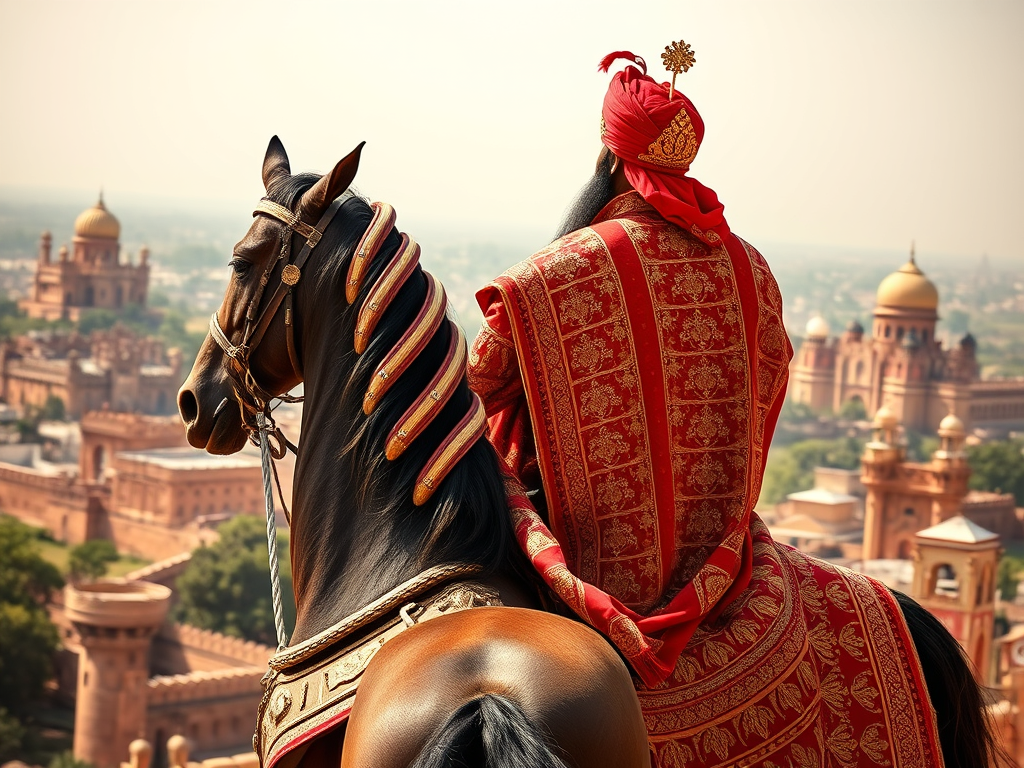
SIKH EMPIRE
MAHARAJA RANJIT SINGH
The Lion of Punjab • 1780–1839
Introduction to Ranjit Singh and the Sikh Empire
Maharaja Ranjit Singh (1780–1839 CE), known as the “Lion of Punjab,” was the founder and most prominent ruler of the Sikh Empire (1799–1849 CE). Born in Gujranwala, he unified the Sikh misls (militias) to establish a centralized, secular state in Punjab, extending its influence across northwest India, including parts of modern-day Pakistan, Jammu, and Kashmir.
His reign (1799–1839) marked the zenith of Sikh power, characterized by military reforms, administrative efficiency, and cultural patronage. Ranjit Singh’s inclusive governance and modernized army enabled the Sikh Empire to resist Mughal remnants, Afghan invasions, and early British expansion, earning him a legacy as a visionary ruler.

(From the Princess Bamba Collection, Lahore Fort)
The provided text emphasizes corroborating literary and archaeological sources for historical reconstruction, noting their strengths and limitations. For Ranjit Singh’s era, literary sources like Sikh chronicles, European accounts, and court records provide detailed narratives, while archaeological evidence, including forts, coins, and inscriptions, offers insights into material culture. Integrating both is crucial, as literary sources may reflect courtly or colonial biases, and archaeological evidence focuses on cultural processes rather than specific events.
Chronology and Key Events
Ranjit Singh’s reign is divided into three phases: unification of the misls, territorial expansion, and consolidation of power.
Unification and Early Rule
- ☬ Unified the 12 Sikh misls by diplomacy and force, consolidating power under his leadership.
- ☬ Capture of Lahore (1799): Seized the Mughal stronghold, declaring himself Maharaja and establishing the Sikh Empire’s capital.
- ☬ Captured Amritsar (1802), the spiritual center of Sikhism, consolidating religious and political authority.
Territorial Expansion
- ☬ Conquest of Multan (1818): Defeated the Afghan governor, securing southern Punjab.
- ☬ Annexation of Kashmir (1819): Captured Srinagar, extending Sikh influence into the Himalayas.
- ☬ Battle of Shopian (1819): Defeated Afghan forces, solidifying control over Kashmir.
- ☬ Annexation of Peshawar (1834): Captured the Afghan stronghold, marking the empire’s westernmost extent.
Formed alliances with regional powers (e.g., Dogras of Jammu) and maintained diplomatic relations with the British.
Consolidation and Decline
- ☬ Modernized the Sikh army (Khalsa Dal) with European-style training under generals like Jean-Francois Allard and Ventura, incorporating artillery and disciplined infantry.
- ☬ Strengthened administration through revenue reforms and a merit-based bureaucracy.
- ☬ Died in 1839, leaving the empire to his son Kharak Singh, whose weak rule led to succession disputes and British intervention.
Archaeological Sources for Ranjit Singh’s Reign
Archaeological evidence, including forts, coins, and inscriptions, provides insights into Ranjit Singh’s military, administrative, and cultural contributions. The text classifies these as structures, artifacts, and inscriptions.
Forts & Palaces
- Lahore Fort — Renovated by Ranjit Singh; served as administrative and military headquarters.
- Gobindgarh Fort (Amritsar) — Built to protect the Golden Temple; showcases military fortification.
- Summer Palace, Ramnagar — Royal residence blending Sikh and Mughal styles.
Coins, Weapons & Relics
- Nanakshahi Coins — Minted in gold, silver & copper bearing “Deg Tegh Fateh” (Victory to Charity and Arms).
- Weapons — Advanced artillery, muskets and swords confirming modernization of the Khalsa Dal.
- Jewelry & Relics — Koh-i-Noor diamond and royal ornaments reflecting courtly opulence.
Records & Grants
- Golden Temple & Lahore Fort inscriptions proclaiming titles and patronage.
- Revenue grants and sanads on stone and copper plates documenting land assignments.
- Scientific techniques like GIS mapping trace fort networks and trade routes.
Literary Sources and Their Limitations
Key Literary Sources
Umdat-ut-Tawarikh by Sohan Lal Suri — Ranjit Singh’s court historian detailing campaigns, administration, and diplomacy.
British travelers (Alexander Burnes, William Moorcroft) and East India Company records; French accounts by generals Allard and Ventura on military reforms.
Court farmans, revenue records, and diplomatic letters detailing governance and taxation.
Limitations & Biases
Socio-Economic and Cultural Features
Social Organization
- Unified Society: Centralized the Sikh misls, integrating Sikhs, Hindus, and Muslims into a merit-based administration. Key officials included Dogra brothers and Muslim generals like Fakir Azizuddin.
- Egalitarian Ideals: The Khalsa’s principles fostered social cohesion across communities.
- Archaeology reveals diverse burial practices and multi-religious structures patronized by the Maharaja.
Economy & Revenue
- Agriculture: Lighter taxation system than the Mughals to ensure peasant loyalty.
- Trade: Control over Punjab trade routes boosted commerce with Central Asia and Europe. Nanakshahi coins confirm economic stability.
- Revenue: Nazrana (tribute) from subordinate states funded the army and infrastructure.
Religion, Culture & Technology
Secular governance. Donated gold to Golden Temple, restored mosques, supported Hindu shrines.
Promoted Punjabi culture and architecture. Embellishment of the Golden Temple reflects opulence.
European-style artillery and infantry trained by French and Italian generals. Advanced cannons excavated at Lahore Fort.
Decline and Legacy
Factors of Decline
Enduring Legacy
- The unified Sikh Empire — a high point of Sikh political power resisting Afghan and British threats.
- Cultural syncretism and secular governance that shaped lasting Punjabi identity.
- The modernized Khalsa Dal influenced later Indian military traditions.
Integration of Sources & Exam Relevance
The text stresses corroborating literary and archaeological evidence for a holistic reconstruction. Literary sources like Umdat-ut-Tawarikh provide detailed event-based history, while forts, coins, and inscriptions validate territorial control and administration.
Mastering these topics is essential for both factual recall in Prelims and analytical depth in Mains.
Recent Developments & Conclusion
As of June 2025
Conclusion
For students and historians alike, the lesson remains clear: only by weaving together the written word and the physical artifact can we truly understand the Lion of Punjab and the golden age he created.
Leave a Reply