
Study Material
The Preamble to the Constitution of India is a concise introductory statement that outlines the objectives, philosophy, and guiding principles of the Constitution. Often referred to as the “soul” or “identity card” of the Constitution, it encapsulates the vision of India’s founding fathers. This study material provides a detailed exploration of the Preamble, including its text, significance, components, amendments, judicial interpretations, and relevance as of June 19, 2025.
Introduction
The Preamble serves as the preface to the Constitution, reflecting India’s aspirations for justice, liberty, equality, and fraternity. Adopted by the Constituent Assembly on November 26, 1949, and effective from January 26, 1950, it draws inspiration from the U.S. Constitution’s Preamble and the French Revolution’s ideals. It is not merely a ceremonial statement but a source of constitutional interpretation, as affirmed by landmark judicial rulings.
Text of the Preamble
The Preamble, as amended by the 42nd Amendment (1976), reads:
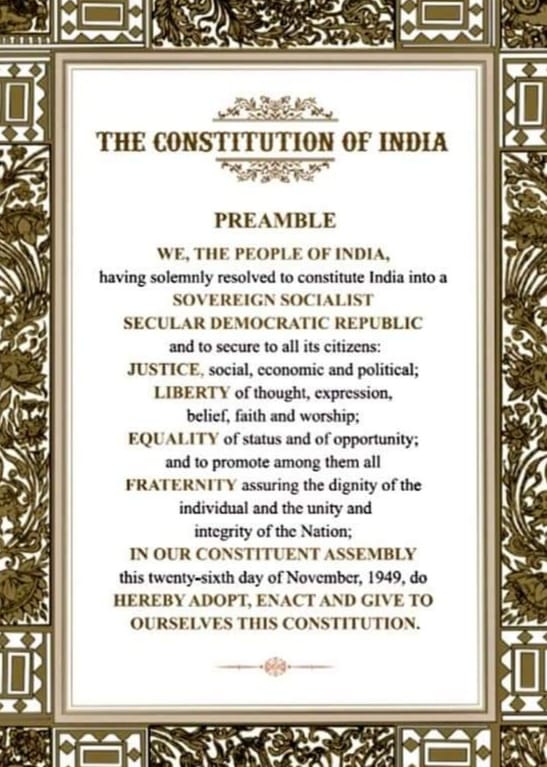
WE, THE PEOPLE OF INDIA, having solemnly resolved to constitute India into a SOVEREIGN SOCIALIST SECULAR DEMOCRATIC REPUBLIC and to secure to all its citizens:
JUSTICE, social, economic and political;
LIBERTY of thought, expression, belief, faith and worship;
EQUALITY of status and of opportunity;
and to promote among them all
FRATERNITY assuring the dignity of the individual and the unity and integrity of the Nation;
IN OUR CONSTITUENT ASSEMBLY this twenty-sixth day of November, 1949, do HEREBY ADOPT, ENACT AND GIVE TO OURSELVES THIS CONSTITUTION.
Key Components of the Preamble
- Source of Authority: “We, the People of India” signifies that the Constitution derives its authority from the citizens, emphasizing popular sovereignty.
- Nature of the State:
- Sovereign: India is free from external control and has supreme authority internally and externally.
- Socialist: Added by the 42nd Amendment (1976), it reflects a commitment to reducing inequalities and promoting welfare (interpreted as democratic socialism).
- Secular: Added by the 42nd Amendment (1976), it ensures equal respect for all religions and state neutrality in religious matters.
- Democratic: India follows a system of representative government based on free and fair elections.
- Republic: India has an elected head of state (President), rejecting monarchy.
- Objectives:
- Justice: Social (eliminating discrimination), economic (reducing inequalities), and political (equal access to political processes).
- Liberty: Freedom of thought, expression, belief, faith, and worship.
- Equality: Equal status and opportunities for all citizens, eliminating discrimination.
- Fraternity: Promoting brotherhood, individual dignity, and national unity and integrity (the term “integrity” was added by the 42nd Amendment).
- Date of Adoption: November 26, 1949, marks the formal adoption of the Constitution by the Constituent Assembly.
- U.S. Constitution: The concept of a Preamble as a concise statement of objectives.
- French Constitution: Ideals of Liberty, Equality, and Fraternity.
- Indian National Movement: Emphasis on sovereignty, democracy, and social justice.
- Objective Resolution (1946): Moved by Jawaharlal Nehru, it formed the basis for the Preamble, outlining India’s vision as a sovereign, democratic republic.
Significance of the Preamble
- Guiding Light: It provides the philosophical foundation for interpreting the Constitution’s provisions.
- Identity of the Constitution: Reflects India’s commitment to democracy, secularism, and social justice.
- Judicial Tool: Courts use the Preamble to resolve ambiguities in constitutional provisions.
- Moral Compass: It inspires legislation and policies aimed at achieving justice, liberty, equality, and fraternity.
- Sovereignty of the People: Emphasizes that the Constitution is a creation of the people, not a colonial imposition.
Amendment to the Preamble
- 42nd Amendment (1976):
- Added three words: Socialist, Secular, and Integrity.
- Socialist: Signified a commitment to reducing inequalities through democratic means (not state socialism).
- Secular: Clarified India’s neutral stance toward all religions, reinforcing equal treatment.
- Integrity: Strengthened the emphasis on national unity and territorial integrity.
- Added three words: Socialist, Secular, and Integrity.
- Controversy: The amendment was debated, as some argued it altered the Constitution’s original intent. However, courts upheld its validity, affirming that the Preamble can be amended without violating the Basic Structure Doctrine.
Judicial Interpretations
The Preamble’s legal status and role have been clarified through landmark cases:
- Berubari Union Case (1960):
- Held that the Preamble is not a part of the Constitution and cannot be enforced legally.
- However, it was recognized as a key to understanding the Constitution’s objectives.
- Kesavananda Bharati v. State of Kerala (1973):
- Overruled the Berubari view, declaring the Preamble as an integral part of the Constitution.
- Held that the Preamble reflects the Basic Structure, and its core principles (e.g., democracy, secularism) cannot be amended.
- Indira Nehru Gandhi v. Raj Narain (1975):
- Reinforced that the Preamble’s principles, like democracy and secularism, are part of the Basic Structure.
- LIC of India v. Consumer Education and Research Centre (1995):
- Affirmed that the Preamble is a guiding tool for interpreting socio-economic provisions.
- S.R. Bommai v. Union of India (1994):
- Emphasized secularism as a basic feature, using the Preamble to uphold state neutrality in religious matters.
Key Features of the Preamble
- Non-Justiciable: The Preamble is not enforceable in courts but serves as a guiding principle.
- Part of the Constitution: Judicial rulings confirm its integral role.
- Basic Structure: Principles like sovereignty, secularism, and democracy are protected from amendment.
- Universal Ideals: Reflects global values (e.g., liberty, equality) adapted to India’s context.
- Dynamic Nature: The 42nd Amendment demonstrates its adaptability to changing needs.
Relevance in Contemporary India (Up to June 19, 2025)
- Secularism: Amid debates on religious pluralism, the Preamble’s emphasis on secularism guides policies and judicial rulings.
- Socialism: The term “socialist” informs welfare schemes like Ayushman Bharat and PM-KISAN, aiming to reduce inequalities.
- Fraternity: In a diverse nation, the Preamble’s focus on fraternity addresses challenges like communal tensions and regional disparities.
- Judicial Role: Courts continue to invoke the Preamble in cases involving rights, federalism, and governance (e.g., challenges to reservation policies).
- Policy Framework: The Preamble inspires initiatives for social justice, such as reservations for EWS (103rd Amendment) and women’s empowerment.
Summary Table: Key Aspects of the Preamble
| Aspect | Details |
|---|---|
| Source of Authority | We, the People of India |
| Nature of State | Sovereign, Socialist, Secular, Democratic, Republic |
| Objectives | Justice (social, economic, political), Liberty, Equality, Fraternity |
| Amendment | 42nd Amendment (1976): Added Socialist, Secular, Integrity |
| Judicial Status | Integral part of Constitution; reflects Basic Structure (Kesavananda, 1973) |
| Key Cases | Berubari (1960), Kesavananda (1973), S.R. Bommai (1994) |
Practical Implications
- Constitutional Interpretation: The Preamble resolves ambiguities in provisions like Fundamental Rights and Directive Principles.
- Policy Guidance: It shapes laws and schemes aimed at social justice and equality.
- National Unity: Promotes fraternity and integrity in a diverse nation.
- Judicial Safeguard: Protects core constitutional values through the Basic Structure Doctrine.
Suggested Study Tips
- Memorize the Text: Learn the exact wording of the Preamble, including the 42nd Amendment additions.
- Focus on Keywords: Understand the meaning of Sovereign, Socialist, Secular, Democratic, Republic, and the four objectives.
- Link to Cases: Study Kesavananda Bharati and S.R. Bommai to grasp the Preamble’s legal role.
- Use Mnemonics: For objectives, use “JELF” (Justice, Equality, Liberty, Fraternity).
- Relate to Current Issues: Connect the Preamble to debates on secularism, reservations, and welfare policies.

Leave a comment