
The year 1947 marked a pivotal juncture in Indian history, signifying the culmination of the protracted struggle against British colonial rule through the attainment of independence on August 15, 1947. This event, however, was inextricably linked to the partition of British India into two sovereign nations: the Dominion of India and the Dominion of Pakistan. Orchestrated under the Indian Independence Act of 1947, the partition aimed to address communal tensions between Hindus and Muslims but resulted in profound human suffering, territorial disputes, and long-term geopolitical ramifications. Central elements included the delineation of borders via the Radcliffe Line and the ensuing refugee crisis, which displaced millions and precipitated widespread violence. These developments were influenced by negotiations involving the Indian National Congress, the Muslim League, and British authorities, reflecting the complexities of decolonization.
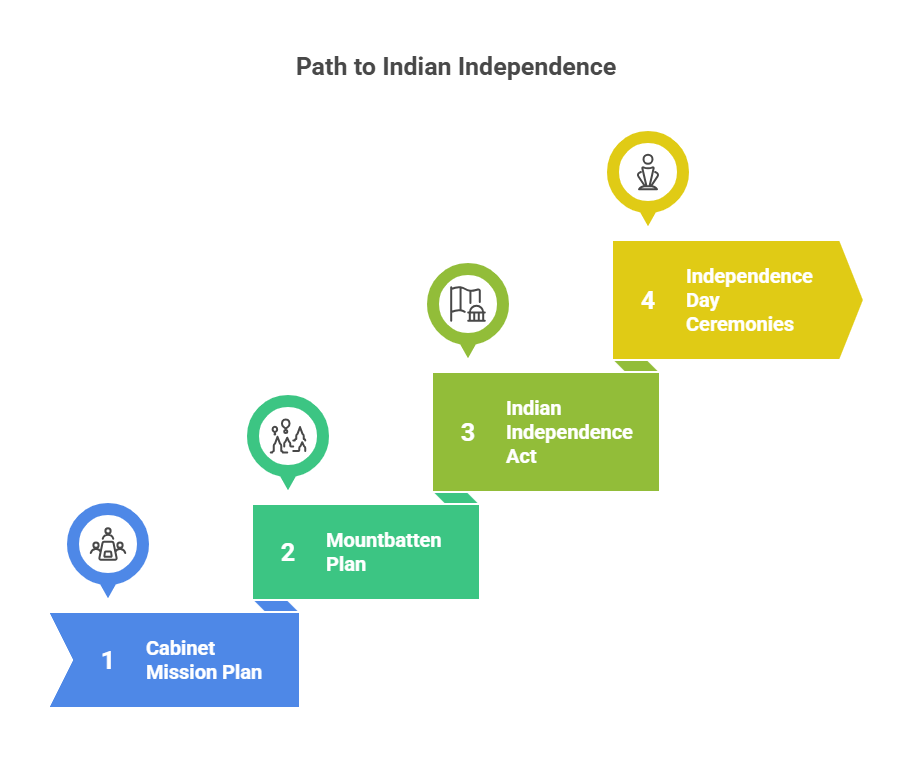
Path to Independence in 1947
The momentum toward independence accelerated post-World War II, as Britain’s weakened economy and global anti-colonial sentiments compelled a reevaluation of its imperial holdings. Key negotiations and events shaped this transition:
- Cabinet Mission Plan (1946): A British delegation proposed a federal structure for a united India, with provisions for provincial autonomy and safeguards for minorities. While initially accepted by the Congress, it was rejected by the Muslim League, led by Muhammad Ali Jinnah, who demanded a separate Muslim-majority state.
- Mountbatten Plan (June 3, 1947): Viceroy Lord Mountbatten advanced the timeline for independence to August 15, 1947, and endorsed partition to avert civil war. This plan divided Punjab and Bengal along religious lines and allowed princely states to accede to either dominion.
- Indian Independence Act (July 18, 1947): Enacted by the British Parliament, this legislation formalized the creation of India and Pakistan as independent dominions, transferring sovereignty and dissolving British paramountcy over princely states.
- Independence Day Ceremonies: On August 14, 1947, Pakistan celebrated its independence with Jinnah as Governor-General. India followed on August 15, with Jawaharlal Nehru delivering his “Tryst with Destiny” speech as the first Prime Minister, and Lord Mountbatten serving as the initial Governor-General.
These steps facilitated a transfer of power but were marred by haste, contributing to subsequent chaos.
The Partition of India
Partition entailed the division of British India into Hindu-majority India and Muslim-majority Pakistan, encompassing West Pakistan (present-day Pakistan) and East Pakistan (later Bangladesh). Driven by the Muslim League’s “Two-Nation Theory,” which posited Hindus and Muslims as distinct nations, the process exacerbated communal divisions fomented by colonial policies.
- Communal Violence: Pre-partition riots, such as those in Calcutta (1946) claiming over 4,000 lives, foreshadowed the bloodshed. Post-partition, sectarian clashes in Punjab and Bengal resulted in estimates of 500,000 to 2 million deaths.
- Princely States Integration: Over 560 princely states were urged to join India or Pakistan. Contentious accessions, like those of Hyderabad, Junagadh, and Kashmir, led to military interventions and enduring conflicts, notably the Indo-Pakistani War of 1947–1948 over Kashmir.
- Economic and Administrative Division: Assets, including the civil service, military, and railways, were bifurcated, often inequitably, straining nascent governments.
The partition’s rationale sought to resolve religious strife but instead institutionalized division, displacing populations and sowing seeds for future hostilities.
The Radcliffe Line
Named after Sir Cyril Radcliffe, a British lawyer appointed to chair boundary commissions for Punjab and Bengal, the Radcliffe Line delineated the borders between India and Pakistan. Tasked with completing the demarcation in mere weeks, Radcliffe’s decisions profoundly shaped the subcontinent’s geography.
- Boundary Commissions (1947): Separate commissions for Punjab and Bengal, comprising representatives from both communities, were established. Radcliffe, lacking prior knowledge of India, relied on outdated census data, maps, and submissions from stakeholders.
- Criteria and Challenges: Borders were drawn primarily based on religious majorities, contiguous territories, and natural features. However, complexities arose in mixed-population areas, irrigation systems, and strategic assets like canals and railways.
- Announcement and Implementation: The awards were finalized on August 13, 1947, but disclosed on August 17, post-independence, to prevent preemptive violence. The Punjab line divided the province into East (India) and West (Pakistan) Punjab, while Bengal was split into West Bengal (India) and East Bengal (Pakistan).
- Criticisms and Consequences: The line’s arbitrariness severed communities, disrupted economies, and triggered mass migrations. Anomalies, such as the allocation of Muslim-majority areas to India and vice versa, fueled disputes, including over the Gurdaspur district, which provided India access to Kashmir.
The Radcliffe Line exemplified the rushed nature of partition, leaving a legacy of contested borders and irredentist claims.
The Refugee Crisis
The partition precipitated one of the largest forced migrations in history, with approximately 14–18 million people displaced across borders, accompanied by horrific violence and humanitarian catastrophe.
- Scale and Demographics: Hindus and Sikhs fled from Pakistan to India, while Muslims moved in the opposite direction. Punjab bore the brunt, with over 10 million crossings, followed by Bengal’s more protracted exodus.
- Violence and Atrocities: Mobs attacked trains, villages, and convoys, resulting in mass killings, abductions, and sexual violence. Estimates suggest up to 2 million fatalities, with women disproportionately affected.
- Government Responses: India established the Ministry of Relief and Rehabilitation, setting up camps and facilitating property exchanges. Pakistan similarly managed influxes, though resources were strained. International aid from organizations like the United Nations Relief and Rehabilitation Administration provided limited support.
- Long-Term Impacts: Refugees faced economic hardship, cultural dislocation, and social integration challenges. The crisis influenced urban development, with cities like Delhi absorbing millions, and exacerbated poverty. Psychological trauma persisted across generations, shaping communal relations.
The refugee crisis underscored the human cost of partition, prompting reflections on nationalism and identity in post-colonial South Asia.
Key Events and Timelines
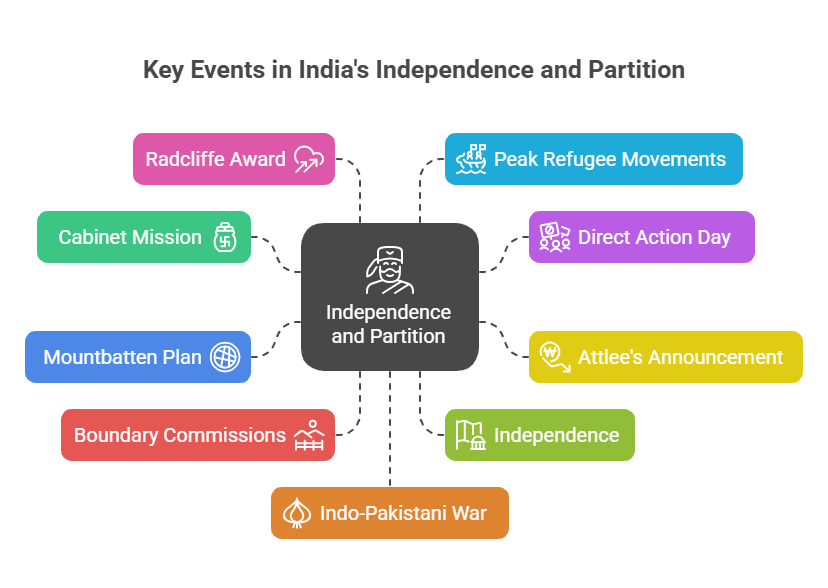
The following table outlines major milestones related to independence, partition, the Radcliffe Line, and the refugee crisis, illustrating their interconnected progression.
| Year/Month | Event | Description | Significance |
|---|---|---|---|
| March 1946 | Cabinet Mission Arrives | Proposal for a united federal India. | Highlighted irreconcilable differences between Congress and League. |
| August 1946 | Direct Action Day | Muslim League’s call leads to Calcutta Killings. | Escalated communal tensions, making partition inevitable. |
| February 1947 | Attlee’s Announcement | Britain sets June 1948 deadline for withdrawal, later advanced. | Accelerated negotiations amid mounting unrest. |
| June 3, 1947 | Mountbatten Plan | Outlines partition and independence timeline. | Formalized division of India and Pakistan. |
| July 1947 | Boundary Commissions Formed | Radcliffe tasked with border demarcation. | Initiated the drawing of the Radcliffe Line. |
| August 14–15, 1947 | Independence | Pakistan and India gain sovereignty. | Marked the end of British rule but onset of violence. |
| August 17, 1947 | Radcliffe Award Published | Borders announced, triggering migrations. | Sparked the refugee crisis and territorial disputes. |
| September–December 1947 | Peak Refugee Movements | Mass exodus and violence in Punjab and Bengal. | Resulted in millions displaced and significant loss of life. |
| 1948 | Indo-Pakistani War | Conflict over Kashmir accession. | Stemmed from partition ambiguities, leading to ongoing rivalry. |
Legacy and Impact
India’s independence and partition in 1947 forged modern South Asia, establishing democratic frameworks while entrenching divisions that persist in Indo-Pakistani relations. The Radcliffe Line remains a symbol of arbitrary colonial legacies, with unresolved issues like the Line of Control in Kashmir. The refugee crisis fostered resilience among displaced populations, influencing cultural narratives through literature and cinema, such as in the works of Saadat Hasan Manto. These events underscore the challenges of decolonization, emphasizing the need for inclusive governance to mitigate communal strife and humanitarian disasters in transitional societies.

Leave a comment