
Rise and Causes of Extremism
The emergence of extremism stemmed from several factors:
- Failure of Moderate Methods: By the early 20th century, the INC’s moderate leaders, such as Gopal Krishna Gokhale, had achieved limited reforms through petitions and dialogues, leading to frustration among younger nationalists who sought faster progress.
- British Repressive Policies: Events like the Partition of Bengal (1905), aimed at dividing Hindu-Muslim unity, and economic exploitation through high taxes and famines fueled anti-colonial sentiment.
- Influence of Global Events: Inspirations from revolutionary movements in Ireland, Russia, and Japan encouraged a militant stance.
- Ideological Foundations: Extremists drew from Indian philosophy, interpreting texts like the Bhagavad Gita to justify active resistance, while promoting concepts like Swaraj as a birthright.
This phase divided the INC into moderates, who favored gradual reforms within the British framework, and extremists, who pushed for complete independence through boycott and self-reliance.
Key Leaders: Bal Gangadhar Tilak
Bal Gangadhar Tilak (1856–1920), often called “Lokmanya” (accepted by the people), was a prominent extremist leader from Maharashtra and a driving force behind the radical wing of the INC.
- Early Life and Education: Born in Ratnagiri, Maharashtra, Tilak received a modern education, graduating in mathematics and law. He co-founded the Deccan Education Society and Fergusson College in Pune to promote nationalist education.
- Political Career: Tilak joined the INC in 1890 and used his newspapers, Kesari (Marathi) and Maratha (English), to criticize British rule. He popularized festivals like Ganesh Chaturthi and Shivaji Jayanti to foster national unity.
- Contributions: Tilak advocated “Swaraj is my birthright, and I shall have it.” He authored works like Gita Rahasya, interpreting the Bhagavad Gita as a call to action. During the Swadeshi Movement, he promoted boycott and passive resistance. Arrested in 1908 for sedition, he spent six years in Mandalay prison, emerging as a symbol of resilience.
- Ideology: Tilak emphasized cultural nationalism, economic boycott, and mass agitation, differing from moderates by rejecting mendicancy politics.
Tilak’s leadership culminated in the Lucknow Pact of 1916, reuniting moderates and extremists while allying with the Muslim League.
Key Leaders: Bipin Chandra Pal
Bipin Chandra Pal (1858–1932), a Bengali nationalist and orator, formed part of the Lal-Bal-Pal triumvirate and played a crucial role in spreading extremist ideas through journalism and public speeches.
- Early Life and Education: Born in Sylhet (now in Bangladesh), Pal was educated at Presidency College, Calcutta. Influenced by Brahmo Samaj, he initially focused on social reforms but shifted to politics amid growing anti-British sentiment.
- Political Career: Pal joined the INC in 1886 and edited newspapers like Bande Mataram and New India to propagate radical views. He supported the Swadeshi Movement by advocating boycott of British goods and institutions.
- Contributions: Known for his fiery eloquence, Pal toured India and abroad to rally support for independence. He emphasized self-reliance, education, and cultural revival, coining phrases like “Vande Mataram” as a nationalist slogan. In 1907, he was imprisoned for refusing to testify against Aurobindo Ghose.
- Ideology: Pal advocated “constructive Swadeshi,” focusing on village-level self-governance and economic independence. He critiqued British education as alienating and promoted a nationalism blending Hindu philosophy with modern ideas.
Pal’s efforts helped transform the INC into a mass organization, though he later withdrew from active politics due to ideological differences.
The Swadeshi Movement (1905–1911)
The Swadeshi Movement emerged as a direct response to the Partition of Bengal announced by Lord Curzon in 1905, which divided the province along communal lines to weaken nationalism.
- Background: The partition sparked widespread protests, viewed as a “divide and rule” tactic. On October 16, 1905, Bengalis observed a day of mourning, tying rakhis as symbols of unity.
- Features and Methods:
- Boycott: Rejection of British goods, schools, courts, and titles to economically pressure the Raj.
- Swadeshi Promotion: Encouragement of indigenous industries, education (e.g., National Council of Education), and cultural revival through songs, literature, and festivals.
- Leadership and Spread: Led by extremists like Tilak, Pal, and Lajpat Rai, it spread beyond Bengal to Punjab, Maharashtra, and Madras. Women and students participated actively.
- Extremist vs. Moderate Approaches: Extremists extended boycott to passive resistance and full Swaraj, while moderates limited it to Bengal and petitions.
- Impact: The movement heightened national consciousness, led to the annulment of the partition in 1911, and boosted Indian industries. However, it faced repression, including arrests and communal tensions.
The Swadeshi era marked the INC’s transformation, with the 1906 Calcutta session declaring Swaraj as the goal.
Key Events and Ideological Conflicts
- Surat Split (1907): At the INC session in Surat, clashes between moderates (favoring Rash Behari Ghosh as president) and extremists (backing Tilak) led to a formal division. Extremists were expelled, weakening the INC temporarily.
- Government Repression: Extremists faced arrests; Tilak’s 1908 sedition trial and Pal’s imprisonment exemplified British crackdowns.
- Reunion and Legacy Events: The 1916 Lucknow Pact reunited factions, paving the way for the Gandhian era.
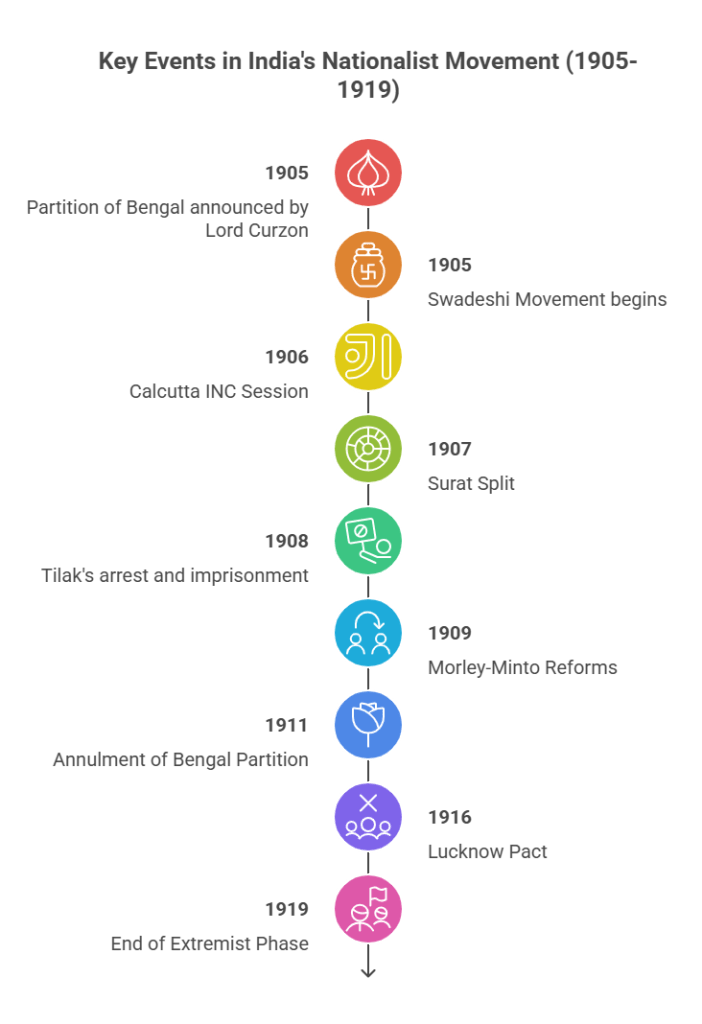
Timeline of Key Events
The following table provides a chronological overview of major developments during the Extremist Phase, highlighting the roles of Tilak, Pal, and the Swadeshi Movement.
| Year | Event | Description | Key Figures Involved |
|---|---|---|---|
| 1905 | Partition of Bengal | Announced by Lord Curzon, sparking protests and the launch of Swadeshi. | Tilak, Pal, Lajpat Rai |
| 1905 | Swadeshi Movement Begins | Formal boycott resolution passed in Calcutta; promotion of indigenous goods. | Bipin Chandra Pal (key orator), Bal Gangadhar Tilak (supporter) |
| 1906 | Calcutta INC Session | Swaraj declared as INC goal; Vande Mataram adopted as slogan. | Tilak, Pal |
| 1907 | Surat Split | Division of INC into moderate and extremist factions amid chaos. | Tilak (extremist leader), Pal |
| 1908 | Tilak’s Arrest and Imprisonment | Convicted of sedition for articles in Kesari; sentenced to six years. | Bal Gangadhar Tilak |
| 1909 | Morley-Minto Reforms | Introduced separate electorates; rejected by extremists as inadequate. | INC extremists including Pal |
| 1911 | Annulment of Bengal Partition | British reversal due to Swadeshi pressure; capital shifted to Delhi. | Movement leaders like Tilak and Pal |
| 1916 | Lucknow Pact | Reunion of INC factions; alliance with Muslim League for joint demands. | Tilak (key negotiator) |
| 1919 | End of Extremist Phase | Transition to Gandhian non-cooperation amid Rowlatt Act protests. | Influence of Tilak and Pal wanes |
Legacy and Impact
The Extremist Phase laid the groundwork for mass-based nationalism, inspiring future movements like Non-Cooperation and Quit India. Tilak and Pal’s emphasis on Swadeshi fostered economic self-reliance, influencing post-independence policies. Despite internal divisions and repression, this era democratized the freedom struggle, integrating diverse groups and shifting from elite petitions to popular agitation. It ultimately contributed to India’s independence in 1947 by intensifying anti-colonial resolve.

Leave a comment