
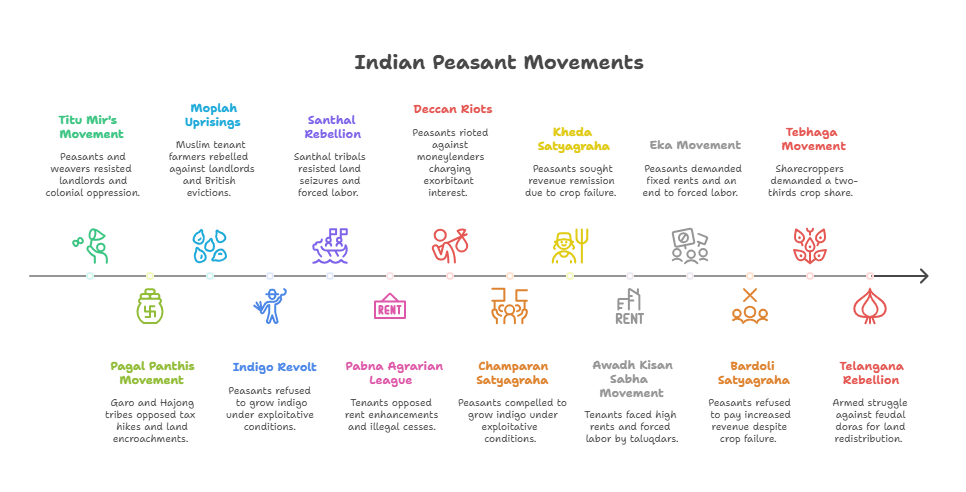
Phases of Peasant Movements
Peasant movements can be categorized into three broad phases based on their nature and alignment with nationalism:
- Pre-1857 Phase (Restorative and Localized Revolts): These were spontaneous uprisings against immediate grievances, often violent and aimed at restoring pre-colonial agrarian structures. They lacked national coordination but exposed colonial exploitation.
- 1857-1917 Phase (Transitional Agitations): Movements became more organized, with some non-violent elements, and began linking local issues to broader anti-British sentiments. Influences from early nationalists emerged.
- Post-1917 Phase (Nationalist-Integrated Movements): Aligned with the Indian National Congress and leftist groups, these used satyagraha, strikes, and armed resistance. They demanded land reforms and influenced post-independence policies.
Major Peasant Movements: Detailed Analysis
The following table lists key movements, drawing from historical records. Each entry includes background, leaders, methods, outcomes, and specific impacts. This covers a comprehensive range, including both well-known and lesser-discussed uprisings.
| Movement | Year and Location | Background and Causes | Key Leaders and Participants | Methods and Key Events | Outcomes | Major Impacts |
|---|---|---|---|---|---|---|
| Titu Mir’s Movement (Narkelberia Uprising) | 1782-1831, West Bengal | Peasants and weavers resisted Hindu landlords imposing beard taxes and other levies, alongside Wahhabi-inspired religious reforms against colonial and feudal oppression. | Titu Mir (Mir Nithar Ali) | Guerrilla warfare; construction of bamboo forts; attacks on zamindars and British indigo plantations. | Suppressed by British forces in 1831; Titu Mir killed. | Highlighted religious-peasant synergy; inspired future anti-zamindari struggles; weakened local landlord authority temporarily. |
| Pagal Panthis Movement | 1825-1835, Bengal (now Bangladesh) | Garo and Hajong tribes opposed zamindari tax hikes and land encroachments by British-backed landlords. | Karam Shah and Tipu Shah | Religious-sectarian mobilization; armed raids on zamindars; establishment of alternative governance. | Suppressed in 1833; leaders imprisoned or killed. | Exposed tribal exploitation; influenced later tribal-peasant alliances; led to minor tax reliefs in affected areas. |
| Moplah (Mappila) Uprisings | 1836-1921, Malabar (Kerala) | Muslim tenant farmers (Mappilas) rebelled against Hindu landlords (jenmis) and British evictions, exacerbated by revenue demands and religious tensions. | Various local leaders, including Sayyid Alavi Tangal | Armed revolts; attacks on landlords and police; peaked in 1921 with Khilafat linkage. | Brutally suppressed in 1921; over 2,000 deaths; martial law imposed. | Contributed to agrarian reforms in Malabar; integrated with Non-Cooperation Movement; highlighted communal aspects of peasant struggles. |
| Indigo Revolt (Nil Bidroho) | 1859-1860, Bengal | Peasants forced to grow indigo under exploitative tinkathia system by European planters, leading to debt and famine. | Bishnu Charan Biswas, Digambar Biswas | Refusal to plant indigo; strikes; petitions; attacks on plantations. | Indigo Commission formed; partial abolition of forced cultivation; Act of 1860 provided relief. | Empowered peasants legally; inspired Champaran; reduced indigo as a cash crop, shifting to other agriculture. |
| Santhal Rebellion (Hul) | 1855-1856, Bengal Presidency (now Jharkhand) | Santhal tribals resisted zamindars and moneylenders seizing lands, high rents, and forced labor. | Sidhu and Kanhu Murmu | Armed uprising; declaration of independence; guerrilla attacks on oppressors. | Suppressed by British troops; leaders executed. | Led to Santhal Parganas Act (1855) for tribal protections; influenced non-tribal peasant awareness; symbolized tribal resistance. |
| Pabna Agrarian League | 1873-1876, Bengal (now Bangladesh) | Tenants opposed zamindari rent enhancements and illegal cesses under Permanent Settlement. | Ishan Chandra Roy, Shambhu Pal | Formation of agrarian leagues; legal petitions; rent strikes; non-violent protests. | Bengal Tenancy Act (1885) enacted, granting occupancy rights. | Strengthened tenant rights; model for organized, legal peasant resistance; reduced zamindari powers. |
| Deccan Riots | 1875, Maharashtra (Poona and Ahmednagar) | Ryotwari peasants rioted against moneylenders (sahukars) charging exorbitant interest, leading to land loss. | Local ryots (peasants) | Violent attacks on moneylenders’ homes; burning of debt bonds. | Deccan Agriculturists’ Relief Act (1879) passed to regulate moneylending. | Curbed usury; inspired Bombay Presidency reforms; highlighted ryotwari system flaws. |
| Champaran Satyagraha | 1917-1918, Bihar | Peasants compelled to grow indigo under tinkathia system by European planters. | Mahatma Gandhi, Raj Kumar Shukla | Non-violent satyagraha; surveys; boycotts; civil disobedience. | Tinkathia abolished; partial refunds; Champaran Agrarian Act (1918). | Gandhi’s entry into Indian politics; boosted Congress rural base; inspired non-violent agrarian tactics nationwide. |
| Kheda Satyagraha | 1918, Gujarat | Crop failure due to famine, but British demanded full revenue; peasants sought remission. | Mahatma Gandhi, Vallabhbhai Patel | No-tax campaign; satyagraha; village boycotts. | Revenue suspended for affected peasants. | Strengthened peasant unity; elevated Patel; integrated agrarian issues with nationalism. |
| Awadh Kisan Sabha Movement | 1920-1921, United Provinces (now Uttar Pradesh) | Tenants faced high rents, begar (forced labor), and evictions by taluqdars. | Baba Ramchandra, Jawaharlal Nehru | Formation of kisan sabhas; protests; rent strikes. | Awadh Rent Act (1921) provided some relief. | Mobilized masses for Non-Cooperation; led to Eka Movement; fostered peasant organizations. |
| Eka Movement | 1921-1922, United Provinces (Hardoi, Barabanki) | Extension of Awadh issues; demands for fixed rents and end to begar. | Madari Pasi | Oath-bound unity (eka); non-payment of rents; meetings. | Suppressed; leaders arrested. | Highlighted lower-caste peasant issues; influenced Congress to address rural grievances. |
| Bardoli Satyagraha | 1928, Gujarat | 30% revenue hike despite crop failure; peasants refused payment. | Vallabhbhai Patel | No-tax campaign; satyagraha; women and youth involvement. | Revenue reduced; fair reassessment. | Earned Patel “Sardar” title; model for civil disobedience; enhanced Congress organizational strength. |
| Tebhaga Movement | 1946-1947, Bengal | Sharecroppers (bargadars) demanded two-thirds crop share instead of half from jotedars. | All-India Kisan Sabha (Communist Party) | Crop seizures; strikes; armed clashes amid famine. | Suppressed but led to Bargadars Act (1950). | Bolstered communist rural influence; influenced West Bengal land reforms; raised tenancy rights awareness. |
| Telangana Rebellion | 1946-1951, Hyderabad (now Telangana) | Armed struggle against Nizam’s feudal doras; demands for land redistribution and end to vetti (forced labor). | Communist Party leaders like Ravi Narayan Reddy | Guerrilla warfare; land seizures; parallel governments. | Hyderabad integrated into India (1948); land redistributed (over 1 million acres). | Prompted zamindari abolition nationally; model for leftist peasant insurgencies; exposed princely state feudalism. |
Broader Causes of Peasant Movements
- Economic Exploitation: Colonial policies commercialized agriculture, prioritizing cash crops (indigo, opium) over food, leading to famines (e.g., Bengal Famine 1943 influencing Tebhaga).
- Land Systems: Zamindari created absentee landlords; ryotwari burdened individual peasants; both caused indebtedness.
- Social Factors: Caste hierarchies, tribal displacements, and religious tensions amplified grievances.
- External Influences: World Wars increased taxes; nationalist movements provided ideological support.
Overall Impacts on Indian Society and Politics
- Political Integration: Transformed isolated revolts into national struggles; peasants became a key force in the independence movement, as seen in Congress resolutions on agrarian reforms (e.g., Karachi Session 1931).
- Agrarian Reforms: Post-1947, movements led to constitutional provisions (Article 31A) and laws like Zamindari Abolition Acts (1950s), Land Ceiling Acts, and tenancy protections, redistributing land to tillers.
- Social Changes: Empowered marginalized groups (tribals, lower castes); challenged feudalism and caste oppression; fostered gender participation (e.g., women in Bardoli).
- Economic Shifts: Critiqued colonial mercantilism; promoted self-sufficiency, influencing Green Revolution policies.
- Legacy: Paved way for contemporary movements (e.g., Naxalite uprisings in 1967, drawing from Telangana); underscored rural-urban divide in Indian politics.
Key Themes and Lessons for Study
- Evolution from Violence to Non-Violence: Early movements (e.g., Santhal) were armed; later ones (e.g., Champaran) adopted Gandhian methods.
- Role of Leadership: From tribal chiefs to nationalists (Gandhi, Patel) and communists.
- Limitations: Many were suppressed; communal elements (e.g., Moplah) complicated unity; post-independence reforms were uneven.
- Historiographical Note: These movements are studied as subaltern resistance (per Ranajit Guha), highlighting peasant agency beyond elite nationalism.
- Which movement was led by Mahatma Gandhi against the tinkathia system in Bihar?
a) Tebhaga Movement
b) Champaran Satyagraha
c) Telangana Rebellion
d) Bardoli Satyagraha
Answer: b) Champaran Satyagraha - In which year did the Tebhaga Movement primarily occur?
a) 1917-1918
b) 1928
c) 1946-1947
d) 1855-1856
Answer: c) 1946-1947 - What was the primary demand of sharecroppers in the Tebhaga Movement?
a) Abolition of zamindari
b) Two-thirds share of the crop
c) End to forced indigo cultivation
d) Reduction in land revenue
Answer: b) Two-thirds share of the crop - Who led the Bardoli Satyagraha in Gujarat?
a) Mahatma Gandhi
b) Vallabhbhai Patel
c) Jawaharlal Nehru
d) Baba Ramchandra
Answer: b) Vallabhbhai Patel - The Telangana Rebellion was directed against the feudal regime of which ruler?
a) British authorities
b) The Nizam of Hyderabad
c) European indigo planters
d) Hindu landlords in Malabar
Answer: b) The Nizam of Hyderabad - Which movement involved the Santhal tribals resisting land seizures in Bengal Presidency?
a) Moplah Uprisings
b) Santhal Rebellion
c) Indigo Revolt
d) Pabna Agrarian League
Answer: b) Santhal Rebellion - What was the outcome of the Champaran Satyagraha?
a) Redistribution of land
b) Abolition of the tinkathia system
c) Formation of kisan sabhas
d) Integration of Hyderabad into India
Answer: b) Abolition of the tinkathia system - The Deccan Riots of 1875 were primarily against whom?
a) Zamindars
b) Moneylenders
c) British planters
d) Tribal chiefs
Answer: b) Moneylenders - Which act was influenced by the Pabna Agrarian League?
a) Bengal Tenancy Act (1885)
b) Deccan Agriculturists’ Relief Act (1879)
c) Champaran Agrarian Act (1918)
d) Bargadars Act (1950)
Answer: a) Bengal Tenancy Act (1885) - The Eka Movement in 1921-1922 focused on demands for what?
a) Fixed rents and end to forced labor
b) Two-thirds crop share
c) Abolition of indigo cultivation
d) Revenue remission due to famine
Answer: a) Fixed rents and end to forced labor - Who were the leaders of the Santhal Rebellion?
a) Sidhu and Kanhu Murmu
b) Titu Mir
c) Karam Shah and Tipu Shah
d) Bishnu Charan Biswas
Answer: a) Sidhu and Kanhu Murmu - The Moplah Uprisings peaked in which year with linkage to the Khilafat Movement?
a) 1836
b) 1859
c) 1921
d) 1946
Answer: c) 1921 - What was the key method used in the Bardoli Satyagraha?
a) Armed guerrilla warfare
b) No-tax campaign and civil disobedience
c) Crop seizures
d) Burning of debt bonds
Answer: b) No-tax campaign and civil disobedience - The Telangana Rebellion led to the redistribution of how many acres of land?
a) Over 100,000 acres
b) Over 500,000 acres
c) Over 1 million acres
d) Over 2 million acres
Answer: c) Over 1 million acres - Which movement was organized by the All-India Kisan Sabha?
a) Champaran Satyagraha
b) Tebhaga Movement
c) Kheda Satyagraha
d) Indigo Revolt
Answer: b) Tebhaga Movement - The Pagal Panthis Movement involved which tribes?
a) Santhal
b) Garo and Hajong
c) Mappila
d) Ryot
Answer: b) Garo and Hajong - What act resulted from the Indigo Revolt?
a) Santhal Parganas Act (1855)
b) Act of 1860 providing relief
c) Awadh Rent Act (1921)
d) Land Ceiling Acts
Answer: b) Act of 1860 providing relief - The Awadh Kisan Sabha Movement was linked to which nationalist leader?
a) Vallabhbhai Patel
b) Jawaharlal Nehru
c) Ravi Narayan Reddy
d) Madari Pasi
Answer: b) Jawaharlal Nehru - Which movement used guerrilla warfare and bamboo forts?
a) Titu Mir’s Movement
b) Deccan Riots
c) Eka Movement
d) Kheda Satyagraha
Answer: a) Titu Mir’s Movement - The Kheda Satyagraha sought remission of revenue due to what?
a) High rents
b) Famine and crop failure
c) Forced labor
d) Indigo cultivation
Answer: b) Famine and crop failure - What was the primary cause of peasant movements in colonial India?
a) Industrial exploitation
b) Exploitative land revenue systems
c) Urban migration
d) Educational reforms
Answer: b) Exploitative land revenue systems - The Bargadars Act of 1950 was influenced by which movement?
a) Champaran Satyagraha
b) Tebhaga Movement
c) Santhal Rebellion
d) Pabna Agrarian League
Answer: b) Tebhaga Movement - Who led the Telangana Rebellion?
a) Communist Party leaders like Ravi Narayan Reddy
b) Mahatma Gandhi
c) Ishan Chandra Roy
d) Sayyid Alavi Tangal
Answer: a) Communist Party leaders like Ravi Narayan Reddy - The Santhal Parganas Act was enacted after which uprising?
a) Indigo Revolt
b) Santhal Rebellion
c) Moplah Uprisings
d) Deccan Riots
Answer: b) Santhal Rebellion - Which movement highlighted communal tensions in Malabar?
a) Tebhaga Movement
b) Moplah Uprisings
c) Bardoli Satyagraha
d) Awadh Kisan Sabha
Answer: b) Moplah Uprisings - The Deccan Agriculturists’ Relief Act regulated what?
a) Zamindari rents
b) Moneylending practices
c) Indigo contracts
d) Tribal lands
Answer: b) Moneylending practices - In the Eka Movement, what does ‘Eka’ refer to?
a) Unity through oaths
b) Crop sharing
c) Revenue hike
d) Armed struggle
Answer: a) Unity through oaths - Which movement contributed to the integration of Hyderabad into India?
a) Champaran Satyagraha
b) Telangana Rebellion
c) Tebhaga Movement
d) Pagal Panthis Movement
Answer: b) Telangana Rebellion - The Pabna Agrarian League used which primary method?
a) Violent riots
b) Legal petitions and rent strikes
c) Guerrilla warfare
d) Satyagraha
Answer: b) Legal petitions and rent strikes - Titu Mir’s Movement was inspired by what religious reform?
a) Khilafat
b) Wahhabi
c) Brahmo Samaj
d) Arya Samaj
Answer: b) Wahhabi - Which phase of peasant movements was characterized by spontaneous, violent revolts?
a) Pre-1857
b) 1857-1917
c) Post-1917
d) Post-1947
Answer: a) Pre-1857 - The Zamindari Abolition Acts were influenced by the legacy of which movements?
a) Urban labor strikes
b) Peasant movements like Telangana and Tebhaga
c) Industrial reforms
d) Educational uprisings
Answer: b) Peasant movements like Telangana and Tebhaga - Who earned the title ‘Sardar’ from the Bardoli Satyagraha?
a) Mahatma Gandhi
b) Vallabhbhai Patel
c) Baba Ramchandra
d) Madari Pasi
Answer: b) Vallabhbhai Patel - The Indigo Revolt led to the formation of which commission?
a) Indigo Commission
b) Revenue Commission
c) Tenancy Commission
d) Agrarian Commission
Answer: a) Indigo Commission - Which movement involved attacks on moneylenders’ debt bonds?
a) Santhal Rebellion
b) Deccan Riots
c) Tebhaga Movement
d) Kheda Satyagraha
Answer: b) Deccan Riots - The Awadh Rent Act of 1921 provided relief from what?
a) Forced indigo
b) High rents and evictions
c) Crop failures
d) Tribal encroachments
Answer: b) High rents and evictions - Pagal Panthis established what during their movement?
a) Parallel governments
b) Alternative governance
c) Kisan sabhas
d) Agrarian leagues
Answer: b) Alternative governance - Which movement was suppressed with martial law in 1921?
a) Champaran Satyagraha
b) Moplah Uprisings
c) Bardoli Satyagraha
d) Telangana Rebellion
Answer: b) Moplah Uprisings - The Tebhaga Movement occurred amid which crisis?
a) Bengal Famine
b) Deccan Famine
c) Malabar Evictions
d) Awadh Begar
Answer: a) Bengal Famine - Kheda Satyagraha was co-led by Gandhi and whom?
a) Jawaharlal Nehru
b) Vallabhbhai Patel
c) Raj Kumar Shukla
d) Ravi Narayan Reddy
Answer: b) Vallabhbhai Patel - Which movement symbolized tribal resistance in Jharkhand region?
a) Titu Mir’s Movement
b) Santhal Rebellion
c) Eka Movement
d) Pabna Agrarian League
Answer: b) Santhal Rebellion - The post-1917 phase of movements integrated with what?
a) Princely state reforms
b) Indian National Congress and leftist groups
c) British revenue policies
d) Urban industrialization
Answer: b) Indian National Congress and leftist groups - What critiqued colonial mercantilism in these movements?
a) Prioritization of cash crops over food security
b) Educational disparities
c) Military recruitment
d) Judicial reforms
Answer: a) Prioritization of cash crops over food security - The Eka Movement was led by a leader from which caste?
a) Upper caste
b) Lower caste (Madari Pasi)
c) Tribal
d) Muslim tenant
Answer: b) Lower caste (Madari Pasi) - Which act protected tribal lands after the Santhal Rebellion?
a) Bengal Tenancy Act
b) Santhal Parganas Act
c) Deccan Relief Act
d) Awadh Rent Act
Answer: b) Santhal Parganas Act - Tebhaga challenged exploitation by whom?
a) European planters
b) Zamindars and jotedars
c) Moneylenders
d) Tribal chiefs
Answer: b) Zamindars and jotedars - The Telangana Rebellion used what method prominently?
a) Non-violent satyagraha
b) Guerrilla warfare and land seizures
c) Legal petitions
d) Rent strikes
Answer: b) Guerrilla warfare and land seizures - Which movement fostered gender participation notably?
a) Santhal Rebellion
b) Bardoli Satyagraha
c) Pagal Panthis
d) Indigo Revolt
Answer: b) Bardoli Satyagraha - Post-independence, these movements influenced what constitutional provision?
a) Article 31A on agrarian reforms
b) Article 19 on free speech
c) Article 370 on special status
d) Article 226 on writs
Answer: a) Article 31A on agrarian reforms - The legacy of peasant movements laid groundwork for what in contemporary India?
a) Urban development policies
b) Ongoing farmer agitations
c) Industrial subsidies
d) Educational quotas
Answer: b) Ongoing farmer agitations

Leave a comment