

Introduction to the Mines Act, 1952
The Mines Act, 1952 is a comprehensive Indian legislation aimed at regulating the mining industry, ensuring the safety, health, and welfare of workers employed in mines. It consolidates and amends previous laws, including the Indian Mines Act, 1923, and came into force on July 1, 1952.
The Act applies to all mines in India, including those owned by the government, and covers the extraction of minerals such as coal, metals, and oils. It was enacted in response to hazardous working conditions in mines, frequent accidents, and the need for better labor protections.
Objectives:
- To regulate labor conditions and ensure safety in mining operations.
- To provide for the health, welfare, and proper working environment of mine workers.
- To prevent exploitation, especially of vulnerable groups like women and children.
- To establish mechanisms for inspections, inquiries, and penalties for non-compliance.
- To empower the Central Government to make rules and regulations for mining safety and management.
Note on Current Status (as of November 2025): The Mines Act, 1952 remains in force but is set to be repealed and subsumed under the Occupational Safety, Health and Working Conditions Code, 2020 (OSH Code).
However, the OSH Code’s full implementation is delayed; as of late 2025, many states are still finalizing draft rules, and no nationwide enforcement date has been notified.
Until fully implemented, the Mines Act continues to apply.
Applicability and Key Definitions (Sections 1 & 2)
- Applicability: Extends to the whole of India, including territorial waters; applies to all mines (excavations for minerals) but exempts prospecting excavations not for commercial use or sale. The Central Government can exempt specific mines or workers via notification. Does not apply to railways under the Indian Railways Act, 1890.
- Key Definitions:
- Mine: Any excavation for obtaining minerals (including rock, stone, sand, mineral oils); includes shafts, opencast workings, conveyors, machinery, and associated buildings/premises.
- Minerals: Substances obtainable from the earth by mining (e.g., coal, iron ore); major minerals (Central control) vs. minor minerals (State control, like sand, clay).
- Owner: Proprietor, lessee, or occupier with ultimate control; includes contractors/sub-lessees.
- Agent: Person representing the owner in management.
- Manager: Appointed person responsible for mine operations.
- Worker/Employed Person: Any person working in a mine (manual, supervisory, or technical); excludes office staff not in mining areas.
- Adult: ≥18 years;
Adolescent: 15-18 years (amended; no work below 18 post-1983). - Serious Bodily Injury: Permanent loss of limb/sight/hearing or fracture.
- Reportable Injury: Absence from work >72 hours.
- Week: 7 days from midnight Saturday (or as approved).
- Wages: Basic pay + allowances (dearness, underground); excludes overtime/bonus.
- Below Ground/Above Ground/Open Cast: Based on excavation depth (below: >6m depth; open cast: surface mining).
Inspectors and Certifying Surgeons
(Chapter II, Sections 5-11)
- Appointment: Central Government appoints Chief Inspector (for all India) and Inspectors (with qualifications; no mining interests). District Magistrates can exercise powers.
- Powers and Duties: Enter/inspect mines anytime; inquire into safety/health/ventilation; seize documents; prohibit unsafe work; conduct searches with warrants; order surveys/exams. Owners must provide facilities; non-compliance is an offense.
- Occupational Health Surveys: Inspectors can mandate medical exams; unfit workers get alternative jobs or compensation.
- Secrecy: Inspection info confidential; breach punishable (up to 1 year imprisonment/fine).
- Certifying Surgeons: Qualified doctors appointed to examine workers (e.g., adolescents, hazardous jobs); issue fitness certificates; no mining interests.
Committees (Chapter III, Sections 12-15)
- Formation: Central Government constitutes a Committee with a Chairman, Chief Inspector, union/owner reps, and experts.
- Functions: Advise on rules; inquire into accidents/diseases; hear appeals against Inspector orders.
- Powers: Like a civil court (summon witnesses, documents); expenses recoverable from owners.
Mining Operations and Management
(Chapter IV, Sections 16-18)
- Notice: Owners must notify Chief Inspector 1 month before starting/resuming operations (details: location, workers, manager).
- Manager Appointment: Mandatory qualified manager; owner/agent can self-appoint; responsible for safety/compliance.
- Duties: Owners/agents/managers ensure Act adherence; liable for violations unless due diligence proven.
Health, Sanitation, and Safety Provisions
(Chapter V, Sections 19-27)
- Drinking Water: Wholesome supply at convenient points; marked; away from latrines.
- Sanitation: Separate, lighted, ventilated latrines/urinals for males/females; cleaned daily.
- Medical Facilities: First-aid boxes/rooms (trained staff); ambulance/hospital arrangements for >150 workers.
- Safety Measures: Adequate ventilation, lighting, dust control, explosives handling; fencing of dangerous areas; rescue appliances.
- Danger Notices: Inspectors can prohibit work in unsafe areas; workers get wages/alternative jobs during prohibition.
- Accidents: Immediate notice for fatal/serious incidents; inquiry by court/Committee; accident registers.
- Occupational Diseases: Notification; medical inquiries; compensation under Workmen’s Compensation Act.
Welfare Facilities (Under Rules/Regulations)
- Shelters/Canteens: Rest shelters for >50 workers; canteens for >250.
- Welfare Officers: Appointed for >500 workers; oversee welfare.
- Crèches: For women workers’ children.
- Other: Protective gear, education, housing (prescribed by Central Government rules).
Hours of Work and Employment Conditions (Chapter VI, Sections 28-48)
- Weekly Hours: Max 48 hours (above ground: 9/day; below: 8/day); spread-over ≤12 hours with 0.5-hour rest after 5 hours.
- Weekly Rest: 1 day/week (Sunday or substitute); compensatory rest if deprived.
- Overtime: Double wages for excess hours.
- Shifts: No overlapping; notices displayed; night shifts require 24-hour rest.
- Prohibitions on Employment:
- No persons <18 years (post-1983 Amendment; apprentices ≥16 with approval).
- Women: No below ground; above ground 6 AM-7 PM (extendable, but not 10 PM-5 AM).
- No double employment; max 10 hours/day including overtime.
- Registers: Maintain attendance, shifts, fitness certificates.
Leave and Holidays (Chapter VII, Sections 49-56)
- Annual Leave with Wages: Below ground: 1 day/15 days worked; above: 1/20; min 190/240 attendances/year; accumulates to 30 days.
- Payment: Average daily wage; advance for ≥4 days; on termination, pay for unused leave.
- Exemptions: If mine rules provide better benefits.
Regulations, Rules, and Bye-laws (Chapter VIII, Sections 57-62)
- Central Government Powers: Make regulations on safety (ventilation, machinery, explosives), qualifications, notices, welfare (canteens, officers).
- Bye-laws: Owners frame internal rules (e.g., worker conduct); approved by Chief Inspector.
- Publication: Rules laid before Parliament; emergencies without prior publication.
Penalties and Procedure (Chapter IX, Sections 63-81)
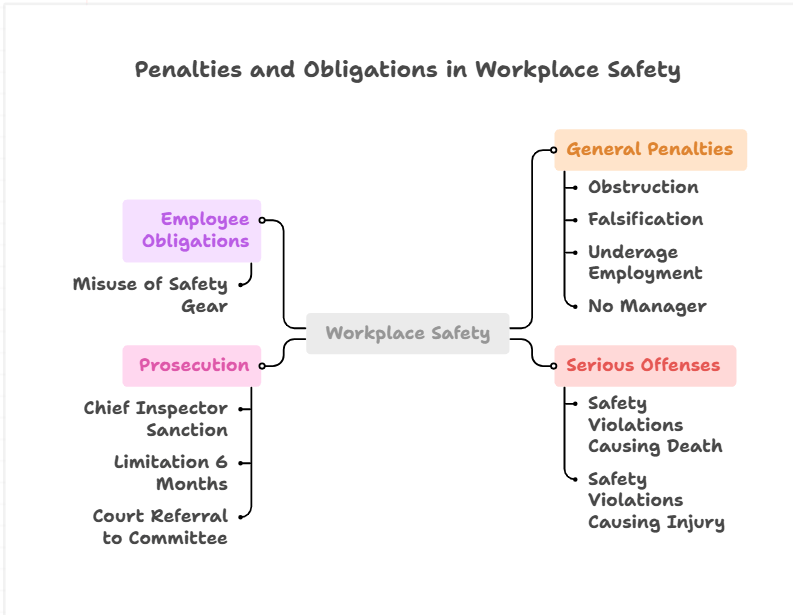
- General Penalties: Obstruction: ≤3 months/₹500; falsification: ≤3 months/₹1,000; underage employment: ₹500; no manager: ≤3 months/₹2,500.
- Serious Offenses: Safety violations causing death: ≤2 years/₹5,000; injury: ≤1 year/₹3,000; enhanced for repeats.
- Prosecution: Requires Chief Inspector sanction; limitation 6 months; courts can refer to Committee.
- Employee Obligations: Misuse of safety gear: Fine ≤₹500
Miscellaneous (Chapter X, Sections 82-88)
- Exemptions: Central Government can grant/rescind.
- Government Mines: Act applies.
- No Fees: For welfare facilities.
- Protection: Good faith actions immune.
Key Amendments:
- 1983 Amendment: Prohibits <18 years in mines; women employment restrictions strengthened.
- Other minor amendments for safety and definitions.

Leave a comment