
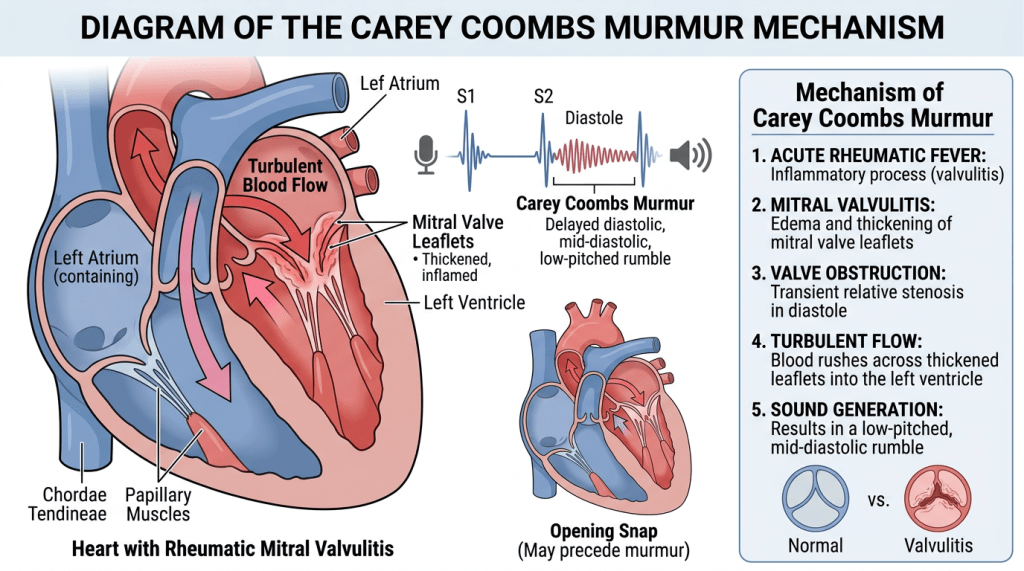
The correct answer is (b) Soft mid-diastolic murmur due to mitral valvulitis.
Quick Breakdown:
- Carey Coombs murmur is a short, soft mid-diastolic rumble heard at the apex in acute rheumatic fever.
- It results from mitral valvulitis (inflammation and thickening of the mitral valve leaflets), causing turbulent flow during diastole.
- It is not systolic, not due to aortic valve disease, and disappears as the acute valvulitis resolves.
Understanding the Carey Coombs Murmur – A Classic Sign of Acute Rheumatic Carditis
The Carey Coombs murmur (also called Coombs murmur) is a historically important auscultatory finding first described by British physician Carey Franklin Coombs in 1907. It remains a valuable clinical clue in acute rheumatic fever (ARF), particularly when carditis is present.
What Exactly Is the Carey Coombs Murmur?
- Timing: Mid-diastolic (sometimes described as short or running into pre-systolic phase).
- Character: Soft, low-pitched rumbling murmur (similar to the rumble of mitral stenosis but transient).
- Location: Best heard at the cardiac apex with the bell of the stethoscope, patient in left lateral decubitus position.
- Cause: Active mitral valvulitis — inflammation causes edema and thickening of the mitral valve leaflets. Increased blood flow across this inflamed valve during diastole produces the murmur.
- Associated findings: Often accompanied by an S3 gallop. It may coexist with the pansystolic murmur of mitral regurgitation (common in ARF).
How to Distinguish It from Mitral Stenosis
| Feature | Carey Coombs Murmur | Mitral Stenosis Murmur |
|---|---|---|
| Timing | Mid-diastolic, short | Mid-diastolic with presystolic accentuation |
| Opening Snap | Absent | Present |
| S1 | Normal or soft | Loud |
| Duration | Transient (disappears with resolution of valvulitis) | Persistent |
| Context | Acute rheumatic fever | Chronic rheumatic heart disease |
Why Option (b) Is Correct
- It is specifically a soft mid-diastolic murmur due to mitral valvulitis in the setting of acute rheumatic fever.
- (a) is wrong — it is diastolic, not systolic.
- (c) and (d) are wrong — it has nothing to do with the aortic valve (no aortic regurgitation or stenosis).
Clinical Relevance Today
Although less commonly encountered in developed countries due to declining rheumatic fever incidence, the Carey Coombs murmur is still seen in endemic areas. Its presence indicates active carditis and warrants aggressive anti-inflammatory treatment (e.g., aspirin or corticosteroids) plus secondary penicillin prophylaxis. Echocardiography is essential to assess the degree of valvulitis and regurgitation.
Key Message: In a child or young adult with suspected ARF who has a mid-diastolic rumble at the apex without an opening snap — think Carey Coombs murmur and evaluate urgently for rheumatic carditis.
Mastering these subtle murmurs sharpens your bedside diagnostic skills. Have you ever picked up a Carey Coombs murmur in a patient with acute rheumatic fever? Share your experience!

Leave a comment