
✅ UPSC CSE 2026 | Modern History – Constitutional Development
Question:
Consider the following assertion:
The genesis of political alliances based on community lay in the very nature of the Montague-Chelmsford Reforms, 1919.
Which of the following statements support/supports the above assertion?
- Reforms retained and extended the principle of separate electorates.
- Separate electorates were supposed to counter Indian nationalism, which was growing stronger.
- Deprived classes rallied around the favours inherent in separate electorates.
Select the answer using the code given below:
(a) 1 only
(b) 2 and 3 only
(c) 1 and 2 only
(d) 1, 2 and 3
✅ Correct Answer: (d) 1, 2 and 3
Detailed Explanation (Accurate | Standard References)
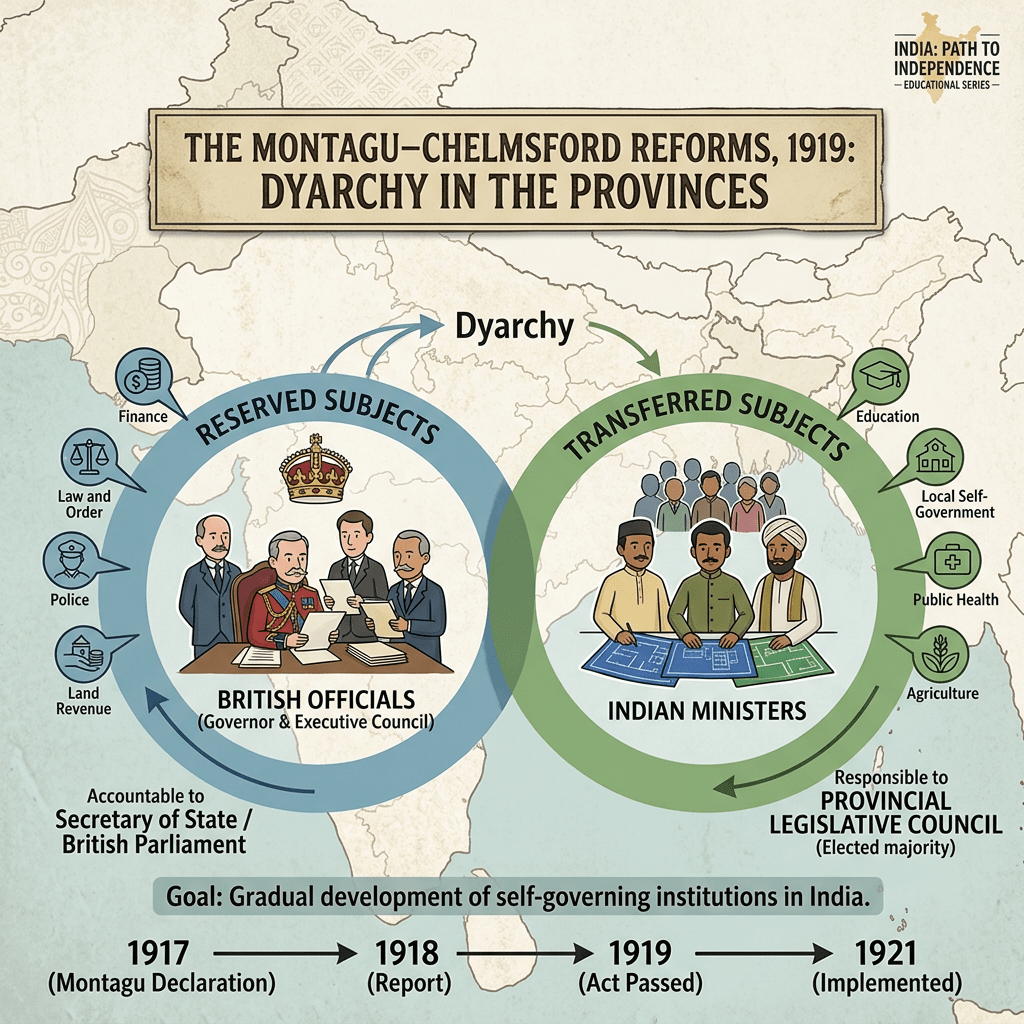
The Montagu-Chelmsford Reforms (Government of India Act, 1919) introduced dyarchy in provinces but are also remembered for consolidating and extending communal representation.
The assertion states that the roots of community-based political alliances in Indian politics can be traced back to the very structure of these reforms.
Analysis of Statements
| Statement | Content | Status | How it Supports the Assertion |
|---|---|---|---|
| 1 | Reforms retained and extended the principle of separate electorates | Correct | The 1909 system was not only retained but extended to Sikhs, Indian Christians, Anglo-Indians, and Europeans. This institutionalized communal electorates. |
| 2 | Separate electorates were supposed to counter Indian nationalism, which was growing stronger | Correct | After the rise of Extremists, Home Rule Movement, and Lucknow Pact (1916), the British used separate electorates as a divide-and-rule tool to weaken united Indian nationalism. |
| 3 | Deprived classes rallied around the favours inherent in separate electorates | Correct | Separate electorates created reserved seats and weightage, encouraging minority/deprived groups to organize politically on communal lines to secure benefits. This fostered identity-based political alliances. |
All three statements correctly support the assertion.
Why Montagu-Chelmsford Reforms Promoted Communal Politics
1. Retention & Extension of Separate Electorates
- Morley-Minto Reforms (1909) had introduced separate electorates for Muslims.
- The 1919 Reforms extended this to:
- Sikhs
- Indian Christians
- Anglo-Indians
- Europeans
- This made religion and community the basis of political representation.
2. British Strategy to Counter Nationalism
- By 1919, Indian nationalism had become stronger (Home Rule Leagues, Lucknow Pact unity between Congress and Muslim League).
- The British deliberately promoted communal electorates to keep Indians divided along religious lines.
- This prevented the emergence of a united national political platform.
3. Creation of Community-Based Political Mobilization
- Separate electorates gave weightage and reserved seats to certain communities.
- Leaders began to appeal to narrow communal interests rather than broader national issues.
- This laid the foundation for future communal political alliances and the eventual demand for Pakistan.
Long-Term Impact (High-Yield for UPSC)
| Development | Connection with 1919 Reforms |
|---|---|
| Rise of Communal Politics | Institutionalized by separate electorates |
| Muslim League’s growth | Benefited from separate electorates |
| Demand for Pakistan | Logical outcome of communal representation |
| Weakening of united nationalism | Divide-and-rule through communal electorates |
Visual: Montagu-Chelmsford Reforms 1919
Montagu-Chelmsford Reforms (Government of India Act, 1919) — A landmark that introduced dyarchy but also deepened communal divisions through separate electorates.
UPSC Quick Revision Points
- 1909 (Morley-Minto): Introduced separate electorates for Muslims.
- 1919 (Montagu-Chelmsford): Retained + Extended separate electorates (to Sikhs, Christians, etc.).
- 1935 (Government of India Act): Further extended communal representation.
- The system continued till independence and became a major factor in the Partition of India.
Pro Tip:
In questions on separate electorates, remember the sequence:
1909 → Introduced → 1919 → Extended → 1935 → Further Expanded
Why This Question Matters for UPSC CSE 2026
- Tests understanding of British divide-and-rule policy through constitutional reforms.
- Important for Constitutional Development + Rise of Communalism.
- Frequently asked in Prelims (assertion-reason or statement-based questions).
- Helps in Mains answers on causes of Partition and failure of national unity.
CrackTarget One-Line Revision:
“Montagu-Chelmsford Reforms (1919) retained & extended separate electorates to weaken growing Indian nationalism and encouraged community-based political mobilization.”

Leave a comment