
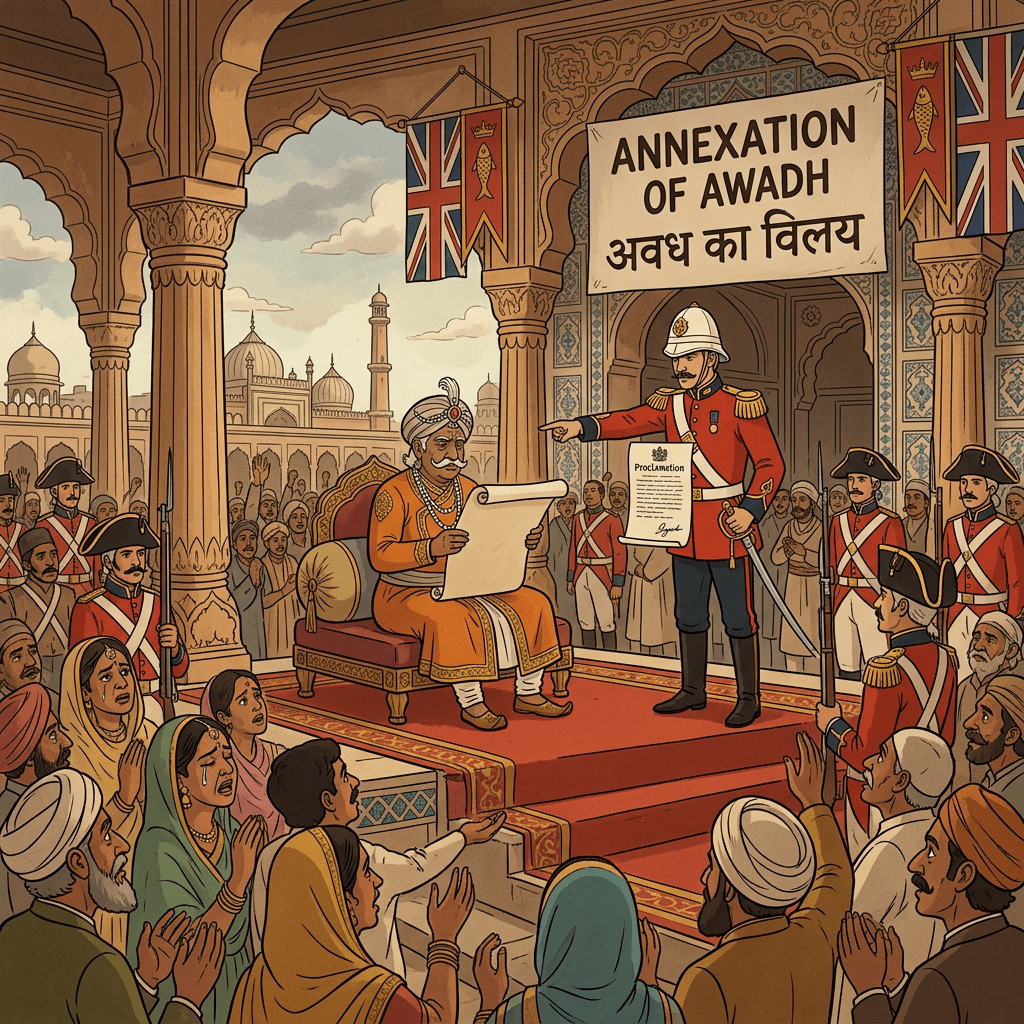
✅ UPSC CSE 2026 | Modern History – Revolt of 1857 (Awadh Annexation)
Question:
Consider the following statements regarding the British policy in Awadh immediately after its annexation in 1856:
- The taluqdars were dispossessed of their estates but allowed to retain their arms and forts.
- A Summary Revenue Settlement was made in 1856 assuming that the taluqdars were outsiders.
- The British believed in taking revenue directly from the peasants by removing the taluqdars.
Which of the statements given above is/are correct?
(a) 2 and 3 only
(b) 1 and 3 only
(c) 1, 2 and 3
(d) 2 only
✅ Correct Answer: (a) 2 and 3 only
Detailed Explanation (Accurate | NCERT + Standard Sources)
Awadh was annexed by the British in February 1856 by Lord Dalhousie on the pretext of misgovernment (not Doctrine of Lapse). This annexation became one of the major causes of the Revolt of 1857.
Analysis of Statements
| Statement | Content | Status | Explanation |
|---|---|---|---|
| 1 | Taluqdars were dispossessed but allowed to retain arms and forts | Incorrect | Taluqdars were dispossessed of estates. Their forts were destroyed and they were disarmed. They were not allowed to retain arms and forts. |
| 2 | Summary Revenue Settlement (1856) assumed taluqdars were outsiders | Correct | The British viewed taluqdars as interlopers who had grabbed land through force and fraud. The settlement aimed to remove them. |
| 3 | British wanted to collect revenue directly from peasants by removing taluqdars | Correct | The policy was to eliminate intermediaries and establish a direct link with cultivators (similar to Ryotwari spirit). |
British Policy in Awadh After Annexation (1856)
1. Dispossession of Taluqdars
- Taluqdars (large landholders) controlled nearly 67% of villages in Awadh before annexation.
- After 1856, they were systematically dispossessed of their estates.
- Their forts were demolished and they were disarmed.
- This created massive resentment among the taluqdari class, who later became active leaders in the 1857 Revolt (e.g., Begum Hazrat Mahal, Maulvi Ahmadullah Shah).
2. Summary Settlement of 1856
- Also called the First Revenue Settlement of Awadh.
- Based on the assumption that taluqdars were outsiders/interlopers with no hereditary rights.
- The British tried to settle revenue directly with village communities or actual proprietors.
- Result: Taluqdars’ control reduced from 67% to 38% of villages.
- This policy caused widespread agrarian distress and became a major cause of the Revolt of 1857 in Awadh.
3. Direct Revenue from Peasants
- The British wanted to bypass intermediaries (taluqdars) and collect land revenue directly from peasants.
- This was part of their broader policy of creating a class of loyal peasant proprietors directly under British control.
- However, in practice, it led to confusion, over-assessment, and peasant discontent.
Why This Policy Backfired (High-Yield Point)
- The Summary Settlement created widespread resentment among:
- Taluqdars (lost land, forts, and power)
- Peasants (faced higher demands and rigid collection)
- Sepoys (many from Awadh were affected as their families lost land)
- This turned Awadh into one of the most active centres of the 1857 Revolt.
Quick Revision Table
| Aspect | Pre-Annexation (Nawabi Rule) | Post-Annexation (British 1856) |
|---|---|---|
| Taluqdars’ Position | Powerful intermediaries | Largely dispossessed & disarmed |
| Forts & Arms | Retained by taluqdars | Destroyed / Confiscated |
| Revenue System | Taluqdari system | Summary Settlement (direct with peasants) |
| British Assumption | Taluqdars as local chiefs | Taluqdars as outsiders/interlopers |
| Impact on 1857 Revolt | – | Major cause of participation in Awadh |
UPSC Strategy & Common Traps
- Statement 1 is the trap. Many students think taluqdars were allowed to keep arms and forts. But standard sources clearly state forts were destroyed and they were disarmed.
- Always remember: Summary Settlement of 1856 = Anti-taluqdar policy.
- Link this topic with:
- Causes of Revolt of 1857 (Awadh annexation)
- Role of taluqdars in 1857
- Difference between Permanent Settlement, Ryotwari, and Summary Settlement
Pro Tip:
In questions on Awadh 1856, the keywords are:
- Dispossession of taluqdars
- Summary Settlement
- Direct revenue from peasants
- Destruction of forts
Why This Question Matters for UPSC CSE 2026
- Direct from Revolt of 1857 (one of the most important topics).
- Tests understanding of British land revenue policies and their socio-political impact.
- Frequently asked in Prelims (statement-based questions on 1857 causes).
- Helps in Mains answers on agrarian causes of the Revolt.
CrackTarget One-Line Revision:
“After Awadh’s annexation (1856), taluqdars were dispossessed + disarmed, forts destroyed. Summary Settlement assumed they were outsiders. British wanted direct revenue from peasants.”

Leave a comment