
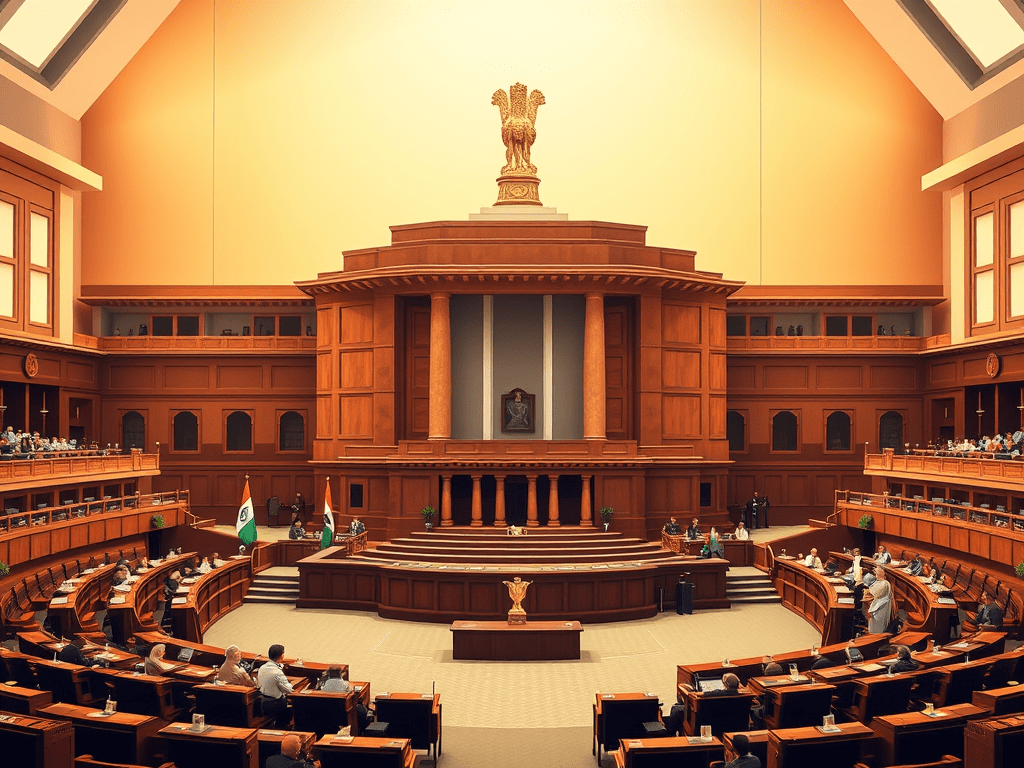
Detailed Study Note: Structure of the Indian Parliament
Introduction
The Indian Parliament is the supreme legislative body of India, responsible for making laws, approving budgets, and overseeing the government’s work. It is a bicameral legislature, meaning it has two houses: the Lok Sabha (House of the People) and the Rajya Sabha (Council of States). The structure is outlined in the Constitution of India under Part V (Articles 79–122). Understanding the composition, roles, and functions of these houses, along with their presiding officers, is crucial for the SSA/UDC exam, as it forms the foundation for questions on parliamentary procedure.
Key Components of the Indian Parliament
- President of India:
- The President is an integral part of Parliament, though not a member of either house.
- Role:
- Summons and prorogues Parliament sessions.
- Approves or returns bills passed by both houses (except Money Bills).
- Addresses the joint session at the start of each year’s first session.
- Can dissolve the Lok Sabha (e.g., for early elections).
- Example: The President gives assent to bills to make them laws.
- Lok Sabha (House of the People):
- Composition:
- Maximum strength: 552 members (530 from states, 20 from Union Territories, 2 nominated by the President for Anglo-Indians, if needed).
- Current strength (2025): 543 elected + up to 2 nominated (though nomination is rarely used now).
- Members are elected directly by the people through general elections every 5 years.
- Eligibility:
- Minimum age: 25 years.
- Must be an Indian citizen.
- Tenure: 5 years, unless dissolved earlier by the President.
- Key Functions:
- Passes laws on Union and Concurrent Lists.
- Approves the Union Budget and Money Bills (exclusive power).
- Exercises control over the executive through questions, motions, and no-confidence votes.
- Presiding Officer: The Speaker (assisted by the Deputy Speaker).
- Speaker’s Role:
- Conducts Lok Sabha proceedings.
- Maintains discipline and decorum.
- Decides on Money Bills and disqualifications under the Anti-Defection Law (10th Schedule).
- Example: The Speaker decides if a bill is a Money Bill, which Rajya Sabha cannot reject.
- Speaker’s Role:
- Composition:
- Rajya Sabha (Council of States):
- Composition:
- Maximum strength: 250 members (238 elected, 12 nominated by the President for expertise in fields like arts, science, or social service).
- Current strength (2025): 233 elected + 12 nominated.
- Members are elected indirectly by state and Union Territory legislatures using proportional representation (single transferable vote).
- Eligibility:
- Minimum age: 30 years.
- Must be an Indian citizen.
- Tenure: Permanent body, not dissolved; one-third of members retire every 2 years (6-year term per member).
- Key Functions:
- Reviews and suggests changes to bills passed by Lok Sabha (except Money Bills).
- Can initiate non-Money Bills.
- Represents states’ interests in federal matters.
- Has special powers (e.g., passing a resolution under Article 249 to allow Parliament to legislate on State List subjects).
- Presiding Officer: The Chairman (Vice President of India), assisted by the Deputy Chairman.
- Chairman’s Role:
- Conducts Rajya Sabha proceedings.
- Maintains order but has no role in Money Bill decisions.
- Example: The Vice President chairs Rajya Sabha but cannot vote unless there’s a tie.
- Chairman’s Role:
- Composition:
- Key Features of the Structure:
- Bicameralism: Balances representation of people (Lok Sabha) and states (Rajya Sabha).
- Sessions: Parliament meets in three main sessions—Budget (Feb–May), Monsoon (Jul–Aug), and Winter (Nov–Dec)—summoned by the President.
- Joint Sitting: Called by the President (under Article 108) to resolve disagreements between houses (except on Money Bills). Presided by the Speaker.
- Committees: Support Parliament’s work (e.g., Public Accounts Committee, Standing Committees).
- Example: A joint sitting resolved the deadlock on the Dowry Prohibition Bill in 1961.
- Parliamentary Privileges:
- Members enjoy freedoms (e.g., freedom of speech in Parliament) and immunities (e.g., no arrest during sessions, subject to conditions).
- Example: MPs can debate freely without fear of legal action for their statements in Parliament.
- Key Terms Related to Structure:
- Quorum: Minimum number of members needed for a sitting (1/10th of total strength).
- Adjournment: Temporary pause in a session.
- Prorogation: End of a session by the President.
- Dissolution: End of Lok Sabha’s term, leading to elections (Rajya Sabha is never dissolved).
100 MCQs on Structure of the Indian Parliament
Below are 100 MCQs divided into Easy (40 questions), Moderate (40 questions), and Hard (20 questions) levels, with answers and brief explanations. These align with the SSA/UDC exam’s focus on simple parliamentary concepts.
Easy Level MCQs (40 Questions)
- Q: What is the Indian Parliament also known as?
- A) Sansad B) Vidhan Sabha C) Lok Pal D) Nyaya Panchayat
- A: A) Sansad
- Explanation: The Indian Parliament is called “Sansad,” meaning assembly, in Hindi.
- Q: How many houses does the Indian Parliament have?
- A) One B) Two C) Three D) Four
- A: B) Two
- Explanation: It is bicameral, with Lok Sabha and Rajya Sabha.
- Q: Which house is known as the House of the People?
- A) Rajya Sabha B) Lok Sabha C) Vidhan Sabha D) Council of Ministers
- A: B) Lok Sabha
- Explanation: Lok Sabha represents the people, elected directly by voters.
- Q: Who is the presiding officer of the Lok Sabha?
- A) President B) Speaker C) Prime Minister D) Vice President
- A: B) Speaker
- Explanation: The Speaker conducts Lok Sabha proceedings.
- Q: Who chairs the Rajya Sabha?
- A) Speaker B) Vice President C) Prime Minister D) Chief Justice
- A: B) Vice President
- Explanation: The Vice President is the ex-officio Chairman of Rajya Sabha.
- Q: What is the maximum strength of the Lok Sabha?
- A) 500 B) 552 C) 250 D) 300
- A: B) 552
- Explanation: Lok Sabha can have up to 552 members (530 states, 20 UTs, 2 nominated).
- Q: What is the maximum strength of the Rajya Sabha?
- A) 250 B) 552 C) 300 D) 200
- A: A) 250
- Explanation: Rajya Sabha can have up to 250 members (238 elected, 12 nominated).
- Q: Who elects Lok Sabha members?
- A) State legislatures B) People of India C) President D) Governors
- A: B) People of India
- Explanation: Lok Sabha members are elected directly by voters.
- Q: Who elects Rajya Sabha members?
- A) People directly B) State legislatures C) President D) Lok Sabha
- A: B) State legislatures
- Explanation: Rajya Sabha members are elected indirectly by state and UT legislatures.
- Q: What is the tenure of a Lok Sabha member?
- A) 6 years B) 5 years C) 4 years D) 3 years
- A: B) 5 years
- Explanation: Lok Sabha’s term is 5 years unless dissolved earlier.
- Q: What is the tenure of a Rajya Sabha member?
- A) 5 years B) 6 years C) 4 years D) Permanent
- A: B) 6 years
- Explanation: Each member serves 6 years; one-third retire every 2 years.
- Q: Who can dissolve the Lok Sabha?
- A) Speaker B) President C) Prime Minister D) Vice President
- A: B) President
- Explanation: The President can dissolve Lok Sabha for early elections.
- Q: Is the Rajya Sabha subject to dissolution?
- A) Yes B) No C) Sometimes D) Only during emergency
- A: B) No
- Explanation: Rajya Sabha is a permanent body; it cannot be dissolved.
- Q: Who nominates members to the Rajya Sabha?
- A) Prime Minister B) President C) Speaker D) Chief Justice
- A: B) President
- Explanation: The President nominates 12 members for expertise.
- Q: What is the minimum age to be a Lok Sabha member?
- A) 21 B) 25 C) 30 D) 35
- A: B) 25
- Explanation: Lok Sabha members must be at least 25 years old.
- Q: What is the minimum age to be a Rajya Sabha member?
- A) 25 B) 30 C) 35 D) 40
- A: B) 30
- Explanation: Rajya Sabha members must be at least 30 years old.
- Q: Who assists the Speaker in the Lok Sabha?
- A) Deputy Speaker B) Vice President C) Deputy Chairman D) Prime Minister
- A: A) Deputy Speaker
- Explanation: The Deputy Speaker supports the Speaker in conducting proceedings.
- Q: Who assists the Chairman in the Rajya Sabha?
- A) Deputy Speaker B) Deputy Chairman C) Prime Minister D) President
- A: B) Deputy Chairman
- Explanation: The Deputy Chairman assists the Vice President.
- Q: Which house has exclusive power over Money Bills?
- A) Rajya Sabha B) Lok Sabha C) Both D) Neither
- A: B) Lok Sabha
- Explanation: Lok Sabha has sole authority to pass Money Bills.
- Q: Who summons Parliament sessions?
- A) Speaker B) President C) Prime Minister D) Vice President
- A: B) President
- Explanation: The President calls Parliament to meet.
- Q: What is the term for ending a Parliament session?
- A) Adjournment B) Prorogation C) Dissolution D) Suspension
- A: B) Prorogation
- Explanation: Prorogation ends a session, ordered by the President.
- Q: What is the term for a temporary pause in a session?
- A) Prorogation B) Dissolution C) Adjournment D) Closure
- A: C) Adjournment
- Explanation: Adjournment pauses proceedings temporarily.
- Q: Who can call a joint sitting of Parliament?
- A) Speaker B) President C) Prime Minister D) Vice President
- A: B) President
- Explanation: The President calls a joint sitting under Article 108.
- Q: Who presides over a joint sitting of Parliament?
- A) President B) Speaker C) Vice President D) Chief Justice
- A: B) Speaker
- Explanation: The Lok Sabha Speaker presides over joint sittings.
- Q: Which house represents the states in Parliament?
- A) Lok Sabha B) Rajya Sabha C) Both D) Neither
- A: B) Rajya Sabha
- Explanation: Rajya Sabha represents state interests.
- Q: How many Anglo-Indian members can the President nominate to Lok Sabha?
- A) 1 B) 2 C) 3 D) 4
- A: B) 2
- Explanation: Up to 2 Anglo-Indian members can be nominated (rarely used now).
- Q: What is the quorum for a Lok Sabha sitting?
- A) 1/5th B) 1/10th C) 1/3rd D) 1/4th
- A: B) 1/10th
- Explanation: One-tenth of members are needed for a valid sitting.
- Q: What is the quorum for a Rajya Sabha sitting?
- A) 1/10th B) 1/5th C) 1/3rd D) 1/2
- A: A) 1/10th
- Explanation: Same as Lok Sabha, one-tenth is the quorum.
- Q: Who decides if a bill is a Money Bill?
- A) President B) Speaker C) Vice President D) Finance Minister
- A: B) Speaker
- Explanation: The Speaker’s decision on Money Bills is final.
- Q: Can Rajya Sabha reject a Money Bill?
- A) Yes B) No C) Sometimes D) Only with approval
- A: B) No
- Explanation: Rajya Sabha can suggest changes but cannot reject Money Bills.
- Q: Which article defines the composition of Parliament?
- A) Article 79 B) Article 108 C) Article 356 D) Article 370
- A: A) Article 79
- Explanation: Article 79 outlines Parliament’s structure.
- Q: What is the role of the President in Parliament?
- A) Voting member B) Part of Parliament C) Only ceremonial D) Lawmaker
- A: B) Part of Parliament
- Explanation: The President is part of Parliament but does not vote.
- Q: How often are Lok Sabha elections held?
- A) Every 4 years B) Every 5 years C) Every 6 years D) Every 3 years
- A: B) Every 5 years
- Explanation: General elections occur every 5 years unless dissolved earlier.
- Q: How many members are elected to Rajya Sabha from states?
- A) 238 B) 12 C) 250 D) 543
- A: A) 238
- Explanation: 238 members are elected, 12 are nominated.
- Q: What is the term for ending the Lok Sabha’s term?
- A) Adjournment B) Prorogation C) Dissolution D) Suspension
- A: C) Dissolution
- Explanation: Dissolution ends Lok Sabha’s term, leading to elections.
- Q: Who can vote in case of a tie in Rajya Sabha?
- A) Speaker B) Vice President C) Deputy Chairman D) Prime Minister
- A: B) Vice President
- Explanation: The Chairman (Vice President) casts a tie-breaking vote.
- Q: Which house is called the Lower House?
- A) Rajya Sabha B) Lok Sabha C) Both D) Neither
- A: B) Lok Sabha
- Explanation: Lok Sabha is the Lower House, Rajya Sabha is the Upper House.
- Q: Which house is called the Upper House?
- A) Lok Sabha B) Rajya Sabha C) Both D) Neither
- A: B) Rajya Sabha
- Explanation: Rajya Sabha is the Upper House, representing states.
- Q: Who conducts Lok Sabha elections?
- A) President B) Election Commission C) Speaker D) Prime Minister
- A: B) Election Commission
- Explanation: The Election Commission organizes elections.
- Q: What is the minimum citizenship requirement for MPs?
- A) Indian citizen B) NRI C) Foreign national D) Dual citizen
- A: A) Indian citizen
- Explanation: MPs must be Indian citizens.
Moderate Level MCQs (40 Questions)
- Q: Under which article can the President summon a joint sitting?
- A) Article 79 B) Article 108 C) Article 123 D) Article 356
- A: B) Article 108
- Explanation: Article 108 allows the President to call a joint sitting for deadlocks.
- Q: How many nominated members are there in the current Rajya Sabha (2025)?
- A) 10 B) 12 C) 14 D) 8
- A: B) 12
- Explanation: 12 members are nominated by the President.
- Q: How many members are elected to Lok Sabha from Union Territories?
- A) 20 B) 30 C) 10 D) 25
- A: A) 20
- Explanation: Up to 20 members represent UTs in Lok Sabha.
- Q: What is the role of the Speaker in a Money Bill?
- A) Suggests amendments B) Certifies it as a Money Bill C) Rejects it D) Votes on it
- A: B) Certifies it as a Money Bill
- Explanation: The Speaker’s certification is final for Money Bills.
- Q: How often do one-third of Rajya Sabha members retire?
- A) Every year B) Every 2 years C) Every 3 years D) Every 4 years
- A: B) Every 2 years
- Explanation: One-third of members retire biennially.
- Q: Who can disqualify an MP under the Anti-Defection Law?
- A) President B) Speaker/Chairman C) Prime Minister D) Supreme Court
- A: B) Speaker/Chairman
- Explanation: The Speaker (Lok Sabha) or Chairman (Rajya Sabha) decides on defections.
- Q: Which schedule governs the Anti-Defection Law?
- A) 7th Schedule B) 10th Schedule C) 9th Schedule D) 5th Schedule
- A: B) 10th Schedule
- Explanation: The 10th Schedule deals with defection rules.
- Q: What is the minimum number of members needed for a Lok Sabha quorum?
- A) 55 B) 100 C) 25 D) 75
- A: A) 55
- Explanation: 1/10th of 552 ≈ 55 members.
- Q: What is the minimum number of members needed for a Rajya Sabha quorum?
- A) 25 B) 50 C) 75 D) 100
- A: A) 25
- Explanation: 1/10th of 250 ≈ 25 members.
- Q: Which house can initiate a non-Money Bill?
- A) Lok Sabha only B) Rajya Sabha only C) Both D) Neither
- A: C) Both
- Explanation: Both houses can introduce non-Money Bills.
- Q: What happens if Rajya Sabha suggests amendments to a Money Bill?
- A) Lok Sabha must accept them B) Lok Sabha can reject them C) Bill is stalled D) President decides
- A: B) Lok Sabha can reject them
- Explanation: Lok Sabha has the final say on Money Bills.
- Q: Who addresses Parliament at the start of the first session each year?
- A) Prime Minister B) President C) Speaker D) Vice President
- A: B) President
- Explanation: The President delivers the address under Article 87.
- Q: Which house has more legislative power over financial matters?
- A) Rajya Sabha B) Lok Sabha C) Both equally D) Neither
- A: B) Lok Sabha
- Explanation: Lok Sabha has exclusive powers over Money Bills.
- Q: What is the maximum gap allowed between two Parliament sessions?
- A) 3 months B) 6 months C) 9 months D) 12 months
- A: B) 6 months
- Explanation: Sessions must be held within 6 months (Article 85).
- Q: Who can appoint the Deputy Speaker of Lok Sabha?
- A) President B) Speaker C) Lok Sabha members D) Prime Minister
- A: C) Lok Sabha members
- Explanation: Lok Sabha elects the Deputy Speaker.
- Q: Who can appoint the Deputy Chairman of Rajya Sabha?
- A) President B) Vice President C) Rajya Sabha members D) Prime Minister
- A: C) Rajya Sabha members
- Explanation: Rajya Sabha elects the Deputy Chairman.
- Q: Which house debates the Union Budget first?
- A) Rajya Sabha B) Lok Sabha C) Both simultaneously D) Joint sitting
- A: B) Lok Sabha
- Explanation: Lok Sabha discusses Money Bills first.
- Q: What is the term for a sitting of both houses together?
- A) Joint session B) Special session C) Emergency session D) Combined session
- A: A) Joint session
- Explanation: Called under Article 108 for deadlocks.
- Q: Which house has a longer tenure for its members?
- A) Lok Sabha B) Rajya Sabha C) Both equal D) Depends on election
- A: B) Rajya Sabha
- Explanation: Rajya Sabha members serve 6 years, Lok Sabha 5 years.
- Q: Who can nominate members for Anglo-Indian representation?
- A) Speaker B) President C) Prime Minister D) Governor
- A: B) President
- Explanation: The President nominates up to 2 Anglo-Indian members.
- Q: Which house is more powerful in passing ordinary bills?
- A) Lok Sabha B) Rajya Sabha C) Both equal D) Neither
- A: C) Both equal
- Explanation: Both houses have equal powers for non-Money Bills.
- Q: What is the role of the President in passing a bill?
- A) Drafts the bill B) Gives assent C) Amends the bill D) Rejects always
- A: B) Gives assent
- Explanation: The President’s assent makes a bill a law.
- Q: How many states elect members to the Rajya Sabha?
- A) 28 B) 29 C) 27 D) 30
- A: A) 28
- Explanation: All 28 states elect members based on population.
- Q: What is the voting system for Rajya Sabha elections?
- A) First-past-the-post B) Proportional representation C) Direct voting D) Random selection
- A: B) Proportional representation
- Explanation: Uses single transferable vote system.
- Q: Who can remove the Speaker of Lok Sabha?
- A) President B) Lok Sabha members C) Prime Minister D) Supreme Court
- A: B) Lok Sabha members
- Explanation: Lok Sabha can pass a resolution to remove the Speaker.
- Q: Who can remove the Deputy Chairman of Rajya Sabha?
- A) President B) Rajya Sabha members C) Vice President D) Prime Minister
- A: B) Rajya Sabha members
- Explanation: Rajya Sabha can remove the Deputy Chairman.
- Q: Which house can initiate a no-confidence motion?
- A) Rajya Sabha B) Lok Sabha C) Both D) Neither
- A: B) Lok Sabha
- Explanation: Only Lok Sabha can move a no-confidence motion against the government.
- Q: What is the minimum number of MPs needed to move a no-confidence motion?
- A) 50 B) 100 C) 25 D) 75
- A: A) 50
- Explanation: At least 50 MPs must support the motion.
- Q: Which house has a role in electing the President of India?
- A) Lok Sabha only B) Rajya Sabha only C) Both D) Neither
- A: C) Both
- Explanation: Both houses’ elected members vote in the presidential election.
- Q: What is the term for MPs’ freedom of speech in Parliament?
- A) Privilege B) Right C) Immunity D) Duty
- A: A) Privilege
- Explanation: MPs have freedom of speech as a parliamentary privilege.
- Q: Can the President attend Parliament sessions as a member?
- A) Yes B) No C) Sometimes D) Only in joint sittings
- A: B) No
- Explanation: The President is part of Parliament but not a voting member.
- Q: Which house has a panel of chairpersons to assist the Speaker?
- A) Lok Sabha B) Rajya Sabha C) Both D) Neither
- A: A) Lok Sabha
- Explanation: Lok Sabha has a panel to conduct proceedings in the Speaker’s absence.
- Q: Which house has a panel of chairpersons to assist the Chairman?
- A) Lok Sabha B) Rajya Sabha C) Both D) Neither
- A: B) Rajya Sabha
- Explanation: Rajya Sabha has a panel for the Chairman’s absence.
- Q: What is the term for the official record of Parliament proceedings?
- A) Hansard B) Gazette C) Journal D) Bulletin
- A: A) Hansard
- Explanation: Hansard records debates and proceedings.
- Q: Which house has more members?
- A) Lok Sabha B) Rajya Sabha C) Equal D) Varies
- A: A) Lok Sabha
- Explanation: Lok Sabha (552 max) has more members than Rajya Sabha (250 max).
- Q: Who certifies the Union Budget as a Money Bill?
- A) President B) Speaker C) Finance Minister D) Prime Minister
- A: B) Speaker
- Explanation: The Speaker certifies financial bills as Money Bills.
- Q: How long can Rajya Sabha delay a Money Bill?
- A) 14 days B) 30 days C) 60 days D) 90 days
- A: A) 14 days
- Explanation: Rajya Sabha must return Money Bills within 14 days.
- Q: Which house can pass a vote of thanks for the President’s address?
- A) Lok Sabha only B) Rajya Sabha only C) Both D) Neither
- A: C) Both
- Explanation: Both houses pass a vote of thanks.
- Q: Who can suspend an MP for misconduct in Lok Sabha?
- A) President B) Speaker C) Prime Minister D) Vice President
- A: B) Speaker
- Explanation: The Speaker maintains discipline in Lok Sabha.
- Q: Who can suspend an MP for misconduct in Rajya Sabha?
- A) Speaker B) Vice President C) Prime Minister D) President
- A: B) Vice President
- Explanation: The Chairman (Vice President) maintains discipline in Rajya Sabha.
Hard Level MCQs (20 Questions)
- Q: Under which article can Rajya Sabha pass a resolution to legislate on State List subjects?
- A) Article 249 B) Article 108 C) Article 356 D) Article 370
- A: A) Article 249
- Explanation: Article 249 allows Rajya Sabha to enable Parliament to legislate on state subjects.
- Q: What majority is needed for a Rajya Sabha resolution under Article 249?
- A) Simple majority B) Two-thirds majority C) Absolute majority D) Special majority
- A: B) Two-thirds majority
- Explanation: A two-thirds majority of members present and voting is required.
- Q: Which committee assists Parliament in financial oversight?
- A) Public Accounts Committee B) Estimates Committee C) Both D) Neither
- A: C) Both
- Explanation: Both committees oversee financial matters, chaired by Lok Sabha members.
- Q: Who was the first Speaker of Lok Sabha?
- A) G.V. Mavalankar B) M.A. Ayyangar C) Sardar Hukam Singh D) Neelam Sanjiva Reddy
- A: A) G.V. Mavalankar
- Explanation: G.V. Mavalankar was the first Speaker (1952–1956).
- Q: How many joint sittings of Parliament have occurred till 2025?
- A) 2 B) 3 C) 4 D) 5
- A: B) 3
- Explanation: Three joint sittings occurred (e.g., Dowry Prohibition Bill, 1961).
- Q: Which article governs parliamentary privileges?
- A) Article 105 B) Article 108 C) Article 79 D) Article 123
- A: A) Article 105
- Explanation: Article 105 defines MPs’ privileges like freedom of speech.
- Q: What happens if the President returns a non-Money Bill?
- A) Bill lapses B) Houses reconsider C) Bill is passed automatically D) Supreme Court decides
- A: B) Houses reconsider
- Explanation: Both houses must reconsider the bill.
- Q: Which house has no role in amending Money Bills?
- A) Lok Sabha B) Rajya Sabha C) Both D) Neither
- A: B) Rajya Sabha
- Explanation: Rajya Sabha’s amendments are not binding.
- Q: How many readings does a bill undergo in Parliament?
- A) Two B) Three C) Four D) Five
- A: B) Three
- Explanation: Bills pass through First, Second, and Third Readings.
- Q: What is the minimum notice period for moving a resolution to remove the Speaker?
- A) 7 days B) 14 days C) 30 days D) 10 days
- A: B) 14 days
- Explanation: A 14-day notice is required under Lok Sabha rules.
- Q: Which house has a Committee on Public Undertakings?
- A) Lok Sabha B) Rajya Sabha C) Both D) Neither
- A: C) Both
- Explanation: The committee includes members from both houses.
- Q: Who chairs the Public Accounts Committee?
- A) Lok Sabha member B) Rajya Sabha member C) Finance Minister D) President
- A: A) Lok Sabha member
- Explanation: Traditionally, a Lok Sabha member chairs it.
- Q: What is the term for MPs’ immunity from arrest during sessions?
- A) Privilege B) Right C) Exemption D) Duty
- A: A) Privilege
- Explanation: MPs have immunity under parliamentary privileges.
- Q: Which article allows the President to address Parliament?
- A) Article 79 B) Article 87 C) Article 108 D) Article 123
- A: B) Article 87
- Explanation: Article 87 mandates the President’s address.
- Q: How many MPs from Lok Sabha vote in the President’s election?
- A) 543 B) 552 C) 545 D) 530
- A: A) 543
- Explanation: Only elected members (543) vote, not nominated ones.
- Q: What is the role of the Leader of the House in Lok Sabha?
- A) Presides over sessions B) Manages government business C) Decides bills D) Nominates MPs
- A: B) Manages government business
- Explanation: Usually the Prime Minister, coordinates government agenda.
- Q: What is the term for the daily agenda of Parliament?
- A) Order Paper B) List of Business C) Hansard D) Gazette
- A: B) List of Business
- Explanation: Lists questions, bills, and motions for the day.
- Q: Which house can pass a resolution to create a new All-India Service?
- A) Lok Sabha B) Rajya Sabha C) Both D) Neither
- A: B) Rajya Sabha
- Explanation: Under Article 312, Rajya Sabha can create such services.
- Q: What majority is needed for a no-confidence motion to pass?
- A) Simple majority B) Two-thirds majority C) Absolute majority D) Special majority
- A: A) Simple majority
- Explanation: A simple majority of members present and voting is enough.
- Q: Which amendment introduced the Anti-Defection Law? – A) 42nd Amendment B) 52nd Amendment C) 44th Amendment D) 86th Amendment – A: B) 52nd Amendment – Explanation: The 52nd Amendment (1985) added the 10th Schedule.
Preparation Tips for MCQs
- Use Cracktarget: Practice these MCQs using Cracktarget’s MCQ section (cracktarget.com → SSC SSA/UDC → Parliamentary Procedure). Create a quiz with these questions for timed practice.
- Focus Areas: Memorize composition (552, 250), presiding officers (Speaker, Vice President), and key articles (79, 108, 249).
- Negative Marking: Attempt only confident answers to avoid the 0.25-mark penalty.
- Revision: Use flashcards for terms like quorum, prorogation, and privileges.
If this response is truncated due to length, please type “yes” to continue with additional details or clarification. Let me know if you need help organizing these MCQs on Cracktarget’s platform or further notes on related topics!
| Syllabus | Study Material Link |
| Structure of the Indian Parliament | Click Here |
| Sessions of Parliament | Click Here |
| Key Parliamentary Terms | Click Here |
| Guidelines on Noting | Click Here |
| Communication, Forms, Channels, and Procedure | Click here |
| Main Page for SSC Departmental Exam | Click Here |
Provide Phone number to get added in special Telegram Group


Leave a comment