
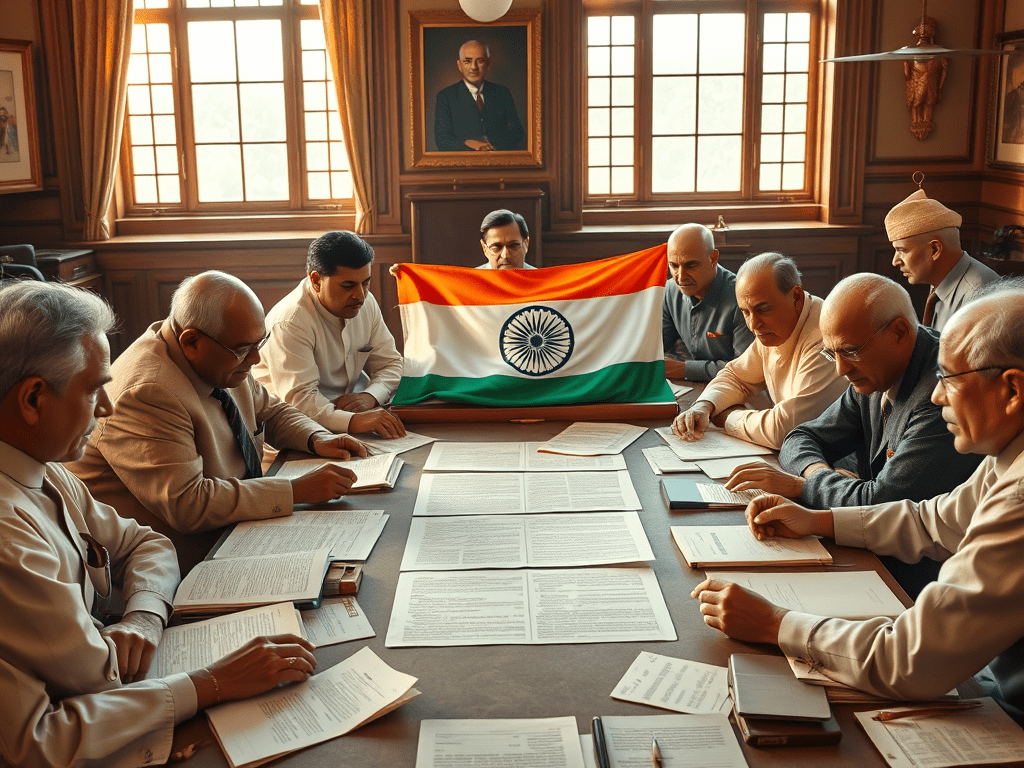
Historical Background and Drafting Process
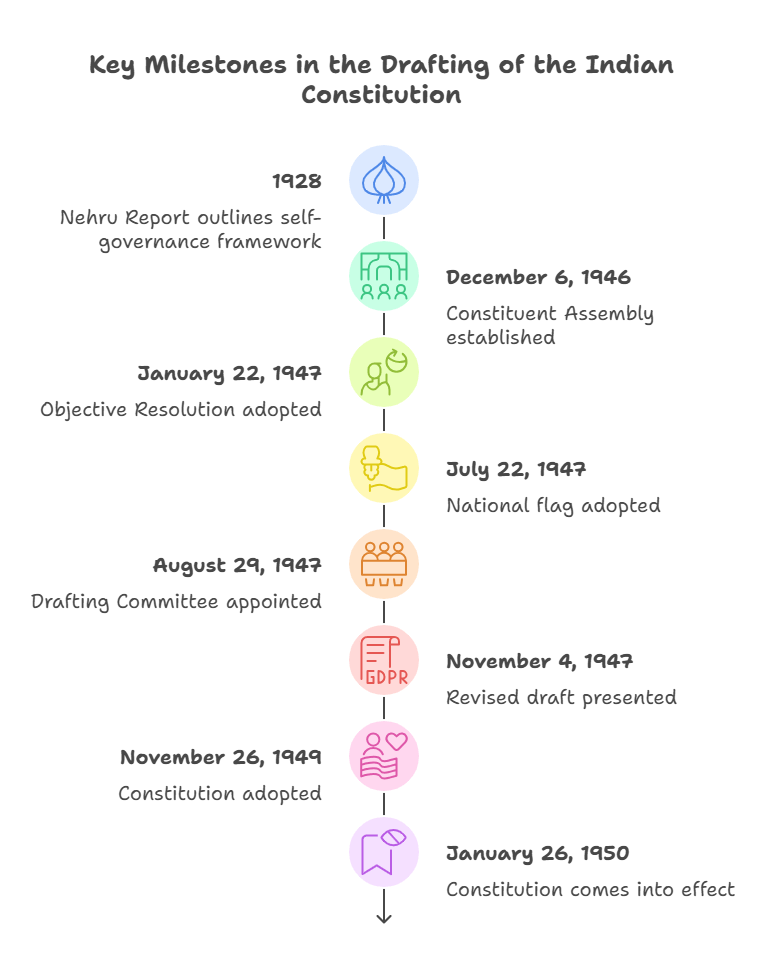
The Constitution of India emerged from the historical context of British colonial rule, which lasted from 1858 to 1947, with India operating as a dominion under the Government of India Act, 1935, and the Indian Independence Act, 1947, until 1950. Early influences included the Nehru Report of 1928, drafted by a committee under Motilal Nehru, which outlined a preliminary framework for self-governance.
The drafting process was undertaken by the Constituent Assembly, established on December 6, 1946, initially comprising 389 members elected by provincial assemblies, later reduced to 299 following the partition of India. The Assembly convened for eleven sessions over 165 days, spanning nearly three years. Key figures included Dr. B. R. Ambedkar, who chaired the Drafting Committee; Jawaharlal Nehru; Rajendra Prasad, the Assembly’s President; and constitutional advisor B. N. Rau. The Drafting Committee, appointed on August 29, 1947, presented a revised draft on November 4, 1947. The Assembly debated and resolved 2,473 out of 7,635 proposed amendments. The Constitution was adopted on November 26, 1949, and came into effect on January 26, 1950, replacing the Government of India Act, 1935. This process incurred a cost of approximately ₹6.4 million and took 2 years, 11 months, and 18 days.
Significant milestones include the first meeting on December 9, 1946; the adoption of the Objective Resolution on January 22, 1947; the national flag’s adoption on July 22, 1947; and the final session on January 24, 1950. The Constitution drew inspiration from various global models, such as the United States (fundamental rights), the United Kingdom (parliamentary system), Canada (federal structure), and Ireland (directive principles).
The Preamble
The Preamble serves as the introductory statement to the Constitution, declaring India a “Sovereign Socialist Secular Democratic Republic.”
It aims to secure justice (social, economic, and political), liberty (of thought, expression, belief, faith, and worship), equality (of status and opportunity), and fraternity (assuring individual dignity and national unity and integrity).
The terms “socialist,” “secular,” and “integrity” were incorporated via the 42nd Amendment Act of 1976.
Derived from Nehru’s Objective Resolution of December 13, 1946, the Preamble embodies the foundational principles and aspirations of the Indian people, emphasizing popular sovereignty and democratic ideals.
Salient Features
The Constitution of India is the world’s longest written national constitution, comprising approximately 145,000 words.
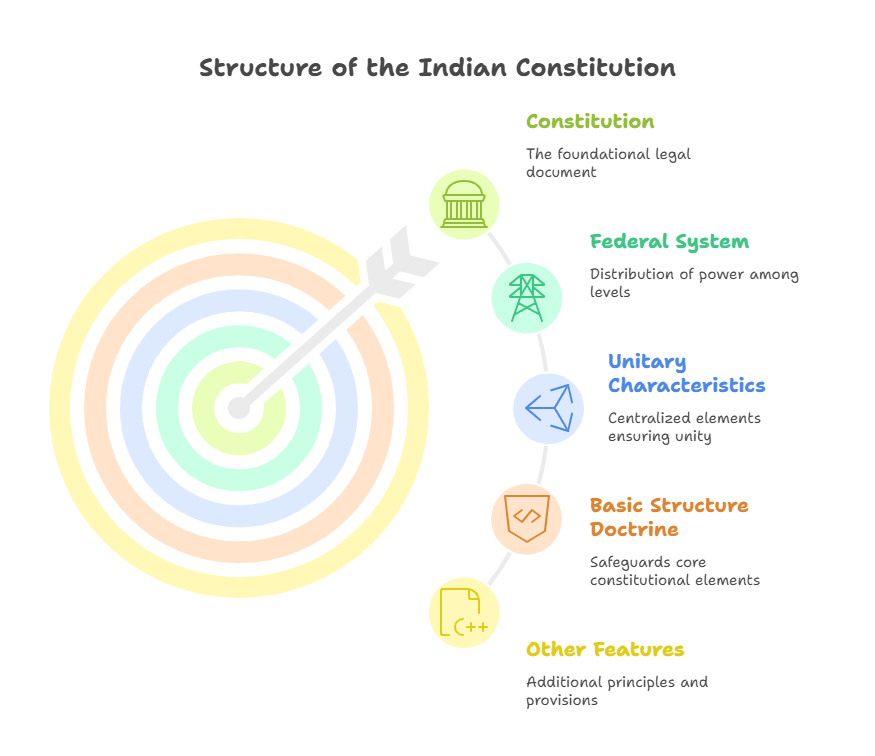
It establishes a federal system with unitary characteristics, featuring a three-tier government (union, state, and local), bicameral legislature at the center, and an independent judiciary. Unitary elements include single citizenship, a strong central government, and integrated judiciary.
It balances rigidity (requiring special majorities for amendments) and flexibility (allowing parliamentary amendments).
The Basic Structure Doctrine, established in the landmark Kesavananda Bharati v. State of Kerala case (1973), safeguards core elements such as supremacy of the Constitution, secularism, federalism, and judicial review from amendment. Other features include secularism, social justice, parliamentary democracy, and provisions for affirmative action.
Structure: Parts, Articles, and Schedules
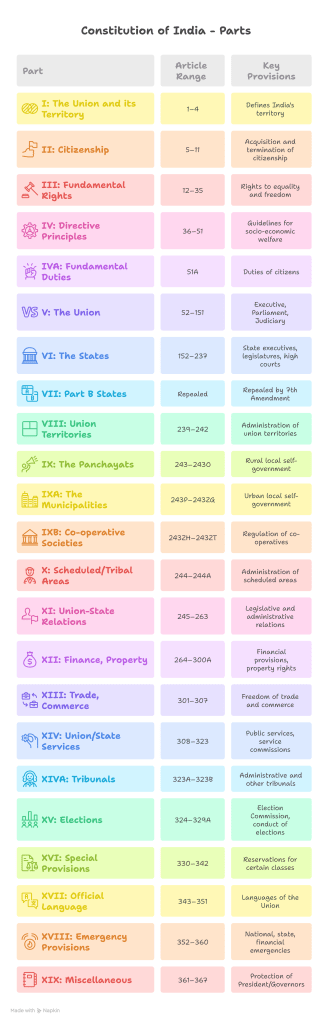
Originally adopted with 395 articles in 22 parts and 8 schedules, the Constitution now contains 470 articles organized into 25 parts, 12 schedules, and 5 appendices, following 106 amendments as of July 2025.
The structure is as follows:
Schedules:
- Allocation of seats in the Council of States.
- Provisions for administration and control of Scheduled Areas and Tribes.
- Forms of oaths and affirmations.
- Allocation of seats in the Rajya Sabha.
- Administration of Scheduled Areas.
- Administration of Tribal Areas in certain states.
- Union List, State List, Concurrent List (division of powers).
- Recognized languages.
- Validation of certain acts and regulations.
- Anti-defection provisions.
- Powers of Panchayats.
- Powers of Municipalities.
The five appendices include additional details on certain provisions.en.
Fundamental Rights
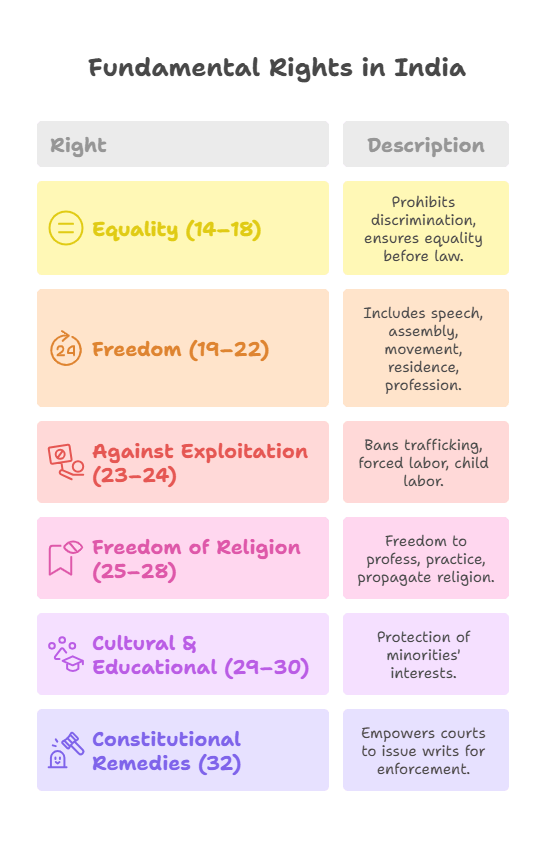
Part III (Articles 12–35) enshrines six categories of justiciable rights enforceable by courts:
Directive Principles of State Policy
Part IV (Articles 36–51) provides non-justiciable guidelines for the state to achieve social and economic democracy, including promotion of welfare, equal pay, education, and environmental protection. These influence policy-making, such as land reforms and education initiatives.
Fundamental Duties
Introduced by the 42nd Amendment (1976) in Article 51A, these include 11 duties such as respecting the Constitution, promoting harmony, protecting the environment, and striving for excellence.
The Union and State Governments
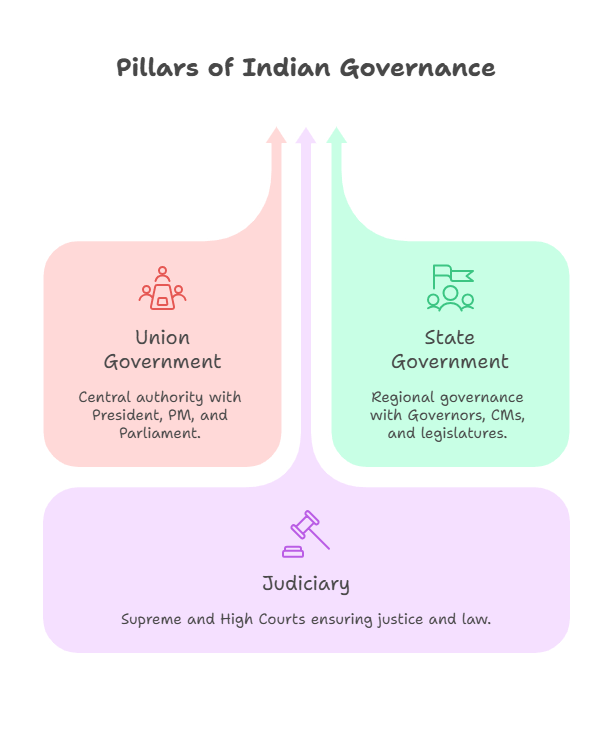
- Union (Part V, Articles 52–151): Comprises the President (elected indirectly), Prime Minister and Council of Ministers, Parliament (Lok Sabha and Rajya Sabha), and Supreme Court.
- States (Part VI, Articles 152–237): Include Governors (appointed by President), Chief Ministers and Councils, state legislatures, and high courts. Provisions allow for new states and union territories.
The Judiciary
An independent judiciary is headed by the Supreme Court (Article 124) with original, appellate, and advisory jurisdiction. High courts (Article 214) oversee state matters, with subordinate courts under their supervision. Judicial review ensures constitutional supremacy.
Emergency Provisions
Part XVIII (Articles 352–360) permits the President to declare national (war/external aggression/internal disturbance), state (failure of constitutional machinery), or financial emergencies, enabling centralized control with safeguards against abuse.
Amendment Process
Article 368 outlines the amendment procedure, requiring a simple majority for ordinary matters or a two-thirds majority in Parliament (plus state ratification for certain changes). As of July 2025, there have been 106 amendments, with the 42nd (1976) being the most comprehensive, often called the “Mini-Constitution.”
Notable amendments include the 1st (1951, restricting freedom of speech),
42nd (1976, adding socialist/secular),
44th (1978, restoring rights),
73rd/74th (1992, local self-government),
and 103rd (2018, economic reservations).
Details : Click Here

Leave a comment