
Introduction to the Role of the Press
The press emerged as a pivotal instrument in India’s struggle for independence from British colonial rule, serving as a medium for disseminating nationalist ideologies, mobilizing public opinion, and fostering a sense of unity among diverse populations. From its inception in the late 18th century, the press facilitated the spread of ideas related to democracy, equality, freedom, and patriotism. It provided a platform for intellectuals, reformers, and political leaders to critique colonial policies, expose injustices, and advocate for social reforms. Despite facing stringent regulations and censorship, such as the Vernacular Press Act of 1878 and the Indian Press Act of 1910, the press adapted by shifting languages or formats to continue its operations. Newspapers in English and vernacular languages connected urban elites with rural masses, amplified movements like Swadeshi and Non-Cooperation, and contributed to the eventual attainment of independence in 1947. Post-independence, the press transitioned into a cornerstone of democratic discourse, though its foundational role during the struggle remains a testament to its influence on national consciousness.
Historical Development of the Press in India
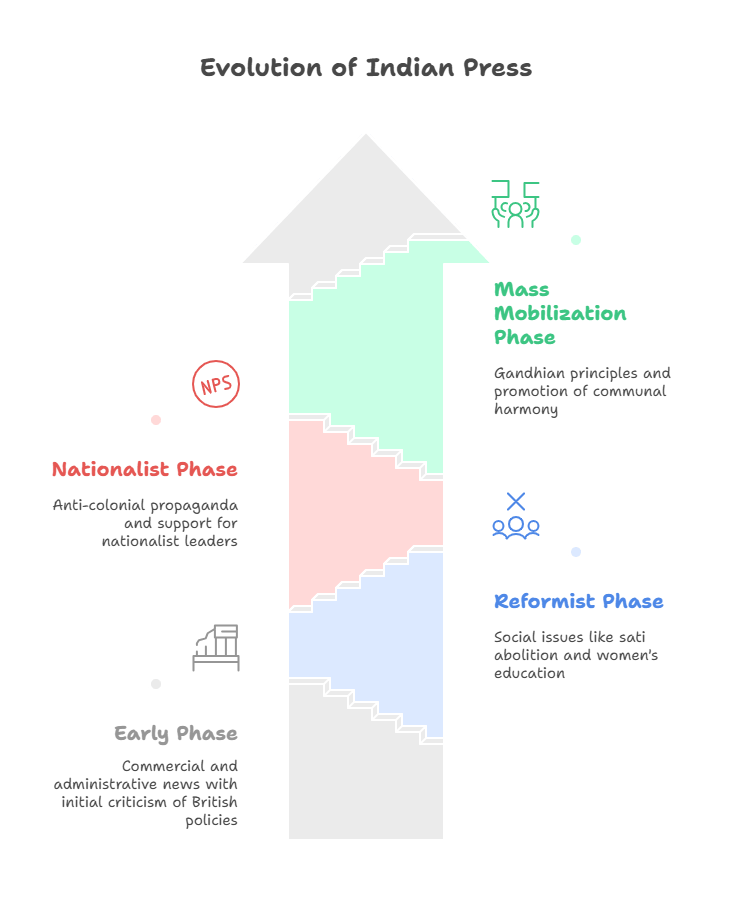
The evolution of the Indian press can be traced through distinct phases:
- Early Phase (1780–1820s): Initiated by European settlers, the press focused on commercial and administrative news but gradually incorporated criticism of British policies. The first newspaper, Bengal Gazette, marked the beginning of journalistic endeavors.
- Reformist Phase (1820s–1870s): Influenced by social reformers like Raja Ram Mohan Roy, publications emphasized social issues such as sati abolition, women’s education, and caste discrimination, laying the groundwork for political awakening.
- Nationalist Phase (1880s–1920s): With the rise of the Indian National Congress, newspapers became tools for anti-colonial propaganda, supporting leaders like Bal Gangadhar Tilak and Mahatma Gandhi.
- Mass Mobilization Phase (1920s–1947): Publications aligned with Gandhian principles of non-violence and civil disobedience, while revolutionary papers inspired armed resistance. The press also promoted communal harmony during turbulent periods like the Partition.
Key influences included the promotion of investigative journalism, regional connectivity, and intellectual discourse, which collectively eroded British authority and unified disparate groups.
Key British Regulations and Censorship Measures
The British administration imposed several laws to curb the press’s growing influence:
- Censorship of Press Act (1799): Introduced pre-censorship to suppress criticism.
- Licensing Regulations (1823): Required licenses for printing presses, leading to the closure of reformist journals.
- Vernacular Press Act (1878): Targeted non-English papers, imposing bonds and censorship; repealed in 1882 due to public outcry.
- Newspaper (Incitement to Offences) Act (1908): Allowed seizure of presses involved in sedition.
- Indian Press Act (1910): Demanded securities from publishers, resulting in forfeitures for nationalist content.
These measures, while restrictive, inadvertently strengthened the resolve of journalists, prompting innovative evasions such as language switches.
Detailed List of Important Newspapers and Journals
The following table enumerates major newspapers and journals involved in the freedom struggle, compiled from historical records. It includes the year founded, founder/editor, location, language, and specific role or influence. The list is organized chronologically for clarity.
| Year Founded | Newspaper/Journal | Founder/Editor | Location | Language | Role/Influence |
|---|---|---|---|---|---|
| 1780 | Bengal Gazette (Calcutta General Advertiser) | James Augustus Hicky | Calcutta | English | First newspaper in India; criticized British governance, establishing press as a tool for dissent. |
| 1784 | Madras Courier | Richard Johnston | Madras | English | Pioneered press in southern India; disseminated administrative news and early political commentary. |
| 1787 | India Gazette | Henry Louis Vivian Derozio (associated) | Calcutta | English | Contributed to early English journalism; influenced intellectual circles. |
| 1789 | Bombay Herald | James Mackenzie Maclean | Bombay | English | Expanded press to western India; focused on local issues and trade. |
| 1795 | Indian Herald | R. Williams (started), Humphreys (published) | Madras | English | Supported early expressions of Indian grievances against colonial rule. |
| 1818 | Digdarshana | John Clark Marshman | Calcutta | Bengali | First Bengali monthly; promoted regional language journalism and cultural awareness. |
| 1818 | Calcutta Journal | J.S. Buckingham | Calcutta | English | Advanced daily reporting; challenged censorship laws. |
| 1818 | Bengal Gazette (Bengali) | Harishchandra Ray | Calcutta | Bengali | First Bengali newspaper; fostered vernacular nationalism. |
| 1821 | Sambad Kaumudi | Raja Ram Mohan Roy | Calcutta | Bengali | Advocated social reforms like sati abolition; protested press restrictions, influencing early nationalism. |
| 1822 | Mirat-ul-Akbar | Raja Ram Mohan Roy | Calcutta | Persian | First Persian journal; promoted rationalism and reforms among Muslim communities. |
| 1822 | Jam-i-Jahan Numah | An English firm | Calcutta | Urdu | First Urdu newspaper; reached Urdu-speaking audiences with political ideas. |
| 1822 | Banga-Duta | Raja Ram Mohan Roy, Dwarkanath Tagore, and others | Calcutta | English, Bengali, Persian, Hindi | Multi-lingual weekly; bridged linguistic divides and spread reformist messages. |
| 1822 | Bombay Samachar | Fardunjee Marzban | Bombay | Gujarati | First Gujarati newspaper; mobilized Parsi and Gujarati communities for social change. |
| 1838 | Bombay Times (later The Times of India) | Robert Knight (foundation), Thomas Bennett (started) | Bombay | English | Evolved into a major daily; shaped public opinion on national issues. |
| 1851 | Rast Goftar | Dadabhai Naoroji | Bombay | Gujarati | Promoted economic nationalism and Parsi rights; influenced moderate politics. |
| 1853 | Hindoo Patriot | Girishchandra Ghosh (later Harishchandra Mukherjee) | Calcutta | English | Critiqued indigo exploitation; supported early nationalist sentiments. |
| 1858 | Som Prakesh/Somaprakasha | Ishwar Chandra Vidyasagar/Dwarkanath Vidyabhushan | Calcutta | Bengali | First Bengali political paper; advocated education and social equality. |
| 1862 | Indian Mirror | Devendranath Tagore | Calcutta | English | First Indian-owned English daily; promoted Brahmo Samaj ideals and nationalism. |
| 1862 | Bengalee | Girishchandra Ghosh (later S.N. Banerjee) | Calcutta | English | Voiced moderate nationalist views; influenced Congress politics. |
| 1865 | National Paper | Devendranath Tagore | Calcutta | English | Supported cultural revival and political discourse. |
| 1868 | Madras Mail | – | Madras | English | First evening paper; covered regional politics. |
| 1868 | Amrita Bazar Patrika | Sisir Kumar Ghosh, Motilal Ghosh | Jessore (later Calcutta) | Bengali (initially), later English | Detailed below in dedicated section. |
| 1873 | Bangadarshan | Bankim Chandra Chatterji | Calcutta | Bengali | Promoted literary nationalism; inspired cultural pride. |
| 1875 | Indian Statesman (later The Statesman) | Robert Knight | Calcutta | English | Critiqued colonial policies; influenced elite opinion. |
| 1876 | Pioneer | George Allen | Allahabad | English | Provided balanced reporting on administrative issues. |
| 1877 | Deenbandhu | Krishnarao Pandurang Bhalekar | Pune | Marathi | Catered to laborers; highlighted socio-economic exploitation. |
| 1878 | The Hindu | G. Subramania Iyer, Viraraghavachariar, and others | Madras | English | Detailed below in dedicated section. |
| 1881 | Tribune | Dayal Singh Majeetia | Lahore | English | Advocated Punjab’s interests; supported non-cooperation. |
| 1881 | Kesari | Bal Gangadhar Tilak | Pune | Marathi | Promoted Swaraj; faced sedition charges, mobilizing masses. |
| 1881 | Maharatta | Bal Gangadhar Tilak | Pune | English | Companion to Kesari; spread extremist nationalism. |
| 1888 | Sudharak | Gopal Ganesh Agarkar | Pune | Marathi | Focused on social reforms alongside political agitation. |
| 1896 | Prabuddha Bharata | Swami Vivekananda (at behest) | – | English | Promoted spiritual nationalism; influenced youth. |
| 1899 | Udbodhana | Swami Vivekananda | Calcutta | Bengali | Advocated cultural revival and unity. |
| 1903 | Indian Opinion | Mahatma Gandhi | Durban (South Africa, later India) | English, Gujarati, Hindi, Tamil | Spread Satyagraha principles; foundational for Gandhian journalism. |
| 1905 | Bande Mataram | Lala Lajpat Rai/Bipin Chandra Pal/Aurobindo Ghosh | Calcutta | English | Inspired revolutionary fervor; key in Swadeshi movement. |
| 1910 | Bombay Chronicle | Firoze Shah Mehta | Bombay | English | Supported moderate nationalism; critiqued government policies. |
| 1911 | Comrade | Maulana Mohammad Ali | Calcutta | English | Promoted Muslim-Hindu unity; influenced Khilafat movement. |
| 1912 | Al-Balagh | Abul Kalam Azad | Calcutta | Urdu | Advocated Islamic revival and anti-colonialism. |
| 1912 | Al-Hilal | Abul Kalam Azad | Calcutta | Urdu | Mobilized Muslims for freedom; faced bans. |
| 1913 | New India | Annie Besant | Madras | English | Supported Home Rule; amplified Theosophical nationalism. |
| 1913 | Pratap | Ganesh Shankar Vidyarthi | Kanpur | Hindi | Promoted revolutionary ideas; highlighted peasant struggles. |
| 1914 | Commonweal | Annie Besant | Madras | English | Companion to New India; focused on labor rights. |
| 1919 | Independent | Motilal Nehru | Allahabad | English | Critiqued Rowlatt Act; supported Congress agenda. |
| 1919 | Young India | Mahatma Gandhi | Ahmedabad | English | Propagated non-violence; key during Non-Cooperation. |
| 1919 | Navjivan | Mahatma Gandhi | Ahmedabad | Gujarati | Spread Gandhian ideals in vernacular; reached rural audiences. |
| 1924 | Hindustan Times | Sunder Singh Lyallpuri | Delhi | English | Supported Swaraj Party; became a major national daily. |
| 1930 | Free Press Journal | Swaminathan Sadanand | Bombay | English | Advocated press freedom; critiqued emergency measures. |
| 1933 | Harijan | Mahatma Gandhi | Ahmedabad | English, Hindi, Gujarati | Focused on untouchability eradication; promoted social justice. |
| 1938 | National Herald | Jawaharlal Nehru | Lucknow | English | Voiced socialist and secular views; influenced post-independence discourse. |
Amrita Bazar Patrika
Amrita Bazar Patrika, founded on 20 February 1868 by Sisir Kumar Ghosh and Motilal Ghosh in Jessore (later moved to Calcutta), began as a Bengali weekly named after their mother, Amritamoyee. It transitioned to a bilingual format in 1871 and became an English daily in 1891, with editions from Cuttack, Ranchi, and Allahabad. Edited initially by Sisir Kumar, then Motilal, and later Tushar Kanti Ghosh until its closure in 1991, it reached a circulation of 25,000.
Its role in the freedom struggle was profound: it exposed indigo planter exploitation, evaded the Vernacular Press Act by switching to English, and faced sedition charges under the 1910 Press Act. It supported Tilak’s 1897 trial, criticized the 1905 Bengal Partition, and advocated civil liberties. Lenin praised it in 1920 as India’s best nationalist paper. During the Salt Satyagraha, its editor was imprisoned, and it promoted communal harmony amid 1946 riots. Its investigative journalism, such as revealing Kashmir annexation plans, influenced policy and public opinion, making it a cornerstone of anti-colonial resistance.
The Hindu
The Hindu, established on 20 September 1878 in Madras by G. Subramania Iyer, M. Veeraraghavachariar, and others (the “Triplicane Six”), started as an English weekly and became a daily in 1889. Owned by the Kasturi family since 1905, it expanded to 21 locations across India, with a circulation exceeding 1 million by 2019.
During the freedom struggle, it championed liberal nationalism, critiqued colonial policies, and supported the Indian National Congress. It promoted social reforms, economic self-reliance, and unity, influencing southern India’s political landscape. Its balanced reporting earned international acclaim, including as one of the world’s top newspapers in 1965. Post-struggle, it continued investigative journalism, notably on the Bofors scandal, reinforcing its influence on democratic accountability.
Overall Influence of the Press
The press’s collective impact was transformative: it educated the populace, unified regions linguistically and ideologically, and pressured the British through sustained criticism. By 1947, it had nurtured leaders, amplified movements, and shaped a national identity, transitioning into a vigilant watchdog in independent India. Its legacy underscores the power of information in achieving societal change.
Important MCQs
Which newspaper is considered the first in India and criticized British governance?
a) Bengal Gazette
b) Madras Courier
c) India Gazette
d) Bombay Herald
Answer: a) Bengal Gazette
Who founded the Sambad Kaumudi, which advocated for social reforms like the abolition of sati?
a) Raja Ram Mohan Roy
b) Dwarkanath Tagore
c) Ishwar Chandra Vidyasagar
d) Bal Gangadhar Tilak
Answer: a) Raja Ram Mohan Roy
In which year was the Vernacular Press Act enacted to target non-English newspapers?
a) 1878
b) 1799
c) 1910
d) 1823
Answer: a) 1878
Which newspaper was founded by Bal Gangadhar Tilak in Marathi and promoted the idea of Swaraj?
a) Kesari
b) The Hindu
c) Amrita Bazar Patrika
d) Bande Mataram
Answer: a) Kesari
What was the primary role of the press during the nationalist phase (1880s–1920s) in India’s freedom struggle?
a) Supporting leaders like Tilak and Gandhi
b) Focusing solely on social reforms
c) Promoting British policies
d) Reporting only commercial news
Answer: a) Supporting leaders like Tilak and Gandhi
Which regulation required licenses for printing presses and led to the closure of reformist journals?
a) Licensing Regulations (1823)
b) Censorship of Press Act (1799)
c) Indian Press Act (1910)
d) Newspaper (Incitement to Offences) Act (1908)
Answer: a) Licensing Regulations (1823)
Who was the founder of the Amrita Bazar Patrika, initially a Bengali weekly?
a) Sisir Kumar Ghosh and Motilal Ghosh
b) G. Subramania Iyer
c) Mahatma Gandhi
d) Jawaharlal Nehru
Answer: a) Sisir Kumar Ghosh and Motilal Ghosh
Which newspaper transitioned to English to evade the Vernacular Press Act and faced sedition charges?
a) Amrita Bazar Patrika
b) The Hindu
c) Young India
d) Harijan
Answer: a) Amrita Bazar Patrika
In what year was The Hindu established as an English weekly in Madras?
a) 1878
b) 1868
c) 1780
d) 1903
Answer: a) 1878
Which newspaper was praised by Lenin in 1920 as India’s best nationalist paper?
a) Amrita Bazar Patrika
b) Kesari
c) Indian Opinion
d) The Statesman
Answer: a) Amrita Bazar Patrika
Who founded the Bombay Samachar, the first Gujarati newspaper?
a) Fardunjee Marzban
b) Dadabhai Naoroji
c) Bal Gangadhar Tilak
d) Raja Ram Mohan Roy
Answer: a) Fardunjee Marzban
Which act allowed the seizure of presses involved in sedition?
a) Newspaper (Incitement to Offences) Act (1908)
b) Vernacular Press Act (1878)
c) Censorship of Press Act (1799)
d) Indian Press Act (1910)
Answer: a) Newspaper (Incitement to Offences) Act (1908)
What was the first Bengali monthly journal, founded in 1818?
a) Digdarshana
b) Sambad Kaumudi
c) Banga-Duta
d) Som Prakesh
Answer: a) Digdarshana
Which newspaper was started by Mahatma Gandhi in South Africa and spread Satyagraha principles?
a) Indian Opinion
b) Young India
c) Navjivan
d) Harijan
Answer: a) Indian Opinion
Who edited the Hindoo Patriot, which critiqued indigo exploitation?
a) Harishchandra Mukherjee
b) Girishchandra Ghosh
c) Bankim Chandra Chatterji
d) Devendranath Tagore
Answer: a) Harishchandra Mukherjee
Which phase of the press evolution focused on social issues like women’s education and caste discrimination?
a) Reformist Phase (1820s–1870s)
b) Early Phase (1780–1820s)
c) Nationalist Phase (1880s–1920s)
d) Mass Mobilization Phase (1920s–1947)
Answer: a) Reformist Phase (1820s–1870s)
What was the first Urdu newspaper, founded in 1822?
a) Jam-i-Jahan Numah
b) Mirat-ul-Akbar
c) Al-Hilal
d) Comrade
Answer: a) Jam-i-Jahan Numah
Which newspaper was founded by Annie Besant and supported the Home Rule movement?
a) New India
b) Commonweal
c) The Hindu
d) Bande Mataram
Answer: a) New India
Who founded the Rast Goftar, promoting economic nationalism?
a) Dadabhai Naoroji
b) Firoze Shah Mehta
c) Sunder Singh Lyallpuri
d) Motilal Nehru
Answer: a) Dadabhai Naoroji
Which regulation introduced pre-censorship to suppress criticism?
a) Censorship of Press Act (1799)
b) Licensing Regulations (1823)
c) Vernacular Press Act (1878)
d) Indian Press Act (1910)
Answer: a) Censorship of Press Act (1799)
What was the multi-lingual weekly founded by Raja Ram Mohan Roy and others in 1822?
a) Banga-Duta
b) Sambad Kaumudi
c) Digdarshana
d) Bengal Gazette
Answer: a) Banga-Duta
Which newspaper was the first Indian-owned English daily?
a) Indian Mirror
b) Bengalee
c) National Paper
d) The Statesman
Answer: a) Indian Mirror
Who founded the Al-Hilal, which mobilized Muslims for freedom?
a) Abul Kalam Azad
b) Maulana Mohammad Ali
c) Lala Lajpat Rai
d) Ganesh Shankar Vidyarthi
Answer: a) Abul Kalam Azad
Which newspaper promoted literary nationalism and was edited by Bankim Chandra Chatterji?
a) Bangadarshan
b) Prabuddha Bharata
c) Udbodhana
d) Som Prakesh
Answer: a) Bangadarshan
What was the role of the press in amplifying movements like Swadeshi and Non-Cooperation?
a) Mobilizing public opinion and fostering unity
b) Supporting colonial policies
c) Focusing only on cultural revival
d) Reporting administrative news exclusively
Answer: a) Mobilizing public opinion and fostering unity
Which newspaper was founded by Jawaharlal Nehru and voiced socialist views?
a) National Herald
b) Hindustan Times
c) Free Press Journal
d) Independent
Answer: a) National Herald
Who was associated with the Bande Mataram, inspiring revolutionary fervor?
a) Bipin Chandra Pal and Aurobindo Ghosh
b) Bal Gangadhar Tilak
c) Mahatma Gandhi
d) Annie Besant
Answer: a) Bipin Chandra Pal and Aurobindo Ghosh
Which act demanded securities from publishers, leading to forfeitures for nationalist content?
a) Indian Press Act (1910)
b) Vernacular Press Act (1878)
c) Newspaper (Incitement to Offences) Act (1908)
d) Censorship of Press Act (1799)
Answer: a) Indian Press Act (1910)
What was the first Bengali political paper, advocating education and social equality?
a) Som Prakesh
b) Bangadarshan
c) Digdarshana
d) Sambad Kaumudi
Answer: a) Som Prakesh
Which newspaper focused on untouchability eradication and was published in multiple languages?
a) Harijan
b) Young India
c) Navjivan
d) Indian Opinion
Answer: a) Harijan
Who founded The Hindu along with the “Triplicane Six”?
a) G. Subramania Iyer and M. Veeraraghavachariar
b) Kasturi family
c) Sisir Kumar Ghosh
d) Robert Knight
Answer: a) G. Subramania Iyer and M. Veeraraghavachariar
Which newspaper critiqued the 1905 Bengal Partition and supported Tilak’s trial?
a) Amrita Bazar Patrika
b) Kesari
c) The Hindu
d) Tribune
Answer: a) Amrita Bazar Patrika
What was the circulation of Amrita Bazar Patrika at its peak during the struggle?
a) 25,000
b) 1 million
c) 10,000
d) 50,000
Answer: a) 25,000
Which newspaper was the companion to Kesari and spread extremist nationalism in English?
a) Maharatta
b) Sudharak
c) Deenbandhu
d) Pioneer
Answer: a) Maharatta
Who founded the Pratap, promoting revolutionary ideas and peasant struggles?
a) Ganesh Shankar Vidyarthi
b) Krishnarao Pandurang Bhalekar
c) Gopal Ganesh Agarkar
d) Dayal Singh Majeetia
Answer: a) Ganesh Shankar Vidyarthi
Which phase saw the press aligning with Gandhian principles of non-violence?
a) Mass Mobilization Phase (1920s–1947)
b) Nationalist Phase (1880s–1920s)
c) Reformist Phase (1820s–1870s)
d) Early Phase (1780–1820s)
Answer: a) Mass Mobilization Phase (1920s–1947)
What was the first Persian journal, promoting rationalism among Muslim communities?
a) Mirat-ul-Akbar
b) Jam-i-Jahan Numah
c) Al-Balagh
d) Comrade
Answer: a) Mirat-ul-Akbar
Which newspaper supported the Khilafat movement and promoted Muslim-Hindu unity?
a) Comrade
b) Al-Hilal
c) Independent
d) Bombay Chronicle
Answer: a) Comrade
Who founded the Tribune, advocating Punjab’s interests?
a) Dayal Singh Majeetia
b) Sunder Singh Lyallpuri
c) Firoze Shah Mehta
d) Motilal Nehru
Answer: a) Dayal Singh Majeetia
Which newspaper was critiqued for its role in exposing Kashmir annexation plans?
a) Amrita Bazar Patrika
b) The Hindu
c) Hindustan Times
d) National Herald
Answer: a) Amrita Bazar Patrika
What was the primary influence of the press post-independence?
a) Becoming a cornerstone of democratic discourse
b) Focusing on colonial history
c) Promoting armed resistance
d) Supporting regional divisions
Answer: a) Becoming a cornerstone of democratic discourse
Which newspaper evolved into a major daily and shaped public opinion on national issues?
a) Bombay Times (later The Times of India)
b) Madras Mail
c) Indian Statesman
d) Bengal Gazette
Answer: a) Bombay Times (later The Times of India)
Who was associated with the Prabuddha Bharata, promoting spiritual nationalism?
a) Swami Vivekananda
b) Devendranath Tagore
c) Bankim Chandra Chatterji
d) Ishwar Chandra Vidyasagar
Answer: a) Swami Vivekananda
Which regulation was repealed in 1882 due to public outcry?
a) Vernacular Press Act (1878)
b) Indian Press Act (1910)
c) Licensing Regulations (1823)
d) Censorship of Press Act (1799)
Answer: a) Vernacular Press Act (1878)
What was the role of The Hindu in southern India’s political landscape?
a) Championing liberal nationalism and critiquing colonial policies
b) Supporting revolutionary armed resistance
c) Focusing on commercial trade news
d) Promoting caste discrimination
Answer: a) Championing liberal nationalism and critiquing colonial policies
Which newspaper catered to laborers and highlighted socio-economic exploitation?
a) Deenbandhu
b) Sudharak
c) Maharatta
d) Kesari
Answer: a) Deenbandhu
Who founded the Young India, propagating non-violence during Non-Cooperation?
a) Mahatma Gandhi
b) Jawaharlal Nehru
c) Motilal Nehru
d) Annie Besant
Answer: a) Mahatma Gandhi
Which newspaper was the first evening paper in India?
a) Madras Mail
b) Pioneer
c) Free Press Journal
d) Bombay Chronicle
Answer: a) Madras Mail
What overall impact did the press have by 1947 in India’s freedom struggle?
a) Nurturing leaders, amplifying movements, and shaping national identity
b) Eroding national unity
c) Supporting British authority
d) Focusing solely on social reforms
Answer: a) Nurturing leaders, amplifying movements, and shaping national identity
Which newspaper promoted Theosophical nationalism and labor rights?
a) Commonweal
b) New India
c) Bande Mataram
d) Indian Opinion
Answer: a) Commonweal


Leave a comment