
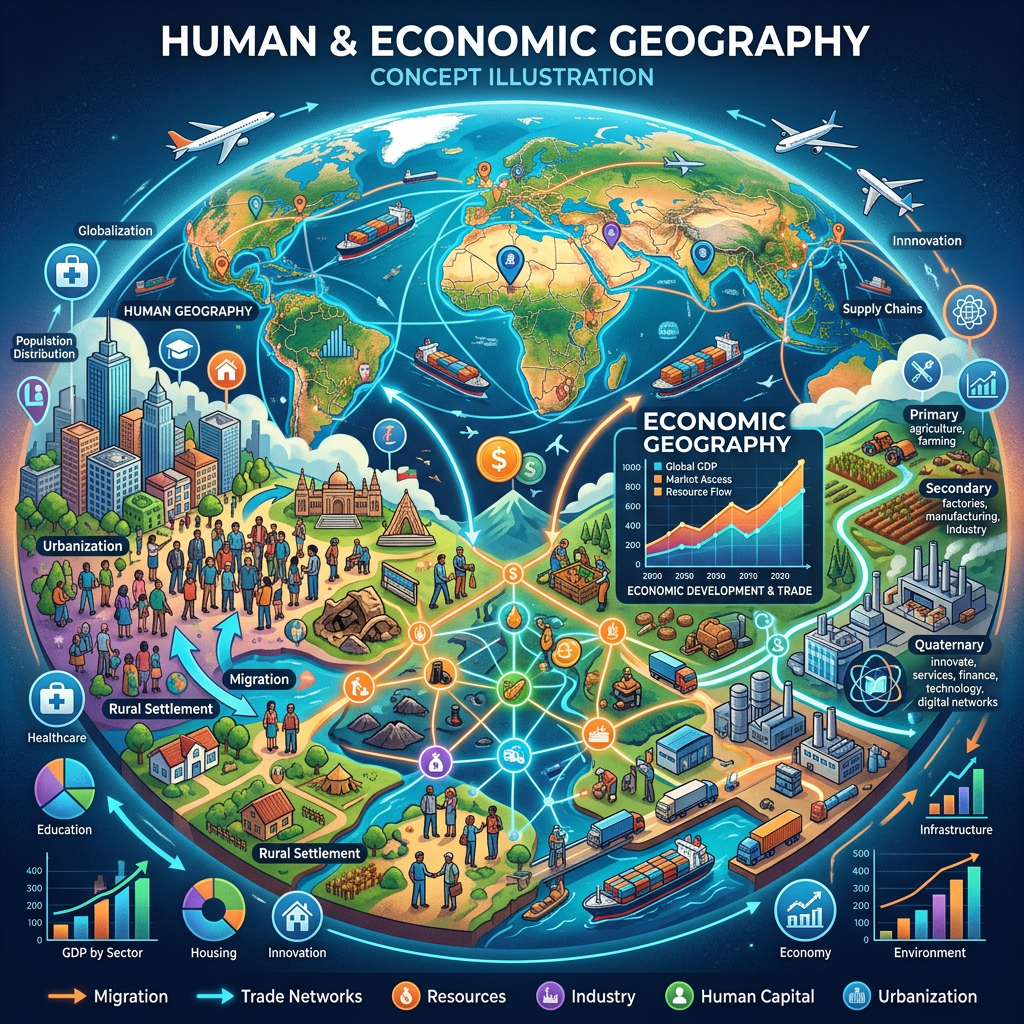
Human & Economic Geography – 50 MCQs
1. Population Geography
Q1. Which theory of population growth is associated with Thomas Malthus?
A) Optimum Population Theory
B) Demographic Transition Theory
C) Malthusian Theory
D) Boserup Theory
Q2. ‘Demographic Dividend’ refers to:
A) High birth rates
B) Large working-age population relative to dependents
C) Negative population growth
D) High dependency ratio
Q3. Which country has the highest population in the world as of 2026?
A) India
B) China
C) USA
D) Indonesia
Q4. A population pyramid with broad base and narrow top indicates:
A) Ageing population
B) Young population with high birth rates
C) Stable population
D) High life expectancy
Q5. Which Indian state has the highest population density (among major states)?
A) Uttar Pradesh
B) Bihar
C) West Bengal
D) Kerala
Q6. Overpopulation means:
A) High absolute numbers
B) Population exceeding carrying capacity
C) Only high growth rate
D) Urban concentration
Q7. In which stage of Demographic Transition are both birth and death rates low?
A) Stage 1
B) Stage 2
C) Stage 3
D) Stage 4
Q8. Highest natural population growth rate is found in:
A) Developed countries
B) Least Developed Countries (LDCs)
C) Newly Industrialized Countries
D) Oil-exporting countries
2. Migration & Settlement
Q9. Ravenstein’s Laws of Migration mainly explain:
A) International migration
B) Distance decay and step migration
C) Forced migration
D) Urban-rural balance
Q10. Compact settlement with houses close together is called:
A) Dispersed
B) Linear
C) Nucleated
D) Semi-compact
Q11. The world’s largest megacity by population is:
A) Tokyo
B) Delhi
C) Shanghai
D) São Paulo
Q12. Which is a push factor of migration?
A) Better jobs
B) Poverty and unemployment
C) Good education
D) Peaceful environment
Q13. A Primate City is:
A) The largest city dominating the urban system
B) A religious city
C) A planned capital
D) A fast-growing small city
Q14. Lewis Model explains rural-urban migration due to:
A) Wage differentials
B) Climate
C) Transport
D) Government policy
Q15. Conurbation means:
A) A single city
B) Merger of two or more cities
C) Rural settlement
D) Isolated farms
3. Cultural & Social Geography
Q16. Cultural diffusion by direct contact is:
A) Hierarchical diffusion
B) Contagious diffusion
C) Relocation diffusion
D) Stimulus diffusion
Q17. Cultural Hearth refers to:
A) Areas of cultural innovation and spread
B) Declining culture
C) Isolated culture
D) Modern culture only
Q18. Largest language family by speakers:
A) Sino-Tibetan
B) Indo-European
C) Afro-Asiatic
D) Niger-Congo
Q19. Gender Inequality Index (GII) is published by:
A) World Bank
B) UNDP
C) UNESCO
D) WTO
Q20. Folk culture is:
A) Mass-produced and fast-changing
B) Traditional, rural and slow-changing
C) Urban and global
D) Digital only
4. Political Geography
Q21. Heartland Theory was given by:
A) Alfred Mahan
B) Halford Mackinder
C) Nicholas Spykman
D) Ratzel
Q22. A Buffer State is:
A) A neutral state between two rival powers
B) A landlocked country
C) A federal state
D) An island nation
Q23. Example of Supranational organization:
A) EU
B) ASEAN
C) NATO
D) All of the above
Q24. ‘Lebensraum’ is associated with:
A) Ratzel’s Organic Theory
B) Rimland Theory
C) Domino Theory
D) Heartland Theory
Q25. Gerrymandering means:
A) Redrawing electoral boundaries for political gain
B) Peace treaty
C) Trade agreement
D) Refugee policy
5. Agricultural Geography
Q26. Von Thünen’s Model is based on:
A) Land rent and distance from market
B) Soil fertility
C) Technology
D) Climate
Q27. Dominant agriculture in monsoon Asia:
A) Commercial grain farming
B) Intensive subsistence farming
C) Mixed farming
D) Plantation agriculture
Q28. Green Revolution mainly increased:
A) Wheat and Rice
B) Millets
C) Pulses
D) Cash crops only
Q29. Shifting cultivation in Northeast India is called:
A) Jhum
B) Sedentary farming
C) Horticulture
D) Mechanized farming
Q30. Largest wheat producing country:
A) India
B) China
C) Russia
D) USA
Q31. Mediterranean agriculture is famous for:
A) Wheat & Maize
B) Citrus, Olives & Grapes
C) Rice & Jute
D) Rubber & Tea
Q32. Food security includes:
A) Availability, Access, Utilization & Stability
B) Only production
C) Only distribution
D) Export only
Q33. Dairy farming is an example of:
A) Extensive agriculture
B) Intensive commercial farming
C) Subsistence farming
D) Nomadic herding
6. Industrial Geography
Q34. Weber’s Least Cost Theory focuses on:
A) Raw material, labour & transport cost
B) Market demand only
C) Government policy
D) Climate
Q35. Ruhr region (Germany) is famous for:
A) High-tech industry
B) Traditional heavy industry (coal & steel)
C) Footloose industry
D) Cottage industry
Q36. Footloose industry example:
A) Iron & Steel
B) Cotton textile
C) Electronics / IT
D) Shipbuilding
Q37. Largest industrial region of India:
A) Mumbai-Pune
B) Hugli
C) Ahmedabad-Vadodara
D) Bangalore
Q38. New Industrial Regions are characterized by:
A) Heavy industries
B) High-tech and flexible production
C) Coal-based location
D) Port-based only
Q39. De-industrialization means:
A) Decline in manufacturing employment
B) Setting up new factories
C) Export promotion
D) Import substitution
7. Trade, Transport & Services
Q40. Gravity Model of trade is based on:
A) Size of economy and distance
B) Only political relations
C) Climate
D) Cultural ties
Q41. Largest container port in the world:
A) Shanghai
B) Singapore
C) Rotterdam
D) Dubai
Q42. Highest GDP contributing sector in developed countries:
A) Primary
B) Secondary
C) Tertiary
D) Quaternary
Q43. Suez Canal connects:
A) Atlantic–Pacific
B) Mediterranean–Red Sea
C) Indian–Pacific
D) Black Sea–Mediterranean
Q44. WTO deals with:
A) International trade rules
B) Military alliances
C) Environment
D) Health
Q45. Globalization mainly means:
A) Increasing economic interconnectedness
B) Localization
C) Protectionism
D) Self-sufficiency
8. Resources, Development & Environment
Q46. Sustainable Development Goals (SDGs) adopted in:
A) 2000
B) 2015
C) 1992
D) 1972
Q47. Non-renewable resource:
A) Solar energy
B) Petroleum
C) Wind energy
D) Managed forests
Q48. Human Development Index (HDI) includes:
A) Life expectancy, education & per capita income
B) Only GDP
C) Military strength
D) Land area
Q49. ‘Tragedy of the Commons’ was given by:
A) Garrett Hardin
B) Amartya Sen
C) Malthus
D) Rostow
Q50. Measures of economic development:
A) GDP per capita
B) GII
C) HDI
D) All of the above
ANSWERS (Correct Options)
- C 2. B 3. A 4. B 5. B 6. B 7. D 8. B
- B 10. C 11. A 12. B 13. A 14. A 15. B
- B 17. A 18. B 19. B 20. B
- B 22. A 23. D 24. A 25. A
- A 27. B 28. A 29. A 30. B
- B 32. A 33. B
- A 35. B 36. C 37. A 38. B 39. A
- A 41. A 42. C 43. B 44. A 45. A
- B 47. B 48. A 49. A 50. D

Leave a comment