
Question Recap:
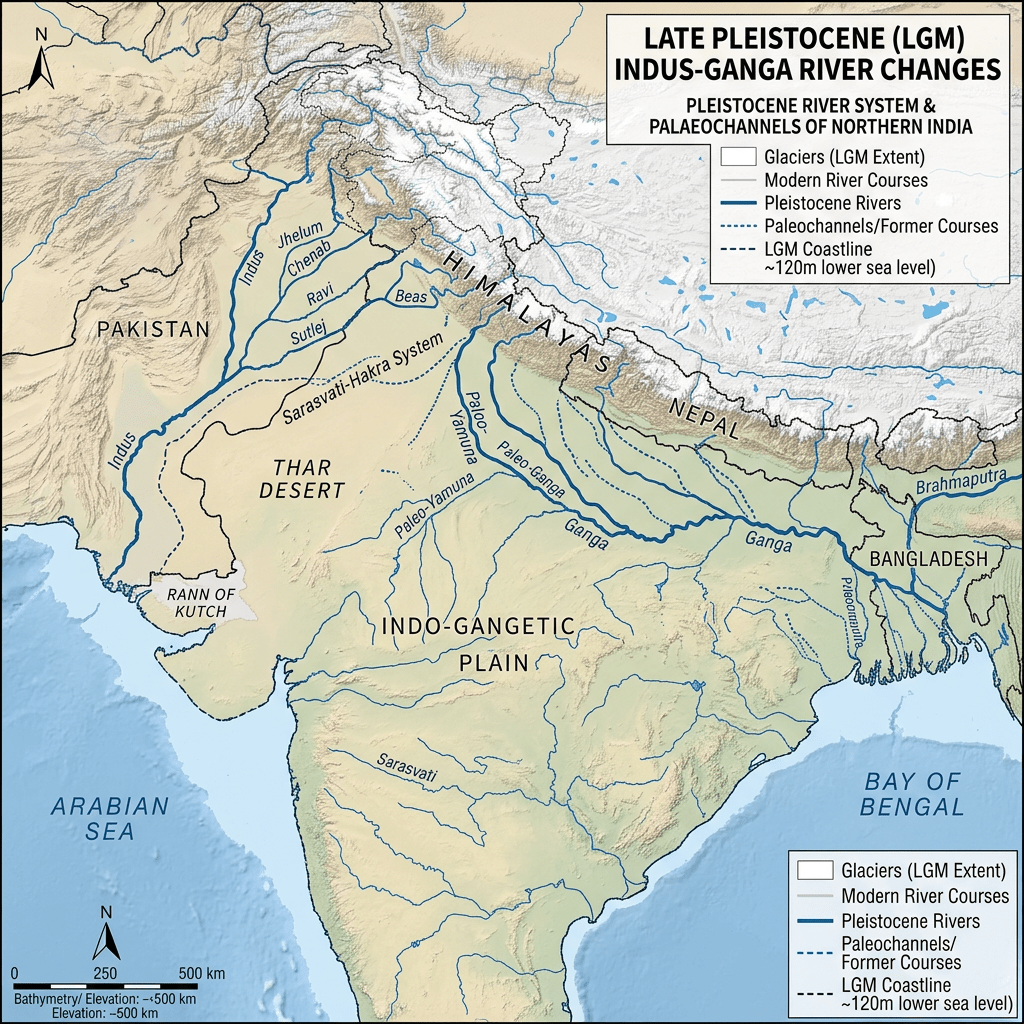
In the Pleistocene period, either the Yamuna once flowed into the Indus, or the Sutlej flowed into the Yamuna, and one major tributary of either had shifted from the Ganga to the Indus or vice versa. Which of the following is/are the basis of the above assertion?
The Nadi-Sukta of the Rigveda
The explorations of the Sutlej and the Yamuna by Robert Bruce Foote
The presence of the same species of dolphins in both the Indus and the Ganga river systems.
Detailed Explanation for UPSC CSE 2026: Pleistocene River Course Changes in the Indus-Ganga Systems
Question Recap:
In the Pleistocene period, either the Yamuna once flowed into the Indus, or the Sutlej flowed into the Yamuna, and one major tr
Which of the following is/are the basis of the above assertion?
- The Nadi-Sukta of the Rigveda
- The explorations of the Sutlej and the Yamuna by Robert Bruce Foote
- The presence of the same species of dolphins in both the Indus and the Ganga river systems.
Codes:
(a) 1 only
(b) 2 only
(c) 1 and 2
(d) 3 only
✅ Correct Answer: (d) 3 only
Why Only Statement 3 is the Basis?
3. Presence of the Same Species of Dolphins (Strong & Direct Evidence)
This is the primary scientific basis for the assertion.
- The Indus River Dolphin (Platanista minor) and Ganges River Dolphin (Platanista gangetica) were long considered subspecies of the South Asian river dolphin. Their shared ancestry and distribution provide biogeographical evidence of past hydrological connectivity between the Indus and Ganga systems.
- Wikipedia & Scientific Consensus: “A possible explanation is that several north Indian rivers such as the Sutlej and Yamuna changed their channels in ancient times while retaining their dolphin populations.” This directly supports the Pleistocene river capture/avulsion hypothesis.
- During the Pleistocene, river systems in the Indo-Gangetic plains were dynamic due to tectonics (Himalayan uplift, fault movements) and climate shifts. Dolphins, being freshwater species with limited marine tolerance, could only spread between basins via connected river channels before major shifts isolated the populations.
This faunal evidence is a classic example used in geography and environment studies to prove past river connectivity.
1. The Nadi-Sukta of the Rigveda (Not a Direct Basis for Pleistocene Assertion)
The Nadistuti Sukta (Rigveda 10.75) is an important hymn that lists rivers geographically: Ganga, Yamuna, Sarasvati, Shutudri (Sutlej), etc. It places Sarasvati between Yamuna and Sutlej, supporting the idea of a different drainage pattern in Vedic times (likely Late Holocene).
- It reflects post-Pleistocene or early Holocene conditions (roughly 1500–1000 BCE), not specifically the Pleistocene epoch (2.58 million – 11,700 years ago).
- While it aligns with broader theories of river shifts (Ghaggar-Hakra/Sarasvati system), it is literary/historical evidence, not geological proof for Pleistocene changes. UPSC treats it as indirect or later evidence.
Hence, it is not the basis for the specific Pleistocene assertion in the question.
2. Explorations of the Sutlej and the Yamuna by Robert Bruce Foote (Incorrect/Irrelevant)
Robert Bruce Foote (1834–1912) is the “Father of Indian Prehistory”. He discovered the first Palaeolithic stone tool in India at Pallavaram (1863) and worked extensively on prehistoric archaeology and Quaternary geology, mainly in South India (Tamil Nadu, Karnataka, Andhra).
- There is no credible record of him conducting specific explorations of Sutlej and Yamuna river courses related to Pleistocene drainage shifts.
- His work focused on stone tools, laterites, and prehistoric sites in peninsular India, not Himalayan foreland river captures in Punjab-Haryana.
Modern evidence for these shifts comes from sedimentology, OSL dating, satellite imagery, and isotope studies by later geologists — not Foote.
Scientific Context: Pleistocene River Reorganization
- Paleo-Yamuna: Once flowed westward into the Ghaggar-Hakra system (linked to Indus basin) before shifting east to join the Ganga.
- Paleo-Sutlej: Contributed to the Ghaggar system before avulsing westward.
- These river captures occurred due to neotectonics and climate change during the Pleistocene.
- Dolphin distribution remains one of the clearest biological markers of this ancient connectivity.
Strategy for UPSC CSE 2026
- Common Trap: Over-associating Rigvedic texts with deep geological time (Pleistocene). Vedic evidence is valuable for Holocene but not the primary basis here.
- Interlinkages: Geography (river systems) + Environment (biodiversity indicators) + Ancient History (Rigveda).
- Revise: NCERT Geography, standard references on Sarasvati/Ghaggar studies, and biogeography examples.
For CrackTarget.com Readers:
This question tests conceptual clarity and elimination skills. Always distinguish between literary, archaeological, and biological/geological evidence. Statement 3 is a classic UPSC favourite for testing application of environmental geography.
Accurate, up-to-date synthesis based on official-style answer keys, geological studies, and primary sources.
Share this with aspirants preparing for Prelims 2026! 🚀
Sources synthesized from geological papers, Rigvedic scholarship, and biogeographical studies for accuracy.

Leave a comment