
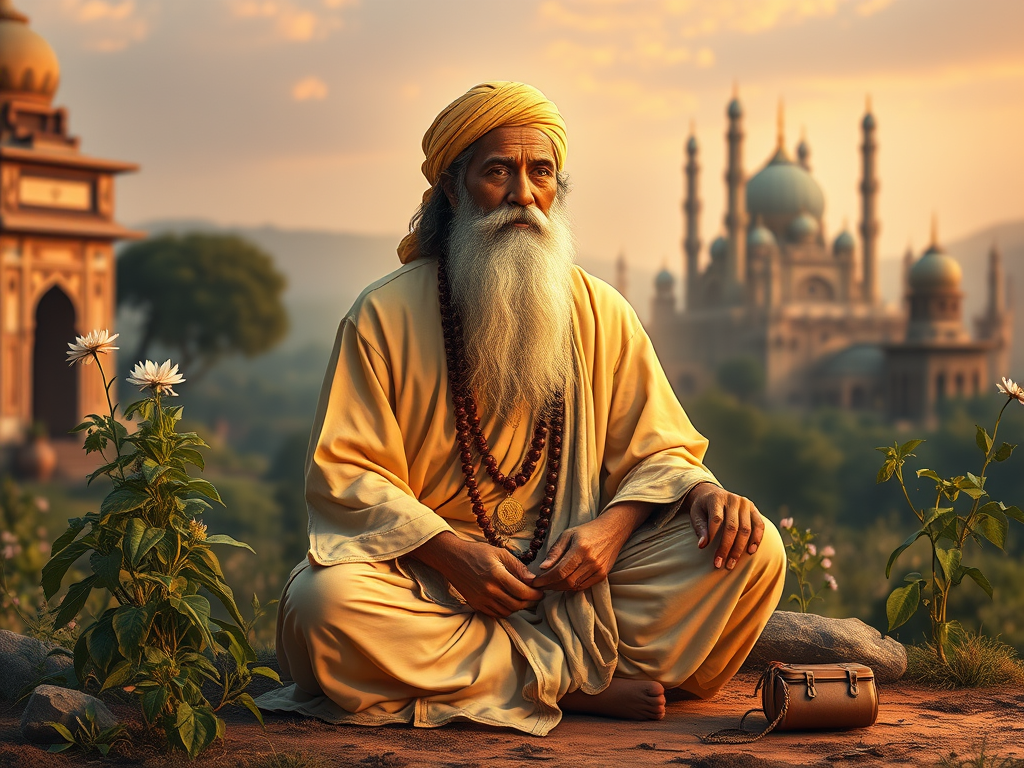
Bhakti & Sufi Movements:
Kabir
The Weaver-Saint who bridged worlds — Nirguna Bhakti, social equality & Hindu-Muslim harmony in medieval India.
Quick Navigation
8 Sections • InteractiveIntroduction: The Weaver Who Spoke to the Divine
Kabir (c. 1398–1518 CE) stands as one of the most powerful and original voices in Indian spiritual history. A mystic poet-saint from Varanasi, he emerged at the intersection of the Bhakti movement (devotional Hinduism) and the Sufi movement (Islamic mysticism). His verses, composed in the simple vernacular of the common people, cut through centuries of ritualism, caste discrimination, and religious hypocrisy.
Kabir belonged to the Julaha (weaver) community. According to tradition, he was raised by a Muslim family but was deeply influenced by the Hindu Bhakti saint Ramananda. His poetry reflects a profound synthesis: the intense personal devotion of Bhakti combined with the Sufi emphasis on divine love and inner experience. He preached Nirguna Bhakti — devotion to a formless, attributeless God — rejecting both idol worship and empty rituals of organized religion.
“I went looking for the evil in the world and found none. When I searched my own heart, I found the real evil there.”
— Kabir (on self-reflection)
His teachings transcended sectarian boundaries. He addressed God as both Ram and Rahim, declaring them to be one and the same. This syncretic message made him a symbol of communal harmony in medieval India and continues to inspire movements for social justice and secularism today.
Historical Context: Bhakti & Sufi Movements
The Path of Loving Devotion
The Bhakti movement began in South India with the Alvars (Vaishnava) and Nayanars (Shaiva) between the 6th–9th centuries. It emphasized personal, emotional devotion (bhakti) to a personal God over elaborate Vedic rituals and priestly mediation.
Islamic Mysticism & Divine Love
Sufism entered India with the Delhi Sultanate. It stressed direct personal experience of God through love, meditation, music (sama), and ethical living rather than strict legalism (Sharia alone).
Life of Kabir: Legend, History & Chronology
Kabir’s life is known mainly through hagiographies and oral traditions. Exact dates are approximate; historians treat many stories as symbolic rather than literal.
Sources for Reconstructing Kabir’s History
Because Kabir left no contemporary autobiography or inscriptions in his name, historians reconstruct his life and times using two complementary categories of evidence.
Core Teachings & Famous Dohas
Kabir’s philosophy rests on a few powerful pillars: God is one and formless (Nirguna), accessible through love and inner purity rather than rituals or priests. He was a fierce critic of religious hypocrisy, caste discrimination, and blind superstition.
Iconic Dohas of Kabir
Click to copy • Bilingualजो दिल खोजा आपना, तो बुरा मिलिया न कोय॥
Jo dil khojā āpanā, to burā miliyā na koy.
ढाई आखर प्रेम का, पढ़े सो पंडित होय॥
Ḍhāī ākhar prem kā, paḍhe so paṇḍit hoy.
ना काहू से दोस्ती, ना काहू से बैर॥
Nā kāhū se dostī, nā kāhū se bair.
सबको एक ही देखे, जो देखे सच्चा॥
Sabko ek hī dekhe, jo dekhe saccā.
Click any doha card to copy its content for notes • More dohas available in full Kabir collections
Impact and Enduring Legacy
Relevance for Competitive Exams
- • Kabir’s period, birthplace, community & death place
- • Meaning and features of Nirguna Bhakti
- • Major literary sources (Bijak, Guru Granth Sahib) and their compilers
- • Archaeological evidence: Kabir Chaura, ASI findings (2024)
- • Social reforms and critique of caste/rituals
- • Influence on Sikhism and composite culture of medieval India
- • Comparison between Bhakti & Sufi movements
Test Your Knowledge
For educational use. Verify latest facts with standard references (NCERT, Spectrum, etc.).
Leave a comment