

Current Affairs 17 October 2026
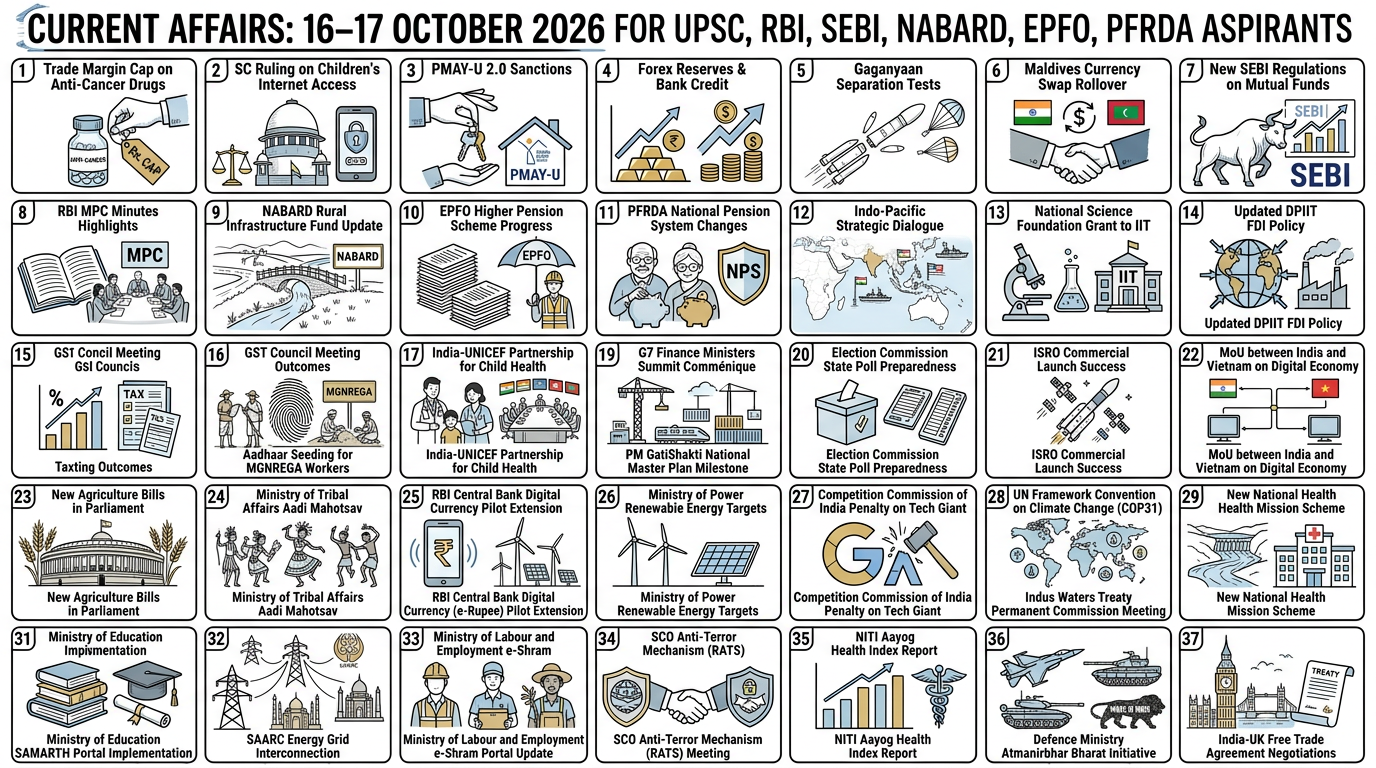
37 stories from 16–17 October 2026 for UPSC, RBI, SEBI, NABARD, EPFO and PFRDA aspirants: trade margin cap on anti-cancer drugs, the Supreme Court ruling on children's internet access, PMAY-U 2.0 sanctions, forex reserves and bank credit, Gaganyaan separation tests, the Maldives currency swap rollover and other verified updates.
On this page
Key facts at a glance
The numbers and names most likely to turn up in Prelims, Phase 1 or a GA section.
| Topic | What to remember | Source, date |
|---|---|---|
| NPPA trade margin cap | 137 anti-cancer drugs; margin capped at 30% of MRP; prices cut up to 70%; effective 9 Nov 2026 | NPPA / PIB, 17 Oct |
| Forex reserves | USD 726.03 bn as on 9 Oct 2026; down USD 8.58 bn in the week | RBI, 16 Oct |
| Bank credit & deposits | Credit +19.4% YoY; deposits +17.8% YoY (as on 30 Sep 2026) | RBI, 16 Oct |
| 6.94% GS 2036 | Rs 34,000 cr re-issue; cut-off yield 7.3955%; no devolvement | RBI, 16 Oct |
| Children & internet | Fundamental right under Art. 21 read with Art. 19(1)(a); no blanket age ban | Supreme Court, 17 Oct |
| PM CARES for Children | Aadhaar authentication notified; S.O. 5628(E) of 14 Oct 2026 | MoSJE, 16–17 Oct |
| PMAY-U 2.0 | 1.93 lakh more houses; total 20.80 lakh; 97% to women | MoHUA / PIB, 16 Oct |
| PM-AJAY | 18,093 Adarsh Grams; 785 hostels completed | MoSJE / PIB, 16 Oct |
| Maldives swap | Rs 3,000 cr (INR 30 bn) rollover from 23 Oct 2026; SAARC framework 2024–27 | MEA, 16 Oct |
| FSSAI tea MRLs | Acetamiprid 20 ppm; Imidacloprid 50 ppm (draft) | FSSAI / PIB, 17 Oct |
| Gaganyaan | CM–SM separation tests done at VSSC; G1 uncrewed mission next | ISRO, 16 Oct |
| Space economy | About USD 9 bn now; USD 40–45 bn in 7–8 years | PIB, 17 Oct |
| FSIB | Shri S. C. L. Das part-time Chairperson for 3 years | DFS, 16 Oct |
| CAQM PTZ cameras | All Direction No. 98 industries in NCR; deadline 30 Nov 2026 | CAQM / PIB, 16 Oct |
Economy
3 storiesNPPA caps trade margins on 137 non-scheduled anti-cancer drugs at 30%
The National Pharmaceutical Pricing Authority (NPPA), which functions under the Department of Pharmaceuticals in the Ministry of Chemicals and Fertilizers, notified Trade Margin Rationalisation for 137 non-scheduled anti-cancer drugs through a Gazette notification dated 17 October 2026. Trade margins on these medicines have been capped at 30 per cent of the Maximum Retail Price under Paragraph 19 of the Drugs (Prices Control) Order, 2013, and the authority expects retail prices to fall by up to 70 per cent depending on the existing price structure of each drug. The list was recommended by an Expert Committee under the Directorate General of Health Services, made up of oncologists, hospital experts and government officers, and it will be updated from time to time. Manufacturers must inform NPPA of their revised prices within seven days, and retailers and hospitals must charge the reduced prices from 9 November 2026 and display them prominently. The exercise builds on a 2019 pilot in which margins on 42 anti-cancer drugs were capped at 30 per cent, which led to price cuts of up to 90 per cent across 526 brands.
Commerce Department holds 'Leveraging FTAs' outreach for exporters in Jaipur
The Department of Commerce organised a 'Leveraging FTAs – Outreach Programme' in Jaipur, Rajasthan, on 17 October 2026 to help exporters understand and make better use of the preferential market access available under India's Free Trade Agreements. The programme was addressed by Joint Secretary Shri Mohit Yadav and saw participation from exporters, the Government of Rajasthan, the Directorate General of Foreign Trade, the Jaipur Special Economic Zone and the Gem and Jewellery Export Promotion Council. Participants discussed the practical difficulties of claiming tariff preferences, along with export documentation, product standards, logistics and market intelligence. Officials pointed out that India's trade agreements with partners such as the UAE, Australia, the European Free Trade Association countries and the United Kingdom offer reduced or zero-duty access for many Indian products. Textiles, handicrafts, gems and jewellery and engineering units in districts such as Jaipur, Jodhpur, Udaipur and Bhilwara were identified as segments that could gain the most from wider use of these agreements.
India's space economy projected to grow from USD 9 billion to USD 40–45 billion
India's space economy, currently valued at around USD 9 billion, is expected to grow to USD 40–45 billion over the next seven to eight years, Union Minister of State (Independent Charge) for Science and Technology Dr. Jitendra Singh said in New Delhi on 17 October 2026. He was speaking at a media roundtable on 'Space, Sovereignty and New Economy' organised by the Bloomberg New Economy Forum, which was also attended by representatives of IN-SPACe and the international space community. The Minister said the opening of the space sector to private participation in 2019–20 had delivered significant results within five to six years, and that the next priority is to build globally competitive commercial space companies. He listed predictable demand through anchor government customers, regulatory approvals within defined timelines, lower business costs and stronger supply chains as the main requirements for scaling up private firms. He also noted that space-based information is widely used for project monitoring, agriculture and disaster management, and is shared with neighbouring countries such as Myanmar, Bangladesh and Sri Lanka.
Banking & Markets
4 storiesForeign exchange reserves stand at USD 726.03 billion as on 9 October
India's foreign exchange reserves stood at USD 726.03 billion in the week ended 9 October 2026, according to the Reserve Bank of India's Weekly Statistical Supplement released on 16 October. Reserves declined by USD 8.58 billion during the week, but remained USD 34.92 billion higher than at the end of March 2026 and USD 28.24 billion higher than a year earlier. Foreign currency assets, the largest component, fell by USD 7.14 billion to USD 597.61 billion, while gold reserves slipped by USD 1.32 billion to USD 105.09 billion. Special Drawing Rights eased to USD 18.55 billion, and India's reserve position in the International Monetary Fund edged down to USD 4.78 billion. Weekly changes in foreign currency assets also reflect valuation effects arising from movements in non-US currencies held in the reserves.
Bank credit growth rises to 19.4% and deposit growth to 17.8% year-on-year
Data released by the Reserve Bank of India on 16 October 2026 showed that bank credit of scheduled commercial banks grew 19.4 per cent year-on-year as on 30 September 2026, compared with 11.4 per cent a year earlier. Outstanding bank credit reached about Rs 229.95 lakh crore, of which non-food credit made up about Rs 228.98 lakh crore. Aggregate deposits rose 17.8 per cent year-on-year to about Rs 283.96 lakh crore, against growth of 9.9 per cent in the same period of 2025. Broad money (M3) recorded year-on-year growth of 16.9 per cent as on 30 September 2026. The RBI also noted that, under the Banking Laws (Amendment) Act, 2025, a reporting fortnight now ends on the 15th and the last calendar day of each month instead of on alternate Fridays.
RBI auction of 6.94% GS 2036 raises Rs 34,000 crore at 7.3955% cut-off yield
The Reserve Bank of India conducted an auction on 16 October 2026 for the re-issue of the Government of India's 6.94% GS 2036 for a notified amount of Rs 34,000 crore. The cut-off price was fixed at Rs 96.91, which works out to an implicit yield of 7.3955 per cent, while the weighted average yield was 7.3925 per cent. The auction drew 400 competitive bids worth about Rs 94,072 crore, of which 113 bids amounting to about Rs 33,961 crore were accepted, along with non-competitive bids of about Rs 39 crore. In the underwriting auction held earlier the same day, Primary Dealers underwrote the full notified amount at an Additional Competitive Underwriting commission cut-off of 0.38 paise per Rs 100. There was no devolvement on Primary Dealers, which means the market took up the entire issue.
RBI notifies Rs 23,000 crore T-bill auction and Rs 24,400 crore State bond sale
The Reserve Bank of India announced on 16 October 2026 that it will auction Government of India Treasury Bills worth Rs 23,000 crore on 21 October 2026, with settlement on 22 October. The amount is made up of Rs 8,000 crore each of 91-day and 182-day bills and Rs 7,000 crore of 364-day bills, and the auction will be price-based using the multiple price method. Individuals can bid on a non-competitive basis through the RBI Retail Direct portal, with the retail allocation capped at five per cent of the notified amount. Separately, eleven States and Union Territories are set to raise Rs 24,400 crore by auctioning State Government Securities on 19 October 2026 on the RBI's E-Kuber platform. Treasury Bills are short-term money market instruments that help the Centre manage temporary mismatches between its receipts and payments.
Polity & Governance
4 storiesSupreme Court holds that children have a fundamental right to access the internet
The Supreme Court on 17 October 2026 held that the right to access and use the internet is a fundamental right of every individual under Article 21 read with Article 19(1)(a) of the Constitution, and that children enjoy this right irrespective of their age. A Bench of Justices J.B. Pardiwala and Vinod K. Chandran gave the ruling in proceedings arising from the Just Rights for Children Alliance case on online child sexual exploitation and abuse material. The Court observed that blanket age-based bans on internet use by children would be disproportionate and could push young users towards unregulated and more dangerous websites. It suggested safeguards instead, including parental consent and oversight, a special 'child mode' for accounts, and faster detection, reporting and removal of abusive material by platforms. The Court also directed the Centre to frame guidelines for national databases of perceptual hashes and URLs so that platforms can identify and remove matching material in a coordinated way.
Aadhaar authentication notified for PM CARES for Children scholarship benefits
The Ministry of Social Justice and Empowerment has notified that beneficiaries of the Special Scholarship Scheme under the PM CARES for Children Scheme must undergo Aadhaar authentication or furnish proof of possession of an Aadhaar number. The notification, S.O. 5628(E) dated 14 October 2026 and reported on 16–17 October, has been issued under Section 7 of the Aadhaar (Targeted Delivery of Financial and Other Subsidies, Benefits and Services) Act, 2016. The scholarship supports the continued education of eligible children from Class 1 to Class 12. Children without Aadhaar must apply for enrolment with the consent of a parent or legal guardian, and until a number is assigned they may establish identity with documents such as a birth certificate and proof of relationship with the guardian. The notification states that no child shall be denied the benefit merely because authentication fails or an Aadhaar number has not been assigned, and it provides for alternative biometric, OTP-based and offline verification.
Food and Public Distribution Department reports mid-campaign progress under Special Campaign 6
The Department of Food and Public Distribution released its mid-campaign progress under Special Campaign 6, which runs from 2 to 31 October 2026 to institutionalise Swachhata and reduce pendency in government offices. As on 15 October, the Department had reviewed 35,743 physical files against a target of 1,10,600 and weeded out 2,513 files. On the digital side, 13,546 e-files had been reviewed and 7,040 closed, while 48 of 54 references from Members of Parliament and 710 public grievances had been disposed of. Campaign activities also generated revenue of Rs 10,76,262 and freed about 23,843 square feet of office space. Senior officers are monitoring progress in coordination with the PSUs and attached and subordinate offices of the Department.
Ministry of Mines transforms 136 Cleanliness Target Units under Swachhata Hi Seva 2026
The Ministry of Mines, together with its field offices and organisations, reported on 17 October 2026 on its participation in the Swachhata Hi Seva Campaign 2026. Under the campaign, 136 Cleanliness Target Units were transformed with the participation of 10,723 people, and 59 public spaces were cleaned with the involvement of 5,498 individuals. Union Minister for Coal and Mines Shri G. Kishan Reddy joined a cleanliness drive at Yashwant Palace Market in Chanakyapuri, New Delhi, along with Mines Secretary Shri Keshav Chandra and senior officials. The Ministry also held a health camp for Safai Mitras and staff in recognition of their contribution to clean and hygienic workplaces. Field offices cleaned lakes and water bodies, organised shramdaan, and held essay-writing and waste-to-art competitions in schools to build environmental awareness.
International Relations
3 storiesIndia rolls over Rs 3,000 crore currency swap facility for the Maldives
India has accepted the request of the Government of the Maldives to roll over the Rs 30 billion (Rs 3,000 crore) currency swap facility under the Indian rupee window, with the first rollover taking effect from 23 October 2026, the Ministry of External Affairs said on 16 October. The facility is provided under the Framework on Currency Swap Arrangement for SAARC countries for 2024–27, through an agreement between the Reserve Bank of India and the Maldives Monetary Authority signed during the state visit of H.E. Dr. Mohamed Muizzu, President of the Maldives, to India in October 2024. The first drawdown of Rs 30 billion under the arrangement was extended to the Maldives on 23 April 2026. The Maldives Government expressed its sincere appreciation for the decision, calling it a reaffirmation of the longstanding friendship between the two countries. India has described the support as part of its Neighbourhood First policy and as a contribution to the financial stability of the Maldives.
EAM Dr. S. Jaishankar to host UAE and US counterparts in Mumbai
The Ministry of External Affairs announced on 16 October 2026 that External Affairs Minister Dr. S. Jaishankar will host H.E. Sheikh Abdullah bin Zayed Al Nahyan, Deputy Prime Minister and Foreign Minister of the United Arab Emirates, in Mumbai on 19 and 20 October 2026. The visit will review all aspects of the India–UAE Comprehensive Strategic Partnership, including energy, trade, investment, fintech, defence and connectivity, and will include an exchange of views on the situation in West Asia. On 20 October, Dr. Jaishankar will also hold talks with H.E. Mr. Marco Rubio, Secretary of State of the United States, and attend the celebration of the 250th anniversary of the independence of the United States as Guest of Honour. The India–US talks are expected to cover energy, trade, investment, defence and critical and emerging technologies under the Comprehensive Global Strategic Partnership. The UAE Foreign Minister's visit follows Dr. Jaishankar's own official visit to the UAE from 14 to 16 October 2026.
US waiver on Graham Act sanctions eases pressure on India's Russian oil imports
H.E. Mr. Donald Trump, President of the United States, issued an executive order on 16 October 2026 (US time) waiving the sanctions, restrictions and duties mandated under the Lindsey O. Graham Sanctioning Russia and Iran Act, which he had signed into law on 18 September. The law had authorised tariffs of up to 100 per cent on goods from the five largest importers of Russian crude oil and gas, and these measures were due to take effect around 18 October. The waiver is not specific to any country, can be reconsidered later, and does not lift sanctions on Russia that were already in force. India, the largest importer of Russian seaborne crude, bought about 1.82 million barrels per day in September 2026, and analysts expect October volumes to stay at around 1.8–1.9 million barrels per day. The decision follows a US Treasury step on 9 October that allowed the sale and import of Russian diesel until 7 April 2027.
Schemes & Missions
3 storiesCSMC approves 1.93 lakh more houses under PMAY-U 2.0; sanctions reach 20.80 lakh
The Central Sanctioning and Monitoring Committee of Pradhan Mantri Awas Yojana–Urban 2.0 approved more than 1.93 lakh additional houses at its 10th meeting in New Delhi on 16 October 2026, chaired by Shri Satendra Singh, Secretary, Department of Urban Development, Ministry of Housing and Urban Affairs. The houses were sanctioned under the Beneficiary Led Construction and Affordable Housing in Partnership verticals for Economically Weaker Section families in 11 States, with Uttar Pradesh (73,182) and Bihar (52,866) receiving the largest numbers. With these approvals, total sanctions under PMAY-U 2.0 have reached 20.80 lakh houses, of which 20.16 lakh, or 97 per cent, are in the name of women as sole or joint owners. Launched in September 2024, PMAY-U 2.0 aims to provide assistance of up to Rs 2.50 lakh each to one crore additional urban poor and middle-class families through four verticals, which also include Affordable Rental Housing and an Interest Subsidy Scheme. Across PMAY-U and PMAY-U 2.0 together, more than 1.27 crore houses have been sanctioned and 1.01 crore completed.
PM-AJAY: 18,093 Scheduled Caste-majority villages declared Adarsh Grams
The Ministry of Social Justice and Empowerment said on 16 October 2026 that 18,093 villages had been declared Adarsh Grams under the Pradhan Mantri Anusuchit Jaati Abhyuday Yojana (PM-AJAY) as on 8 September 2026. The Adarsh Gram component has covered more than 47,200 Scheduled Caste-majority villages with over 47.79 lakh residents, with 46,944 development works completed and 27,032 Village Development Plans prepared. Under the Grants-in-Aid component, about Rs 1,730 crore was released directly to States and districts between 2021-22 and 2025-26, supporting skilling and livelihood activities for more than 2.5 lakh beneficiaries. A total of 785 student hostels had been completed by September 2026, and Rs 61.46 crore has been allocated in 2026-27 for two new hostel projects that will house 264 students. PM-AJAY is a 100 per cent Centrally funded scheme and is now monitored through a dedicated mobile app and portal.
Union Minister Dr. Mansukh Mandaviya addresses Viksit Bharat Yuva Samvaad in Porbandar
Union Minister for Youth Affairs and Sports Dr. Mansukh Mandaviya addressed the Viksit Bharat Yuva Samvaad at S. M. Jadeja Arts and Commerce College, Kutiyana, in Porbandar district of Gujarat, on 17 October 2026. He called on young people to take a leading role in nation-building and to work towards the goal of a developed India by 2047. The Minister said efforts are under way, under the guidance of Hon'ble Prime Minister Shri Narendra Modi, to develop one lakh young leaders across the country. He highlighted the MY Bharat portal as a platform for youth participation, career guidance and leadership development, including visits to border villages. Dr. Mandaviya also urged students to support the Nasha Mukt Bharat campaign and to rely on credible sources of information on social media.
Health & Nutrition
4 storiesFSSAI proposes pesticide residue limits for Acetamiprid and Imidacloprid in tea
The Food Safety and Standards Authority of India (FSSAI) has proposed Maximum Residue Limits for two pesticides, Acetamiprid and Imidacloprid, in tea through draft amendment regulations published in the Gazette of India on 16 October 2026. The draft Food Safety and Standards (Contaminants, Toxins and Residues) Amendment Regulations, 2026 propose limits of 20 mg/kg (20 ppm) for Acetamiprid and 50 mg/kg (50 ppm) for Imidacloprid. FSSAI noted that the proposed Acetamiprid limit is lower than the corresponding limits of 30 ppm in Japan and 50 ppm in the United States, while the Imidacloprid limit has been set with reference to Codex standards. A Maximum Residue Limit is the highest legally permitted concentration of a pesticide residue in a food commodity and is fixed on the basis of residue data, dietary exposure and safety assessment. The authority also pointed out that India's average pesticide use of less than 0.5 kg per hectare is well below the global average of 2.38 kg per hectare.
FSSAI proposes ban on added sucrose and fructose in foods for infants up to six months
The Food Safety and Standards Authority of India has published a draft amendment to the Food Safety and Standards (Foods for Infant Nutrition) Regulations, 2020, proposing to prohibit the addition of sucrose and fructose in products meant for infants up to six months of age. The draft Food Safety and Standards (Foods for Infant Nutrition) Amendment Regulations, 2026 were published in the Gazette of India on 16 October 2026. Under the existing rules, lactose and glucose polymers are the preferred carbohydrate sources, and sucrose or fructose may be added only where required, within prescribed limits. The proposal seeks to reduce early exposure to added sugars, which is linked to dietary risks such as childhood obesity. It also supports the public health recommendation of exclusive breastfeeding during the first six months of life.
AIIA marks a decade of service with 37.74 lakh patients treated
The All India Institute of Ayurveda (AIIA), New Delhi, released a report on 16 October 2026 showing that 37,74,524 patients received healthcare services across its network between October 2016 and September 2026. Of these, about 30.37 lakh patients were treated at the main campus in Sarita Vihar, which can attend to around 3,000 outpatients a day and has a 200-bed inpatient department. Satellite and outreach facilities, including the Goa centre and units at Safdarjung Hospital, the National Cancer Institute at Jhajjar and Ekta Nagar (Kevadia), together served about 7.37 lakh patients. AIIA Director Prof. (Vaidya) P. K. Prajapati said patient footfall had risen more than fourfold, from about 1.23 lakh in 2020 to over 5.40 lakh by September 2026. The report was released on the institute's Foundation Day.
ITRA Jamnagar hosts 'Ayu-Tech Navonmesh 2026' on AI and Ayurveda
The Institute of Teaching and Research in Ayurveda (ITRA), Jamnagar, hosted a national conference on Artificial Intelligence and Ayurveda under 'Ayu-Tech Navonmesh 2026' to mark its 6th Foundation Day, the Ministry of Ayush said on 16 October 2026. Experts discussed the responsible use of AI in Ayurvedic research, drug development, quality assurance, clinical trials, education and healthcare services. Speakers from the WHO Global Traditional Medicine Centre stressed that AI should complement, not replace, the core principles of Ayurveda, and flagged ethical issues such as data privacy and regulatory barriers. Officials of the Ministry of Ayush showcased AI-driven chatbots and digital tools developed under the Ayush Grid initiative. ITRA Director Prof. Tanuja Nesari described the event as a platform for dialogue between traditional knowledge and advanced technology.
Environment
3 storiesCAQM extends PTZ camera monitoring to all industries under Direction No. 98 in NCR
The Commission for Air Quality Management in NCR and Adjoining Areas (CAQM) has extended the requirement for Pan-Tilt-Zoom (PTZ) cameras to all categories of industries covered under its Statutory Direction No. 98 in the National Capital Region, through an order announced on 16 October 2026. The order covers the 17 categories of highly polluting industries identified by the Central Pollution Control Board, Red Category medium and large air-polluting units, food processing and textile units with boilers or thermic fluid heaters, and metal industries with furnaces. Cameras must be installed at fuel-feeding points, stack-emission and online emission monitoring (OCEMS) sampling locations and fume extraction areas, and gas-based units must also cover their gas meters. Video feeds have to be streamed continuously in real time to the servers of CPCB and the respective State Pollution Control Boards or the Delhi Pollution Control Committee. Installation must be completed by 30 November 2026, and the order replaces the Commission's earlier order of 5 October 2026.
CAQM Enforcement Task Force reviews 124 inspections and 55 violations in NCR
The Enforcement Task Force of the Commission for Air Quality Management reviewed compliance across the National Capital Region at its 141st meeting held on 16 October 2026. Between 25 September and 9 October 2026, 124 inspections were carried out, covering 54 industrial units, 64 diesel generator sets and six construction and demolition sites, and they revealed 55 violations. Proposed action includes closure of two construction projects and three industrial units, sealing of 12 units, environmental compensation and referral of cases to pollution control boards. Cumulatively, CAQM flying squads have inspected 28,868 units and projects in the NCR and issued 1,837 closure directions, of which 1,491 were followed by resumption orders after compliance was verified. On the same day, a CAQM team led by Member (Technical) Dr. T. S. Panwar visited Moga district in Punjab to review measures to prevent stubble burning during the paddy harvest season.
Environment Minister engages start-ups on technology solutions for Delhi-NCR air pollution
Union Minister for Environment, Forest and Climate Change Shri Bhupender Yadav interacted with start-ups and innovators working on air pollution solutions for Delhi-NCR in New Delhi on 17 October 2026. The interaction was held under the theme 'Saaf Hawa mein Hissedaari, Hum Sabhi ki hai Zimmedaari' and was attended by Minister of State Shri Kirti Vardhan Singh and Delhi Environment Minister Sardar Manjinder Singh Sirsa. The Minister presented problem statements covering nine key areas of air pollution management, from monitoring and prediction to enforcement and mitigation. Solutions discussed included tamper-proof emission monitoring, AI-based detection of industrial violations, automated identification of vehicles without valid PUC certificates, round-the-clock detection of stubble burning and systems to use paddy straw for bioenergy and packaging. Shri Yadav described the engagement as a proactive step to bridge the gap between policymakers and technology innovators and to complement measures such as the Graded Response Action Plan.
Science & Tech
2 storiesISRO completes Crew Module–Service Module separation tests for Gaganyaan
The Indian Space Research Organisation (ISRO) announced on 16 October 2026 that it has successfully completed a series of Crew Module–Service Module separation tests for the Gaganyaan human spaceflight programme. The Gaganyaan Orbital Module consists of a Crew Module and a Service Module, which work as a single unit from launch until the end of the orbital phase and are separated just before re-entry into the Earth's atmosphere. The tests, carried out on a specially instrumented set-up at the Vikram Sarabhai Space Centre, Thiruvananthapuram, simulated the sequenced pyrotechnic separation events and the severing of umbilical connections between the two modules. They also showed that critical Crew Module systems, including avionics, inertial navigation, thermal protection and the crew module uprighting system, can withstand the separation shock. ISRO said the results give confidence ahead of the first uncrewed Gaganyaan mission, G1, targeted for launch in 2026.
IITM Pune hosts first stakeholder consultation of Climate Science into Services for India Forum
The Indian Institute of Tropical Meteorology (IITM), Pune, under the Ministry of Earth Sciences, hosted the First Stakeholder Consultation Meeting of the Climate Science into Services for India Forum (CSSIF) on 17 October 2026. The meeting brought together more than 150 participants from over 80 institutions, including government ministries, operational agencies such as the India Meteorological Department and NDRF, research bodies, the Reserve Bank of India, NGOs and the private sector. Technical sessions examined weather and climate products, climate models and data, and the need for a national Climate Services Information System. Thematic groups discussed the needs of sectors such as water resources, agriculture and food security, disaster risk reduction, health, energy and finance, and coastal and marine services. The recommendations are expected to strengthen the link between climate science, policy and societal needs, and the meeting marks the start of sustained engagement under the forum.
Defence
2 storiesProject Seabird Phase IIA facilities inaugurated at Karwar Naval Base
Vice Admiral Sanjay Vatsayan, Flag Officer Commanding-in-Chief, Western Naval Command, inaugurated new infrastructure under Project Seabird Phase IIA at Naval Base, Karwar, on 15 October 2026, the Ministry of Defence said on 17 October. The facilities include five residential towers with 300 dwelling units for naval defence civilians and a Station Health Organisation complex that raises the capacity of INHS Patanjali to 409 beds. A two-lakh-litre hilltop water reservoir, a sewage treatment plant, an integrated solid waste management facility, and a four-lane access gate and bridge with pedestrian and cycle paths were also opened. The wider scope of Phase IIA includes a dual-use Naval Air Station, a full-fledged naval dockyard and logistics facilities for ships and aircraft. The project sources over 90 per cent of its materials and equipment domestically and is designed to achieve an IGBC Gold green building rating on completion.
Navy's First Training Squadron completes Seychelles port call with PASSEX
Ships of the Indian Navy's First Training Squadron, INS Tir and INS Sujata, along with Indian Coast Guard Ship Sarathi, left Port Victoria, Seychelles, on 15 October 2026 after a port call that began on 12 October, the Ministry of Defence said on 17 October. During the visit, the Senior Officer of the squadron and the commanding officers called on Maj Gen Michael Rosette, Chief of Defence Forces of the Seychelles Defence Force. The programme included cross-training visits and firefighting and small-arms training for Seychelles personnel. The squadron also held a Passage Exercise (PASSEX) with Seychelles Coast Guard Ship Andromache, involving joint patrolling, communication drills and coordinated manoeuvres. Outreach activities included a medical camp and a performance by the Indian Navy Band, in line with India's MAHASAGAR (Mutual and Holistic Advancement for Security and Growth Across Regions) vision.
Appointments
1 storyShri Subhas Chandra Lal Das appointed part-time Chairperson of FSIB
The Department of Financial Services in the Ministry of Finance has appointed former IAS officer Shri Subhas Chandra Lal Das as part-time Chairperson of the Financial Services Institutions Bureau (FSIB) for three years, according to a resolution issued on 16 October 2026. Six part-time members have also been appointed: Shri Arijit Basu, Shri Satish Kashinath Marathe, Shri Ramanathan Subramanian, Shri Siddhartha Mohanty, Smt. Neerja Kapur and Smt. T. L. Alamelu. The first three will handle matters relating to public sector banks and financial institutions, while the other three will look after public sector insurers. Shri Das is a retired 1992-batch IAS officer of the AGMUT cadre. The FSIB, set up with effect from 1 July 2022 in place of the Banks Board Bureau, recommends candidates for appointment as whole-time directors and non-executive chairpersons of public sector banks, financial institutions and insurers.
Reports & Indices
1 storyPIB backgrounder details rail, road and air connectivity gains in Jammu and Kashmir
A Press Information Bureau backgrounder titled 'Connecting Kashmir: Building the Infrastructure for Growth', released on 17 October 2026, reviewed the expansion of rail, road and air connectivity in Jammu and Kashmir. It noted that the 272-km Udhampur–Srinagar–Baramulla Rail Link, built at a cost of Rs 43,780 crore with 36 tunnels and 943 bridges, has linked the Kashmir Valley to the national rail network. The project includes the Chenab Rail Bridge, the world's highest railway arch bridge at 359 metres above the riverbed, and the Anji Khad bridge, India's first cable-stayed railway bridge. On the road side, the 13.153-km Zojila Tunnel between Baltal and Minamarg achieved its main-tube breakthrough in June 2026 and is expected to cut travel time between Sonamarg and Minamarg from about two hours to around 30 minutes. The backgrounder also highlighted the extension of Vande Bharat services to Jammu Tawi and a Rs 1,677 crore expansion of the civil enclave at Srinagar International Airport.
Sports
3 storiesIndia Women beat Zimbabwe by four wickets in first T20I at Raipur
India Women defeated Zimbabwe Women by four wickets in the first T20 International of a three-match series at the Shaheed Veer Narayan Singh International Cricket Stadium, Raipur, on 16 October 2026. Batting first, Zimbabwe scored 114 for 5, with Sharne Mayers unbeaten on 43 and Kelis Ndhlovu making 42, while Nandni Sharma took two wickets for 11 runs. India slipped to 19 for 4 inside four overs, but Deepti Sharma (49) and debutant Niki Prasad (39 not out) added 82 runs for the fifth wicket to take the hosts to 116 for 6 in 15.4 overs. The match was Smriti Mandhana's first as full-time captain and the first women's international match hosted in Raipur. India lead the series 1-0, and the second match will be played at the same venue on 18 October.
BCCI names India squads for ODI and Test series in New Zealand
The Board of Control for Cricket in India (BCCI) announced the Indian men's squads for the ODI and Test series in New Zealand on 16 October 2026. Shubman Gill will captain the side in the first three of the five ODIs and in both Tests, while Shreyas Iyer will lead in the fourth and fifth ODIs with Ishan Kishan as vice-captain. KL Rahul has been named vice-captain of the Test squad, which includes Jasprit Bumrah, Ravindra Jadeja and Yashasvi Jaiswal, with Rishabh Pant's inclusion subject to fitness clearance. The ODI series begins in Auckland on 4 November and ends with two matches at Mount Maunganui on 13 and 15 November 2026. The Tests will be played in Wellington from 19 November and in Christchurch from 27 November 2026.
Railways Minister meets Asian Games gold-winning women's kabaddi team
Union Minister for Railways Shri Ashwini Vaishnaw met members of the Indian women's kabaddi team, gold medallists at the 2026 Asian Games in Aichi-Nagoya, Japan, at Rail Bhawan, New Delhi, on 16 October 2026. India defended its Asian Games title by defeating Iran 37-34 in a closely fought final on 26 September 2026. The team was coached by Neeta Moreshwar Dadwe and captained by Pushpa Rana. The Railway sportspersons who met the Minister included the head coach and players Ritu Negi, Pooja, Pinky Roy, Sonali Vishnu Shingate and Raj Rani. Indian Railways supports sporting talent through the Railway Sports Promotion Board, whose athletes have represented India at the Olympics, Asian Games and Commonwealth Games.
Important Days
2 storiesNational Security Guard marks its Raising Day on 16 October
The National Security Guard (NSG) observed its Raising Day on 16 October 2026. Hon'ble Prime Minister Shri Narendra Modi extended greetings to NSG personnel, saying they embody courage, precision and an unwavering commitment to duty. He added that their steadfast vigil against terrorism and their readiness to protect people and vital national assets inspire immense confidence and pride. The NSG, popularly known as the 'Black Cats', is a federal counter-terrorism force under the Ministry of Home Affairs. It was raised in 1984 and is governed by the National Security Guard Act, 1986.
World Menopause Day 2026: Ministry of Ayush highlights holistic women's health
World Menopause Day is observed every year on 18 October, and the Ministry of Ayush used the 2026 observance to highlight awareness, preventive care and research on women's health during menopause. Through the Central Council for Research in Ayurvedic Sciences (CCRAS), the Ministry is promoting a better understanding of physical health, emotional well-being and quality of life during this stage. Menopause is the permanent end of menstruation following the loss of ovarian follicular activity, and it usually occurs between 45 and 55 years of age. In Ayurveda, the related symptoms are discussed under the concept of Rajonivritti, with an emphasis on prevention, lifestyle practices and individualised care. Ayush Secretary Vaidya Rajesh Kotecha said the Ministry remains committed to strengthening research and scientific validation in this area.
Art & Culture
2 stories106 young artists to receive Ustad Bismillah Khan Yuva Puraskar on 19 October
Union Minister of Culture and Tourism Shri Gajendra Singh Shekhawat will confer the Sangeet Natak Akademi's Ustad Bismillah Khan Yuva Puraskar for 2024 and 2025 on 106 young artists in music, dance and drama on 19 October 2026 at Meghdoot Complex, Rabindra Bhavan, New Delhi, the Ministry of Culture announced on 16 October. The awardees were unanimously selected by the General Council of the Sangeet Natak Akademi at its meeting held from 22 to 26 March 2026. Instituted in 2006, the award recognises young artists up to the age of 40. Each award carries a purse of Rs 25,000 along with a Tamrapatra and an Angavastram. Culture Secretary Shri Vivek Aggarwal will be the Guest of Honour, and Sangeet Natak Akademi Chairman Dr. Sandhya Purecha will preside over the ceremony.
Veteran Tamil film composer Deva passes away at 75
Veteran Tamil film music composer Deva passed away on 17 October 2026 at the age of 75. He was widely known for bringing Chennai's gaana music tradition into mainstream cinema and for popular songs and background scores in films such as Annamalai, Arunachalam and Baashha. Over his career, he composed music for more than 400 films in Tamil, Telugu, Malayalam and Kannada. Hon'ble Vice-President of India Shri C. P. Radhakrishnan expressed deep sorrow at his demise, describing it as a great loss to the Tamil film and music industry. The Vice-President said Deva's memorable compositions and his distinctive contribution to gaana music would be cherished by generations of music lovers.
Quick-revision MCQs
Ten questions drawn from today’s stories. Tap an option to check yourself.
Q1.Under Trade Margin Rationalisation notified on 17 October 2026, trade margins on 137 anti-cancer drugs are capped at:
Answer: C. Margins are capped at 30% of MRP under Paragraph 19 of DPCO, 2013.
Q2.India's foreign exchange reserves as on 9 October 2026 stood at about:
Answer: B. USD 726.03 billion, after a weekly fall of USD 8.58 billion.
Q3.The Supreme Court ruling of 17 October 2026 placed the right to access the internet under:
Answer: D. Article 21 read with Article 19(1)(a), applicable to children irrespective of age.
Q4.The first rollover of India's Rs 3,000 crore currency swap for the Maldives takes effect from:
Answer: A. Effective 23 October 2026; the first drawdown was on 23 April 2026.
Q5.After the 10th CSMC meeting, total houses sanctioned under PMAY-U 2.0 stand at:
Answer: C. 20.80 lakh houses, of which 97% are in women's names or joint names.
Q6.The cut-off yield in the 16 October 2026 auction of 6.94% GS 2036 was:
Answer: B. 7.3955%; the weighted average yield was 7.3925%.
Q7.FSSAI's draft Maximum Residue Limit for Acetamiprid in tea is:
Answer: D. 20 ppm, lower than Japan's 30 ppm and the USA's 50 ppm.
Q8.ISRO's Crew Module–Service Module separation tests for Gaganyaan were conducted at:
Answer: A. The test set-up was realised at VSSC, Thiruvananthapuram.
Q9.Who has been appointed part-time Chairperson of the Financial Services Institutions Bureau?
Answer: C. Shri Subhas Chandra Lal Das, a retired 1992-batch IAS officer, for three years.
Q10.CAQM has set which deadline for installing PTZ cameras in industries covered under Direction No. 98?
Answer: B. PTZ cameras must be installed by 30 November 2026.
Source: Press Information Bureau (PIB), Reserve Bank of India, ISRO, DD News, All India Radio (News On AIR), BCCI, The Hindu, Business Standard and Mint.
Disclaimer: This page is for educational purposes only. It is compiled from publicly available official sources and reputable news reports, and every story is written in our own words for exam revision. CrackTarget is not affiliated with, endorsed by or connected to any government body, regulator or ministry. Readers should check the official notifications, circulars and press releases before relying on any detail for an examination, application or decision.